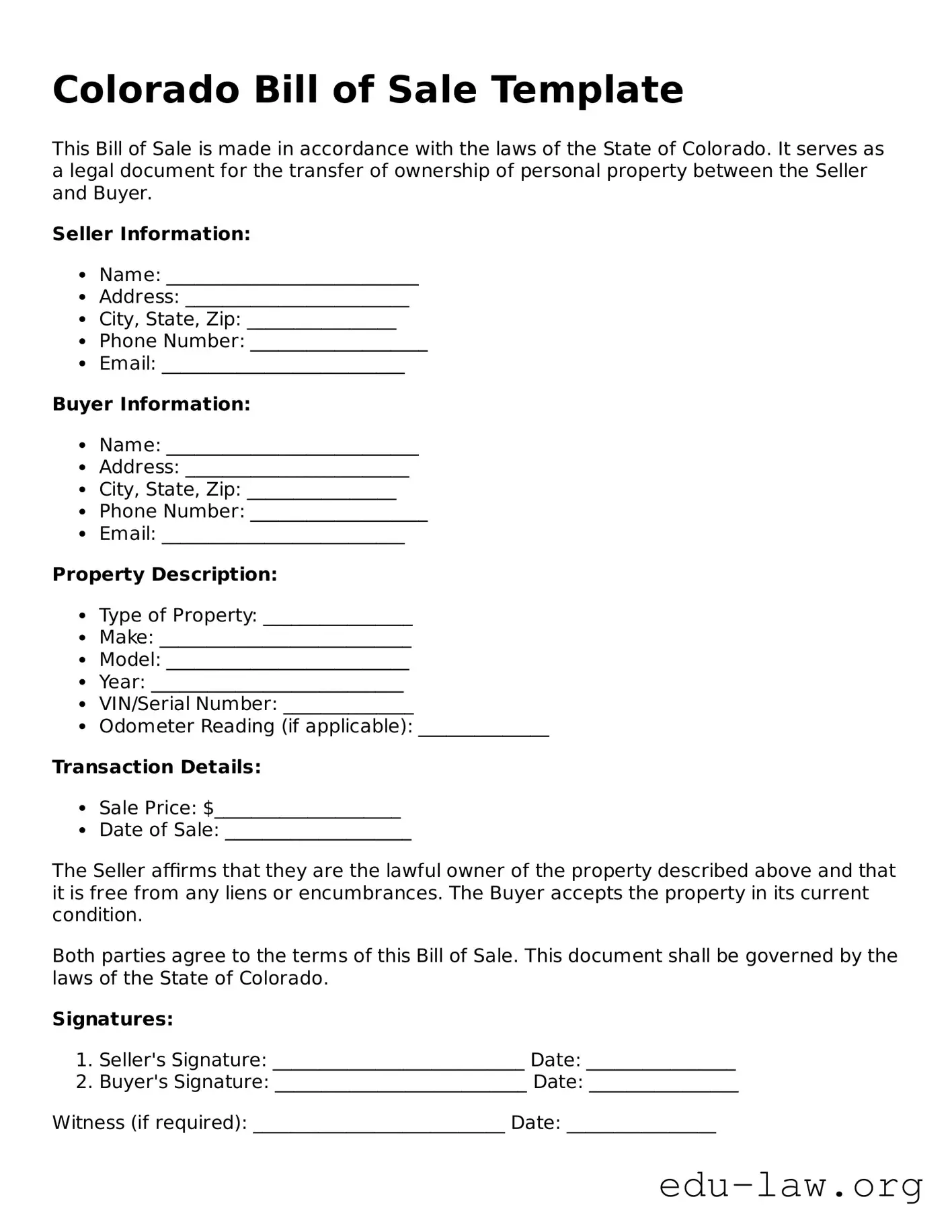
The Colorado Bill of Sale form serves as a vital document in the transfer of ownership for personal property, ensuring that both buyers and sellers have a clear record of the transaction. This form is particularly important for items such as vehicles, boats, and other significant assets, as it provides proof of sale and protects the interests of both parties involved. Essential details such as the names and addresses of the buyer and seller, a description of the item being sold, and the sale price must be included. Additionally, the form often requires the date of the transaction and may include information about any warranties or conditions related to the sale. By utilizing this form, individuals can avoid potential disputes and establish a transparent agreement that outlines the terms of the sale, making it an indispensable tool in Colorado's marketplace.
Colorado Bill of Sale Template
This Bill of Sale is made in accordance with the laws of the State of Colorado. It serves as a legal document for the transfer of ownership of personal property between the Seller and Buyer.
Seller Information:
Buyer Information:
Property Description:
Transaction Details:
The Seller affirms that they are the lawful owner of the property described above and that it is free from any liens or encumbrances. The Buyer accepts the property in its current condition.
Both parties agree to the terms of this Bill of Sale. This document shall be governed by the laws of the State of Colorado.
Signatures:
Witness (if required): ___________________________ Date: ________________
| Fact Name | Description |
|---|---|
| Purpose | The Colorado Bill of Sale form serves as a legal document to record the transfer of ownership of personal property from one party to another. |
| Types of Property | This form can be used for various types of personal property, including vehicles, boats, and equipment. |
| Governing Laws | The Colorado Bill of Sale is governed by Colorado Revised Statutes, specifically Title 4, Article 9 for goods and Title 42 for motor vehicles. |
| Notarization | While notarization is not always required, it is recommended for added legal protection and to prevent disputes. |
| Required Information | The form must include details such as the names and addresses of both the buyer and seller, a description of the item, and the sale price. |
| Record Keeping | Both parties should keep a copy of the Bill of Sale for their records, as it serves as proof of the transaction. |
After obtaining the Colorado Bill of Sale form, the next step is to accurately complete it to ensure a valid transaction. This document serves as proof of the sale and provides essential details about the buyer, seller, and the item being sold. Following these steps will help ensure that the form is filled out correctly.
What is a Colorado Bill of Sale?
A Colorado Bill of Sale is a legal document that records the transfer of ownership of personal property from one party to another. This form serves as proof of the transaction and includes essential details such as the names of the buyer and seller, a description of the item being sold, and the sale price. It is crucial for protecting both parties in the transaction.
When do I need a Bill of Sale in Colorado?
You typically need a Bill of Sale when buying or selling items such as vehicles, boats, trailers, or valuable personal property. While not always legally required, having a Bill of Sale can help clarify ownership and protect both parties in case of disputes.
What information should be included in a Colorado Bill of Sale?
A comprehensive Bill of Sale should include the full names and addresses of both the buyer and seller, a detailed description of the item being sold (including make, model, and VIN for vehicles), the sale price, and the date of the transaction. Additionally, it's wise to include any warranties or conditions of the sale, if applicable.
Is a Bill of Sale required to register a vehicle in Colorado?
Yes, when you purchase a vehicle in Colorado, a Bill of Sale is typically required to register the vehicle in your name. It serves as proof of ownership and is needed for the title transfer process. Be sure to keep a copy for your records as well.
Do I need to get the Bill of Sale notarized in Colorado?
In Colorado, notarization of a Bill of Sale is not required for most transactions. However, if the sale involves a vehicle or if either party wishes to have an additional layer of verification, it can be beneficial to have the document notarized.
Can I create my own Bill of Sale, or should I use a template?
You can create your own Bill of Sale, but using a template can simplify the process and ensure that you include all necessary information. Templates can provide a clear structure and help avoid missing critical details that could lead to complications later.
What should I do with the Bill of Sale after the transaction?
After the transaction is complete, both the buyer and seller should keep a signed copy of the Bill of Sale for their records. This document can be crucial for proving ownership, especially if any disputes arise in the future. It may also be needed for tax purposes or when registering the item with local authorities.
Not providing complete buyer and seller information. It's essential to include full names, addresses, and contact details for both parties.
Forgetting to include a detailed description of the item being sold. This should include make, model, year, and any identifying numbers.
Neglecting to specify the sale price. Clearly stating the amount helps avoid confusion later on.
Leaving out the date of the transaction. This is crucial for record-keeping and legal purposes.
Not obtaining signatures from both the buyer and seller. Both parties must sign to validate the agreement.
Failing to provide any necessary disclosures. If the item has defects or issues, these should be noted to protect both parties.
Using incorrect or outdated forms. Always ensure you have the most recent version of the Colorado Bill of Sale form.
When completing a transaction that involves the sale of goods or property in Colorado, several documents may accompany the Colorado Bill of Sale. Each of these forms serves a specific purpose, ensuring that the transaction is documented thoroughly and legally. Below is a list of essential forms often used in conjunction with the Bill of Sale.
Using these forms alongside the Colorado Bill of Sale helps ensure a smooth and legally sound transaction. Each document plays a vital role in protecting both the buyer and the seller, making the process more transparent and secure.
The Vehicle Bill of Sale is a document used specifically for the transfer of ownership of a vehicle. It includes details such as the vehicle identification number (VIN), make, model, and year, along with the seller and buyer's information. Like the Colorado Bill of Sale, it serves as proof of the transaction and can be used for registration purposes. Both documents protect the interests of both parties by providing a clear record of the sale.
The Personal Property Bill of Sale is similar in that it facilitates the transfer of ownership for personal items, such as furniture or electronics. This document outlines the description of the item, the sale price, and the parties involved. Much like the Colorado Bill of Sale, it acts as a legal record, ensuring that both the buyer and seller have a reference point in case of disputes or claims regarding the item sold.
The Boat Bill of Sale is tailored for the sale of boats and watercraft. It includes specific information about the vessel, such as its hull identification number and registration details. This document functions similarly to the Colorado Bill of Sale by documenting the transfer of ownership and providing necessary information for registration with state authorities. Both documents help establish clear ownership and protect the rights of the buyer and seller.
The Firearm Bill of Sale is used for the transfer of firearms between individuals. This document includes details about the firearm, such as its make, model, and serial number, along with the buyer and seller's information. Like the Colorado Bill of Sale, it serves as a legal record of the transaction, ensuring compliance with state and federal laws regarding firearm sales and ownership transfer.
The Business Bill of Sale is utilized when transferring ownership of a business or its assets. This document outlines the specifics of the sale, including the assets being sold, the purchase price, and the involved parties. It parallels the Colorado Bill of Sale by providing a formal record of the transaction, which can be crucial for tax purposes and future legal references.
The Equipment Bill of Sale is designed for the sale of heavy machinery or equipment, often used in construction or agriculture. It details the equipment being sold, including make, model, and condition. Similar to the Colorado Bill of Sale, this document serves as proof of ownership transfer and can be important for warranty claims or financing arrangements related to the equipment.
The Livestock Bill of Sale is specifically for the sale of livestock, such as cattle or horses. This document includes information about the animals, such as breed, age, and health status. Like the Colorado Bill of Sale, it provides a legal record of the transaction, which can be important for tracking ownership and ensuring compliance with agricultural regulations.
When filling out the Colorado Bill of Sale form, it's important to follow certain guidelines to ensure everything is completed correctly. Here’s a list of things to do and avoid:
When it comes to the Colorado Bill of Sale form, several misconceptions can lead to confusion for buyers and sellers alike. Understanding these misunderstandings is essential for anyone involved in a transaction. Here are eight common misconceptions:
Many people believe that a Bill of Sale is only required for certain types of transactions. However, it is a good practice to use one for any sale of personal property, regardless of the item’s value.
While both documents are important, a Bill of Sale serves as a receipt for the transaction, whereas a title proves ownership of a vehicle or property. They serve different purposes.
Some people think that notarization is a requirement for a Bill of Sale in Colorado. In reality, notarization is not necessary, but it can add an extra layer of security and legitimacy to the document.
Many assume that a Bill of Sale is primarily for the seller’s benefit. In fact, it protects both parties by documenting the terms of the sale and providing proof of the transaction.
Some believe that a Bill of Sale is only for sales involving money. However, it can also be used to document the transfer of ownership for gifts, providing clarity and proof of the transaction.
There is a misconception that a simple statement of sale is sufficient. In reality, including detailed descriptions of the item, such as make, model, and condition, can help avoid disputes later on.
While many associate Bills of Sale with vehicle transactions, they are equally important for other personal property sales, such as furniture, electronics, and recreational equipment.
Some think that any Bill of Sale template will suffice for all transactions. However, it is crucial to tailor the document to fit the specific details of the sale to ensure it meets legal requirements.
Understanding these misconceptions can help you navigate the process of buying or selling personal property in Colorado more effectively. Always consider using a Bill of Sale to protect your interests and ensure a smooth transaction.
When filling out and using the Colorado Bill of Sale form, it is important to understand its purpose and the necessary details required for a valid transaction. Here are some key takeaways:
Using the Colorado Bill of Sale form correctly can help protect both parties and ensure a smooth transaction. Always keep a copy for your records after completion.