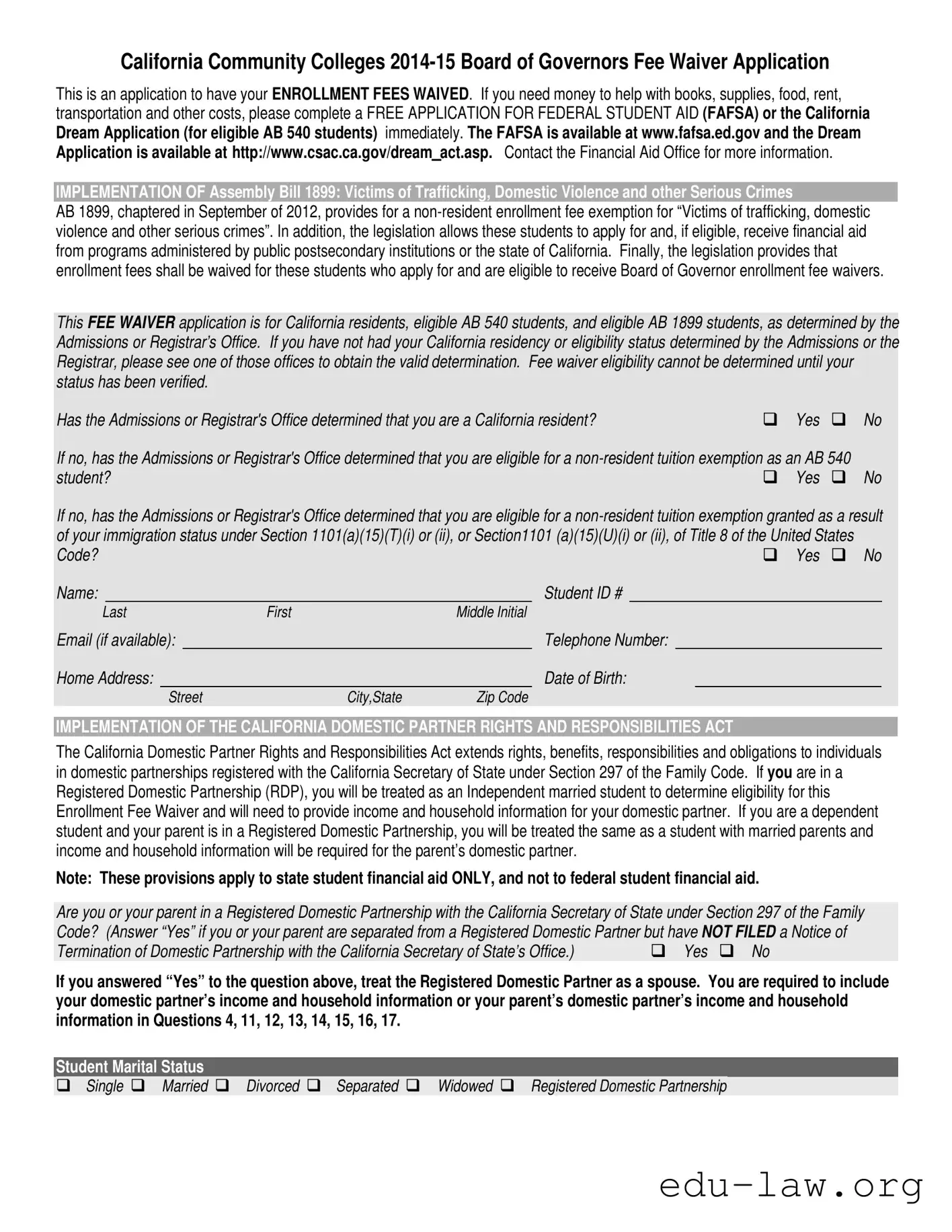
The Colleges Fee Waiver form is an essential resource for California students seeking financial assistance to cover enrollment fees at community colleges. This application allows eligible individuals to have their enrollment fees waived, thereby reducing the financial burden associated with higher education. To qualify, applicants must demonstrate financial need, which can be assessed through the Free Application for Federal Student Aid (FAFSA) or the California Dream Application, specifically designed for eligible AB 540 students. The form also incorporates provisions from Assembly Bill 1899, offering fee exemptions to victims of trafficking, domestic violence, and other serious crimes. Additionally, students in registered domestic partnerships are treated similarly to married students for the purpose of determining eligibility, necessitating the inclusion of household income information. The application requires students to provide personal details, including residency status, marital status, and household composition, as these factors influence eligibility. Furthermore, it outlines special classifications that may qualify students for additional fee waivers, such as those related to military service or specific victim statuses. By completing this form accurately and submitting it to the Financial Aid Office, students can access vital financial support that facilitates their educational pursuits.

California Community Colleges
This is an application to have your ENROLLMENT FEES WAIVED. If you need money to help with books, supplies, food, rent, transportation and other costs, please complete a FREE APPLICATION FOR FEDERAL STUDENT AID (FAFSA) or the California Dream Application (for eligible AB 540 students) immediately. The FAFSA is available at www.fafsa.ed.gov and the Dream Application is available at http://www.csac.ca.gov/dream_act.asp. Contact the Financial Aid Office for more information.
IMPLEMENTATION OF Assembly Bill 1899: Victims of Trafficking, Domestic Violence and other Serious Crimes
AB 1899, chaptered in September of 2012, provides for a
This FEE WAIVER application is for California residents, eligible AB 540 students, and eligible AB 1899 students, as determined by the Admissions or Registrar’s Office. If you have not had your California residency or eligibility status determined by the Admissions or the Registrar, please see one of those offices to obtain the valid determination. Fee waiver eligibility cannot be determined until your status has been verified.
Has the Admissions or Registrar's Office determined that you are a California resident? Yes No
If no, has the Admissions or Registrar's Office determined that you are eligible for a
student? Yes No
If no, has the Admissions or Registrar's Office determined that you are eligible for a
Code? |
|
|
|
|
|
|
|
Yes No |
|||
Name: |
|
|
|
|
|
Student ID # |
|
||||
Last |
First |
|
Middle Initial |
||||||||
Email (if available): |
|
|
|
|
|
Telephone Number: |
|
||||
Home Address: |
|
|
|
|
|
Date of Birth: |
|
||||
|
|
Street |
|
City,State |
Zip Code |
||||||
IMPLEMENTATION OF THE CALIFORNIA DOMESTIC PARTNER RIGHTS AND RESPONSIBILITIES ACT
The California Domestic Partner Rights and Responsibilities Act extends rights, benefits, responsibilities and obligations to individuals in domestic partnerships registered with the California Secretary of State under Section 297 of the Family Code. If you are in a Registered Domestic Partnership (RDP), you will be treated as an Independent married student to determine eligibility for this Enrollment Fee Waiver and will need to provide income and household information for your domestic partner. If you are a dependent student and your parent is in a Registered Domestic Partnership, you will be treated the same as a student with married parents and income and household information will be required for the parent’s domestic partner.
Note: These provisions apply to state student financial aid ONLY, and not to federal student financial aid.
Are you or your parent in a Registered Domestic Partnership with the California Secretary of State under Section 297 of the Family Code? (Answer “Yes” if you or your parent are separated from a Registered Domestic Partner but have NOT FILED a Notice of
Termination of Domestic Partnership with the California Secretary of State’s Office.) |
Yes No |
If you answered “Yes” to the question above, treat the Registered Domestic Partner as a spouse. You are required to include your domestic partner’s income and household information or your parent’s domestic partner’s income and household information in Questions 4, 11, 12, 13, 14, 15, 16, 17.
Student Marital Status
Single Married Divorced Separated Widowed Registered Domestic Partnership

DEPENDENCY STATUS
The questions below will determine whether you are considered a Dependent student or Independent student for fee waiver eligibility and whether parental information is needed. If you answer “Yes” to ANY of the questions
1. |
Were you born before January 1, 1991? |
Yes |
|
No |
2. |
As of today, are you married or in a Registered Domestic Partnership (RDP)? |
(Answer "Yes" if you are separated but not divorced |
||
|
or have not filed a termination notice to dissolve partnership. |
Yes |
|
No |
3.Are you a veteran of the U.S. Armed Forces or currently serving on active duty for purposes other than training?
Yes No
4.Do you have children who will receive more than half of their support from you between July 1,
|
and through June 30, 2015 |
Yes |
No |
5. |
At any time since you turned age 13, were both your parents deceased, were you in foster care, or were you a dependent or ward |
||
|
of the court? |
Yes |
No |
6. |
Are you or were you an emancipated minor as determined by a court in your state of legal residence? |
Yes |
No |
|
|
||
7. |
Are you or were you in legal guardianship as determined by a court in your state of legal residence? |
|
|
|
|
Yes |
No |
8. |
At any time on or after July 1, 2013, did your high school or school district homeless liaison determine that you were an |
|
|
|
unaccompanied youth who was homeless |
Yes |
No |
9.At any time on or after July 1, 2013, did the director of an emergency shelter or transitional housing program funded by the U.S. Department of Housing and Urban Development determine that you were an unaccompanied youth who was homeless?
Yes No
10.At any time on or after July 1, 2013, did the director of a runaway or homeless youth basic center or transitional living program determine that you were an unaccompanied youth who was homeless or were
Yes No
•If you answered "Yes" to any of the questions 1 - 10, you are considered an INDEPENDENT student for enrollment fee waiver purposes and must provide income and household information about yourself (and your spouse or RDP if applicable). Skip to Question #13.
•If you answered "No" to all questions 1 - 10, complete the following questions:
11. |
If your parent(s) or his/her RDP filed or will file a 2013 U.S. Income Tax Return, were you, or will you be claimed on their tax return |
||
|
as an exemption by either or both of your parents? |
|
Will Not File Yes No |
12. |
Do you live with one or both of your parent(s) and/or his/her RDP? |
|
Yes No |
•If you answered "No" to questions 1 - 10 and "Yes" to either question 11 or 12, you must provide income and household information about your PARENT(S)/RDP. Please answer questions for a DEPENDENT student in the sections that follow.
•If you answered "No" or "Parent(s) will not file" to question 11, and "No" to question 12, you are a dependent student for all student aid except this enrollment fee waiver. You may answer questions as an INDEPENDENT student on the rest of this application, but please try to get your PARENT information and file a FAFSA so you may be considered for other student aid. You cannot get other student aid without your parent(s’) information.

13. Are you (the student ONLY) currently receiving monthly cash assistance for yourself or any dependents from:
TANF/CalWORKs? |
Yes |
No |
|
SSI/SSP (Supplemental Security Income/State Supplemental Program)? |
Yes |
|
No |
General Assistance? |
Yes |
|
No |
14. If you are a dependent student, are your parent(s)/RDP receiving monthly cash assistance from TANF/CalWORKs or SSI/SSP as
a primary source of income? |
Yes No |
If you answered "Yes" to question 13 or 14 you are eligible for an ENROLLMENT FEE WAIVER. Sign the Certification at the end of this form. You are required to show current proof of benefits. Submit application and documentation to the financial aid office.
METHOD B ENROLLMENT FEE WAIVER
15.DEPENDENT STUDENT: How many persons are in your parent(s)/RDP household? (Include yourself, your parent(s)/RDP, and anyone who lives with your parent(s)/RDP and receives more than 50% of their support from your parents/RDP, now and through June 30, 2015.)
16.INDEPENDENT STUDENT: How many persons are in your household? (Include yourself, your spouse/RDP, and anyone who lives with you and receives more than 50% of their support from you, now and through June 30, 2015.)
17.2013 Income Information
(Dependent students should not include their income information for Q 17 a and b below.)
a.Adjusted Gross Income (If 2013 U.S. Income Tax Return was filed, enter the amount from Form 1040, line 37; 1040A, line 21; 1040EZ, line 4).
b.All other income (Include ALL money received in 2013 that is not included in line (a) above (such as disability, child support, military living allowance, Workman’s Compensation, untaxed pensions).
TOTAL Income for 2013 (Sum of a + b)
|
DEPENDENT STUDENT: |
INDEPENDENT STUDENT: |
||||
|
PARENT(S)/ RDP |
STUDENT (& SPOUSE'S/ |
||||
|
INCOME ONLY |
RDP) INCOME |
||||
$ |
|
|
$ |
|
|
|
|
$ |
|
|
$ |
|
|
|
$ |
|
|
$ |
|
|
The Financial Aid Office will review your income and let you know if you qualify for an ENROLLMENT FEE WAIVER under Method B. Submit application and documentation to the financial aid office.
If you do not qualify using Method A or Method B, you should file a FAFSA (for U.S. citizens or eligible
|
SPECIAL CLASSIFICATIONS ENROLLMENT FEE WAIVERS |
|
|
|
|
|
|
|
|
|
|
||
|
18. |
Do you have certification from the CA Department of Veterans Affairs that you are eligible for a dependent's fee waiver? |
|
|||
|
|
Submit certification. |
Yes |
|
No |
|
|
19. |
Do you have certification from the National Guard Adjutant General that you are eligible for a dependent's fee waiver? |
|
|
|
|
|
|
Submit certification. |
Yes |
No |
|
|
|
20. |
Are you eligible as a recipient of the Congressional Medal of Honor or as a child of a recipient? |
Yes |
No |
|
|
|
|
Submit documentation from the Department of Veterans Affairs. |
|
|||
|
21. |
Are you eligible as a dependent of a victim of the September 11, 2001, terrorist attack? |
Yes |
No |
|
|
|
|
Submit documentation from the CA Victim Compensation and Government Claims Board. |
|
|||
|
22. |
Are you eligible as a dependent of a deceased law enforcement/fire suppression personnel killed in the line of duty? |
|
|
|
|
|
|
Submit documentation from the public agency employer of record. |
Yes |
|
No |
|
|
|
|
|
|||
•If you answered "Yes" to any of the questions from
CERTIFICATION FOR ALL APPLICANTS: READ THIS STATEMENT AND SIGN BELOW

I hereby swear or affirm, under penalty of perjury, that all information on this form is true and complete to the best of my knowledge. If asked by an authorized official, I agree to provide proof of this information, which may include a copy of my and my spouse/registered domestic partner and/or my parent's/registered domestic partner’s 2013 U.S. Income Tax Return(s). I also realize that any false statement or failure to give proof when asked may be cause for the denial, reduction, withdrawal, and/or repayment of my waiver. I authorize release of information regarding this application between the college, the college district, and the Chancellor's Office of the California Community Colleges.
I understand the following information (please check each box):
Federal and state financial aid programs are available to help with college costs (including enrollment fees, books & supplies, transportation and room and board expenses). By completing the FAFSA or the California Dream Application, additional financial assistance may be available in the form of Cal Grants, Pell and other grants, work study and other aid.
I may apply for and receive financial assistance if I am enrolled, either full time or part time, in an eligible program of study (certificate, associate degree or transfer).
Financial aid program information and application assistance is available in the college financial aid office.
|
|
|
|
|
|
|
|
Applicant’s Signature |
Date |
|
Parent Signature (Dependent Students Only) |
Date |
|
CALIFORNIA INFORMATION PRIVACY ACT
State and federal laws protect an individual’s right to privacy regarding information pertaining to oneself. The California Information Practices Act of 1977 requires the following information be provided to financial aid applicants who are asked to supply information about themselves. The principal purpose for requesting information on this form is to determine your eligibility for financial aid. The Chancellor’s Office policy and the policy of the community college to which you are applying for aid authorize maintenance of this information. Failure to provide such information will delay and may even prevent your receipt of financial assistance. This form’s information may be transmitted to other state agencies and the federal government if required by law. Individuals have the right of access to records established from information furnished on this form as it pertains to them.
The officials responsible for maintaining the information contained on this form are the financial aid administrators at the institutions to which you are applying for financial aid. The SSN may be used to verify your identity under record keeping systems established prior to January 1, 1975. If your college requires you to provide an SSN and you have questions, you should ask the financial aid officer at your college for further information. The Chancellor’s Office and the California community colleges, in compliance with federal and state laws, do not discriminate on the basis of race, religion, color, national origin, gender, age, disability, medical condition, sexual orientation, domestic partnership or any other legally protected basis. Inquiries regarding these policies may be directed to the financial aid office of the college to which you are applying.
FOR OFFICE USE ONLY
|
|
Special Classification |
RDP |
Student is not |
|||||||||
TANF/CalWORKs |
|
|
|
|
Veteran |
National Guard |
Student |
eligible |
|||||
GA |
|
|
|
Dependent |
Parent |
|
|
||||||
SSI/SSP |
|
Medal of Honor |
9/11 Dependent |
|
|
|
|||||||
|
|
|
|
|
|
|
|
|
|
|
|||
|
|
|
|
|
|
Dep. of deceased law enforcement/fire |
|
|
|
||||
|
|
|
|
|
|
|
personnel |
|
|
|
|
|
|
Comments: |
|
|
|
|
|
|
|
|
|
|
|
|
|
Certified by: |
|
|
|
|
|
|
|
Date: |
|
|
|
|
|

Board of Governors Fee Waiver Program
Family Size |
2013 Income |
|
|
1 |
$17,235 |
2 |
$23,265 |
3 |
$29,295 |
4 |
$35,325 |
5 |
$41,355 |
6 |
$47,385 |
7 |
$53,415 |
8 |
$59,445 |
Each Additional Family |
|
Member |
$6,030 |
|
|
*These standards are based upon the federal poverty guidelines, as published each year by the US Department of Health and Human Services. Under Title 5 of the California Code of Regulations, the student or student’s family must have a total income in the prior year (in this case, 2013) that is equal to or less than 150% of the U.S. Department of Health and Human Services Poverty Guidelines based on family size.
The U.S. Department of Health and Human Services published the 2013 Poverty Guidelines in January 2013 (Fed er al Regist er , Vol . 7 8 , No. 1 6 , Jan u ar y 2 4 , 2 0 1 3 , p p . 5 1 8 2 - 5 1 8 3 ).
These income standards are for the
http://aspe.hhs.gov/poverty/12poverty.shtml
| Fact Name | Details |
|---|---|
| Purpose of the Form | This application allows students to waive their enrollment fees for California Community Colleges. |
| Eligibility Criteria | Applicants must be California residents, AB 540 students, or eligible under AB 1899. |
| AB 1899 Implementation | Victims of trafficking, domestic violence, and other serious crimes can receive a non-resident enrollment fee exemption. |
| FAFSA Requirement | Students must complete a FAFSA or California Dream Application to access additional financial aid. |
| Dependent vs. Independent Status | Eligibility is determined by answering questions about marital status, age, and other factors. |
| Registered Domestic Partnership | Students in a Registered Domestic Partnership are treated as independent for fee waiver eligibility. |
| Income Standards | Eligibility for BOGFW-B is based on family income being at or below 150% of the federal poverty guidelines. |
| Privacy Protections | The California Information Practices Act protects applicants' personal information provided on the form. |
| Special Classifications | Students may qualify for additional waivers if they meet specific criteria, such as being a veteran or a dependent of a victim of the September 11 attacks. |
| Submission Instructions | Completed forms must be submitted to the Financial Aid Office along with any required documentation. |
Completing the Colleges Fee Waiver form involves several steps to ensure that all necessary information is accurately provided. After filling out the form, applicants should submit it along with any required documentation to the financial aid office for review. The financial aid office will then determine eligibility based on the information provided.
What is the Colleges Fee Waiver form?
The Colleges Fee Waiver form allows eligible students to have their enrollment fees waived at California Community Colleges. This can significantly reduce the financial burden of attending college, making education more accessible for those who qualify.
Who is eligible to apply for the fee waiver?
Eligibility for the fee waiver includes California residents, eligible AB 540 students, and students who qualify under Assembly Bill 1899, which provides exemptions for victims of trafficking, domestic violence, and other serious crimes. It's essential to have your residency or eligibility status confirmed by the Admissions or Registrar’s Office before applying.
How do I apply for the fee waiver?
To apply, complete the Colleges Fee Waiver form and submit it to the financial aid office at your college. Additionally, you may need to provide documentation proving your eligibility. If you require assistance, the financial aid office can guide you through the process.
What if I need additional financial support beyond the fee waiver?
If you need help with expenses such as books, supplies, or living costs, you should complete a Free Application for Federal Student Aid (FAFSA) or the California Dream Application if you are an eligible AB 540 student. These applications can open doors to additional financial aid, including grants and work-study opportunities.
What documentation is required for the fee waiver application?
Documentation may include proof of income, tax returns, or certification of eligibility for specific programs. If you are receiving cash assistance from programs like TANF or SSI, you will need to provide proof of those benefits as well.
How is my household size determined for the fee waiver?
Your household size includes yourself, your spouse or registered domestic partner, and anyone who lives with you and receives more than half of their support from you. For dependent students, it also includes your parents and their registered domestic partner.
What if my residency status has not been determined?
If your residency status has not been verified by the Admissions or Registrar’s Office, you must seek that determination before you can apply for the fee waiver. Eligibility cannot be confirmed without this verification.
Can I receive the fee waiver if I am a dependent student?
Yes, dependent students can apply for the fee waiver. However, they must provide their parents' or registered domestic partner's income information as part of the application process. This information is crucial for determining eligibility.
What happens if I provide false information on my application?
Providing false information can lead to denial, reduction, or withdrawal of your fee waiver. It is important to ensure that all information submitted is accurate and truthful to avoid any complications.
Incomplete Information: Many applicants fail to provide all required personal details, such as their full name, student ID, or contact information. Omitting this information can delay the processing of the application.
Incorrect Residency Status: Some individuals do not verify their California residency status before applying. If the Admissions or Registrar's Office has not confirmed residency, applicants should seek clarification before submitting the fee waiver form.
Ignoring Dependency Status: Applicants often misunderstand their dependency status. Misclassifying themselves as independent when they are actually dependent can lead to incorrect income reporting and jeopardize their eligibility.
Missing Required Documentation: Many forget to include necessary documentation, such as proof of income or benefits. Without this information, the application may be deemed incomplete, affecting the eligibility for a fee waiver.
Failure to Sign the Certification: Some applicants neglect to sign the certification statement at the end of the form. This signature is crucial, as it confirms that the information provided is accurate and complete.
The Colleges Fee Waiver form is an essential document for students seeking to waive their enrollment fees at California Community Colleges. In addition to this form, several other documents are often required to determine eligibility for financial assistance and other related benefits. Below is a list of these commonly used forms and documents, along with a brief description of each.
These documents collectively support the application process for financial aid and fee waivers, ensuring that students receive the assistance they need to pursue their educational goals. It is crucial for students to be aware of these requirements and to prepare the necessary documentation in advance to facilitate a smooth application process.
The Free Application for Federal Student Aid (FAFSA) is a critical document for students seeking financial assistance for their education. Similar to the Colleges Fee Waiver form, the FAFSA assesses a student's financial need and eligibility for various forms of aid, including grants, work-study, and loans. Both forms require detailed personal and financial information, which helps determine the level of support a student may receive. Completing the FAFSA is essential for students who wish to explore additional financial aid opportunities beyond fee waivers, making it a vital tool in the pursuit of higher education.
The California Dream Application serves as another important document for students who are undocumented or qualify under the AB 540 legislation. Like the Colleges Fee Waiver form, this application allows eligible students to apply for financial aid, specifically tailored to their unique circumstances. Both forms focus on ensuring that students can access the resources necessary to pursue their education, regardless of their immigration status. The California Dream Application also emphasizes the importance of financial support for students facing barriers, aligning closely with the goals of the fee waiver program.
The Pell Grant application is another document that shares similarities with the Colleges Fee Waiver form. This application is specifically designed for low-income students seeking federal financial aid. Both documents require students to provide income information and other personal details to establish eligibility. The Pell Grant is awarded based on financial need, just as the Colleges Fee Waiver aims to relieve the burden of enrollment fees for those who qualify. Both processes are integral to helping students achieve their educational goals without the overwhelming stress of financial constraints.
The California Chafee Grant application is also comparable to the Colleges Fee Waiver form, as it provides financial assistance to foster youth pursuing postsecondary education. Similar to the fee waiver application, the Chafee Grant application requires students to demonstrate financial need and eligibility. Both documents aim to empower students from vulnerable backgrounds by alleviating financial barriers to education. The Chafee Grant serves as an additional resource, ensuring that former foster youth have the support necessary to succeed in their academic endeavors.
When filling out the Colleges Fee Waiver form, it's important to follow some guidelines to ensure a smooth process. Here are seven things you should and shouldn't do:
By following these tips, you can help ensure that your application is processed smoothly and efficiently.
This is not entirely true. While income is a significant factor, other criteria, such as residency status and specific circumstances, also determine eligibility.
Students can apply for the fee waiver whether they are enrolled full-time or part-time in an eligible program.
While there are several questions, the application is straightforward. Most students can complete it without much difficulty.
Returning students and those transferring from other institutions can also apply for the fee waiver.
Receiving a fee waiver does not prevent students from applying for and receiving other types of financial aid, such as grants or loans.
Having a job does not disqualify students. The overall income and household circumstances are what matter.
The fee waiver primarily covers enrollment fees. However, students are encouraged to apply for additional aid to help with other costs, like books and supplies.
Once approved, the fee waiver typically remains valid for the academic year, but students should check for any specific requirements for renewal.
Filling out the Colleges Fee Waiver form can be a vital step in making education more affordable. Here are key takeaways to keep in mind:
Understanding these key points can streamline the process and enhance your chances of securing the necessary financial assistance for your education.