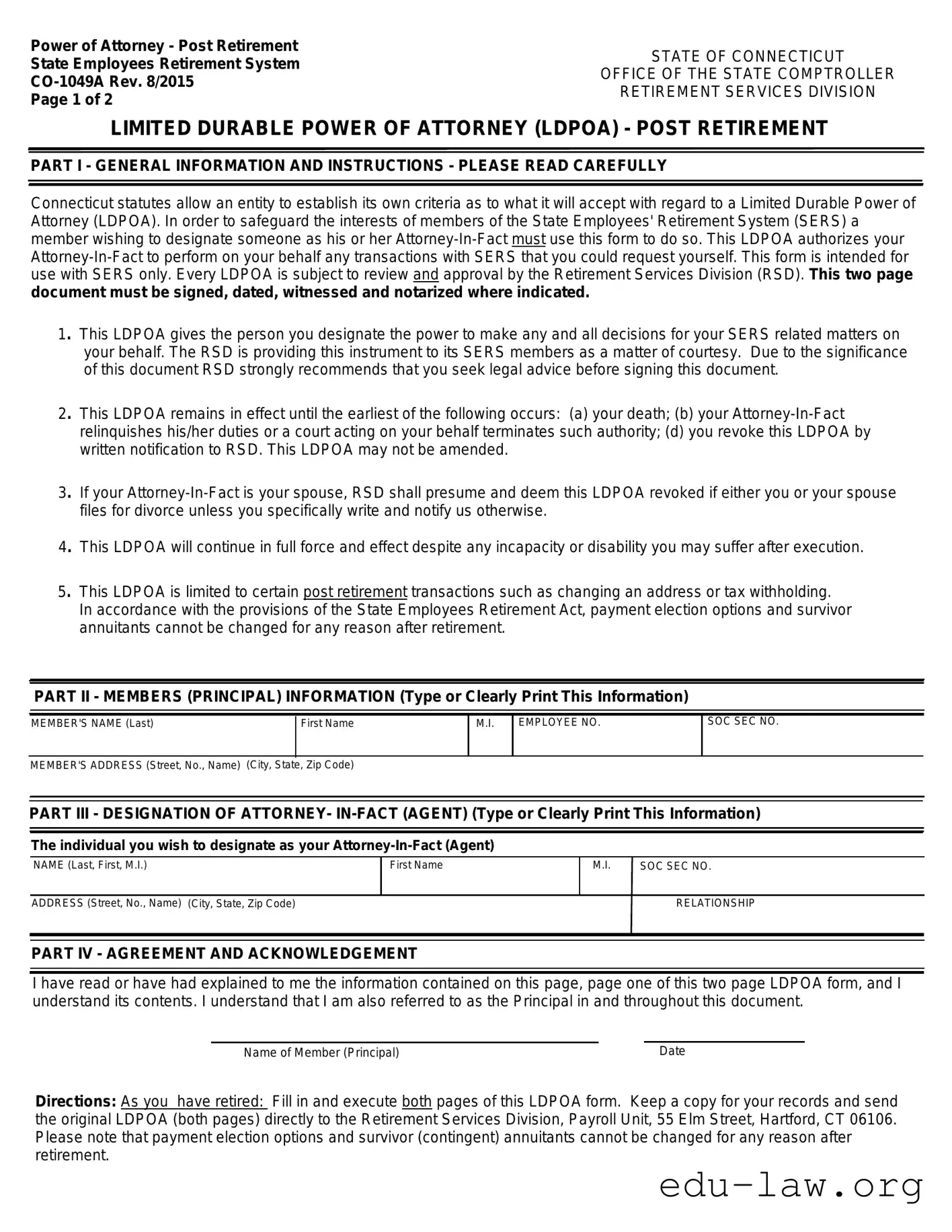
The CO-1049A form, also known as the Limited Durable Power of Attorney (LDPOA) for post-retirement, is an essential document for members of the Connecticut State Employees Retirement System (SERS). This form allows a member to designate an Attorney-In-Fact, enabling that person to handle specific transactions related to the member's retirement benefits. By using this form, members can authorize their Attorney-In-Fact to perform actions such as changing their address, updating tax withholding, and responding to requests for information from SERS. It’s important to note that this power of attorney is limited to post-retirement matters and cannot be used to alter payment election options or survivor annuitants after retirement. The CO-1049A must be signed, dated, witnessed, and notarized to be valid. Members should be aware that the form remains effective until the member's death, a court action terminates it, or the member revokes it in writing. Given the significance of this document, it is advisable for members to seek legal advice before execution. Understanding the implications of this form can help ensure that retirement benefits are managed according to the member's wishes.
Power of Attorney - Post Retirement |
STATE OF CONNECTICUT |
|
State Employees Retirement System |
||
OFFICE OF THE STATE COMPTROLLER |
||
RETIREMENT SERVICES DIVISION |
||
Page 1 of 2 |
||
|
LIMITED DURABLE POWER OF ATTORNEY (LDPOA) - POST RETIREMENT
PART I - GENERAL INFORMATION AND INSTRUCTIONS - PLEASE READ CAREFULLY
Connecticut statutes allow an entity to establish its own criteria as to what it will accept with regard to a Limited Durable Power of Attorney (LDPOA). In order to safeguard the interests of members of the State Employees' Retirement System (SERS) a member wishing to designate someone as his or her
1. This LDPOA gives the person you designate the power to make any and all decisions for your SERS related matters on your behalf. The RSD is providing this instrument to its SERS members as a matter of courtesy. Due to the significance of this document RSD strongly recommends that you seek legal advice before signing this document.
2. This LDPOA remains in effect until the earliest of the following occurs: (a) your death; (b) your
3. If your
4. This LDPOA will continue in full force and effect despite any incapacity or disability you may suffer after execution.
5. This LDPOA is limited to certain post retirement transactions such as changing an address or tax withholding.
In accordance with the provisions of the State Employees Retirement Act, payment election options and survivor annuitants cannot be changed for any reason after retirement.
PART II - MEMBERS (PRINCIPAL) INFORMATION (Type or Clearly Print This Information)
MEMBER'S NAME (Last)
First Name
M.I.
EMPLOYEE NO.
SOC SEC NO.
MEMBER'S ADDRESS (Street, No., Name) (City, State, Zip Code)
PART III - DESIGNATION OF ATTORNEY-
The individual you wish to designate as your
NAME (Last, First, M.I.)
First Name
M.I. |
SOC SEC NO. |
ADDRESS (Street, No., Name) (City, State, Zip Code) |
RELATIONSHIP |
PART IV - AGREEMENT AND ACKNOWLEDGEMENT
I have read or have had explained to me the information contained on this page, page one of this two page LDPOA form, and I understand its contents. I understand that I am also referred to as the Principal in and throughout this document.
Name of Member (Principal) |
Date |
Directions: As you have retired: Fill in and execute both pages of this LDPOA form. Keep a copy for your records and send the original LDPOA (both pages) directly to the Retirement Services Division, Payroll Unit, 55 Elm Street, Hartford, CT 06106. Please note that payment election options and survivor (contingent) annuitants cannot be changed for any reason after retirement.

Power of Attorney - |
STATE OF CONNECTICUT |
||
OFFICE OF THE STATE COMPTROLLER |
|||
State Employees Retirement System |
|||
RETIREMENT SERVICES DIVISION |
|||
|
|||
Page 2 of 2 |
|
||
|
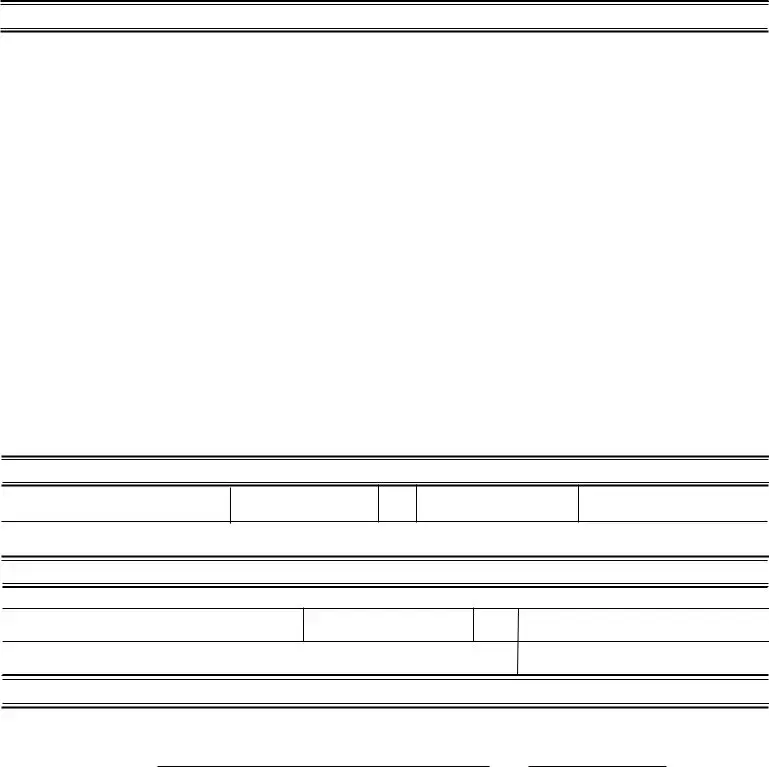
LIMITED DURABLE POWER OF ATTORNEY (LDPOA) - POST RETIREMENT |
||
I hereby give |
|
(name of |
|
on the first page of this two page form, the full power and authority to represent me in the following post retirement plan transactions on my behalf with SERS to the extent that I could do myself as a member of SERS. My
Responding to SERS request for information or documents or representing me in any request for information or forms.
Designate a beneficiary to receive remaining contributions and interest (if any) after my death and the death of any contingent annuitant.
Changing my tax withholding.
Changing the address or bank to which my SERS payments are sent: however SERS will not make the check payable to my
Important Note For Direct Deposit & Direct Deposit Changes Only: A power of attorney may not be necessary to make changes to direct deposits. For direct deposit and direct deposit changes only, RSD will accept a copy of the Representative Payee designation made by the Commissioner of Social Security. There are two such types of payees: an individual representative payee who could be a family member or friend or a lawyer, a legal guardian, or a volunteer for a government or
By signing this form. I am granting(name of
authority to act on my behalf with regard to the SERS transactions I have marked above. I understand the legal impact in executing this LDPOA and hereby agree to hold SERS, the State of Connecticut and its employees harmless for any alleged misuse, mismanagement or malfeasance by the
IN WITNESS WHEREOF, I have signed this Limited Durable Power of Attorney on |
, 20 |
|
|
|||
|
|
|
|
|
|
|
Signature of Member (Principal) |
|
Address (Street/Town/State) Where Signed |
|
|||
Statement of Witnesses: I declare that the Principal has identified himself or herself to me, that the Principal signed or acknowledged this LDPOA in my presence, that I believe the Principal to be of sound mind, that the Principal has affirmed that the Principal is aware of the nature of the document and is signing it voluntarily and free from duress.
1. Witness Signature: |
|
|
2. Witness Signature: |
|
|
||
Date signed: |
|
|
Date signed: |
|
|||
Address: |
|
|
|
Address: |
|
||
Acknowledgement: On this day before me, a Notary Public or Commissioner of the Superior Court, authorized to administer
oaths in the State that the Member resides, personally appeared |
|
|
(Member/Principal) who is personally |
known to me or proved to me on the basis of satisfactory evidence |
to be the person whose name is subscribed as the Principal |
||
within this instrument, executed this document in my presence, and personally acknowledged to me that he/she executed this LDPOA for the purposes herein stated.
Signed and sworn before me this |
|
day of |
|
, 20 |
|
|
|
||
Signature of Notary Public or Commissioner of the Superior Court: |
|
|
|
|
|
||||
State: |
Town: |
|
My commission expires |
|
|
SEAL HERE |
|||
| Fact Name | Description |
|---|---|
| Form Purpose | The CO-1049A form serves as a Limited Durable Power of Attorney specifically for post-retirement transactions related to the State Employees Retirement System (SERS) in Connecticut. |
| Governing Law | This form is governed by the Connecticut General Statutes, particularly those pertaining to powers of attorney and the State Employees Retirement Act. |
| Authority Granted | It allows the designated Attorney-In-Fact to manage various SERS-related matters on behalf of the member, such as changing addresses or tax withholding. |
| Revocation Conditions | The power of attorney remains effective until the member's death, the Attorney-In-Fact relinquishes duties, or the member revokes it in writing. |
| Spousal Consideration | If the Attorney-In-Fact is the member's spouse, the form is automatically revoked if either party files for divorce, unless notified otherwise. |
| Execution Requirements | The form must be signed, dated, witnessed, and notarized. It consists of two pages that should be submitted to the Retirement Services Division. |
Filling out the CO-1049A form is a crucial step for members of the State Employees Retirement System (SERS) in Connecticut who wish to designate someone as their Attorney-In-Fact. After completing the form, it must be sent to the Retirement Services Division for processing. Below are the steps to ensure the form is filled out correctly.
What is the CO-1049A form?
The CO-1049A form is a Limited Durable Power of Attorney (LDPOA) specifically designed for members of the State Employees Retirement System (SERS) in Connecticut. This form allows a member to designate an Attorney-In-Fact who can make decisions and perform transactions on their behalf related to their retirement benefits after they have retired.
Who can be designated as an Attorney-In-Fact?
Any individual can be designated as an Attorney-In-Fact, including family members, friends, or trusted individuals. It is important to choose someone who you trust to act in your best interests regarding your retirement matters.
What powers does the Attorney-In-Fact have?
The Attorney-In-Fact can perform various transactions on behalf of the member, including responding to requests for information from SERS, changing tax withholding, and updating the member's address. However, they cannot change payment election options or survivor annuitants after retirement.
Does the CO-1049A form need to be notarized?
Yes, the CO-1049A form must be signed, dated, witnessed, and notarized. This ensures that the document is legally valid and that the member understands its contents and implications.
How long does the LDPOA remain in effect?
The LDPOA remains in effect until one of the following occurs: the member's death, the Attorney-In-Fact relinquishes their duties, a court terminates the authority, or the member revokes the LDPOA through written notification to the Retirement Services Division.
What happens if my Attorney-In-Fact is my spouse and we divorce?
If the Attorney-In-Fact is the member's spouse and either party files for divorce, the LDPOA will be presumed revoked unless the member provides written notification to the Retirement Services Division stating otherwise.
Can the CO-1049A form be amended?
No, the CO-1049A form cannot be amended once it has been executed. If changes are necessary, a new LDPOA form must be completed and submitted.
What should I do with the completed CO-1049A form?
After completing and signing the CO-1049A form, the member should keep a copy for their records and send the original document directly to the Retirement Services Division at the specified address in Hartford, CT.
Is a power of attorney necessary for direct deposit changes?
For direct deposit and direct deposit changes, a power of attorney may not be necessary. The Retirement Services Division will accept a copy of the Representative Payee designation made by the Commissioner of Social Security, which can simplify the process.
What should I do if I have questions about the CO-1049A form?
If you have questions or concerns about the CO-1049A form, it is advisable to seek legal advice. Understanding the implications of the document is crucial to ensuring that your rights and interests are protected.
Incomplete Information: Failing to provide all required personal details, such as the member's name, employee number, and social security number, can lead to delays or rejection of the form.
Missing Signatures: Not signing the form, or neglecting to have it witnessed and notarized, invalidates the document. All signatures must be present for the form to be considered complete.
Improper Designation of Attorney-In-Fact: Designating someone who does not meet the requirements set by the Retirement Services Division can cause complications. Ensure that the chosen Attorney-In-Fact is eligible and that their information is accurately filled out.
Failure to Understand Limitations: Not recognizing that the Limited Durable Power of Attorney is restricted to specific post-retirement transactions can lead to misunderstandings. Members should be aware of what actions their Attorney-In-Fact can and cannot perform.
The CO-1049A form, also known as the Limited Durable Power of Attorney (LDPOA) for post-retirement, serves a crucial function for members of the Connecticut State Employees Retirement System (SERS). However, it is often accompanied by several other forms and documents that facilitate the management of retirement benefits. Understanding these additional documents can help ensure that all necessary steps are taken to protect one's interests.
In summary, the CO-1049A form is part of a broader set of documents that facilitate the management of retirement benefits for members of SERS. Each of these forms plays a specific role in ensuring that members' rights and preferences are honored, especially in matters related to post-retirement transactions. Being aware of and utilizing these documents can significantly aid in the effective management of retirement affairs.
The Limited Durable Power of Attorney (LDPOA) form, such as the CO-1049A, shares similarities with a General Power of Attorney (GPOA). Both documents grant authority to an appointed individual, known as the Attorney-In-Fact, to act on behalf of another person, referred to as the Principal. However, while a GPOA provides broad powers that can encompass a wide range of financial and legal matters, the LDPOA is specifically tailored for post-retirement transactions within the Connecticut State Employees Retirement System. This distinction makes the LDPOA more focused, allowing the Attorney-In-Fact to handle only specific actions related to retirement benefits, ensuring that the Principal's interests are safeguarded in a targeted manner.
Another document that bears resemblance to the CO-1049A is the Healthcare Power of Attorney. This form allows an individual to designate someone to make medical decisions on their behalf if they become unable to do so themselves. Like the LDPOA, it requires the Principal to select a trusted individual to act in their best interest. Both documents are essential for ensuring that one's wishes are respected during critical times, whether in financial matters post-retirement or in healthcare decisions. The focus on trust and the need for clear communication about the Principal's desires are common threads that bind these two forms.
A Living Will is also similar to the CO-1049A in that it outlines an individual's preferences regarding medical treatment in specific scenarios, particularly at the end of life. While the LDPOA empowers someone to act on financial matters related to retirement, a Living Will focuses on healthcare decisions. Both documents emphasize the importance of making choices known in advance, allowing individuals to maintain control over their circumstances even when they cannot speak for themselves. Each serves a distinct purpose but shares the underlying goal of ensuring that the Principal's wishes are honored.
The Revocable Trust Agreement shares a connection with the CO-1049A as well. This legal document allows individuals to place their assets into a trust, managed by a trustee, for their benefit during their lifetime and for their beneficiaries after their passing. Similar to the LDPOA, a Revocable Trust can designate a trusted individual to manage financial matters. However, while the LDPOA is limited to post-retirement transactions with SERS, a Revocable Trust can cover a broader spectrum of assets and provide more comprehensive estate planning. Both documents highlight the importance of proactive planning to secure one's financial future.
Lastly, the Durable Power of Attorney (DPOA) is akin to the CO-1049A in that it grants authority to an Attorney-In-Fact to make decisions on behalf of the Principal. The key difference lies in the durability aspect; a DPOA remains effective even if the Principal becomes incapacitated, much like the LDPOA. However, the DPOA can cover a wider range of decisions, including financial, legal, and personal matters, whereas the LDPOA is specifically limited to retirement-related transactions. Both documents provide a safety net for individuals, ensuring that their affairs are managed according to their wishes, even when they can no longer do so themselves.
When filling out the CO-1049A form, there are important guidelines to follow. Here’s a list of things you should and shouldn't do:
Following these guidelines will help ensure that your submission is processed smoothly and without unnecessary delays.
Understanding the CO-1049A form, which is a Limited Durable Power of Attorney for post-retirement, can be challenging. Here are some common misconceptions that people often have:
Being informed about these misconceptions can help you navigate the process more effectively and ensure that your intentions are clearly understood and legally upheld.
When filling out and using the CO-1049A form, which is a Limited Durable Power of Attorney (LDPOA) for post-retirement matters in Connecticut, there are several important points to keep in mind:
By adhering to these guidelines, you can effectively use the CO-1049A form to manage your retirement affairs with confidence.