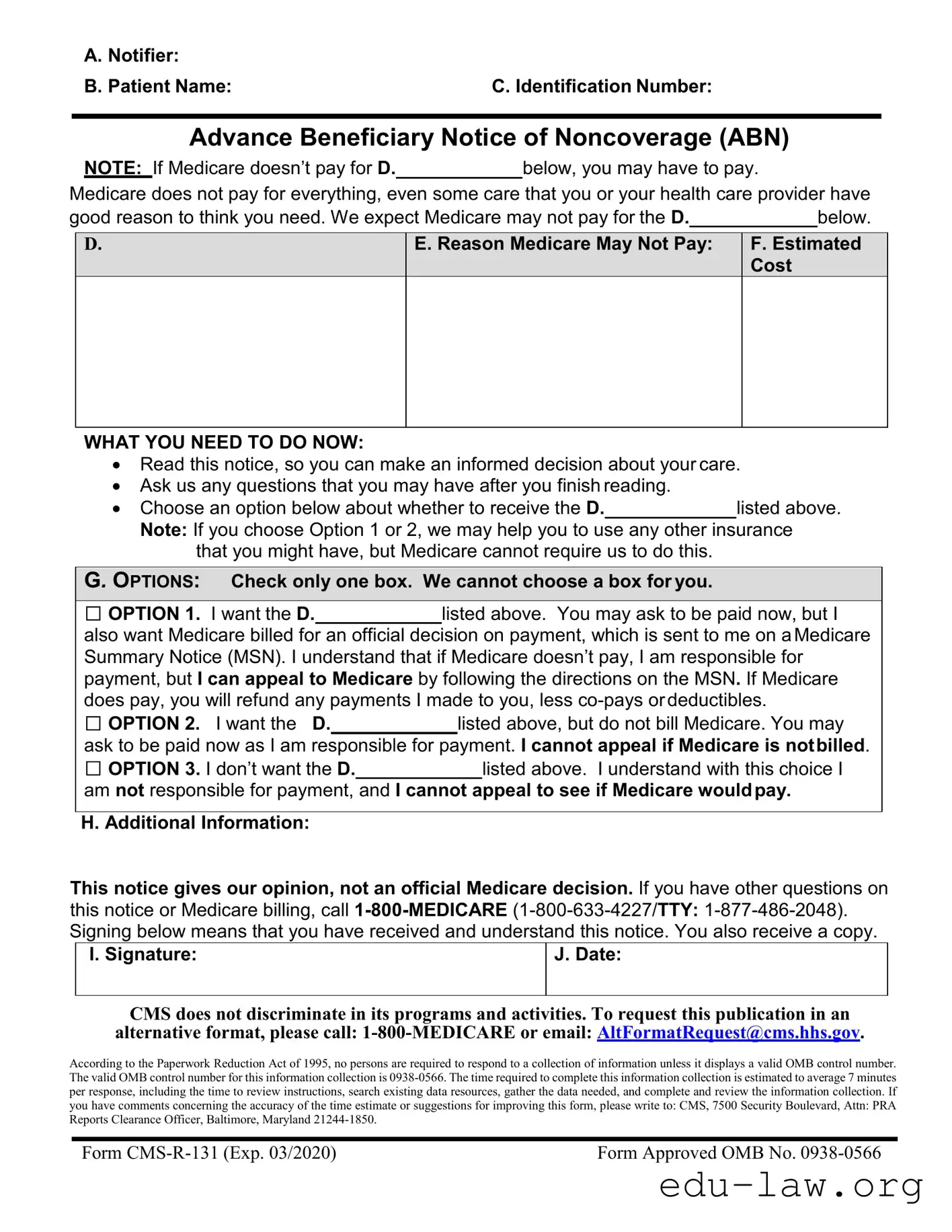
The CMS R-131 Advance Beneficiary Notice of Noncoverage (ABN) serves as a crucial communication tool between healthcare providers and Medicare beneficiaries. This form is designed to inform patients when Medicare is unlikely to cover certain services or items, allowing them to make informed decisions regarding their care. Key sections of the form include the notifier's information, the patient's name and identification number, and a detailed description of the services or items in question. Beneficiaries must understand that if Medicare denies payment for the listed services, they may be responsible for the costs. The form outlines various options for beneficiaries, including the choice to request Medicare billing or to pay for the services out-of-pocket without appealing. Additionally, the ABN provides estimated costs and reasons for potential noncoverage, ensuring that patients have all necessary information to weigh their options effectively. It is essential for notifiers to deliver the ABN in a timely manner, allowing beneficiaries adequate time to review the notice and ask questions. By fostering transparency in the billing process, the ABN helps patients navigate their healthcare choices while clarifying their financial responsibilities.
A. Notifier: |
|
B. Patient Name: |
C. Identification Number: |
Advance Beneficiary Notice of Noncoverage (ABN)
NOTE: If Medicare doesn’t pay for D. below, you may have to pay.
Medicare does not pay for everything, even some care that you or your health care provider have
good reason to think you need. We expect Medicare may not pay for the D. |
|
below. |
D.
E. Reason Medicare May Not Pay:
F.Estimated Cost
WHAT YOU NEED TO DO NOW:
•Read this notice, so you can make an informed decision about your care.
•Ask us any questions that you may have after you finish reading.
• Choose an option below about whether to receive the D.listed above.
Note: If you choose Option 1 or 2, we may help you to use any other insurance that you might have, but Medicare cannot require us to do this.
G. OPTIONS: Check only one box. We cannot choose a box for you.
□OPTION 1. I want the D. listed above. You may ask to be paid now, but I also want Medicare billed for an official decision on payment, which is sent to me on aMedicare Summary Notice (MSN). I understand that if Medicare doesn’t pay, I am responsible for payment, but I can appeal to Medicare by following the directions on the MSN. If Medicare does pay, you will refund any payments I made to you, less
□ OPTION 2. I want the D. listed above, but do not bill Medicare. You may
ask to be paid now as I am responsible for payment. I cannot appeal if Medicare is notbilled.
□ OPTION 3. I don’t want the D. listed above. I understand with this choice I
am not responsible for payment, and I cannot appeal to see if Medicare wouldpay.
H. Additional Information:
This notice gives our opinion, not an official Medicare decision. If you have other questions on this notice or Medicare billing, call
I. Signature:
J. Date:
CMS does not discriminate in its programs and activities. To request this publication in an alternative format, please call:
According to the Paperwork Reduction Act of 1995, no persons are required to respond to a collection of information unless it displays a valid OMB control number. The valid OMB control number for this information collection is
Form |
Form Approved OMB No. |
Form Instructions
Advance Beneficiary Notice of Noncoverage (ABN)
OMB Approval Number:
Overview
The ABN is a notice given to beneficiaries in Original Medicare to convey that Medicare is not likely to provide coverage in a specific case. “Notifiers” include physicians, providers (including institutional providers like outpatient hospitals), practitioners and suppliers paid under Part B (including independent laboratories), as well as hospice providers and religious
All of the aforementioned physicians, suppliers, practitioners, and providers must complete the ABN as described below, and deliver the notice to affected beneficiaries or their representative before providing the items or services that are the subject of the notice. Medicare inpatient hospitals and skilled nursing facilities (SNFs) use other approved notices for Part A items and services when notice is required; however, these facilities must use the ABN for Part B items and services.
The ABN must be reviewed with the beneficiary or his/her representative and any questions raised during that review must be answered before it is signed. The ABN must be delivered far enough in advance that the beneficiary or representative has time to consider the options and make an informed choice. Employees or subcontractors of the notifier may deliver the ABN. ABNs are never required in emergency or urgent care situations. Once all blanks are completed and the form is signed, a copy is given to the beneficiary or representative. In all cases, the notifier must retain a copy of the ABN delivered to the beneficiary on file.
The ABN may also be used to provide voluntary notification of financial liability for items or services that Medicare never covers. When the ABN is used as a voluntary notice, the beneficiary doesn’t choose an option box or sign the notice. CMS has issued detailed instructions on the use of the ABN in its
ABN Changes
The ABN is a formal information collection subject to approval by the Executive Office of Management and Budget (OMB) under the Paperwork Reduction Act of 1995 (PRA). As part of this process, the notice is subject to public comment and
been revised to include language informing beneficiaries of their rights to CMS nondiscrimination practices and how to request the ABN in an alternative format if needed.
Completing the Notice
ABNs may be downloaded from the CMS website at:
ABNs must be reproduced on a single page. The page may be either letter or
Sections and Blanks:
There are 10 blanks for completion in this notice, labeled from (A) through (J), with accompanying instructions for each blank below. We recommend that notifiers remove the lettering labels from the blanks before issuing the ABN to beneficiaries. Blanks
Header
Blanks
Blank (A) Notifier(s): Notifiers must place their name, address, and telephone number (including TTY number when needed) at the top of the notice. This information may be incorporated into a notifier’s logo at the top of the notice by typing,
If the billing and notifying entities are not the same, the name of more than one entity may be given in the Header as long as it is specified in the Additional Information (H) section who should be contacted for billing questions.
Blank (B) Patient Name: Notifiers must enter the first and last name of the beneficiary receiving the notice, and a middle initial should also be used if there is one on the beneficiary’s Medicare (HICN) card. The ABN will not be invalidated by a misspelling or missing initial, as long as the beneficiary or representative recognizes the name listed on the notice as that of the beneficiary.
Blank (C) Identification Number: Use of this field is optional. Notifiers may enter an identification number for the beneficiary that helps to link the notice with a related claim. The absence of an identification number does not invalidate the ABN. An internal filing number created by the notifier, such as a medical record number, may be used. Medicare numbers (HICNs) or Social Security numbers must not appear on the notice.
Body
Blank (D): The following descriptors may be used in the Blank (D) fields:
Item
Service
Laboratory test
Test
Procedure
Care
Equipment
The notifier must list the specific names of the items or services believed to be noncovered in the column directly under the header of Blank (D).
In the case of partial denials, notifiers must list in the column under Blank (D) the excess component(s) of the item or service for which denial is expected.
For repetitive or continuous noncovered care, notifiers must specify the frequency and/or duration of the item or service. See § 50.7.1 (b) of the MCPM, Chapter 30 for additional information.
General descriptions of specifically grouped supplies are permitted in this column. For example, “wound care supplies” would be a sufficient description of a group of items used to provide this care. An itemized list of each supply is generally not required.
When a reduction in service occurs, notifiers must provide enough additional information so that the beneficiary understands the nature of the reduction. For example, entering “wound care supplies decreased from weekly to monthly” would be appropriate to describe a decrease in frequency for this category of supplies; just writing “wound care supplies decreased” is insufficient.
Please note that there are a total of 7 Blank (D) fields that the notifier must complete on the ABN. Notifiers are encouraged to populate all of the Blank (D) fields in advance when a general descriptor such as “Item(s)/Service(s)” is used. All Blank
(D)fields must be completed on the ABN in order for the notice to be considered valid.
Blank (E) Reason Medicare May Not Pay: In the column under this header, notifiers must explain, in beneficiary friendly language, why they believe the items or services listed in the column under Blank (D) may not be covered by Medicare. Three commonly used reasons for noncoverage are:
“Medicare does not pay for this test for your condition.”
“Medicare does not pay for this test as often as this (denied as too frequent).”
“Medicare does not pay for experimental or research use tests.”
To be a valid ABN, there must be at least one reason applicable to each item or service listed in the column under Blank (D). The same reason for noncoverage may be applied to multiple items in Blank (D) when appropriate.
Blank (F) Estimated Cost: Notifiers must complete the column under Blank (F) to ensure the beneficiary has all available information to make an informed decision about whether or not to obtain potentially noncovered services.
Notifiers must make a good faith effort to insert a reasonable estimate for all of the items or services listed under Blank (D). In general, we would expect that the estimate should be within $100 or 25% of the actual costs, whichever is greater; however, an estimate that exceeds the actual cost substantially would generally still be acceptable, since the beneficiary would not be harmed if the actual costs were less than predicted. Thus, examples of acceptable estimates would include, but not be limited to, the following:
For a service that costs $250:
•Any dollar estimate equal to or greater than $150
•“Between
•“No more than $500”
For a service that costs $500:
•Any dollar estimate equal to or greater than $375
•“Between
•“No more than $700”
Multiple items or services that are routinely grouped can be bundled into a single cost estimate. For example, a single cost estimate can be given for a group of laboratory tests, such as a basic metabolic panel (BMP). An average daily cost estimate is also permissible for long term or complex projections. As noted above, providers may also
CMS will work with its contractors to ensure consistency when evaluating cost estimatesand determining validity of the ABN in general. In addition, contractors will provide ongoing education to notifiers as needed to ensure proper notice delivery. Notifiers should contact the appropriate CMS regional office if they believe that a contractor inappropriately invalidated an ABN.

Options
Blank (G) Options: Blank (G) contains the following three options:
□OPTION 1. I want the (D) listed above. You may ask to be paid now, but I also want Medicare billed for an official decision on payment, which is sent to me on a Medicare Summary Notice (MSN). I understand that if Medicare doesn’t pay, I am responsible for payment, but I can appeal to Medicare by following the directions on the MSN. If Medicare does pay, you will refund any payments I made to you, less
This option allows the beneficiary to receive the items and/or services at issue and requires the notifier to submit a claim to Medicare. This will result in a payment decision that can be appealed. See Ch. 30, §50.15.1 of the online Medicare Claims Processing Manual for instructions on the notifier’s obligation to bill Medicare. Suppliers and providers who don’t accept Medicare assignment may make modifications to Option 1 only as specified below under “D. Additional Information.”
Note: Beneficiaries who need to obtain an official Medicare decision in order to file a claim with a secondary insurance should choose Option 1.
□OPTION 2. I want the (D) listed above, but do not bill Medicare. You may ask to be paid now as I am responsible for payment. I cannot appeal if Medicare isnot billed.
This option allows the beneficiary to receive the noncovered items and/or services and pay for them out of pocket. No claim will be filed and Medicare will not be billed. Thus, there are no appeal rights associated with this option.
□OPTION 3. I don’t want the (D)listed above. I understand with this choice I am not responsible for payment, and I cannot appeal to see if Medicare wouldpay.
This option means the beneficiary does not want the care in question. By checking this box, the beneficiary understands that no additional care will be provided; thus, there are no appeal rights associated with this option.
The beneficiary or his or her representative must choose only one of the three options listed in Blank (G). Under no circumstances can the notifier decide for the beneficiary which of the 3 checkboxes to select.
If there are multiple items or services listed in Blank (D) and the beneficiary wants to receive some, but not all of the items or services, the notifier can accommodate this request by using more than one ABN. The notifier can furnish an additional ABN listing the items/services the beneficiary wishes to receive with the corresponding option.
If the beneficiary cannot or will not make a choice, the notice should be annotated, for
example: “beneficiary refused to choose an option.”
Additional Information
Blank (H) Additional Information: Notifiers may use this space to provide additional clarification that they believe will be of use to beneficiaries. For example, notifiers may use this space to include:
A statement advising the beneficiary to notify his or her provider about certain tests that were ordered, but not received;
Information on other insurance coverage for beneficiaries, such as a Medigap policy, if applicable;
An additional dated witness signature; or Other necessary annotations.
Annotations will be assumed to have been made on the same date as that appearing in Blank J, accompanying the signature. If annotations are made on different dates, those dates should be part of the annotations.
Special guidance ONLY for
Strike the last sentence in the Option 1 paragraph with a single line so that it appears like this: If Medicare does pay, you will refund any payments I made to you, less co- pays or deductibles.
This single line strike can be included on ABNs printed specifically for issuance when unassigned items and services are furnished. Alternatively, the line can be
The sentence must be stricken and can’t be entirely concealed or deleted.
There is no CMS requirement for suppliers or the beneficiary to place initials next to the stricken sentence or date the annotations when the notifier makes the changes to the ABN before issuing the notice to the beneficiary.
When this sentence is stricken, the supplier shall include the following
“This supplier doesn’t accept payment from Medicare for the item(s) listed in the table above. If I checked Option 1 above, I am responsible for paying the supplier’s charge for the item(s) directly to the supplier. If Medicare does pay, Medicare will pay me the
OThis statement can be included on ABNs printed for unassigned items and services, or it can be handwritten in a legible 10 point or larger font.
•An ABN with the Option 1 sentence stricken must contain the
B. Signature Box
Once the beneficiary reviews and understands the information contained in the ABN, the Signature Box is to be completed by the beneficiary (or representative). This box cannot be completed in advance of the rest of the notice.
Blank (I) Signature: The beneficiary (or representative) must sign the notice to indicate that he or she has received the notice and understands its contents. If a representative signs on behalf of a beneficiary, he or she should write out “representative” in parentheses after his or her signature. The representative’s name should be clearly legible or noted in print.
Blank (J) Date: The beneficiary (or representative) must write the date he or she signed the ABN. If the beneficiary has physical difficulty with writing and requests assistance in completing this blank, the date may be inserted by the notifier.
Disclosure Statement: The disclosure statements in the footer of the notice are required to be included on the document.
| Fact Name | Description |
|---|---|
| Purpose | The CMS R-131 Advance Beneficiary Notice (ABN) informs Medicare beneficiaries when Medicare may not cover a specific service or item. |
| Notifiers | Providers such as physicians, suppliers, and home health agencies are responsible for issuing the ABN. |
| Completion Requirement | All blanks (A-J) must be filled out correctly for the ABN to be valid. |
| Options for Beneficiaries | Beneficiaries can choose one of three options regarding the service listed in the ABN. |
| Estimated Costs | Notifiers must provide an estimated cost for the service, which should be within a reasonable range of the actual cost. |
| Signature Requirement | A beneficiary's signature is required to acknowledge receipt and understanding of the notice. |
| Emergency Situations | ABNs are not required in emergency or urgent care situations. |
| Legal Framework | The ABN is governed by the Medicare program regulations and the Paperwork Reduction Act of 1995. |
| Review Process | The ABN is subject to public comment and re-approval every three years by the OMB. |
| Discrimination Policy | CMS does not discriminate in its programs and activities, ensuring accessibility for all beneficiaries. |
Filling out the CMS R-131 Advance Beneficiary Notice (ABN) form is a straightforward process that requires specific information to be provided. Following these steps will ensure that the form is completed correctly and that the patient receives the necessary information regarding potential Medicare noncoverage.
After completing the form, ensure that a copy is provided to the patient or their representative, and retain a copy for your records. This process helps maintain transparency regarding potential costs and coverage under Medicare.
What is the purpose of the CMS R 131 Advance ABN form?
The CMS R 131 Advance Beneficiary Notice of Noncoverage (ABN) form is used to inform Medicare beneficiaries that Medicare may not cover a specific service or item. This notice helps patients make informed decisions about their care by clearly outlining potential financial responsibilities if Medicare denies coverage. It is essential for beneficiaries to understand that not all services are covered by Medicare, even if their healthcare provider believes they are necessary.
What options do I have when I receive an ABN?
When you receive an ABN, you will have three options to choose from regarding the service or item listed. Option 1 allows you to proceed with the service while billing Medicare for an official decision. If Medicare denies coverage, you will be responsible for payment but can appeal. Option 2 means you want the service but do not wish to bill Medicare; you will be responsible for payment without the option to appeal. Option 3 indicates that you do not want the service, and you will not be responsible for payment or able to appeal Medicare’s decision. It is important to choose the option that best fits your situation.
How should I complete the ABN form?
To complete the ABN form, you will need to fill in specific information, including the notifier's details, your name, and the identification number if applicable. The notifier will provide information about the service or item in question, the reason Medicare may not pay, and an estimated cost. It is crucial to review the form carefully and ask any questions before signing it. After signing, you should receive a copy for your records.
What happens if I do not sign the ABN?
If you do not sign the ABN, you may not be able to proceed with the service or item listed. The ABN is meant to inform you about your potential financial liability, and without your acknowledgment, the healthcare provider may not be able to provide the service. It is in your best interest to understand the implications of not signing the ABN and to discuss any concerns with your healthcare provider.
Where can I get more information about the ABN?
If you have further questions about the ABN or Medicare billing, you can call 1-800-MEDICARE (1-800-633-4227) for assistance. They can provide guidance and clarify any doubts you may have regarding your coverage and the services you receive. Additionally, the CMS website offers resources and information related to the ABN and Medicare policies.
Incomplete Information: Failing to fill out all required sections, such as the notifier's name, patient name, and identification number, can lead to confusion and invalidation of the form.
Incorrectly Filling Out Blank D: Not listing specific items or services that may not be covered by Medicare can render the notice ineffective. Each item listed must be clear and detailed.
Insufficient Reasoning: Providing vague or generic reasons in Blank E for why Medicare may not pay can mislead beneficiaries. Clear, understandable language is essential.
Estimated Cost Errors: Underestimating or overestimating the costs in Blank F can misinform the patient. Estimates should be reasonable and reflect potential costs accurately.
Not Reviewing with the Beneficiary: Failing to discuss the form with the beneficiary or their representative can result in misunderstandings about their options and responsibilities.
Not Retaining a Copy: Notifiers must keep a copy of the signed ABN on file. Neglecting this step can lead to complications if questions arise later.
Ignoring Signature Requirements: A cursive signature is required in Blank I. Skipping this step can invalidate the form, leaving the notifier without proof of the beneficiary's acknowledgment.
The CMS R-131 Advance Beneficiary Notice of Noncoverage (ABN) is a critical document for Medicare beneficiaries. It informs patients when Medicare is unlikely to cover certain services or items, allowing them to make informed decisions about their care. Alongside the ABN, several other forms and documents are commonly used in healthcare settings. Below is a list of these documents, along with a brief description of each.
Understanding these documents can help patients navigate their healthcare choices more effectively. Each form serves a specific purpose in ensuring that patients are informed about their rights, responsibilities, and the financial implications of their healthcare decisions.
The Advance Beneficiary Notice of Noncoverage (ABN) is similar to the Home Health Advance Beneficiary Notice (HHABN), which was used specifically for home health services. Like the ABN, the HHABN informed beneficiaries about potential noncoverage of services under Medicare. However, the HHABN has been discontinued since 2013, and the ABN is now the primary document for notifying patients about potential financial liability for services that may not be covered. Both forms aim to ensure that patients are aware of their options and can make informed decisions regarding their care, but the ABN has broader applicability beyond home health services.
Another document comparable to the ABN is the Medicare Summary Notice (MSN). The MSN is sent to beneficiaries every three months and provides a summary of services received, detailing what Medicare covered and what the patient may owe. While the ABN is a proactive notice given before services are rendered, the MSN is retrospective, summarizing past services. Both documents emphasize the importance of patient awareness regarding Medicare coverage and potential out-of-pocket costs, ensuring beneficiaries understand their financial responsibilities.
The Notice of Exclusion from Medicare Benefits (NEMB) is another document that shares similarities with the ABN. The NEMB is used when a service or item is not covered by Medicare, and it informs the beneficiary of this exclusion. Like the ABN, the NEMB requires the provider to explain the reason for noncoverage. Both documents help beneficiaries understand their options and financial responsibilities, but the NEMB is specifically used for services that are not covered at all, whereas the ABN is for services that may or may not be covered.
The Medicare Outpatient Observation Notice (MOON) is also akin to the ABN, as it informs patients about their outpatient observation status. This notice clarifies that a patient is receiving outpatient care rather than being admitted as an inpatient. Both documents serve to communicate important information regarding Medicare coverage, but the MOON specifically addresses the patient's status in a hospital setting, while the ABN focuses on the potential noncoverage of specific services or items.
Lastly, the Skilled Nursing Facility Advance Beneficiary Notice (SNFABN) is another related document. This notice is used in skilled nursing facilities to inform patients about the potential noncoverage of services provided. Similar to the ABN, the SNFABN allows patients to understand their financial responsibilities before receiving care. Both notices serve the same purpose of ensuring patients are informed about their options and potential costs, but the SNFABN is tailored specifically for skilled nursing facility services.
When filling out the CMS R-131 Advance ABN form, there are important dos and don’ts to keep in mind. Here’s a concise list to guide you:
Misconceptions about the CMS R-131 Advance ABN Form
When filling out and using the CMS R-131 Advance Beneficiary Notice of Noncoverage (ABN) form, consider the following key takeaways: