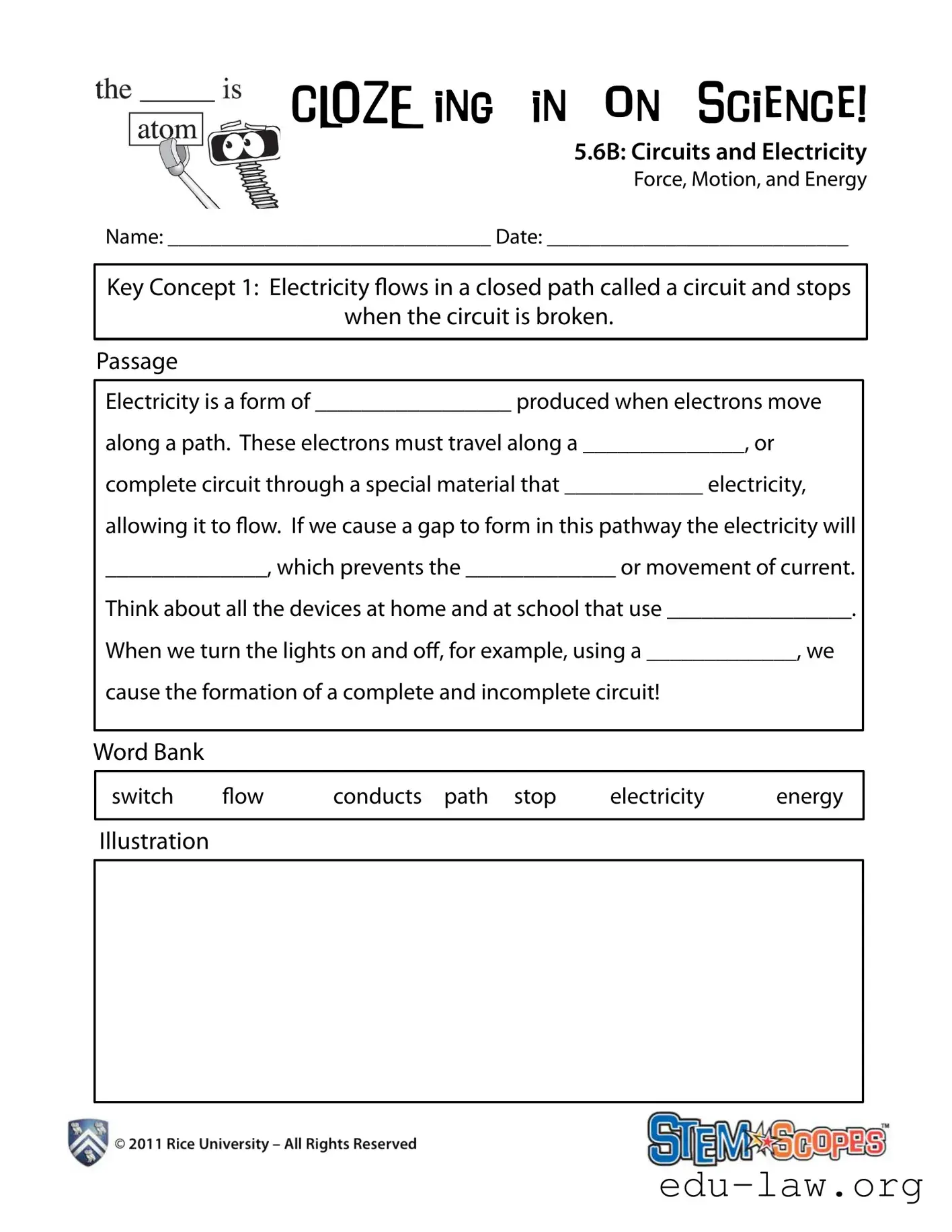
The CMS 100B form serves as a crucial educational tool designed to engage students in the fundamental concepts of electricity and circuits. This form emphasizes the importance of understanding how electricity flows through a closed circuit and what happens when that circuit is interrupted. Key concepts highlight the transformation of electrical energy into various forms, such as light, heat, and sound, which are essential for the operation of everyday devices like televisions and toasters. Students are encouraged to explore how these transformations occur and to consider their own experiences with electrical devices. The form includes interactive elements, such as fill-in-the-blank passages, which prompt students to think critically about the role of electricity in their daily lives. By connecting theoretical knowledge with practical applications, the CMS 100B form aims to foster a deeper appreciation for the science of electricity and its significance in our modern world.
5.6B: Circuits and Electricity
Force, Motion, and Energy
Name: ______________________________ Date: ____________________________
Key Concept 1: Electricity ws in a closed path called a circuit and stops when the circuit is broken.
Passage
Electricity is a form of _________________ produced when electrons move
along a path. These electrons must travel along a ______________, or
complete circuit through a special material that ____________ electricity,
allowing it to w. If we cause a gap to form in this pathway the electricity will
______________, which prevents the _____________ or movement of current.
Think about all the devices at home and at school that use ________________.
When we turn the lights on and off, for example, using a _____________, we
cause the formation of a complete and incomplete circuit! Word Bank
switch |
ow |
conducts path stop |
electricity |
energy |
Illustration
5.6B: Circuits and Electricity
Force, Motion, and Energy
Key Concept 2: We can demonstrate that electricity can produce light,
heat, and sound when owing through a circuit
Passage
There are plenty of items we depend on and enjoy having that use electricity. This electricity is _______________, or transformed, into other
forms of energy in these devices. The television transforms electricity into ___________ energy since we can see the picture, and
____________ energy since we can hear it. When the toaster is turned
on, it produces ____________ energy since it toasts our bread. All of
these things only happen when the circuit is complete, which means electricity can ____________.
Word Bank
light |
ow |
sound |
changed |
thermal/heat |
Illustration |
|
|
|
|
|
|
|
|
|
|
|
|
|
|
5.6B: Circuits and Electricity
Force, Motion, and Energy
Key Concept 3: Many everyday devices use electricity to produce light,
heat, and sound.
Passage
Some devices, such as our doorbell, mainly produce ____________ energy
when they are operated. Other devices like lamps use electricity to produce_____________ energy since we can see the results in a dark room.
Are some of your favorite devices dependent on the use of electricity? If so, they are likely transforming electrical energy into other forms, such as
___________, __________, or _____________. Which is the most useful for
you? Do you prefer one form of energy over another? Think about the forms of energy you use each and every day.
Word Bank
light sound light heat sound
Illustration
5.6B: Circuits and Electricity
Force, Motion, and Energy
Answer Key
Electricity is a form of energy produced when electrons move along a path. These electrons must travel along a path, or complete circuit through a special material that conducts electricity, allowing it to ow. If we cause a gap to form in this pathway the electricity will stop, which prevents the ow or movement of current. Think about all the devices at home and at school that use electricity. When we turn the lights on and off, for example, using a switch, we cause the formation of a complete and incomplete circuit!
There are plenty of items we depend on and enjoy having that use electricity. This electricity is changed, or transformed, into other forms of energy in these devices. The television transforms electricity into light energy since we can see the picture, and sound energy since we can hear it. When the toaster is turned on, it produces thermal/heat energy since it toasts our bread. All of these things only happen when the circuit is complete, which means electricity can ow.
Some devices, such as our doorbell, mainly produce sound energy when they are operated. Other devices like lamps use electricity to produce light energy since we can see the results in a dark room. Are some of your favorite devices dependent on the use of electricity? If so, they are likely transforming electrical energy into other forms, such as heat, sound, or light. Which is the most useful for you? Do you prefer one form of energy over another? Think about the forms of energy you use each and every day.
| Fact Name | Description | Governing Law(s) |
|---|---|---|
| Purpose of CMS 100B | The CMS 100B form is used to report and document various scientific concepts related to electricity and circuits. | Not applicable |
| Key Concepts | This form covers key concepts such as the flow of electricity, transformation of energy, and the operation of everyday devices. | Not applicable |
| Educational Use | It is primarily designed for educational purposes, helping students understand the fundamentals of electricity. | Not applicable |
| Completion Requirement | Students must complete the form by filling in blanks to demonstrate their understanding of the material. | Not applicable |
Filling out the CMS 100B form requires attention to detail and accuracy. This form is essential for specific purposes, and completing it correctly ensures that your information is conveyed effectively. Follow the steps below to fill out the form accurately.
What is the Cms 100B form?
The Cms 100B form is a document used for educational purposes, specifically focused on the concepts of circuits and electricity. It is designed to help students understand how electricity flows, the role of circuits, and how electricity is transformed into other forms of energy.
Who is the Cms 100B form intended for?
This form is primarily intended for students learning about electricity and circuits. It serves as a tool for teachers to assess students’ understanding of these key concepts in science.
What topics does the Cms 100B form cover?
The form covers several key concepts, including the definition of electricity, the structure of a complete circuit, and how electricity can produce light, heat, and sound. It also discusses everyday devices that rely on electricity.
How does the Cms 100B form facilitate learning?
By using fill-in-the-blank passages, the form encourages active participation from students. This method helps reinforce their understanding of the material while allowing them to engage with the concepts in a hands-on way.
Can the Cms 100B form be used in different educational settings?
Yes, the Cms 100B form can be utilized in various educational settings, including classrooms, tutoring sessions, and homeschooling environments. It is adaptable for different age groups and learning levels.
What is the significance of circuits in the Cms 100B form?
Circuits are fundamental to understanding electricity. The form emphasizes that electricity flows in a closed path called a circuit and stops when the circuit is broken. This concept is essential for grasping how electrical devices operate.
How does the Cms 100B form relate to everyday life?
The form connects scientific principles to everyday experiences. It highlights how common devices, like televisions and toasters, transform electrical energy into light, heat, or sound, making the concepts more relatable for students.
What kind of activities can accompany the Cms 100B form?
Teachers can pair the form with hands-on activities, such as building simple circuits or conducting experiments with electrical devices. These activities can enhance understanding and retention of the material covered in the form.
Is there an answer key available for the Cms 100B form?
Yes, an answer key is provided for the Cms 100B form. This key allows educators to easily assess student responses and ensure that the learning objectives are being met.
How can parents support their children using the Cms 100B form?
Parents can support their children by reviewing the form together, discussing the concepts, and encouraging them to think about how electricity impacts their daily lives. Engaging in related activities can also reinforce learning.
Failing to provide a complete name. Individuals often leave the name section blank or incomplete, which can lead to processing delays.
Not including the date. Omitting the date can create confusion regarding the submission timeline.
Misunderstanding key concepts. Some individuals do not fully grasp the key concepts of electricity, circuits, and energy, which may result in incorrect answers.
Ignoring the word bank. Failing to utilize the provided word bank can lead to incomplete sentences and a lack of clarity in responses.
Leaving blank spaces. Some people may leave entire sections blank, thinking they will return to them later, but often do not.
Providing incorrect definitions. Misdefining terms such as "conducts" or "transform" can lead to misunderstandings about the concepts being tested.
Not reviewing answers. Many individuals neglect to review their responses before submission, which can result in avoidable errors.
Using unclear handwriting. Illegible handwriting can cause misinterpretation of answers, leading to further complications.
Failing to follow instructions. Some may overlook specific instructions related to formatting or content, which can impact the evaluation process.
The CMS 100B form is a crucial document often used in various administrative and regulatory processes. Alongside this form, several other documents may be required to ensure compliance and provide necessary information. Below is a list of commonly associated forms and documents.
Understanding the purpose and importance of each of these documents can help organizations navigate the complexities of regulatory requirements more effectively. Proper documentation not only ensures compliance but also fosters trust and transparency in operations.
The CMS 100B form is similar to the IRS Form 1040, which is used for individual income tax returns. Both documents require detailed information to accurately reflect financial situations. The CMS 100B focuses on capturing information about a specific project or program, while the 1040 gathers data about personal income, deductions, and credits. Each form serves to ensure compliance with regulations, whether in education or taxation, and both require careful attention to detail to avoid errors.
Another document that resembles the CMS 100B is the W-9 form, which is used to request taxpayer identification information. Like the CMS 100B, the W-9 requires accurate information to facilitate proper reporting. The W-9 is essential for businesses to collect information from contractors and freelancers, similar to how the CMS 100B collects data for funding and accountability in educational programs. Both forms ensure transparency and compliance with relevant laws.
The Form I-9, used for employment eligibility verification, shares similarities with the CMS 100B in that it collects essential information to verify compliance with regulations. The CMS 100B focuses on educational programs, while the I-9 is concerned with an individual's right to work in the United States. Both forms require personal identification and must be completed accurately to avoid penalties.
Additionally, the FAFSA (Free Application for Federal Student Aid) form is akin to the CMS 100B in its purpose of gathering information for funding. The FAFSA collects financial data from students to determine eligibility for federal financial aid, while the CMS 100B collects information to assess the effectiveness of educational programs. Both forms play a crucial role in ensuring that funding is allocated appropriately based on the information provided.
The Form 990, which is used by tax-exempt organizations to report financial information, is another document similar to the CMS 100B. Both forms require detailed financial disclosures to maintain transparency and accountability. The Form 990 focuses on the financial health and activities of nonprofit organizations, while the CMS 100B assesses educational programs. Each form serves to ensure that funds are used properly and that organizations comply with regulations.
The Uniform Commercial Code (UCC) financing statement is also comparable to the CMS 100B in that it collects information to establish legal rights. The UCC form is used to secure interests in personal property, while the CMS 100B gathers data to ensure educational programs meet specific criteria. Both documents require precise information to protect the rights of stakeholders involved.
The Application for Federal Student Aid (AFSA) is similar to the CMS 100B in that both are used to assess eligibility for funding. The AFSA collects financial and personal information to determine a student's eligibility for federal aid, while the CMS 100B collects information to evaluate educational programs. Each form is vital for ensuring that funds are distributed fairly and based on need.
The SBIR (Small Business Innovation Research) application form shares characteristics with the CMS 100B. Both forms collect detailed information about projects seeking funding. The SBIR form focuses on innovative research and development in small businesses, while the CMS 100B assesses educational initiatives. Each form aims to ensure that funds are allocated to projects that meet specific criteria and have the potential for success.
Lastly, the Form 1023, used for applying for tax-exempt status, is similar to the CMS 100B in its goal of collecting essential information for compliance. The Form 1023 requires detailed information about an organization’s mission, activities, and finances, while the CMS 100B gathers data to evaluate educational programs. Both forms are critical for ensuring that organizations meet regulatory requirements and maintain transparency.
When filling out the CMS 100B form, there are important guidelines to follow. Here’s a list of things you should and shouldn’t do:
Misconceptions about the CMS 100B form can lead to confusion. Here are five common misunderstandings:
Filling out and using the CMS 100B form can be a straightforward process if you keep a few key points in mind. Here are some essential takeaways:
By keeping these takeaways in mind, you can navigate the CMS 100B form with confidence and ease.