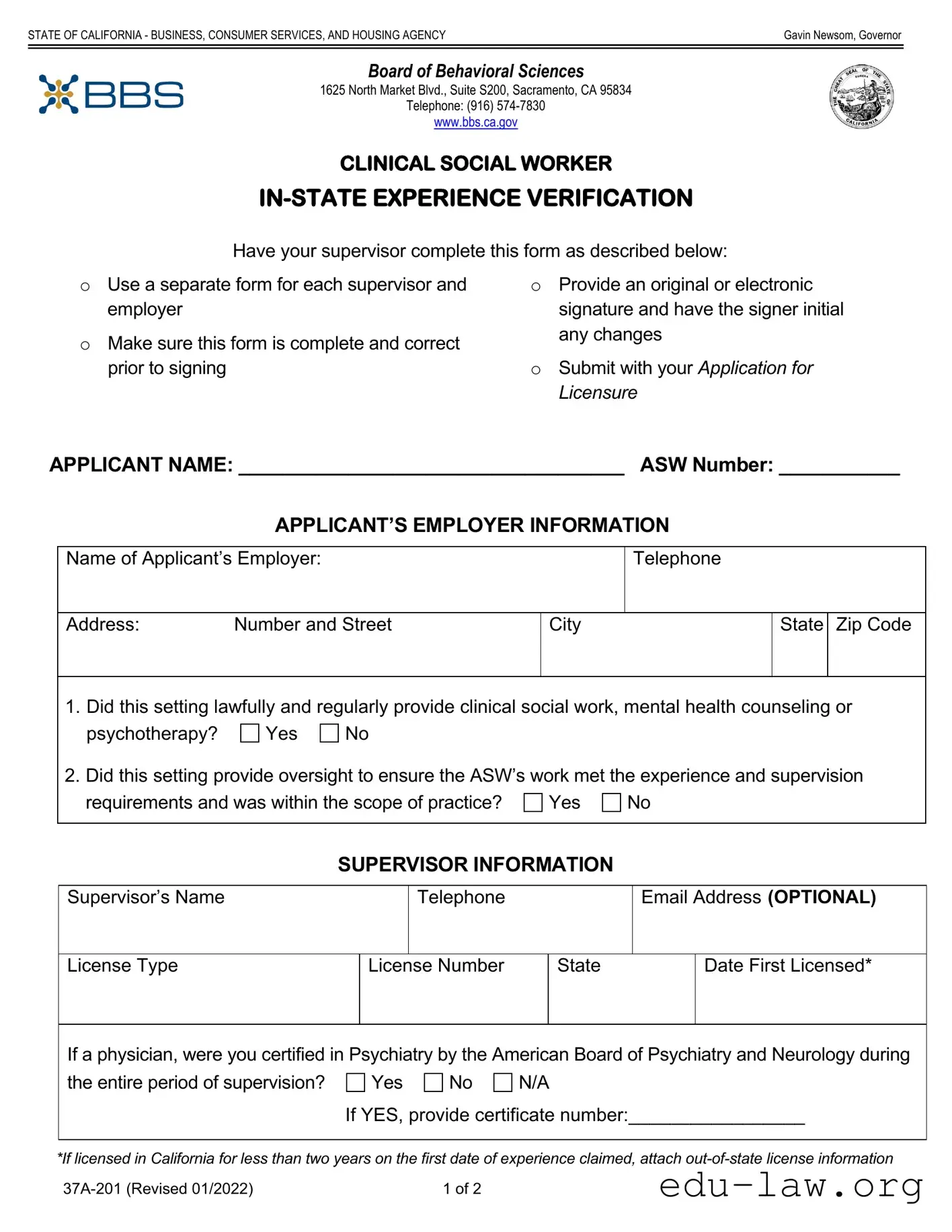
The Clinical Social Experience Verification form is an essential document for individuals seeking licensure as clinical social workers in California. This form plays a pivotal role in confirming that an applicant has completed the necessary supervised experience required by the Board of Behavioral Sciences. It requires detailed information from both the applicant and their supervisor, ensuring that the clinical work was conducted in a legitimate setting that adheres to state regulations. The form prompts supervisors to provide crucial details, including their qualifications and the extent of oversight provided during the applicant's training. Additionally, it outlines specific requirements regarding the total hours of supervised experience, types of clinical work performed, and the necessary supervisory structure. Each applicant must submit this form along with their licensure application, making accuracy and completeness paramount. Any discrepancies or omissions could lead to delays or even denial of the application, underscoring the importance of careful completion. Understanding the components of this verification form is vital for aspiring clinical social workers as they navigate the licensure process.

STATE OF CALIFORNIA - BUSINESS, CONSUMER SERVICES, AND HOUSING AGENCY |
Gavin Newsom, Governor |
Board of Behavioral Sciences
1625 North Market Blvd., Suite S200, Sacramento, CA 95834
Telephone: (916)
www.bbs.ca.gov
CLINICAL SOCIAL WORKER
Have your supervisor complete this form as described below:
oUse a separate form for each supervisor and employer
oMake sure this form is complete and correct prior to signing
oProvide an original or electronic signature and have the signer initial any changes
oSubmit with your Application for Licensure
APPLICANT NAME: ___________________________________ |
|
ASW Number: ___________ |
|||||||||||
|
|
APPLICANT’S EMPLOYER INFORMATION |
|||||||||||
|
|
|
|
|
|
|
|
|
|
|
|
|
|
|
Name of Applicant’s Employer: |
|
|
|
|
|
|
|
Telephone |
||||
|
|
|
|
|
|
|
|
|
|
|
|
|
|
|
Address: |
Number and Street |
|
|
|
City |
|
|
|
State |
Zip Code |
||
|
|
|
|
|
|
|
|
|
|
||||
|
1. Did this setting lawfully and regularly provide clinical social work, mental health counseling or |
||||||||||||
|
psychotherapy? |
Yes |
No |
|
|
|
|
|
|
|
|
|
|
|
2. Did this setting provide oversight to ensure the ASW’s work met the experience and supervision |
||||||||||||
|
requirements and was within the scope of practice? |
|
|
Yes |
No |
||||||||
|
|
|
|
|
|
|
|
|
|
|
|
||
|
|
|
SUPERVISOR INFORMATION |
|
|
|
|
|
|||||
|
|
|
|
|
|
|
|
|
|
|
|
||
|
Supervisor’s Name |
|
|
|
Telephone |
|
|
|
|
Email Address (OPTIONAL) |
|||
|
|
|
|
|
|
|
|
|
|
|
|
||
|
License Type |
|
|
License Number |
|
|
State |
|
|
Date First Licensed* |
|||
|
|
|
|
|
|||||||||
|
If a physician, were you certified in Psychiatry by the American Board of Psychiatry and Neurology during |
||||||||||||
|
the entire period of supervision? |
|
Yes |
No |
N/A |
|
|
|
|
|
|||
|
|
|
If YES, provide certificate number:_________________ |
||||||||||
|
|
|
|
|
|
|
|
|
|
|
|
|
|
*If licensed in California for less than two years on the first date of experience claimed, attach
1 of 2 |

APPLICANT NAME: __________________________________________ ASW#: _______________
SUPERVISOR INFORMATION (continued)
|
Were you (the supervisor) employed by the supervisee’s employer? |
Yes |
No |
|
|
|
|||
|
|
If NO, did you and the supervisee’s employer sign a written agreement pertaining to oversight of |
|||||||
|
|
the supervisee? |
Yes |
No |
|
|
|
|
|
|
|
|
|
|
|
|
|||
EXPERIENCE INFORMATION: |
Dates of experience: From ____________ |
to ____________ |
|||||||
|
|
|
|
(mm/dd/yyyy) |
(mm/dd/yyyy) |
||||
|
|
|
|
|
|
|
|
||
|
1. |
Total supervised weeks (Minimum 104 overall): |
|
|
|
|
|
||
|
|
|
|
|
|
|
|
||
|
2. |
Total hours in individual or triadic supervision (Minimum 52 overall): |
|
|
|
|
|
||
|
|
|
|
|
|
|
|
|
|
|
3. |
Total hours in group supervision: |
|
|
|
|
|
|
|
|
|
|
|
|
|
|
|
||
|
4. |
Average hours worked per week (Maximum 40): |
|
|
|
|
|
||
|
|
|
|
|
|||||
|
5. Total hours of clinical psychosocial diagnosis, assessment, and treatment, including |
A. |
|
|
|||||
|
|
individual or group psychotherapy / counseling (Minimum 2,000 overall): |
|
|
|
||||
|
|
|
|
|
|
||||
|
|
|
|
|
|
||||
|
6. |
Of the above hours, how many were gained performing |
|
|
|
||||
|
|
group psychotherapy/counseling |
(Minimum 750 overall): |
|
|
|
|
|
|
|
|
|
|
|
|
|
|||
|
7. |
Total hours of |
|
B. |
|
|
|||
|
|
workshops, seminars, training sessions or conferences and direct supervisor contact* |
|
|
|
||||
|
|
(Maximum 1,000 overall): |
|
|
|
|
|
|
|
|
|
|
|
|
|
|
|||
|
8. |
Total hours of experience (Minimum 3,000 overall): |
(A + B = C) |
C. |
|
|
|||
|
|
|
|
|
|
|
|||
|
9. |
Was one additional hour of |
|
|
Yes |
|
|||
|
additional hours of |
|
No |
|
|||||
|
than 10 hours of direct clinical counseling was performed? |
|
|
|
|
||||
|
|
|
|
|
|
||||
|
|
|
|
|
|
|
|
|
|
*A maximum of six (6) hours of direct supervisor contact per week may be counted toward the 1,000 hours.
NOTE: Knowingly providing false information or omitting pertinent information may be grounds for denial of the application. The Board may take disciplinary action on a licensee who helps an applicant obtain a license by fraud, deceit or misrepresentation. All information on this form is subject to verification.
Signature of Supervisor: _____________________________________ Date: ______________ |
|
ORIGINAL OR ELECTRONIC SIGNATURE REQUIRED |
|
2 of 2 |
|
| Fact Name | Description |
|---|---|
| Governing Agency | The Clinical Social Experience Verification form is administered by the Board of Behavioral Sciences, under the California Business, Consumer Services, and Housing Agency. |
| Purpose | This form verifies the clinical social work experience of applicants seeking licensure as clinical social workers in California. |
| Supervisor Requirement | Applicants must have their supervisors complete this form, ensuring that each supervisor and employer has a separate form. |
| Signature Requirement | An original or electronic signature is required from the supervisor, along with initials on any changes made to the form. |
| Experience Verification | Applicants must demonstrate a minimum of 3,000 hours of total experience, including specified hours in clinical work and supervision. |
| Clinical Hours | At least 2,000 hours must involve clinical psychosocial diagnosis, assessment, and treatment, with a minimum of 750 hours in face-to-face therapy. |
| Oversight Requirement | The supervisor must confirm that the setting provided oversight to ensure that the applicant's work met experience and supervision requirements. |
| Legal Implications | Providing false information on this form may result in application denial or disciplinary action against a licensee who assists in fraudulent practices. |
Completing the Clinical Social Experience Verification form is an important step in your application for licensure. Each section of the form requires careful attention to detail, ensuring that all information is accurate and complete. This verification form must be filled out by your supervisor, and it is essential to follow the steps below to ensure everything is in order before submission.
Once the form is completed and signed, submit it along with your application for licensure. Double-check that all sections are filled out accurately to avoid any delays in processing your application.
What is the purpose of the Clinical Social Experience Verification form?
This form is used to verify the clinical social work experience of an Associate Social Worker (ASW) in California. It ensures that the applicant's work meets the necessary experience and supervision requirements for licensure.
Who needs to complete this form?
The form must be completed by the supervisor of the ASW. Each supervisor must fill out a separate form for their respective ASWs and employers.
What information is required from the supervisor?
The supervisor must provide their name, contact information, license type, license number, and the date they were first licensed. They must also confirm their oversight of the ASW’s work and provide details about the clinical setting.
How many hours of experience are required for licensure?
Applicants must accumulate a minimum of 3,000 hours of clinical experience. This includes at least 2,000 hours in clinical psychosocial diagnosis, assessment, and treatment, with a minimum of 750 hours in face-to-face individual or group psychotherapy/counseling.
What if the supervisor is not employed by the same organization as the ASW?
If the supervisor is not employed by the ASW's employer, a written agreement must be signed between the supervisor and the employer to outline the oversight of the ASW's work.
Can the form be submitted electronically?
Yes, the form can be submitted electronically, but it must include an original or electronic signature from the supervisor. Any changes made to the form must be initialed by the signer.
What happens if false information is provided on the form?
Providing false information or omitting relevant details may lead to the denial of the application. Additionally, the Board may take disciplinary action against a licensee who assists an applicant in obtaining a license through deceit or misrepresentation.
What is the minimum number of weeks required for supervised experience?
Applicants must have a minimum of 104 weeks of supervised experience. This is crucial for meeting the overall experience requirements.
Is there a maximum number of hours that can be counted toward direct supervisor contact?
Yes, a maximum of six hours of direct supervisor contact per week can be counted toward the 1,000 hours of client-centered advocacy and supervision required.
Where should the completed form be submitted?
The completed Clinical Social Experience Verification form should be submitted along with the Application for Licensure to the Board of Behavioral Sciences at the specified address in Sacramento, California.
Incomplete Information: Many applicants fail to fill out all required fields on the form. This can include missing the supervisor's name, license number, or specific experience dates. Each section of the form is crucial for verification.
Incorrect Signature: Some individuals neglect to provide an original or electronic signature. Additionally, they may overlook the necessity for the supervisor to initial any changes made on the form. This oversight can lead to delays in processing the application.
Failure to Use Separate Forms: Applicants often use a single form for multiple supervisors or employers. It is essential to complete a separate form for each supervisor and employer to ensure that all experiences are accurately documented.
Omitting Required Attachments: If the supervisor has been licensed in California for less than two years, applicants must attach out-of-state license information. Neglecting this requirement can result in application denial.
When applying for licensure as a Clinical Social Worker in California, several forms and documents accompany the Clinical Social Experience Verification form. Each document serves a specific purpose and helps ensure that your application is complete and meets all requirements. Below is a list of commonly used forms that you may need to submit along with your application.
Gathering these documents may seem overwhelming, but each one plays a crucial role in your application. Ensuring that you have everything in order will help facilitate a smoother review process. Always double-check that all forms are complete and accurate before submission, as this can significantly impact the speed of your application review.
The Clinical Social Experience Verification form shares similarities with the Supervised Experience Verification form used by various professional boards. This document serves to confirm that an applicant has completed a specified amount of supervised experience in their field. Like the Clinical Social Experience Verification form, it requires detailed information about the supervisor and the applicant’s work experience, ensuring that the supervision provided meets the necessary standards for licensure.
Another comparable document is the Verification of Clinical Experience form, which is often required for healthcare professionals seeking licensure. This form collects information on the applicant's clinical training and experience, much like the Clinical Social Experience Verification form. It emphasizes the importance of supervision and the number of hours worked, ensuring that applicants have received adequate training before applying for licensure.
The Practicum Experience Verification form is also similar in function. This document is used primarily by educational institutions to validate that students have completed the required practicum hours in a clinical setting. Both forms require the supervisor's signature and detailed information about the applicant’s experience, underscoring the importance of supervised practice in both social work and other health-related fields.
The Internship Verification form is another document that serves a similar purpose. It is commonly used in various fields, including psychology and counseling, to confirm that an intern has completed the necessary hours under supervision. Similar to the Clinical Social Experience Verification form, it outlines the specific requirements for supervision and the types of activities performed during the internship.
The Experience Verification form for Marriage and Family Therapists (MFT) is closely aligned with the Clinical Social Experience Verification form. This document is designed to verify the clinical hours completed by an MFT applicant. Both forms require a detailed account of supervision and direct client contact, ensuring that applicants meet the experience requirements set forth by their respective boards.
Another relevant document is the Clinical Training Verification form, which is utilized by various healthcare professions. This form validates the clinical training received by an applicant and requires similar information about the supervisor and the clinical hours completed. Both documents aim to ensure that the applicant has the necessary experience to provide effective care.
The Licensed Professional Counselor (LPC) Experience Verification form also bears resemblance to the Clinical Social Experience Verification form. This document verifies that LPC applicants have completed the required supervised experience in counseling. It includes similar components, such as the supervisor's credentials and the number of hours worked, reinforcing the standards of supervision across different counseling professions.
The Field Placement Verification form is often used by social work programs to confirm that students have completed their field placement requirements. Like the Clinical Social Experience Verification form, it includes information about the supervisor and the specific tasks performed during the placement, ensuring that students gain the necessary experience before graduation.
The Clinical Supervision Verification form is another document that parallels the Clinical Social Experience Verification form. This form is used to confirm that an applicant has received appropriate supervision during their clinical training. Both forms require detailed information about the supervisory relationship and the applicant’s clinical activities, emphasizing the importance of oversight in the development of clinical skills.
Lastly, the Postgraduate Supervised Experience Verification form is similar in purpose and structure. This document is used by applicants who have completed their postgraduate supervised experience in various mental health fields. It outlines the requirements for supervision and the total hours worked, ensuring that applicants have met the necessary standards before applying for licensure.
When filling out the Clinical Social Experience Verification form, it is essential to follow specific guidelines to ensure accuracy and compliance. Here are ten do's and don'ts to keep in mind:
Following these guidelines will help ensure a smoother application process for licensure. Accuracy and thoroughness are crucial in presenting your clinical social experience.
Misunderstandings about the Clinical Social Experience Verification form can lead to confusion for applicants and their supervisors. Here are four common misconceptions:
Understanding these points can facilitate a smoother application process and help ensure compliance with the Board's requirements.
Filling out the Clinical Social Experience Verification form can be straightforward if you keep a few key points in mind. Here are some essential takeaways to ensure a smooth process:
By following these guidelines, you can navigate the Clinical Social Experience Verification form with confidence and ease.