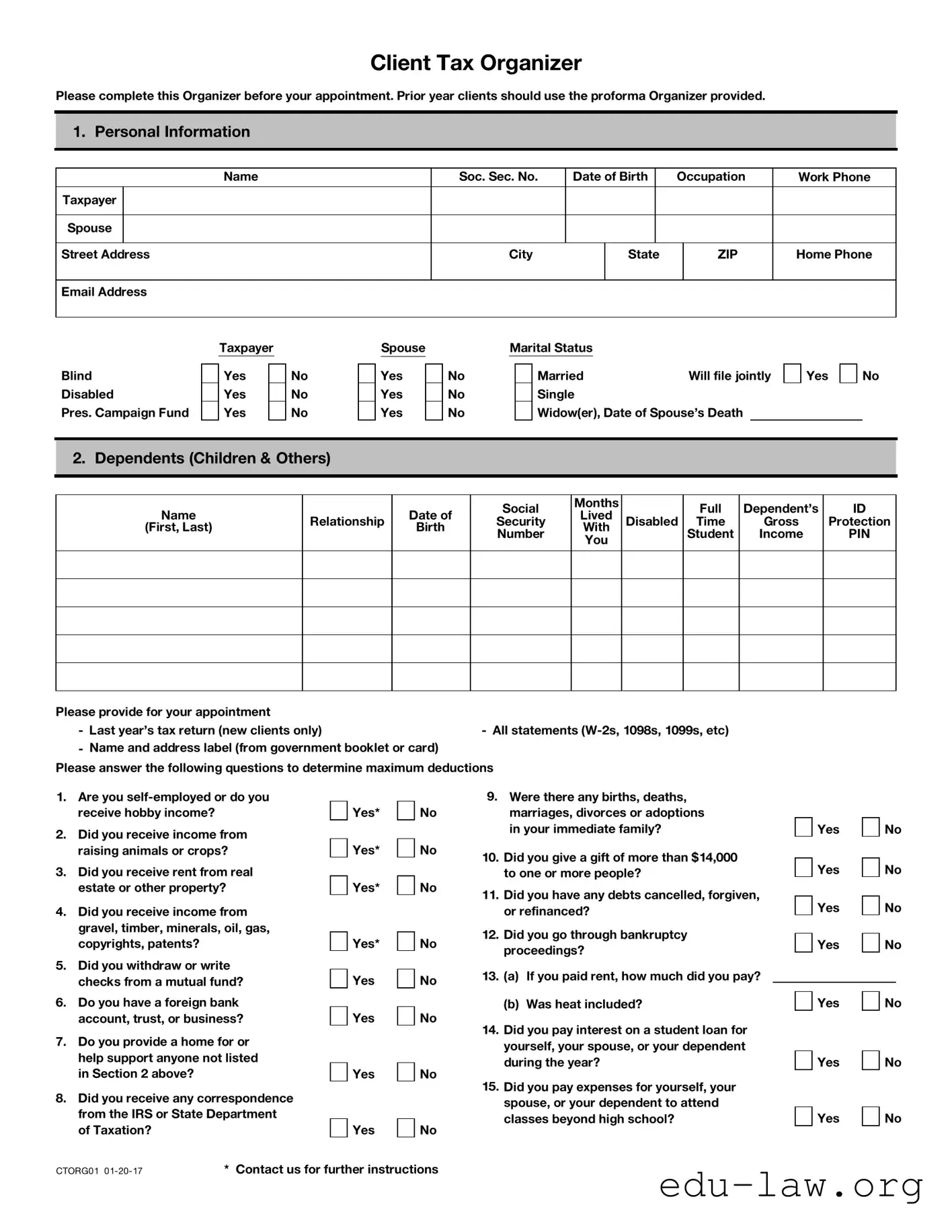
The Client Tax Organizer form is a comprehensive tool designed to assist individuals in preparing for their tax appointments. This form gathers essential personal information, including names, Social Security numbers, and contact details, ensuring that all necessary data is readily available. It prompts users to provide details about dependents, such as children and others living in the household, which is crucial for determining eligibility for various tax credits and deductions. Additionally, the form includes a series of questions aimed at uncovering potential sources of income, such as self-employment, rental income, and investment earnings. It also addresses significant life events, including marriages, divorces, and births, which can impact tax filings. Furthermore, the form requests documentation, such as last year’s tax return and relevant income statements, to facilitate accurate preparation. By systematically collecting this information, the Client Tax Organizer helps ensure that clients maximize their deductions and credits while providing a clear overview of their financial situation for the tax year.
Client Tax Organizer
Please complete this Organizer before your appointment. Prior year clients should use the proforma Organizer provided.
1. Personal Information
|
Name |
Soc. Sec. No. |
Date of Birth |
|
Occupation |
Work Phone |
||
|
|
|
|
|
|
|
|
|
Taxpayer |
|
|
|
|
|
|
|
|
|
|
|
|
|
|
|
|
|
Spouse |
|
|
|
|
|
|
|
|
|
|
|
|
|
|
|
|
|
Street Address |
City |
|
State |
|
ZIP |
Home Phone |
||
|
|
|
|
|
|
|
|
|
Email Address
Blind
Disabled
Pres. Campaign Fund
Taxpayer
Yes
Yes
Yes
No
No
No
Spouse
Yes
Yes
Yes
|
Marital Status |
|
||
No |
|
|
Married |
Will file jointly |
|
|
|||
No |
|
|
Single |
|
No |
|
|
Widow(er), Date of Spouse's Death |
|
Yes
No
2. Dependents (Children & Others)
Name
(First, Last)
Relationship
Date of
Birth
Social
Security
Number
Months
Lived
With
You
Disabled
Full
Time
Student
Dependent's
Gross
Income
ID
Protection
PIN
Please provide for your appointment
- |
Last year's tax return (new clients only) |
- All statements |
- |
Name and address label (from government booklet or card) |
|
Please answer the following questions to determine maximum deductions
1.Are you
2.Did you receive income from raising animals or crops?
3.Did you receive rent from real estate or other property?
4.Did you receive income from gravel, timber, minerals, oil, gas, copyrights, patents?
5.Did you withdraw or write checks from a mutual fund?
6.Do you have a foreign bank account, trust, or business?
7.Do you provide a home for or help support anyone not listed in Section 2 above?
8.Did you receive any correspondence from the IRS or State Department of Taxation?
Yes*
Yes*
Yes*
Yes*
Yes
Yes
Yes
Yes
No
No
No
No
No
No
No
No
9.Were there any births, deaths, marriages, divorces or adoptions in your immediate family?
10.Did you give a gift of more than $14,000 to one or more people?
11.Did you have any debts cancelled, forgiven, or refinanced?
12.Did you go through bankruptcy proceedings?
13.(a) If you paid rent, how much did you pay?
(b)Was heat included?
14.Did you pay interest on a student loan for yourself, your spouse, or your dependent during the year?
15.Did you pay expenses for yourself, your spouse, or your dependent to attend classes beyond high school?
|
Yes |
No |
|
|
Yes |
No |
|
|
Yes |
No |
|
|
Yes |
No |
|
|
|
|
|
|
|
|
|
|
Yes |
No |
|
|
Yes |
No |
|
|
Yes |
No |
|
CTORG01 |
* Contact us for further instructions |

16. Did you have healthcare coverage (health |
|
|
|
|
insurance) for you, your spouse and |
|
|
|
|
dependents during this tax season? If yes, |
|
Yes |
|
No |
include Forms |
|
|
|
|
17.Did you apply for an exemption through the Marketplace /Exchange? If so, provide the exemption certificate number.
18.Did you have any children under the age of
19 or 19 to 23 year old students with |
|
Yes |
|
No |
unearned income of more than $1050? |
|
|
||
|
|
|
|
19.Did you purchase a new alternative technology vehicle or electric vehicle?
20.Did you install any energy property to your residence such as solar water heaters, generators or fuel cells or energy efficient improvements such as exterior doors or windows, insulation, heat pumps, furnaces, central air conditioners or water heaters ?
21.Did you own $50,000 or more in foreign financial assets?
Yes
Yes
Yes
No
No
No
3. Wage, Salary Income
Attach |
|
Employer |
Taxpayer Spouse |
22.Have you or your spouse been a victim of identity theft and given an identity theft protection PIN by the IRS? If yes, enter the six digit identity protection PIN number.
TaxpayerSpouse
4. Interest Income
Attach |
|
Payer |
Amount |
Tax Exempt
5. Dividend Income
From Mutual Funds & Stocks - Attach |
|
||
|
|
Capital |
Non- |
Payer |
Ordinary |
Gains |
Taxable |
7. Property Sold
Attach
Property |
Date Acquired |
Cost & Imp. |
|
|
|
Personal Residence* |
|
|
Vacation Home |
|
|
Land |
|
|
Other |
|
|
*Provide information on improvements, prior sales of home, and cost of a new residence. Also see Section 17
8. I.R.A. (Individual Retirement Acct.)
Contributions for tax year income |
|
|
|
|
U for |
||||
|
|
|
|
|
|
|
|
||
|
Amount |
Date |
Roth |
||||||
|
|
|
|||||||
Taxpayer |
|
|
|
|
|
|
|
|
|
Spouse |
|
|
|
|
|
|
|
|
|
Amounts withdrawn. Attach |
|
|
|
|
|
|
|||
Plan |
|
Reason for |
|
|
|
|
|
|
|
Trustee |
|
Withdrawal |
|
|
Reinvested? |
||||
|
|
|
|
|
|
|
Yes |
|
No |
|
|
|
|
|
|
|
|
||
|
|
|
|
|
|
|
Yes |
|
No |
|
|
|
|
|
|
|
|
||
|
|
|
|
|
|
|
Yes |
|
No |
|
|
|
|
|
|
|
|
||
|
|
|
|
|
|
|
Yes |
|
No |
|
|
|
|
|
|
|
|
||
|
|
|
|
|
|
|
|
|
|
|
|
|
|
|
|
|
|
|
|
9. Pension, Annuity Income
6. Partnership, Trust, Estate Income
List payers of partnership, limited partnership,
CTORG02
Attach |
Reason for |
Payer* |
Withdrawal |
|
|
|
|
|
|
|
|
|
|
*Provide statements from employer or insurance company with information on cost of or contributions to plan.
Did you receive: |
|
Taxpayer |
|
|
|
|
|
|
|
Social Security Benefits |
|
Yes |
|
No |
Railroad Retirement |
|
Yes |
|
No |
Attach SSA 1099, RRB 1099 |
|
|
|
|
Reinvested?
Yes |
|
No |
Yes |
|
No |
Yes |
|
No |
Yes |
|
No |
Spouse |
|
|
|
|
|
Yes |
|
No |
Yes |
|
No |

10. Investments Sold
Stocks, Bonds, Mutual Funds, Gold, Silver, Partnership interest - Attach
Investment |
|
|
Date Acquired/Sold |
Cost |
Sale Price |
|
|
|
|
|
|
|
|
/ |
|
|
|
|
|
|
|
|
|
|
|
/ |
|
|
|
|
|
|
|
|
|
|
|
/ |
|
|
|
|
|
|
|
|
|
|
|
/ |
|
|
|
|
|
|
|
|
|
|
|
|
|
|
|
11. Other Income
List All Other Income (including
Alimony Received Child Support Scholarship (Grants)
Unemployment Compensation (repaid) Prizes, Bonuses, Awards
Gambling, Lottery (expenses) Unreported Tips
Director / Executor's Fee Commissions
Jury Duty
Worker's Compensation Disability Income Veteran's Pension
Payments from Prior Installment Sale State Income Tax Refund
Other
Other
12. Medical/Dental Expenses
Medical Insurance Premiums (paid by you)
Prescription Drugs Insulin Glasses, Contacts Hearing Aids, Batteries Braces
Medical Equipment, Supplies Nursing Care
Medical Therapy Hospital Doctor/Dental/Orthodontist Mileage (no. of miles)
13. Taxes Paid
Real Property Tax (attach bills)
Personal Property Tax
Other
14. Interest Expense
Mortgage interest paid (attach 1098) Interest paid to individual for your home (include amortization schedule)
Paid to: Name Address
Social Security No.
Investment Interest
Premiums paid or accrued for qualified mortgage insurance
15. Casualty/Theft Loss
For property damaged by storm, water, fire, accident, or stolen. Location of Property
Description of Property
Other |
Federally Declared |
|
Disaster Losses |
||
|
Amount of Damage
Insurance Reimbursement
Repair Costs
Federal Grants Received
16. Charitable Contributions
Other
Church
United Way
Scouts
Telethons
University, Public TV/Radio
Heart, Lung, Cancer, etc.
Wildlife Fund
Salvation Army, Goodwill
Other
Volunteer (no. of miles) |
|
@ .14 |
$0.00 |
CTORG03

17. Child & Other Dependent Care Expenses
Name of Care Provider
Address
Soc. Sec. No. or
Employer ID
Amount
Paid
Also complete this section if you receive dependent care benefits from your employer.
18.
Date of move
Move Household Goods
Lodging During Move
Travel to New Home (no. of miles)
19.Employment Related Expenses That You Paid (Not
Dues - Union, Professional Books, Subscriptions, Supplies Licenses
Tools, Equipment, Safety Equipment Uniforms (include cleaning)
Sales Expense, Gifts Tuition, Books (work related) Entertainment
Office in home:
In Square a) Total home
Feet b) Office c) Storage
Rent Insurance Utilities Maintenance
20.
Tax Preparation Fee
Safe Deposit Box Rental
Mutual Fund Fee
Investment Counselor
Other
21. Business Mileage
Do you have written records? |
|
Yes |
|
No |
|
Did you sell or trade in a car used |
|
|
|
|
|
for business? |
|
Yes |
|
No |
|
If yes, attach a copy of purchase agreement |
|
|
|
|
|
Make/Year Vehicle |
|
|
|
|
|
Date purchased |
|
|
|
|
|
Total miles (personal & business) |
|
|
|
|
|
Business miles (not to and from work) |
|
|
|
|
|
From first to second job |
|
|
|
|
|
Education (one way, work to school) |
|
|
|
|
|
Job Seeking |
|
|
|
|
|
Other Business |
|
|
|
|
|
Round Trip commuting distance |
|
|
|
|
|
Gas, Oil, Lubrication |
|
|
|
|
|
Batteries, Tires, etc. |
|
|
|
|
|
Repairs |
|
|
|
|
|
Wash |
|
|
|
|
|
Insurance |
|
|
|
|
|
Interest |
|
|
|
|
|
Lease payments |
|
|
|
|
|
Garage Rent |
|
|
|
|
|
22. Business Travel
If you are not reimbursed for exact amount, give total expenses.
Airfare, Train, etc.
Lodging
Meals (no. of days )
Taxi, Car Rental
Other
Reimbursement Received
CTORG04

23. Estimated Tax Paid
Due Date |
Date Paid |
Federal |
State |
|
|
|
|
|
|
|
|
|
|
|
|
|
|
|
|
|
|
|
|
24. Other Deductions
Alimony Paid to |
|
|
|
|
|
Social Security No. |
|
|
$ |
|
|
Student Interest Paid |
$ |
|
|||
Health Savings Account Contributions |
$ |
|
|||
Archer Medical Savings Acct. Contributions |
$ |
|
|||
|
|
|
|
|
|
25. Education Expenses
Student's Name |
Type of Expense |
Amount |
||
|
|
|
|
|
|
|
|
|
|
|
|
|
|
|
|
|
|
|
|
|
|
|
|
|
|
|
|
|
|
26. Questions, Comments, & Other Information
Residence: |
|
|
|
|
||
Town |
|
|
County |
|
||
Village |
|
|
School District |
|
||
City |
|
|
|
|
|
|
|
|
|
|
|
|
|
27. Direct Deposit of Refund / or Savings Bond Purchases
Would you like to have your refund(s) directly deposited into your account?
(The IRS will allow you to deposit your federal tax refund into up to three different accounts. If so, please provide the following information.)
Yes
No
ACCOUNT 1 |
|
|
|
|
|
|
|
|
|
|
|
|
|
|
Owner of account |
|
|
|
|
|
|
|
|
Taxpayer |
Spouse |
Joint |
|||
|
|
|
|
|
|
|
|
|
|
|
|
|
|
|
Type of account |
MyRA |
|
Checking |
|
Traditional Savings |
|
|
Traditional IRA |
|
Roth IRA |
||||
Name of financial institution |
|
|
Archer MSA Savings |
|
Coverdell Education Savings |
|
|
HSA Savings |
|
SEP IRA |
||||
|
|
|
|
|
|
|
|
|
|
|
|
|
||
Financial Institution Routing Transit Number (if known) |
|
|
|
|
|
|
|
|
|
|
||||
Your account number |
|
|
|
|
|
|
|
|
|
|
|
|
|
|
ACCOUNT 2 |
|
|
|
|
|
|
|
|
|
|
|
|
|
|
Owner of account |
|
|
|
|
|
|
|
|
Taxpayer |
Spouse |
Joint |
|||
|
|
|
|
|
|
|
|
|
|
|
|
|
||
Type of account |
MyRA |
|
Checking |
|
Traditional Savings |
|
|
Traditional IRA |
|
Roth IRA |
||||
|
|
|
|
Archer MSA Savings |
|
Coverdell Education Savings |
|
|
HSA Savings |
|
SEP IRA |
|||
Name of financial institution
Financial Institution Routing Transit Number (if known)
Your account number
CTORG05

ACCOUNT 3 Owner of account Type of account
MyRA
Checking
Archer MSA Savings
|
|
|
Taxpayer |
|
Spouse |
|||
|
|
|
|
|
|
|
||
Traditional Savings |
|
|
Traditional IRA |
|
||||
Coverdell Education Savings |
|
|
HSA Savings |
|
||||
Joint
Roth IRA SEP IRA
Name of financial institution
Financial Institution Routing Transit Number (if known)
Your account number
Would you like to purchase Series I Savings bonds with a portion of your refund? If so, please answer the following:
Amount used for bond purchases for yourself (and spouse if filing jointly). |
|
|
|
|
|
|
Amount used to buy bonds for someone else (or yourself only or spouse only if filing jointly). |
|
|
|
|
||
|
|
|
|
|||
Owner's name |
X if name is for |
Bond purchase Amount |
||||
|
name if applicable |
a beneficiary |
|
|||
|
|
|
|
|
|
|
|
|
|
|
|
|
|
|
|
|
|
|
|
|
To the best of my knowledge the information enclosed in this client tax organizer is correct and includes all income, deductions, and other information necessary for the preparation of this year's income tax returns for which I have adequate records.
Taxpayer |
Date |
Spouse |
Date |
CTORG06
| Fact Name | Description |
|---|---|
| Purpose | The Client Tax Organizer is designed to collect essential information for tax preparation. |
| Personal Information | Section 1 requires personal details such as name, Social Security number, and marital status. |
| Dependents | Section 2 collects information about dependents, including their names and relationships. |
| Income Sources | The form asks about various income sources, including wages, self-employment, and rental income. |
| Healthcare Coverage | Taxpayers must confirm if they had healthcare coverage and provide relevant forms if applicable. |
| State-Specific Forms | Some states may have specific requirements for tax organizers, governed by state tax laws. |
| Charitable Contributions | Taxpayers are prompted to report charitable contributions made during the tax year. |
| Education Expenses | The organizer includes a section for reporting education-related expenses for dependents. |
| Direct Deposit Options | Taxpayers can choose to have their refund directly deposited into their bank accounts. |
| Identity Theft Protection | There is a section for reporting if the taxpayer has been a victim of identity theft. |
Completing the Client Tax Organizer form is an essential step in preparing for your tax appointment. This form gathers important information that will help ensure your tax return is accurate and maximizes your deductions. Make sure to have all necessary documents on hand as you fill out the form.
Once you have completed the Client Tax Organizer, you will be ready for your appointment. Bring the filled-out form along with all necessary documentation. This preparation will help ensure a smooth and efficient tax filing process.
What is the purpose of the Client Tax Organizer form?
The Client Tax Organizer form is designed to help you gather and organize all necessary information for your tax preparation. By completing this form before your appointment, you ensure that your tax professional has all the relevant details to maximize your deductions and streamline the filing process. It covers personal information, dependents, income sources, and various deductions, making it a comprehensive tool for tax season.
Who should complete the Client Tax Organizer form?
All clients, whether new or returning, should complete the Client Tax Organizer form. New clients will benefit from providing last year's tax return, while returning clients should use the proforma Organizer provided to them. This helps maintain consistency and ensures that all relevant information is captured for accurate tax filing.
What information do I need to provide about my dependents?
When filling out the Organizer, you will need to provide the names, relationships, dates of birth, Social Security numbers, and other relevant details for each dependent. This includes information on whether they lived with you for the required months, if they are disabled, or if they are full-time students. Accurate information about dependents is crucial for claiming any applicable tax credits and deductions.
What types of income should I report on the Organizer?
The Organizer requires you to report various types of income, including wages, self-employment income, rental income, and investment income. Be sure to attach relevant forms such as W-2s, 1099s, and any other documents that detail your earnings. This comprehensive reporting helps ensure that all income is accounted for, which is essential for accurate tax calculations.
How do I report my medical and dental expenses?
In the Organizer, you will find a section dedicated to medical and dental expenses. You should list all qualifying expenses, including insurance premiums, prescription medications, and other related costs. Additionally, include any mileage traveled for medical purposes. Keeping detailed records of these expenses can help you claim deductions effectively.
What should I do if I received correspondence from the IRS?
If you received any correspondence from the IRS or the State Department of Taxation, it’s important to include this information in the Organizer. Indicate any notices or letters you have received, as they may affect your tax situation. Your tax professional can provide guidance on how to address any issues raised in the correspondence.
Is it necessary to provide my healthcare coverage information?
Yes, providing information about your healthcare coverage is essential. If you had coverage for yourself, your spouse, and dependents during the tax year, you should include Forms 1095-A, 1095-B, or 1095-C. This information is necessary for compliance with healthcare laws and may impact your tax obligations or eligibility for credits.
Can I use the Organizer for direct deposit information?
Absolutely! The Organizer includes a section where you can provide your banking details for direct deposit of your tax refund. You can specify up to three different accounts for your refund, making it convenient to receive your money promptly. Be sure to double-check your account numbers and routing information to avoid any delays.
Incomplete Personal Information: Many individuals overlook filling out all the required personal details. Missing information like Social Security numbers, dates of birth, or contact information can delay processing and create complications.
Incorrect Dependent Information: It’s common for clients to provide inaccurate details about dependents. This includes errors in names, Social Security numbers, or relationships. Such inaccuracies can lead to issues with tax credits or deductions related to dependents.
Neglecting to Attach Necessary Documents: Failing to include essential documents, such as W-2s or 1099s, can hinder the tax preparation process. Ensure that all relevant income statements and tax forms are attached to avoid delays.
Overlooking Questions on Income Sources: Many clients skip important questions regarding various income sources. Whether it’s hobby income or rental income, answering these questions accurately can maximize deductions and credits.
Misunderstanding Deductions and Credits: Some individuals may not fully understand the deductions and credits for which they qualify. This can lead to missed opportunities for savings. It’s crucial to review the form carefully and consult if unsure about any item.
The Client Tax Organizer form is an essential tool for gathering important information needed for tax preparation. Alongside this form, there are several other documents that can help streamline the process and ensure accuracy. Here is a list of some commonly used forms and documents that complement the Client Tax Organizer.
Having these documents ready can significantly ease the tax preparation process. They provide necessary details that can help maximize deductions and ensure compliance with tax regulations. Collecting and organizing these forms ahead of time will lead to a smoother experience during tax season.
The Client Tax Organizer form is similar to the IRS Form 1040, which is the standard individual income tax return form. Both documents require personal information, including the taxpayer's name, Social Security number, and filing status. They also ask for income details, deductions, and credits, making it essential for taxpayers to gather the necessary documentation to accurately report their financial situation to the IRS.
Another document that shares similarities with the Client Tax Organizer is the Schedule A (Form 1040), which is used for itemizing deductions. Like the Organizer, Schedule A requires detailed information about various expenses, such as medical expenses, mortgage interest, and charitable contributions. Both forms emphasize the importance of accurate record-keeping to maximize potential deductions and credits.
The Client Tax Organizer also resembles the IRS Form W-2, which reports an employee's annual wages and tax withholdings. Both documents require information about income sources, such as wages and salaries, and they necessitate the inclusion of tax identification numbers. This information is crucial for ensuring that taxpayers report their income accurately and comply with tax regulations.
In addition, the Client Tax Organizer is similar to IRS Form 1099-MISC, which is used to report various types of income other than wages. Both forms require the reporting of income from different sources, including self-employment and freelance work. Taxpayers must provide accurate details to avoid discrepancies with the IRS.
The Organizer is also akin to the IRS Form 8862, which is used to claim the Earned Income Tax Credit (EITC) after disallowance. Both documents require information about dependents and income levels. The emphasis on providing accurate information ensures that taxpayers receive the credits they are entitled to without facing penalties.
Another comparable document is the IRS Form 8889, which is used for Health Savings Accounts (HSAs). Both the Organizer and Form 8889 require information about healthcare coverage and contributions. Taxpayers must accurately report their healthcare expenses to determine any potential tax benefits related to their health savings accounts.
The Client Tax Organizer is similar to the IRS Form 8863, which is used to claim education credits. Both documents require details about educational expenses and the taxpayer's status as a student or dependent. This information is vital for maximizing educational tax benefits and ensuring compliance with IRS regulations.
Moreover, the Organizer shares characteristics with the IRS Form 1040-ES, which is used for estimating and paying quarterly taxes. Both forms require taxpayers to report income and deductions to determine tax liability. This helps taxpayers stay on track with their tax obligations throughout the year.
Finally, the Client Tax Organizer has similarities with the IRS Form 4506-T, which is used to request a transcript of tax returns. Both documents involve the collection of personal and financial information. Taxpayers may need to refer to their previous tax returns when completing the Organizer, making this form a valuable resource for accurate reporting.
When filling out the Client Tax Organizer form, attention to detail is crucial. Here are some guidelines to help you navigate the process smoothly:
By following these guidelines, you can help ensure a smoother tax preparation process and maximize your potential benefits. Remember, thoroughness today can lead to peace of mind tomorrow.
Here are some common misconceptions about the Client Tax Organizer form:
Completing the Client Tax Organizer form is an important step in preparing your taxes. Here are key takeaways to keep in mind:
By taking the time to carefully fill out the Client Tax Organizer, you can help ensure a smoother tax preparation process. Your attention to detail will contribute to a more accurate and beneficial outcome.