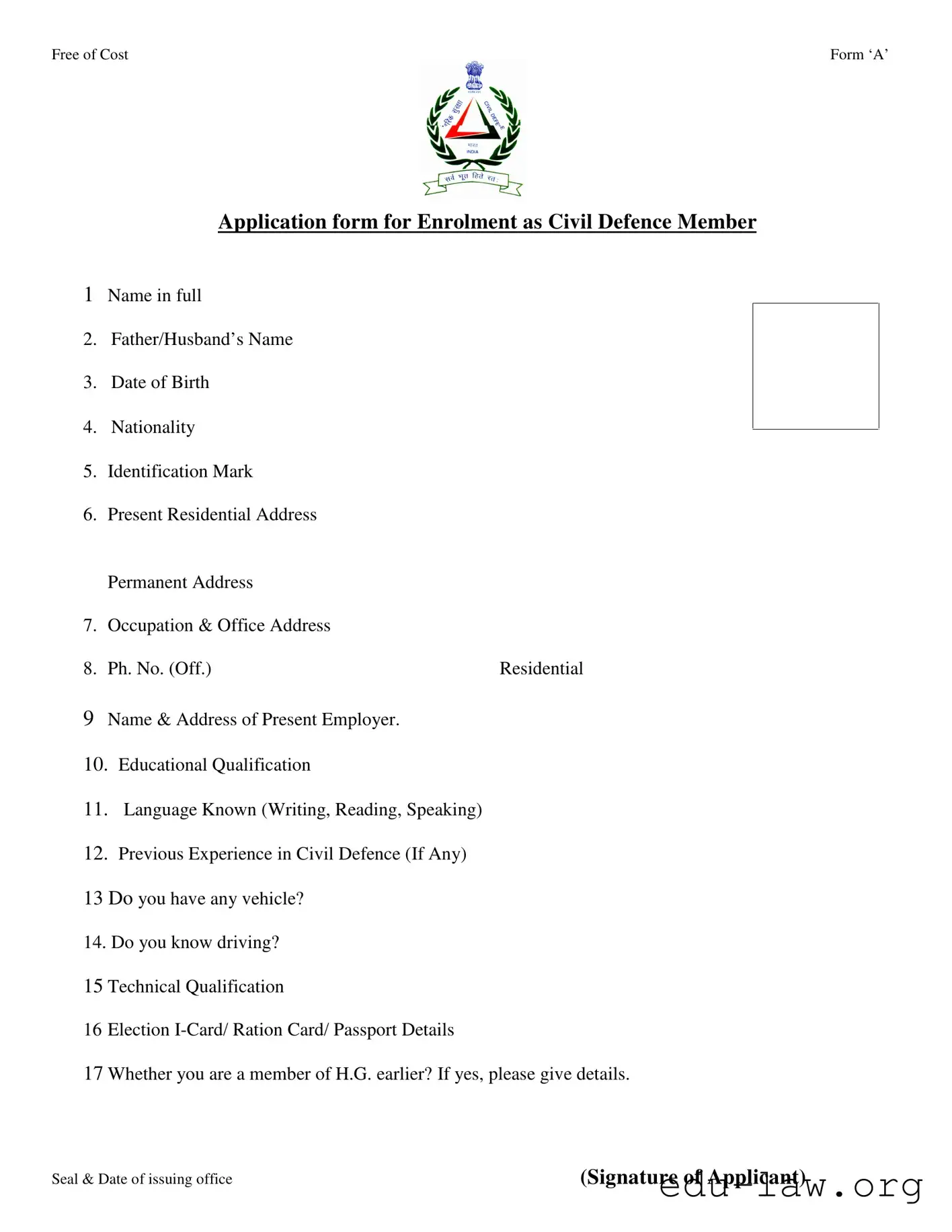
The Civil Defence form is an essential document for individuals looking to enroll as members of the Civil Defence Corps. This form, often referred to as Form ‘A’, gathers a wealth of information to ensure that applicants are well-suited for the responsibilities that come with this vital role. It begins by collecting personal details, such as your full name, father or husband’s name, date of birth, and nationality. You’ll also need to provide identification marks, your residential and permanent addresses, and information about your occupation and current employer. Additionally, the form asks about your educational qualifications and language skills, which can be crucial for effective communication during emergencies. Previous experience in civil defence is another important aspect, as it helps assess your readiness for the tasks ahead. The form doesn’t stop there; it also inquires about your driving skills and whether you own a vehicle, which could be beneficial in emergency situations. Once you’ve filled out the necessary details, a declaration section affirms your commitment to serving the community and following the laws of India. This thorough approach ensures that only those truly dedicated to civil service become part of the Civil Defence Corps, reinforcing the importance of community safety and preparedness.

Free of Cost |
Form ‘A’ |
Application form for Enrolment as Civil Defence Member
1Name in full
2.Father/Husband’s Name
3.Date of Birth
4.Nationality
5.Identification Mark
6.Present Residential Address
Permanent Address
7.Occupation & Office Address
8. Ph. No. (Off.) |
Residential |
9Name & Address of Present Employer.
10.Educational Qualification
11.Language Known (Writing, Reading, Speaking)
12.Previous Experience in Civil Defence (If Any)
13 Do you have any vehicle?
14. Do you know driving?
15 Technical Qualification
16 Election
17 Whether you are a member of H.G. earlier? If yes, please give details.
Seal & Date of issuing office |
(Signature of Applicant) |

Form ‘B’
ISon / Daughter/ Wife ofswear / solemnly affirm that I will be faithful and bear true allegiance to India and to the Constitution of the India as by law established, and that I will loyally carry out duties entrusted to me.
(Signature of Applicant)
Membership Certificate
Govt. of |
CIVIL DEFENCE CORPS |
1.Enrolment No.
2.Full Name
3 Father/Husband’s Name
4 Nationality
5. Date of Birth
6. Identification Mark
7 Permanent Address
8.In which Civil Defence Corps Deployed
9Given Work
10.Name & Add. of the nearest relative
11Signature & Thumb impression of member (Right hand Men/Left hand Women)
Date of Certification |
Signature & Seal of Concerned ICD |
Signature & Seal of Zonal Controller |
Form ‘D’
Service Record
1.Name of Member
2.Enrolment No.
3Date of Enrolment.
|
|
To |
Promoted as |
4 |
Date of Renewel |
To |
Promoted as |
|
|
To |
Promoted as |
|
|
To |
Promoted as |
5 |
First time enrolled as |
|
|
6 |
Date of Promotions |
|
|
with Office Order no.
1
2
3
4
5
6
7Details of Basic Trg. & Adv. Courses
01
2
3
4
5
6
8.Details of Spl. Activities
9Details of certificates issued by the Dte with cash rewards.
10.DG’s Disc/President’s Medal (if any)
Declaration
1 |
I have read the “Civil Defence Regulation 1968”. |
|
|
2 |
As far as I know, I am Physically fit to render efficient service as member of the Corps. |
|
|
3. |
If my application is accepted, I am prepared to services as a whole- time / part- time member of the Corps, i.e. to |
undergo |
|
|
the appropriate training and, in event of an emergency occurring whilst I remain a member of the Corps |
to carry |
out my |
|
obligation as a member thereof. There is no pending case against me in any court. |
|
|
|
|
(Signature of Applicant) |
|
Certificate to be singed by Employer or Sr. Officer |
|
I |
certify that Ishall have no objection to the employee |
attending the training and |
shall release him for duty in an emergency at time and for any period and in any part of the NCT Delhi. |
|
|
Dated |
|
|
Full Address |
|
Employer or Supervisor. |
Note by Director, Civil Defence, Delhi
In requesting the Emergency or the Supervisor Officer, to issue the above certificate the Director desires to point out that emergencies such as those that are referred to in paragraph (I) are not likely to arise very often. Prospecting volunteers should therefore, not be scared away nor should their employees or Supervisor Officer hesitate to issue the above certificate for this reason. The training is generally arranged outside office houres.
Certificate of character signed by two respectable persons e.g. Gazetted Officer’s/Municipal Commissioner/ Councilor/ Division Warden/ Dy. D. Warden/ Post Warden Appointed under the CD Warden Services, who have known you personally for at least three years should be written space below:-
1. |
(Signature of person |
who gives the certificate) |
|
|
Telephone No. |
2. |
(Signature of person |
who gives the certificate) |
|
|
Telephone No. |
If you are a Government servant or an employee in a local authority, a firm or any other office, you should send this form through your Superior Officer with his certificate that he is no objection to your attending the training and that he will release you for duty in any emergency or any time and for any period and in any part of NCT Delhi.

|
DIRECTORATE GENERAL OF HOME GUARDS & CIVIL DEFENCE |
|
|
Nishkam Sewa Bhawan, CTI Complex, Raja Garden, New |
Form ‘C’ |
|
Membership Certificate |
|
Government of |
CIVIL DEFENCE CORPS |
|
1- Enrollment No.
2.Full Name
3 Father’s/Husband’s Name
4.Nationality
5 Date of Birth
6 Identification Mark
7 Permanent Address
8 Name of Civil Defence Corps In which Deployed
9Assignment
10Name & Add. of next of kin
11Signature & Thumb impression of worker (Right hand Men/Left hand Women)
Date of Certification |
Signature & Office stamp of ICD |
Signature & Seal of Zonal Controller |
| Fact Name | Details |
|---|---|
| Form Type | Free of Cost Form ‘A’ for Enrolment as Civil Defence Member |
| Governing Law | Civil Defence Regulation 1968 |
| Personal Information Required | Full name, father's/husband's name, date of birth, nationality, and identification mark |
| Contact Information | Present and permanent residential addresses, occupation, and phone numbers |
| Educational Background | Details of educational qualifications and languages known (writing, reading, speaking) |
| Previous Experience | Information on any previous experience in Civil Defence |
| Membership Certification | Includes enrolment number, signature, and thumb impression of the member |
| Employer's Certification | Employer must certify no objection to training and release for emergency duties |
Filling out the Civil Defence form is a straightforward process. It requires personal information, details about your background, and your commitment to serving in civil defence. After completing the form, it will be submitted for processing, and you will receive further instructions regarding your enrolment.
What is the purpose of the Civil Defence form?
The Civil Defence form serves as an application for individuals who wish to enroll as members of the Civil Defence Corps. This initiative aims to engage citizens in emergency preparedness and response efforts. By completing this form, applicants provide essential personal information, including their qualifications and previous experience, which helps in assessing their suitability for various roles within the organization. Ultimately, this form is a crucial step for those who want to contribute to community safety and resilience during emergencies.
What information is required on the Civil Defence form?
The form requires a range of personal details. Applicants must provide their full name, father or husband’s name, date of birth, nationality, and identification marks. Additionally, they need to include their current and permanent residential addresses, occupation, and contact numbers. Educational qualifications, language proficiencies, and any previous experience in Civil Defence are also requested. Furthermore, applicants should indicate whether they possess a vehicle or know how to drive. This comprehensive collection of information ensures that the Civil Defence Corps can effectively evaluate each applicant's capabilities and background.
Is there a cost associated with submitting the Civil Defence form?
No, the Civil Defence form is free of cost. This accessibility encourages more individuals to participate in civil defence efforts without the barrier of financial constraints. The intention behind offering the form at no charge is to promote community involvement and ensure that anyone interested in serving their community can do so without worrying about fees or expenses.
What happens after I submit the Civil Defence form?
After submitting the Civil Defence form, your application will be reviewed by the relevant authorities. If your application is accepted, you will receive a membership certificate and further instructions regarding training and duties. It is essential to be prepared for potential training sessions, which may be scheduled outside of regular working hours. In case of emergencies, members are expected to be available for duty, so readiness is key. Regular communication from the Civil Defence Corps will keep you informed about your status and upcoming opportunities.
Can I apply for the Civil Defence membership if I have a pending legal case?
Incomplete Information: Many applicants fail to provide all required details. Each section of the form must be filled out completely. Missing information can lead to delays or rejection of the application.
Incorrect Identification: Providing inaccurate identification marks or personal details can create confusion. Ensure that all information matches official documents to avoid discrepancies.
Signature Issues: Some applicants forget to sign the form or use an inconsistent signature. A signature is essential for verification, so it must be clear and consistent with other documents.
Failure to Include Supporting Documents: Applicants often neglect to attach necessary certificates or identification proofs. Double-check the requirements and ensure all supporting documents are included.
Ignoring Employer Certification: If you are employed, not obtaining the required certification from your employer can hinder your application. This certification is crucial for verifying your availability for training and duties.
When enrolling as a Civil Defence member, several other forms and documents may be required to complete the process. Each of these documents plays a crucial role in ensuring that your application is processed smoothly and effectively. Below is a list of commonly used forms and documents that accompany the Civil Defence form.
Gathering these documents can seem daunting, but each one is essential for your application. Make sure to review each requirement carefully to avoid any delays in your enrolment process. Taking action now will help ensure that you are ready to serve when needed.
The Civil Defence form shares similarities with the Employment Application form. Both documents require personal information, including the applicant's full name, contact details, and previous experience. Just as the Employment Application seeks to assess a candidate's qualifications and background for a job, the Civil Defence form evaluates an individual's readiness to serve in a civil capacity. Both forms emphasize the importance of accurate information to ensure proper vetting and selection.
Another comparable document is the Volunteer Registration form. Like the Civil Defence form, this document collects personal details, including name, address, and contact information. Volunteer Registration forms often ask about previous volunteer experiences and skills, paralleling the Civil Defence form's inquiry into prior experience in civil defence activities. Both forms serve to identify individuals willing to contribute to community service.
The Membership Application form for professional organizations also resembles the Civil Defence form. It typically requires personal identification, educational background, and professional experience. Similar to the Civil Defence form, the Membership Application assesses an individual's qualifications for membership in a specific organization, ensuring that applicants meet the necessary criteria to participate effectively.
The Background Check Authorization form aligns closely with the Civil Defence form as well. Both documents necessitate personal information for verification purposes. The Background Check Authorization form seeks consent to conduct a background check, while the Civil Defence form gathers information to evaluate an applicant's suitability for service. Both emphasize the need for thorough vetting to ensure safety and reliability.
The Incident Report form is another document that shares commonalities with the Civil Defence form. While the Civil Defence form focuses on enrollment and qualifications, the Incident Report collects data about specific events and actions taken. Both documents are crucial for maintaining records and ensuring accountability within their respective frameworks, highlighting the importance of accurate documentation in emergency services.
Additionally, the Medical History form bears similarities to the Civil Defence form. Both require detailed personal information, including contact details and health-related inquiries. The Medical History form assesses an individual's fitness for a specific role, much like how the Civil Defence form evaluates an applicant's physical readiness to serve in emergencies. Both forms aim to ensure that individuals are capable of fulfilling their responsibilities.
The Training Registration form also reflects characteristics of the Civil Defence form. Each document gathers personal information and details about the individual's background. The Training Registration form focuses on enrolling participants in training programs, while the Civil Defence form seeks to prepare individuals for service. Both emphasize the importance of training and preparedness in their respective contexts.
The Release of Liability form is another document that shares similarities with the Civil Defence form. While the Civil Defence form collects personal information for enrollment, the Release of Liability form requires individuals to acknowledge potential risks associated with their participation. Both forms serve to protect organizations by ensuring that participants understand their responsibilities and any associated risks.
Finally, the Certification of Good Character form has parallels with the Civil Defence form. Both documents require endorsements from reputable individuals who can vouch for the applicant's character. The Certification of Good Character form focuses on verifying an individual's integrity, while the Civil Defence form uses similar endorsements to ensure that applicants are trustworthy and suitable for service in civil defence roles.
When filling out the Civil Defence form, it is essential to follow specific guidelines to ensure accuracy and completeness. Here are seven things to do and avoid:
Following these guidelines will help streamline your application process and increase the chances of acceptance into the Civil Defence Corps.
This is incorrect. The form is open to all individuals, regardless of their previous experience. Training will be provided to new members.
The form is free of cost, allowing anyone interested to apply without financial barriers.
Submission of the form does not guarantee acceptance. Each application undergoes a review process before approval.
While the Corps responds to emergencies, it also conducts regular training and community preparedness activities.
While physical fitness is important for service, the form allows individuals to self-assess their fitness level. Training can help improve fitness.
Having a vehicle is not a requirement. Members can serve effectively without personal transportation.
The form requests basic information and does not require excessive documentation. Most information is straightforward and easy to provide.
The Corps is open to all genders. Both men and women can serve and contribute equally.
There are no strict educational requirements. The form asks for educational qualifications but does not restrict applicants based on them.
The Corps operates under the Directorate General of Home Guards and Civil Defence, making it a legitimate and recognized entity.
When filling out and using the Civil Defence form, there are several important points to keep in mind. Understanding these key takeaways can help ensure a smooth application process.
By keeping these takeaways in mind, you can better prepare for the application process and your potential role in Civil Defence.