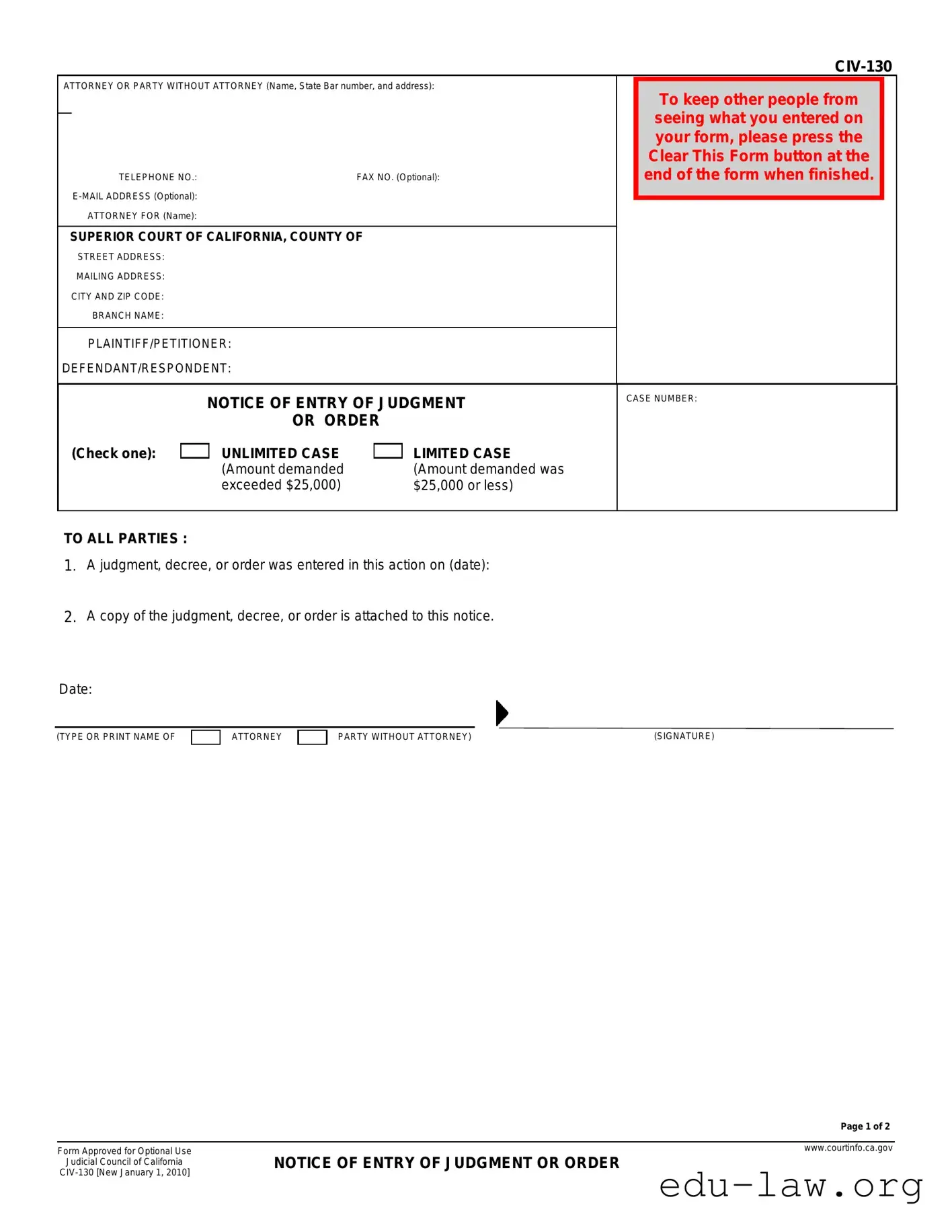
The Civ 130 form is a crucial document used in the California legal system, specifically designed for notifying parties of a judgment or order entered in a civil case. This form serves multiple purposes, including providing essential details about the case, such as the case number, the names of the plaintiff and defendant, and the type of judgment or order issued. It differentiates between unlimited and limited cases based on the amount in controversy, ensuring clarity for all parties involved. The form also requires the signature of the attorney or party without an attorney, affirming the authenticity of the notice. Additionally, it includes a section for proof of service, which must be completed by someone who is not a party to the action, thereby maintaining the integrity of the notification process. This aspect is vital, as it ensures that all parties receive proper notice in compliance with legal standards. Understanding the Civ 130 form is essential for anyone navigating the California court system, as it plays a significant role in the enforcement of judgments and orders.
ATTORNEY OR PARTY WITHOUT ATTORNEY (Name, State Bar number, and address):
TELEPHONE NO.: |
FAX NO. (Optional): |
|
|
ATTORNEY FOR (Name): |
|
SUPERIOR COURT OF CALIFORNIA, COUNTY OF
STREET ADDRESS:
MAILING ADDRESS:
CITY AND ZIP CODE:
BRANCH NAME:
PLAINTIFF/PETITIONER:
DEFENDANT/RESPONDENT:
FOR COURT USE ONLY
To keep other people from seeing what you entered on your form, please press the Clear This Form button at the end of the form when finished.
(Check one):
NOTICE OF ENTRY OF JUDGMENT
OR ORDER
UNLIMITED CASE |
|
LIMITED CASE |
(Amount demanded |
|
(Amount demanded was |
exceeded $25,000) |
|
$25,000 or less) |
CASE NUMBER:
TO ALL PARTIES :
1. A judgment, decree, or order was entered in this action on (date):
2.A copy of the judgment, decree, or order is attached to this notice.
Date:
(TYPE OR PRINT NAME OF
ATTORNEY
PARTY WITHOUT ATTORNEY) |
(SIGNATURE) |
|
Page 1 of 2 |
|
|
Form Approved for Optional Use |
www.courtinfo.ca.gov |
Judicial Council of California |
NOTICE OF ENTRY OF JUDGMENT OR ORDER |
|
PLAINTIFF/PETITIONER:
DEFENDANT/RESPONDENT:
PROOF OF SERVICE BY
NOTICE OF ENTRY OF JUDGMENT OR ORDER
CASE NUMBER:
(NOTE: You cannot serve the Notice of Entry of Judgment or Order if you are a party in the action. The person who served the notice must complete this proof of service.)
1.I am at least 18 years old and not a party to this action. I am a resident of or employed in the county where the mailing took place, and my residence or business address is (specify):
2.I served a copy of the Notice of Entry of Judgment or Order by enclosing it in a sealed envelope with postage fully prepaid and (check one):
a.
b.
deposited the sealed envelope with the United States Postal Service.
placed the sealed envelope for collection and processing for mailing, following this business's usual practices, with which I am readily familiar. On the same day correspondence is placed for collection and mailing, it is deposited in the ordinary course of business with the United States Postal Service.
3.The Notice of Entry of Judgment or Order was mailed:
a.on (date):
b.from (city and state):
4.The envelope was addressed and mailed as follows:
a.Name of person served:
Street address: City:
State and zip code:
b.Name of person served:
Street address: City:
State and zip code:
c.Name of person served:
Street address: City:
State and zip code:
d.Name of person served:
Street address: City:
State and zip code:
Names and addresses of additional persons served are attached. (You may use form
5. Number of pages attached ______.
I declare under penalty of perjury under the laws of the State of California that the foregoing is true and correct.
Date:
(TYPE OR PRINT NAME OF DECLARANT) |
(SIGNATURE OF DECLARANT) |
Page 2 of 2
NOTICE OF ENTRY OF JUDGMENT OR ORDER |
|
|
For your protection and privacy, please press the Clear This Form
button after you have printed the form.
Save This Form
Print This Form
Clear This Form
| Fact Name | Details |
|---|---|
| Form Title | CIV-130 Notice of Entry of Judgment or Order |
| Governing Law | California Code of Civil Procedure, Section 664.5 |
| Form Purpose | To notify parties of a judgment or order entered in a case. |
| Form Usage | Used in unlimited and limited civil cases. |
| Filing Date | Approved for optional use as of January 1, 2010. |
| Signature Requirement | Must be signed by the attorney or party without an attorney. |
| Proof of Service | Requires proof of service by first-class mail. |
| Age Requirement | Server must be at least 18 years old and not a party to the action. |
| Mailing Process | Notice must be mailed via the United States Postal Service. |
| Privacy Note | Users should press the Clear This Form button after printing for privacy. |
Completing the CIV-130 form is essential for notifying parties involved in a legal action about the entry of a judgment or order. Follow the steps below to ensure accurate completion of the form.
After completing the form, ensure all information is accurate before submitting it. Remember to press the Clear This Form button for privacy after printing.
What is the Civ 130 form used for?
The Civ 130 form, also known as the Notice of Entry of Judgment or Order, is used to inform all parties involved in a legal action that a judgment, decree, or order has been entered by the court. This ensures that everyone is aware of the court's decision and has the necessary documentation for their records.
Who can fill out the Civ 130 form?
The form can be filled out by an attorney or a party without an attorney. However, it is important to note that if you are a party involved in the action, you cannot serve the notice yourself. Instead, someone who is not a party must complete the proof of service section.
What information do I need to provide on the Civ 130 form?
You will need to provide your name, address, and contact information. Additionally, you must include the case number, the names of the plaintiff and defendant, and the date of the judgment or order. If applicable, attach a copy of the judgment or order to the form.
How do I serve the Civ 130 form?
The form must be served by mailing it to all parties involved in the case. You can do this by enclosing the form in a sealed envelope with postage and mailing it through the United States Postal Service. Ensure that the proof of service section is completed by someone who is not a party to the action.
What is the proof of service section?
The proof of service section confirms that the Civ 130 form was properly mailed to all parties. It requires the person who served the notice to provide their name, address, and details about how and when the notice was mailed. This section must be completed accurately to validate the service.
Is there a deadline for serving the Civ 130 form?
Can I submit the Civ 130 form electronically?
In some jurisdictions, electronic filing may be allowed. However, you should verify with the local court rules to see if electronic submission is permitted for the Civ 130 form. If not, you will need to print and mail the form as required.
What should I do after completing the Civ 130 form?
After completing the form, make sure to review it for accuracy. Then, serve it to all parties involved in the case. Finally, retain a copy for your records, and if applicable, ensure that the proof of service is properly filled out and filed with the court.
What happens if I do not serve the Civ 130 form?
If the Civ 130 form is not served, the parties may not be aware of the judgment or order, which can lead to complications in the case. It is crucial to serve the notice to ensure all parties are informed and to uphold the legal process.
Not providing complete contact information: Ensure you fill in your name, address, and telephone number completely. Missing any of these details can delay processing.
Choosing the wrong case type: Double-check whether your case is unlimited or limited. Selecting the incorrect option could result in your form being rejected.
Forgetting to attach the judgment copy: Always include a copy of the judgment, decree, or order. Omitting this document can lead to complications.
Incorrectly filling out the service details: Make sure to accurately complete the proof of service section. Errors here can invalidate the notice.
Failing to sign the form: Remember to sign the form before submission. A missing signature can result in delays.
Not using the correct mailing method: Ensure you follow the proper procedure for mailing the notice. This includes using a sealed envelope with prepaid postage.
Providing incorrect recipient information: Double-check the names and addresses of all parties served. Incorrect details can cause significant issues.
Neglecting to note the number of pages attached: Always indicate how many pages are included with your submission. This helps keep everything organized.
Not pressing the Clear This Form button: For your privacy, remember to press this button after printing the form. This ensures your information is not stored.
The CIV-130 form, also known as the Notice of Entry of Judgment or Order, is an important document used in California court proceedings. It notifies all parties involved in a case about the entry of a judgment, decree, or order. Along with this form, several other documents may be required to ensure proper communication and compliance with court procedures. Below is a list of common forms and documents that are often used in conjunction with the CIV-130.
Understanding these forms and documents is crucial for anyone involved in a legal proceeding in California. Each serves a specific purpose and helps ensure that the legal process runs smoothly and fairly for all parties involved. Properly completing and filing these documents can significantly impact the outcome of a case.
The CIV-130 form, also known as the Notice of Entry of Judgment or Order, shares similarities with the CIV-120 form, which is the Notice of Default. Both documents serve as official notifications regarding the status of a case. The CIV-120 informs parties that a default has been entered against them, while the CIV-130 notifies them of a judgment or order that has been issued. Each form requires the sender to provide specific details about the case, including the case number and the parties involved, ensuring that all relevant information is clearly communicated to the recipients.
Another document comparable to the CIV-130 is the CIV-140 form, which is the Notice of Ruling. This form is used to inform parties of a ruling made by the court during a hearing. Similar to the CIV-130, the CIV-140 includes essential information such as the date of the ruling and the specific details of what was decided. Both forms are designed to keep all parties informed about the progress and outcomes of the legal proceedings, thereby promoting transparency within the judicial process.
The CIV-150 form, known as the Proof of Service, is also related to the CIV-130. While the CIV-130 serves as a notice of judgment, the CIV-150 confirms that the notice has been properly delivered to the parties involved. This form includes details about how and when the notice was served, ensuring that there is a record of compliance with legal requirements. Both forms are critical in maintaining proper communication and documentation within a case.
Similar to the CIV-130, the CIV-160 form, which is the Notice of Motion, serves as a formal communication tool within the court system. The CIV-160 is used to inform parties about upcoming motions that will be presented in court. Like the CIV-130, it requires the inclusion of the case number and the involved parties' information. Both documents are essential for ensuring that all parties are aware of important developments and can prepare accordingly.
The CIV-170 form, known as the Notice of Appeal, is another document that shares similarities with the CIV-130. This form is used when a party wishes to challenge a court's decision. Like the CIV-130, the CIV-170 must include pertinent case information and is served to all parties involved. Both documents play a significant role in the appeals process and ensure that all parties are informed of their rights and options following a judgment or order.
Additionally, the CIV-180 form, which is the Notice of Settlement, bears resemblance to the CIV-130. This form is utilized to inform all parties that a settlement has been reached in a case. Just like the CIV-130, the CIV-180 provides critical information about the case and the parties involved. Both forms serve to keep everyone updated on the status of the case and facilitate communication among the parties.
Lastly, the CIV-190 form, known as the Notice of Dismissal, is another document that is similar to the CIV-130. This form is used to officially notify parties that a case has been dismissed. Like the CIV-130, the CIV-190 includes essential case details and is served to all parties involved. Both documents are vital for ensuring that all parties are aware of the current status of the case and any potential implications of the court's decisions.
When filling out the Civ 130 form, careful attention to detail is crucial. Here are some important dos and don'ts to keep in mind:
By following these guidelines, you can help ensure that your submission is complete and compliant with court requirements.
Misconceptions about the Civ 130 form can lead to confusion and potential errors in legal processes. Here are eight common misconceptions, along with clarifications to help individuals better understand this important document.
Understanding these misconceptions can help individuals navigate the legal system more effectively. Proper use of the Civ 130 form is essential for ensuring that all parties are informed of judgments and orders in a timely manner.
Filling out and using the CIV-130 form is an essential step in the legal process for notifying parties of a judgment or order. Here are some key takeaways to consider: