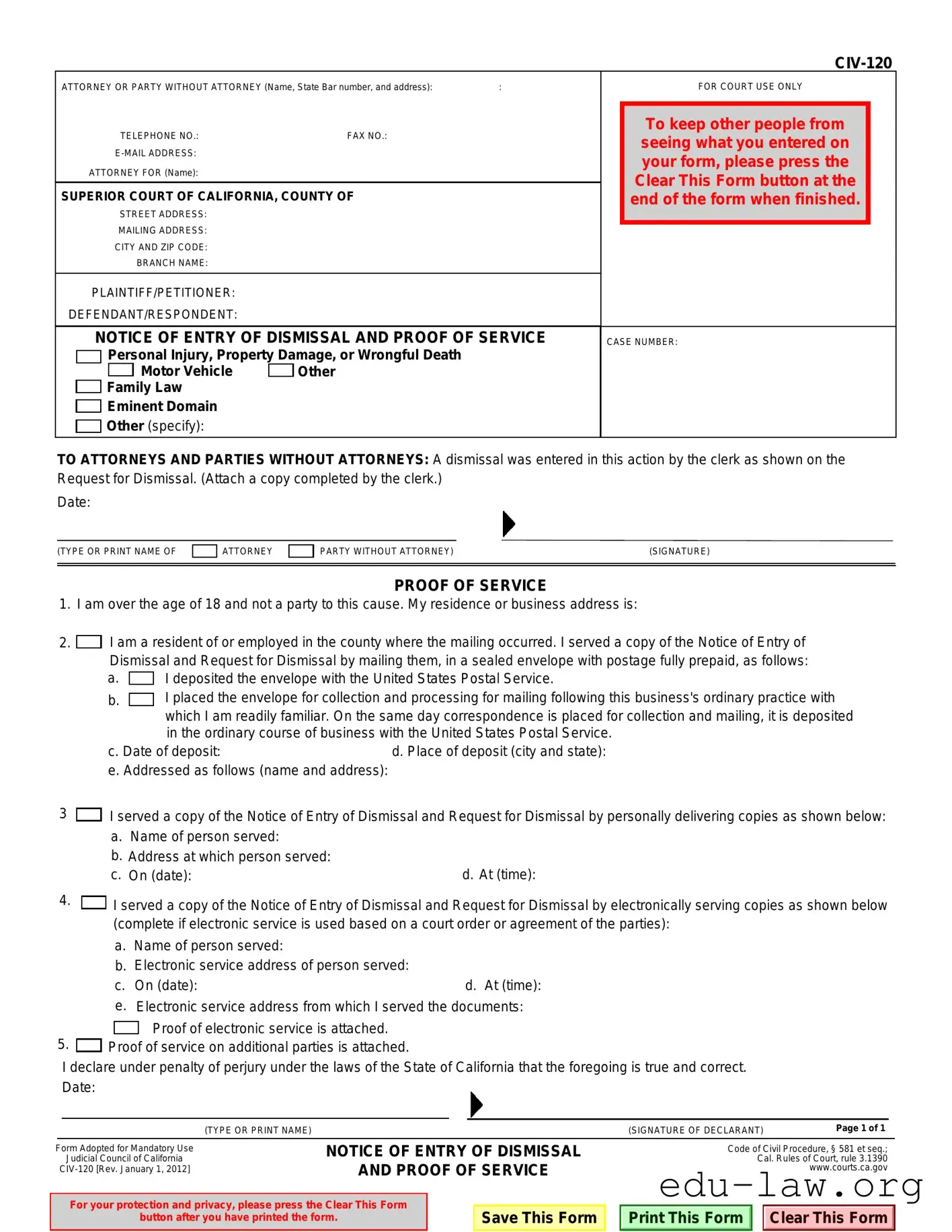
The CIV-120 form plays a crucial role in the California legal system, particularly in matters involving dismissals of civil cases. This form serves as a Notice of Entry of Dismissal and Proof of Service, allowing parties to officially communicate the dismissal of a case to the court and involved parties. It requires essential information such as the names of the parties, case number, and details about the attorney or party submitting the form. The CIV-120 is particularly relevant in various legal contexts, including personal injury, property damage, family law, and wrongful death cases. Completing this form accurately ensures that all parties are informed of the dismissal, which can prevent future disputes. Additionally, the form includes a section for proof of service, confirming how and when the notice was delivered to the involved parties. By understanding the significance of the CIV-120, individuals can navigate the complexities of the legal process more effectively.
ATTORNEY OR PARTY WITHOUT ATTORNEY (Name, State Bar number, and address): |
: |
|
TELEPHONE NO.: |
FAX NO.: |
|
|
|
|
ATTORNEY FOR (Name): |
|
|
SUPERIOR COURT OF CALIFORNIA, COUNTY OF
STREET ADDRESS:
MAILING ADDRESS:
CITY AND ZIP CODE:
BRANCH NAME:
PLAINTIFF/PETITIONER:
DEFENDANT/RESPONDENT:
NOTICE OF ENTRY OF DISMISSAL AND PROOF OF SERVICE
Personal Injury, Property Damage, or Wrongful Death
Motor Vehicle Other
Family Law Eminent Domain
Other (specify):
FOR COURT USE ONLY
To keep other people from seeing what you entered on your form, please press the Clear This Form button at the end of the form when finished.
CASE NUMBER:
TO ATTORNEYS AND PARTIES WITHOUT ATTORNEYS: A dismissal was entered in this action by the clerk as shown on the Request for Dismissal. (Attach a copy completed by the clerk.)
Date:
(TYPE OR PRINT NAME OF
ATTORNEY
PARTY WITHOUT ATTORNEY) |
(SIGNATURE) |
PROOF OF SERVICE
1. I am over the age of 18 and not a party to this cause. My residence or business address is:
2.
I am a resident of or employed in the county where the mailing occurred. I served a copy of the Notice of Entry of Dismissal and Request for Dismissal by mailing them, in a sealed envelope with postage fully prepaid, as follows:
a. I deposited the envelope with the United States Postal Service.
b. I placed the envelope for collection and processing for mailing following this business's ordinary practice with
which I am readily familiar. On the same day correspondence is placed for collection and mailing, it is deposited in the ordinary course of business with the United States Postal Service.
c. Date of deposit:d. Place of deposit (city and state): e. Addressed as follows (name and address):
3 I served a copy of the Notice of Entry of Dismissal and Request for Dismissal by personally delivering copies as shown below:
a.Name of person served:
b.Address at which person served:
c. On (date): |
d. At (time): |
4. I served a copy of the Notice of Entry of Dismissal and Request for Dismissal by electronically serving copies as shown below (complete if electronic service is used based on a court order or agreement of the parties):
a.Name of person served:
b.Electronic service address of person served:
|
|
|
|
|
|
c. On (date): |
|
|
d. At (time): |
|
|
|
|
|||
|
|
|
|
|
|
e. Electronic service address from which I served the documents: |
|
|
|
|
||||||
5. |
|
|
|
|
Proof of electronic service is attached. |
|
|
|
|
|
|
|
||||
|
|
|
|
|
|
|
|
|
|
|
||||||
|
|
Proof of service on additional parties is attached. |
|
|
|
|
|
|
|
|||||||
|
|
|
|
|
|
|
|
|
||||||||
|
|
|
|
|
|
|
|
|
||||||||
|
|
I declare under penalty of perjury under the laws of the State of California that the foregoing is true and correct. |
|
|||||||||||||
|
|
Date: |
|
|
|
|
|
|
|
|
|
|||||
|
|
|
|
|
|
|
|
|
|
|
|
|
|
|
|
|
|
|
|
|
|
|
|
|
(TYPE OR PRINT NAME) |
|
|
|
|
(SIGNATURE OF DECLARANT) |
Page 1 of 1 |
||
|
|
Judicial Council of California |
NOTICE OF ENTRY OF DISMISSAL |
|
|
Cal. Rules of Court, rule 3.1390 |
||||||||||
Form Adopted for Mandatory Use |
|
|
|
|
|
|
Code of Civil Procedure, § 581 et seq.; |
|||||||||
|
AND PROOF OF SERVICE |
|
|
|
www.courts.ca.gov |
|||||||||||
|
|
|
|
|
|
|
|
|
|
|
|
|||||
|
|
|
For your protection and privacy, please press the Clear This Form |
|
|
|
|
|
|
|
|
|||||
|
|
|
|
|
|
|
button after you have printed the form. |
|
|
|
Save This Form |
|
Print This Form |
|
Clear This Form |
|
|
|
|
|
|
|
|
|
|
|
|
|
|
|
|
|
|
| Fact Name | Description |
|---|---|
| Form Purpose | The CIV-120 form serves as a Notice of Entry of Dismissal and Proof of Service in California courts. |
| Governing Law | This form is governed by the California Code of Civil Procedure, specifically sections 581 and following. |
| Mandatory Use | The Judicial Council of California has adopted this form for mandatory use in relevant cases. |
| Filing Requirements | Parties must complete the form and submit it to the court to officially document the dismissal of a case. |
| Proof of Service | The form requires a declaration of service, detailing how the Notice of Entry of Dismissal was served to the involved parties. |
| Age Requirement | The person serving the notice must be over 18 years old and not a party to the case. |
| Service Methods | Service can be accomplished through mail, personal delivery, or electronic service, depending on the circumstances. |
| Signature Requirement | The form must be signed by the person who completed the service, affirming the truth of the information provided. |
| Privacy Considerations | To protect privacy, users are advised to clear the form after printing it to prevent unauthorized access to personal information. |
| Form Revision Date | The current version of the CIV-120 form was revised on January 1, 2012. |
Filling out the Civ 120 form is a straightforward process that ensures all necessary information is accurately provided. By following these steps, you can complete the form efficiently and correctly. Make sure to have all relevant details handy before you begin.
Once you have completed the form, double-check all entries for accuracy. After reviewing, you may want to print the form. For your privacy, remember to press the Clear This Form button when you finish.
What is the purpose of the CIV-120 form?
The CIV-120 form, also known as the Notice of Entry of Dismissal and Proof of Service, is used in California courts to officially document the dismissal of a legal action. This form serves two primary purposes: it provides notice to all parties involved in the case that the action has been dismissed, and it verifies that the notice has been properly served to all relevant parties. It is particularly important in cases involving personal injury, property damage, or family law, among others.
Who needs to fill out the CIV-120 form?
How do I serve the CIV-120 form to other parties?
What should I do after completing the CIV-120 form?
Filling out the CIV-120 form can seem straightforward, but many people make common mistakes that can lead to delays or complications in their legal processes. Here are six frequent errors to avoid:
Many individuals forget to fill in essential details, such as the case number or the names of the parties involved. This omission can halt the processing of your form.
Some people neglect to sign the form or sign in the wrong place. Ensure that the signature is placed where indicated and matches the printed name.
When documenting how the Notice of Entry of Dismissal was served, inaccuracies can arise. Be precise about the method of service and provide correct addresses and dates.
Failing to include the completed Request for Dismissal can lead to a rejection of your form. Always double-check that all necessary attachments are included.
To protect your privacy, many overlook the importance of pressing the "Clear This Form" button after printing. This step is crucial to ensure that sensitive information is not stored on the device.
Some individuals forget to attach proof of service for additional parties. This documentation is vital to demonstrate that all parties received the necessary notices.
By being aware of these common mistakes, you can ensure that your CIV-120 form is completed accurately and efficiently, helping to facilitate a smoother legal process.
The CIV-120 form, known as the Notice of Entry of Dismissal and Proof of Service, is often accompanied by various other forms and documents in legal proceedings. These documents serve specific purposes that facilitate the dismissal process and ensure compliance with legal requirements. Below is a list of commonly used forms alongside the CIV-120.
Understanding these accompanying forms is crucial for anyone involved in a legal dismissal process. Each document plays a significant role in ensuring that all procedural requirements are met and that parties are properly informed throughout the legal proceedings.
The CIV-130 form, known as the Request for Dismissal, is similar to the CIV-120 form in that both are used in the process of dismissing a case. While the CIV-120 serves as a notice of entry of dismissal, the CIV-130 is the formal request made by a party to dismiss their case. Both forms require information about the case, including the names of the parties involved and the case number. Additionally, both documents involve a proof of service section, ensuring that all parties are informed of the dismissal proceedings.
The CIV-140 form, or Notice of Settlement, shares similarities with the CIV-120 in that it communicates important developments in a case. The CIV-140 is filed when parties reach a settlement agreement, indicating that the case will not proceed to trial. Like the CIV-120, it requires details about the parties and the case number. Both forms also emphasize the importance of notifying all involved parties, which is a critical step in maintaining transparency throughout the legal process.
The CIV-150 form, titled Notice of Motion, is another document that aligns with the CIV-120 in its procedural function. The CIV-150 is used to inform parties of a motion being filed in court, similar to how the CIV-120 informs them of a dismissal. Both forms require clear identification of the parties and the case number. They also serve to provide proof of service, ensuring that all parties are kept in the loop regarding significant changes or actions in the case.
Lastly, the CIV-160 form, known as the Substitution of Attorney, is comparable to the CIV-120 in that it facilitates a transition within the legal representation of a party. The CIV-160 is used when a party wishes to change their attorney, while the CIV-120 is used to notify parties of a case dismissal. Both forms include essential information about the case and require signatures to validate the changes. Furthermore, both documents help maintain clear communication among all parties involved in the legal proceedings.
When filling out the CIV-120 form, it is crucial to ensure accuracy and completeness. Here are some guidelines to follow:
Following these guidelines will help ensure that your submission is processed smoothly and efficiently.
Understanding the CIV-120 form is crucial for anyone involved in legal proceedings. However, several misconceptions surround this document. Below are five common misunderstandings, along with clarifications to help demystify the CIV-120 form.
By addressing these misconceptions, individuals can navigate the legal landscape more effectively and ensure they meet all requirements associated with the CIV-120 form.
Filling out and using the Civ 120 form can be straightforward if you follow these key points:
By keeping these points in mind, you can effectively use the Civ 120 form in your legal matters.