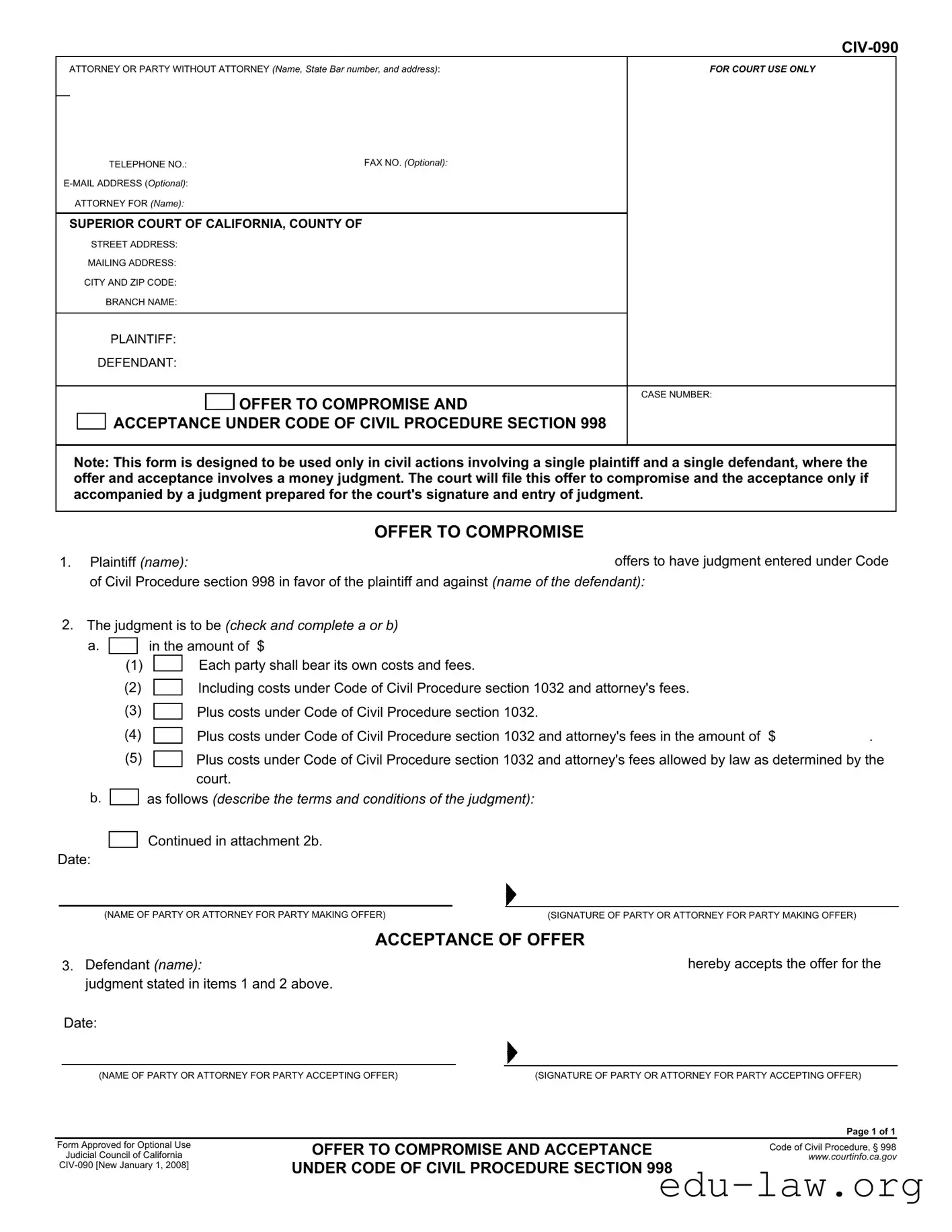
The CIV-090 form plays a crucial role in the resolution of civil cases in California, specifically those involving a single plaintiff and a single defendant. This form facilitates an offer to compromise and acceptance under Section 998 of the Code of Civil Procedure. It is essential for parties looking to settle their disputes without going to trial. The form requires basic information, such as the names and contact details of the parties involved, including their attorneys, if applicable. It outlines the terms of the offer, including the proposed judgment amount and any associated costs or attorney's fees. The acceptance section of the form allows the defendant to agree to the terms set forth by the plaintiff. For the court to process this offer and acceptance, it must be accompanied by a prepared judgment for the court's signature. This form is designed to streamline the settlement process, providing a clear framework for both parties to agree on the terms of their resolution.
ATTORNEY OR PARTY WITHOUT ATTORNEY (Name, State Bar number, and address): |
FOR COURT USE ONLY |
TELEPHONE NO.: |
FAX NO. (Optional): |
|
|
ATTORNEY FOR (Name): |
|
SUPERIOR COURT OF CALIFORNIA, COUNTY OF
STREET ADDRESS:
MAILING ADDRESS:
CITY AND ZIP CODE:
BRANCH NAME:
PLAINTIFF:
DEFENDANT:
CASE NUMBER:
OFFER TO COMPROMISE AND
ACCEPTANCE UNDER CODE OF CIVIL PROCEDURE SECTION 998
Note: This form is designed to be used only in civil actions involving a single plaintiff and a single defendant, where the offer and acceptance involves a money judgment. The court will file this offer to compromise and the acceptance only if accompanied by a judgment prepared for the court's signature and entry of judgment.
|
OFFER TO COMPROMISE |
1. Plaintiff (name): |
offers to have judgment entered under Code |
of Civil Procedure section 998 in favor of the plaintiff and against (name of the defendant):
2.The judgment is to be (check and complete a or b)
a. |
|
|
in the amount of $ |
||
(1) |
|
|
Each party shall bear its own costs and fees. |
||
|
|
||||
b.
Date:
(2) |
|
Including costs under Code of Civil Procedure section 1032 and attorney's fees. |
|
(3) |
|
Plus costs under Code of Civil Procedure section 1032. |
|
|
|
||
(4) |
|
Plus costs under Code of Civil Procedure section 1032 and attorney's fees in the amount of $ |
. |
|
|||
(5) |
|
Plus costs under Code of Civil Procedure section 1032 and attorney's fees allowed by law as determined by the |
|
|
|||
court.
as follows (describe the terms and conditions of the judgment):
Continued in attachment 2b.
(NAME OF PARTY OR ATTORNEY FOR PARTY MAKING OFFER)(SIGNATURE OF PARTY OR ATTORNEY FOR PARTY MAKING OFFER)
ACCEPTANCE OF OFFER
|
3. Defendant (name): |
|
hereby accepts the offer for the |
|
judgment stated in items 1 and 2 above. |
|
|
|
Date: |
|
|
|
|
|
|
|
(NAME OF PARTY OR ATTORNEY FOR PARTY ACCEPTING OFFER) |
|
(SIGNATURE OF PARTY OR ATTORNEY FOR PARTY ACCEPTING OFFER) |
|
|
|
Page 1 of 1 |
Form Approved for Optional Use
Judicial Council of California
OFFER TO COMPROMISE AND ACCEPTANCE
UNDER CODE OF CIVIL PROCEDURE SECTION 998
Code of Civil Procedure, § 998
www.courtinfo.ca.gov
| Fact Name | Details |
|---|---|
| Form Title | CIV-090: Offer to Compromise and Acceptance Under Code of Civil Procedure Section 998 |
| Usage | This form is specifically for civil actions involving one plaintiff and one defendant. |
| Governing Law | California Code of Civil Procedure, Section 998 |
| Purpose | It facilitates a formal offer to settle a case before trial, allowing for a judgment to be entered. |
| Cost Responsibilities | Each party may bear its own costs and fees unless otherwise specified in the offer. |
| Judgment Details | The form allows for the specification of the amount of the judgment and any associated costs or fees. |
| Acceptance Requirement | The acceptance must be signed by the defendant to be valid. |
| Attachments | Additional terms and conditions can be described in an attachment. |
| Form Approval | This form is approved for optional use by the Judicial Council of California. |
After gathering the necessary information, filling out the CIV-090 form requires careful attention to detail. This form is essential for parties involved in civil actions who wish to formalize an offer to compromise and its acceptance. Below are the steps to complete the form accurately.
What is the purpose of the CIV 090 form?
The CIV 090 form is used in civil cases involving one plaintiff and one defendant. It allows the plaintiff to make a formal offer to settle the case for a specific amount of money. If the defendant accepts this offer, it can lead to a judgment in favor of the plaintiff. This process is governed by California's Code of Civil Procedure Section 998, which encourages settlements to avoid lengthy court battles.
Who should use the CIV 090 form?
This form should be used by parties involved in civil litigation where there is a single plaintiff and a single defendant. It is specifically designed for cases that involve a monetary judgment. Both the plaintiff and the defendant can fill out this form to formalize their offer and acceptance, making it easier to resolve disputes without going to trial.
What information is required on the CIV 090 form?
The form requires basic information about the parties involved, including names, addresses, and contact details. It also needs the case number and specific details about the judgment being offered, such as the amount and any costs or attorney's fees involved. Clear terms and conditions of the judgment should also be described. If necessary, additional information can be included in an attachment.
What happens after the CIV 090 form is submitted?
Once the form is completed and signed by both parties, it must be submitted to the court. The court will only file the offer and acceptance if it is accompanied by a prepared judgment for the court's signature. If everything is in order, the court will enter the judgment, finalizing the agreement between the parties. This can help both sides avoid further litigation and reach a resolution quickly.
Incorrectly Identifying the Parties: One common mistake is failing to accurately fill in the names of the plaintiff and defendant. Ensure that the names match exactly with the case information.
Missing Signatures: Both parties must sign the form. Omitting a signature can lead to delays or rejection of the offer.
Inaccurate Amounts: When specifying the judgment amount, ensure that the figures are correct. Double-check calculations to avoid errors.
Neglecting to Include Costs and Fees: Failing to indicate whether costs and attorney’s fees are included can create confusion. Clearly state if these are part of the offer.
Ignoring Attachments: If additional terms or conditions are necessary, they must be detailed in an attachment. Not including this can invalidate the offer.
The CIV-090 form is an important document used in civil actions to formalize an offer to compromise and its acceptance. Alongside this form, several other documents are often utilized to ensure the process is thorough and legally binding. Below are four commonly used forms and documents that complement the CIV-090.
Using these documents in conjunction with the CIV-090 form helps to create a clear, enforceable agreement between the parties involved. Proper preparation and submission of all related forms can significantly impact the outcome of the case.
The Civ 090 form is similar to the Offer to Compromise form, often used in various legal contexts. This document allows one party to propose a settlement to another party, which can help avoid lengthy litigation. Like the Civ 090, it typically includes details about the parties involved, the terms of the offer, and a section for acceptance. Both forms aim to facilitate resolution before trial, promoting efficiency in the legal process.
Another comparable document is the Settlement Agreement. This formal contract outlines the terms agreed upon by parties to resolve a dispute. Similar to the Civ 090, it includes the parties' names, the specifics of the settlement, and signatures. While the Civ 090 focuses on a specific offer and acceptance under a statute, a Settlement Agreement may cover broader terms and conditions, often including non-monetary elements.
The Demand for Settlement is also akin to the Civ 090 form. This document is used by one party to formally request a settlement from another party. Like the Civ 090, it specifies the amount sought and may include the rationale for the demand. Both documents serve to initiate negotiations and can lead to a resolution without court intervention.
Similar in purpose, the Release of Claims form is another document that parallels the Civ 090. This form is used when one party agrees to relinquish their right to pursue further legal action in exchange for a settlement. The Civ 090 facilitates the initial offer and acceptance, while the Release of Claims formalizes the conclusion of the dispute, ensuring both parties are clear on their rights moving forward.
The Notice of Settlement is another related document. It serves to inform the court and other parties that a settlement has been reached, often following the acceptance of an offer like that in the Civ 090. This document helps streamline court processes by notifying all parties involved of the resolution, similar to how the Civ 090 facilitates the acceptance of a compromise.
The Stipulation for Entry of Judgment is also similar to the Civ 090 form. This document allows parties to agree on the terms of a judgment without the need for a trial. It includes the same essential elements, such as the parties’ names and the agreed-upon terms. Both documents are designed to expedite the legal process and provide a clear resolution to disputes.
Another document that shares similarities is the Joint Stipulation for Settlement. This document is created when both parties agree on the terms of a settlement and is signed by both sides. Like the Civ 090, it outlines the specifics of the agreement and provides a clear record of the terms accepted by both parties, ensuring mutual understanding and compliance.
The Acceptance of Offer form also parallels the Civ 090. This document is specifically used to acknowledge acceptance of a settlement offer. While the Civ 090 includes both the offer and acceptance in one form, the Acceptance of Offer form serves as a standalone document to confirm that one party agrees to the terms proposed by another, streamlining the acceptance process.
The Mediation Agreement is another document that resembles the Civ 090 form. This agreement outlines the terms reached during mediation sessions, similar to how the Civ 090 captures an offer and acceptance. Both documents aim to resolve disputes amicably and can significantly reduce the time and costs associated with litigation.
Lastly, the Arbitration Award is akin to the Civ 090 in that it represents a resolution to a dispute. While the Civ 090 facilitates a settlement between parties, an Arbitration Award is the final decision made by an arbitrator after reviewing the case. Both documents signify the end of a dispute, though they arise from different processes within the legal framework.
When filling out the CIV-090 form, there are important guidelines to follow. Here’s a list of things you should and shouldn't do to ensure your submission is correct and complete.
By following these guidelines, you can help ensure that your CIV-090 form is processed smoothly. Attention to detail will serve you well in this process.
Understanding the Civ 090 form can be challenging due to common misconceptions. Here are eight prevalent misunderstandings regarding this form:
Clarifying these misconceptions can help parties navigate the complexities of civil actions more effectively.
When dealing with the CIV-090 form, which is used for making and accepting offers to compromise in civil cases, there are several important points to keep in mind. Here are six key takeaways:
By understanding these key aspects, individuals can navigate the process of using the CIV-090 form more effectively. Properly completing this form can lead to a smoother resolution of civil disputes.