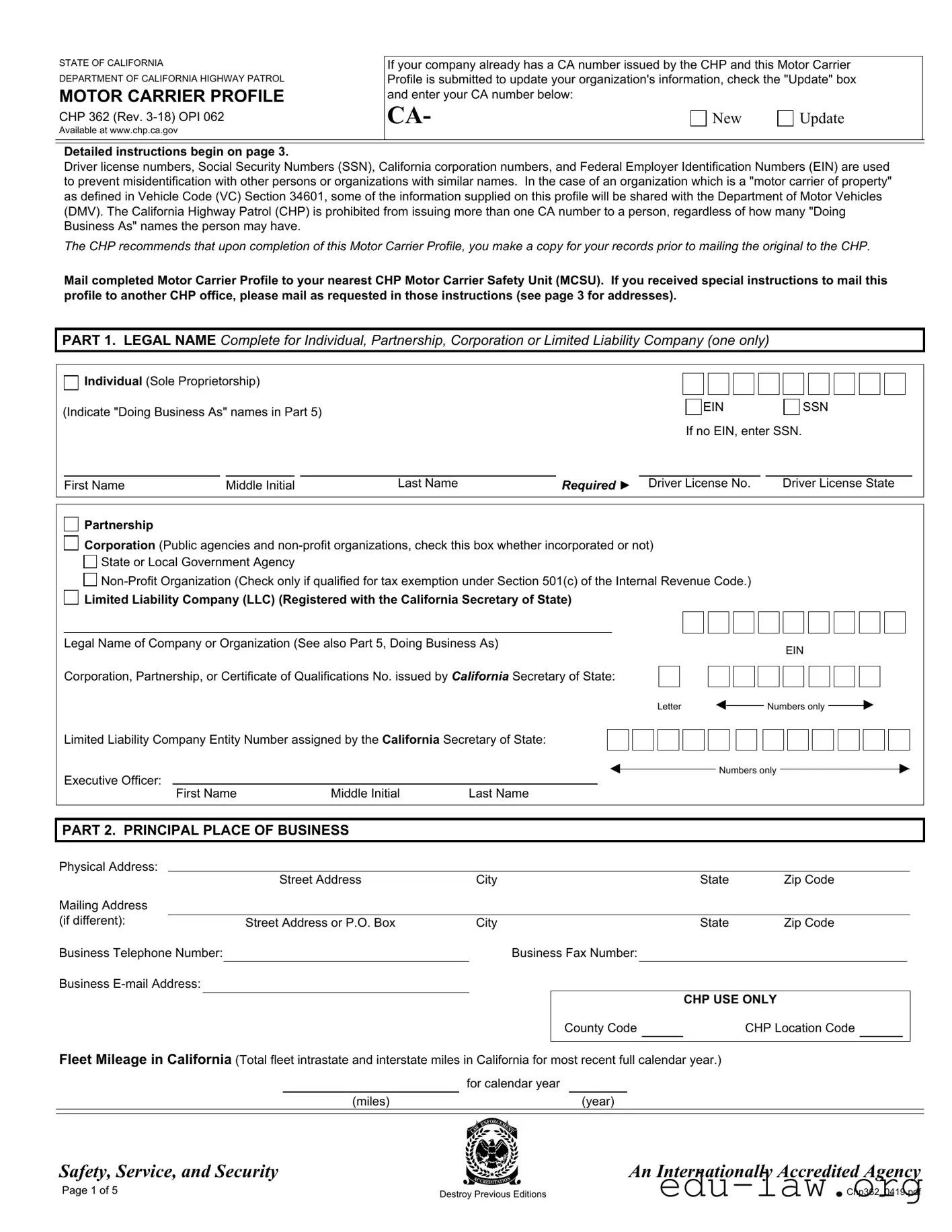
The CHP 362 form, known as the Motor Carrier Profile, plays a vital role in the regulation and safety of commercial motor vehicles in California. This form is essential for organizations operating as motor carriers, whether they transport goods or passengers. It allows the California Highway Patrol (CHP) to gather crucial information about the motor carrier's legal name, principal place of business, and types of operations. Organizations must indicate whether they are submitting a new application or updating existing information. The form requires details such as driver license numbers, Social Security Numbers, and Employer Identification Numbers to prevent misidentification with similar entities. Additionally, it includes sections for emergency contacts, ensuring that the CHP can reach the right individuals in case of an incident involving the carrier's vehicles. The CHP 362 also prompts carriers to specify their operational authority and identify their California terminals, which are key locations from which they dispatch vehicles. By carefully completing this form, carriers help the CHP direct resources effectively and enhance overall road safety.
STATE OF CALIFORNIA
DEPARTMENT OF CALIFORNIA HIGHWAY PATROL
MOTOR CARRIER PROFILE
CHP 362 (Rev.
Available at www.chp.ca.gov
If your company already has a CA number issued by the CHP and this Motor Carrier Profile is submitted to update your organization's information, check the "Update" box and enter your CA number below:
CA- |
New |
Update |
Detailed instructions begin on page 3.
Driver license numbers, Social Security Numbers (SSN), California corporation numbers, and Federal Employer Identification Numbers (EIN) are used to prevent misidentification with other persons or organizations with similar names. In the case of an organization which is a "motor carrier of property" as defined in Vehicle Code (VC) Section 34601, some of the information supplied on this profile will be shared with the Department of Motor Vehicles (DMV). The California Highway Patrol (CHP) is prohibited from issuing more than one CA number to a person, regardless of how many "Doing Business As" names the person may have.
The CHP recommends that upon completion of this Motor Carrier Profile, you make a copy for your records prior to mailing the original to the CHP.
Mail completed Motor Carrier Profile to your nearest CHP Motor Carrier Safety Unit (MCSU). If you received special instructions to mail this profile to another CHP office, please mail as requested in those instructions (see page 3 for addresses).
PART 1. LEGAL NAME Complete for Individual, Partnership, Corporation or Limited Liability Company (one only)
|
|
Individual (Sole Proprietorship) |
|
|
|
|
|
|
|
|
|
|
|
|
|
|
|
|
|
|
|
|
|
|
|
|
|
|
||||
|
|
|
|
|
|
|
|
|
|
|
|
|
|
|
|
|
|
|
|
|
|
|
|
|
|
|
|
|||||
|
|
|
|
|
|
|
|
|
|
|
|
|
|
|
|
|
|
|
|
|
|
|
|
|
|
|
|
|
|
|
|
|
(Indicate "Doing Business As" names in Part 5) |
|
|
|
|
|
EIN |
|
|
|
|
SSN |
|||||||||||||||||||||
|
|
|
|
|
|
|||||||||||||||||||||||||||
|
|
|
If no EIN, enter SSN. |
|||||||||||||||||||||||||||||
|
|
|
|
|
|
|
|
|
|
|||||||||||||||||||||||
|
|
|
|
|
|
|
|
Required ► |
|
|
|
|
|
|
|
|
|
|
|
|
|
|
|
|
|
|
|
|
|
|||
|
First Name |
|
Middle Initial |
Last Name |
Driver License No. |
|
Driver License State |
|||||||||||||||||||||||||
|
|
|
|
|
|
|
|
|
|
|
|
|
|
|
|
|
|
|
|
|
|
|
|
|
|
|
|
|
|
|
|
|
Partnership
Corporation (Public agencies and
State or Local Government Agency
Limited Liability Company (LLC) (Registered with the California Secretary of State)
Legal Name of Company or Organization (See also Part 5, Doing Business As) |
EIN |
|
Corporation, Partnership, or Certificate of Qualifications No. issued by California Secretary of State:
Letter ◄ Numbers only ►
Limited Liability Company Entity Number assigned by the California Secretary of State:
|
|
|
|
|
|
|
|
|
|
|
◄ |
|
|
|
|
|
► |
|
|||
Executive Officer: |
|
|
|
|
|
|
|
|
Numbers only |
|
|
||||||||||
|
|
|
|
|
|
|
|
|
|
|
|
|
|
|
|
|
|
|
|
||
First Name |
|
Middle Initial |
Last Name |
|
|
|
|
|
|
|
|
|
|||||||||
|
|
|
|
|
|
|
|
|
|
|
|
||||||||||
|
|
|
|
|
|
|
|
|
|
|
|
|
|
|
|
|
|
|
|
|
|
|
|
|
|
|
|
|
|
|
|
|
|
|
|
|
|
|
|
|
|
||
PART 2. PRINCIPAL PLACE OF BUSINESS |
|
|
|
|
|
|
|
|
|
|
|
|
|
|
|
||||||
Physical Address: |
|
|
|
|
|
|
|
|
|
|
|
|
|
|
|
|
|
|
|
|
|
|
|
|
Street Address |
|
City |
|
|
State |
Zip Code |
||||||||||||
|
|
|
|
|
|
|
|
||||||||||||||
Mailing Address |
|
|
|
|
|
|
|
|
|
|
|
|
|
|
|
|
|
||||
(if different): |
|
|
|
Street Address or P.O. Box |
|
City |
|
|
State |
Zip Code |
|
||||||||||
Business Telephone Number: |
|
|
|
|
Business Fax Number: |
|
|
|
|
|
|
|
|
|
|||||||
Business |
|
|
|
|
|
|
|
|
|
|
|
|
|
|
|
|
|
||||
|
|
|
|
|
|
|
|
|
|
|
|
|
|
|
CHP USE ONLY |
|
|
|
|
|
|
|
|
|
|
|
|
|
|
|
County Code |
|
|
|
CHP Location Code |
|
|||||||
|
|
|
|
|
|
|
|
|
|
|
|
|
|
|
|
|
|
|
|
|
|
Fleet Mileage in California (Total fleet intrastate and interstate miles in California for most recent full calendar year.) |
|
|
|
|
|
||||||||||||||||
|
|
|
|
|
|
|
for calendar year |
|
|
|
|
|
|
|
|
|
|
|
|||
|
|
|
|
|
|
(miles) |
|
|
|
(year) |
|
|
|
|
|
|
|
|
|
||
|
|
|
|
|
|
|
|
|
|
|
|
|
|
|
|
|
|
|
|
|
|
Safety, Service, and Security |
An Internationally Accredited Agency |
Page 1 of 5 |
Destroy Previous Editions |
Chp362_0419.pdf |
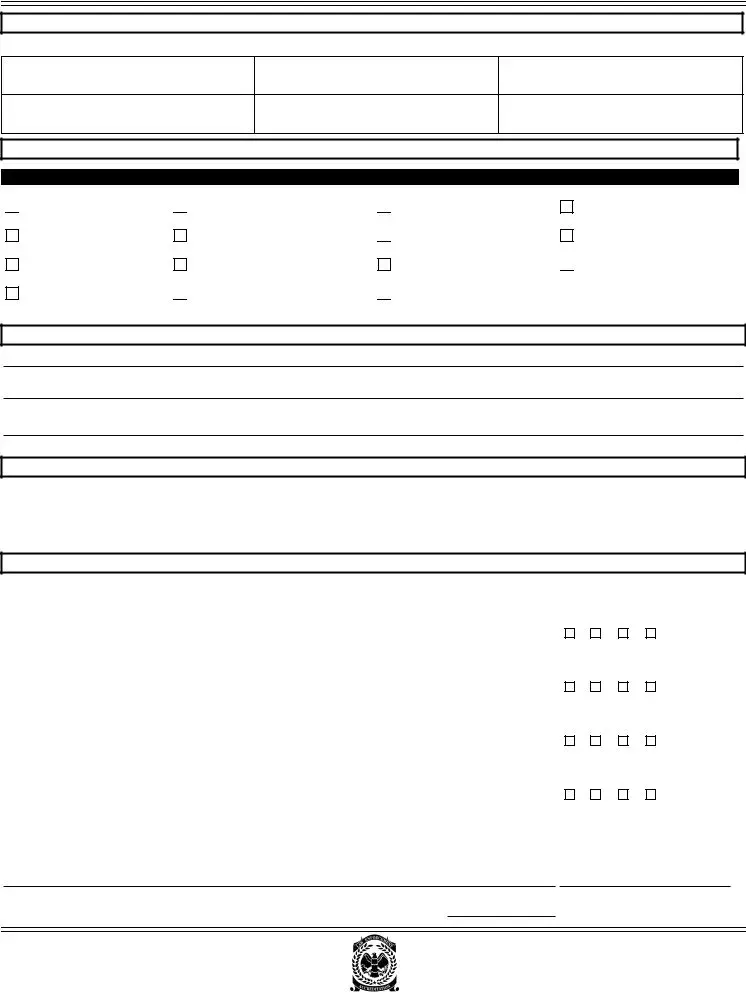
PART 3. EMERGENCY CONTACTS
Persons the CHP should attempt to contact in the event of an emergency involving one of your organization's vehicles or drivers.
Name |
Day Telephone with Area Code |
Night Telephone with Area Code |
Name |
Day Telephone with Area Code |
Night Telephone with Area Code |
PART 4. TYPES OF OPERATION (Check all that apply. This will assist CHP in mailing new information to your organization only when appropriate.)
IMPORTANT! Read the descriptions of each item beginning on pages 4 and 5 before checking the box.
A. Truck
B.Hazardous Materials Carrier
C.Hazardous Materials Shipper
D.Hazardous Waste Transporter
E. Flammable Liquid Cargo Tank
F.Bus w/o Operating Authority (public transit or private)
G.Tour Bus (CPUC or FMCSA authority)
H. School Bus
I. School Pupil Activity Bus
J. Youth Bus
K.General Public Paratransit Vehicle
L. Farm Labor Vehicle
M.Vehicle or combination described in VC 34500 (k)
N.Vehicle described in VC 34500(j)
O. Modified Limousine
PART 5. DOING BUSINESS AS (DBA) (Fictitious Business Name on file with the County or California Secretary of State.)
Doing business in California as
Doing business in California as
Doing business in California as
PART 6. OPERATING AUTHORITIES AND IDENTIFICATION NUMBERS
US DOT (Required) |
|
MC |
|
|
MX |
|
IRP |
|
|
IRP Base State |
|
|
||
|
|
|
PSG |
|
|
TCP |
|
|
||||||
PART 7. CALIFORNIA TERMINALS (Attach additional pages if necessary; provide the same information for each terminal)
California Terminal DBA and Address |
City Name |
Zip |
Phone |
Driver |
|
Vehicle |
CHP |
||
|
USE |
||||||||
(DBA must match Part 5) |
Code |
Number |
Records? Records? |
||||||
|
ONLY |
||||||||
|
|
|
|
|
|
|
|
||
|
|
|
|
|
|
|
|
|
|
Doing Business As |
|
|
|
Y |
N |
Y |
N |
Area |
|
|
|
|
|
|
|||||
Address |
|
|
|
|
|
|
|
Subarea |
|
|
|
|
|
|
|
|
|
|
|
Doing Business As |
|
|
|
Y |
N |
Y |
N |
Area |
|
|
|
|
|
|
|||||
Address |
|
|
|
|
|
|
|
Subarea |
|
|
|
|
|
|
|
|
|
|
|
Doing Business As |
|
|
|
Y |
N |
Y |
N |
Area |
|
|
|
|
|
|
|||||
Address |
|
|
|
|
|
|
|
Subarea |
|
|
|
|
|
|
|
|
|
|
|
Doing Business As |
|
|
|
Y |
N |
Y |
N |
Area |
|
|
|
|
|
|
|||||
Address |
|
|
|
|
|
|
|
Subarea |
|
|
|
|
|
|
|
|
|
|
|
If the CHP needs to clarify any of the information your organization has provided, who should be contacted by telephone for assistance?
Name (Type or print) |
Day Telephone |
Date this Carrier Profile was prepared (information current as of):
Safety, Service, and Security |
An Internationally Accredited Agency |
Page 2 of 5 |
Destroy Previous Editions |
Chp362_0419.pdf |

DIRECTIONS FOR COMPLETING
CHP 362, MOTOR CARRIER PROFILE (Rev.
CA - If your company already has a CA number issued by the CHP, enter it in the box at the top of page 1 and check the box labeled “Update.” Display of a CA number on commercial motor vehicles is required only under specified circumstances. If you are unsure whether your company already has a CA number, contact the nearest CHP MCSU, listed below.
Northern Division |
(530) |
Southern Division |
(323) |
||
2485 Sonoma Street |
(530) |
437 North Vermont Avenue |
(323) |
||
Redding, CA |
|
|
Los Angeles, CA |
|
|
Valley Division |
(916) |
Border Division |
(858) |
||
2555 First Avenue |
(916) |
9330 Farnham Street |
(858) |
||
Sacramento, CA |
|
|
San Diego, CA |
|
|
Golden Gate Division |
(707) |
Coastal Division |
(805) |
||
1551 Benicia Road |
(707) |
4115 Broad Street Suite |
(805) |
||
Vallejo, CA |
|
|
San Luis Obispo, CA |
|
|
Central Division |
(559) |
Inland Division |
(909) |
||
5435 East Olive Avenue |
(559) |
847 East Brier Drive |
(909) |
||
Fresno, CA |
|
|
San Bernardino, CA |
|
|
|
|
||||
CONTACT THE FOLLOWING OFFICES BY SPECIAL INSTRUCTION ONLY. |
|
||||
UNAUTHORIZED USE WILL DELAY PROCESSING OF YOUR APPLICATION. |
|
||||
Commercial Records Unit |
(916) |
Commercial Vehicle Section |
(916) |
||
P.O. Box 942898 |
(916) |
P.O. Box 942898 |
(916) |
||
Sacramento, CA |
|
|
Sacramento, CA |
|
|
PART 1. LEGAL NAME: One choice only - check Individual, Partnership, Corporation (which includes associations, trusts, and public agencies), or Limited Liability Company. Often, trusts hold property but do not operate businesses. Therefore, even if your company's assets are held by a trust but the company remains the motor carrier, enter the ownership information of the company under one of the four categories below.
INDIVIDUAL: If operating as an individual (sole proprietorship) with or without employees. If you have no EIN, enter the individual's SSN. Check the appropriate box to indicate EIN or SSN. A valid driver license number and issuing state are required. The application will not be processed without one. A valid California identification card number issued by the DMV is acceptable in lieu of a driver license number.
Please enter your proper legal name, not a nickname.
PARTNERSHIP: All requested information is required to prevent duplication of records. Businesses held as community property and operated jointly by family members (husband and wife, parent and child, etc.) are not partnerships unless legally organized as such, with an EIN assigned to the partnership. If not legally organized as a partnership, enter as an individual under one person's name and follow instructions outlined above for an individual.
CORPORATION: All requested information is required, to prevent duplication of records. Corporation number is normally stamped on an upper corner of Articles of Incorporation in California. If a foreign corporation, the Certificate of Qualifications number issued by the California Secretary of State is required instead. Information regarding legal status as a state or local government agency, or as a non- profit organization under federal regulations, is requested to prevent misdirected mailings and misapplication of motor carrier safety regulations, requirements for licenses, or fees for various related programs.
LIMITED LIABILITY COMPANY: All requested information is required, to prevent duplication of records. Include the Limited Liability Company number assigned by the California Secretary of State and the assigned EIN.
PART 2. PRINCIPAL PLACE OF BUSINESS: A single location designated by the motor carrier, normally its headquarters, where records required by federal motor carrier safety regulations will be maintained, if applicable, and records of drug and alcohol testing required by Section 34520 of the VC will be made available for inspection. The telephone number should be the normal daytime business number for the company. The principal place of business may be outside of California. Provision is made elsewhere on the Motor Carrier Profile for emergency and other telephone numbers. Do not write in the box marked "CHP USE ONLY".
Safety, Service, and Security |
An Internationally Accredited Agency |
Page 3 of 5 |
Destroy Previous Editions |
Chp362_0419.pdf |

FLEET MILEAGE IN CALIFORNIA: All mileage accumulated in California by vehicles identified in Part 4 during the most recent full calendar year, whether operated in intrastate or interstate service. For this purpose there is no need to separate intrastate mileage from total
PART 3. EMERGENCY CONTACTS: Enter the names of responsible individuals at the
PART 4. TYPES OF OPERATION:
A.Truck - Any truck of three or more axles with a gross vehicle weight rating (GVWR) of more than 10,000 pounds; any truck tractor regardless of number of axles or GVWR; and any truck used to tow a trailer where the overall length of the truck and trailer coupled together exceeds 40 feet.
B.Hazardous Materials Carrier - Any truck, including pickups, used to transport any amount of hazardous materials.
C.Hazardous Materials Shipper - An individual or company who offers hazardous materials for transportation by common carrier, contract carrier, or motor carrier of property, and never transports hazardous materials in any amount on vehicles owned, rented, leased, or otherwise controlled or operated by the shipper.
D.Hazardous Waste Transporter - An individual or company that transports hazardous wastes as defined in California or federal regulations.
E.Flammable Liquid Cargo Tank - Any tank greater than 120 gallons capacity which is used to transport liquids having a flash point of less than 100 degrees Fahrenheit, other than in the regular fuel tank of the vehicle.
F.Bus Without Operating Authority - Any vehicle of more than ten passenger capacity including the driver; the operation of which does not require a certificate, permit, or authority issued by the California Public Utilities Commission (PUC), or the Federal Motor Carrier Safety Administration (FMSCA). This typically includes, but is not limited to, church or other private buses; and public transit buses operated by city or county transit agencies.
G.Tour Bus - Any bus subject to regulation of; and requires a certificate, permit, or authority issued by; the PUC or the FMSCA.
H.School Bus - The traditional yellow school bus specifically certified by the CHP for transportation of school pupils attending public or private schools.
I.School Pupil Activity Bus - A commercial or transit bus specifically certified by the CHP for use in transporting school pupils on
J.Youth Bus - A small bus specifically certified by the CHP for service in transporting school pupils between school and
K.General Public Paratransit Vehicle - A vehicle operated by or under contract to a transit agency in
L.Farm Labor Vehicle - A passenger vehicle or truck specifically certified by the CHP for use in transporting farm laborers.
M.Vehicle or combination described in Section 34500(k) VC - Any commercial motor vehicle with a GVWR of 26,001 or more pounds; or any combination of vehicles consisting of a commercial motor vehicle of any GVWR and a trailer with a gross weight or GVWR greater than 10,000 pounds ("Trailer" for this purpose does not include camp trailers, trailer coaches, or utility trailers).
N.Vehicle described in Section 34500(j) VC - Any other motor truck not described in A, B, D, E, or M above; the operation of which is subject to regulation by the DMV through the Motor Carrier of Property Permit requirements, the PUC, or United States Department of Transportation.
Safety, Service, and Security |
An Internationally Accredited Agency |
Page 4 of 5 |
Destroy Previous Editions |
Chp362_0419.pdf |

O.Modified Limousine - Any vehicle operated
PART 5. DOING BUSINESS AS (DBA): Enter all lawfully registered business names used in California by this entity (businesses not involving the use of regulated vehicles in Part 4 may be excluded). A company, which is a different legal entity and assigned a separate EIN, requires its own CA number and Motor Carrier Profile. Employer Identification Numbers are requested solely to positively identify separate entities and not for any purpose relating to tax issues. Organizations sharing the same EIN shall share the same CA number, although they may continue to be identified by separate DBA names.
PART 6. OPERATING AUTHORITIES AND IDENTIFICATION NUMBERS: Certain types of carriers are not required to display their assigned CA number if they are already displaying valid numbers assigned to them by other specified regulatory agencies. In order to cross reference your organization's other numbers to its CA number, the CHP needs to know what the other numbers are. US DOT: The number assigned by the FMCSA and displayed on vehicles as "USDOT 000000". This number is not the same thing as the docket or ICC number. Many commercial motor vehicle operators have both numbers, and should list both in this Part. The US DOT number is required for all California motor carriers per Section 34507.5 VC. MC: The number assigned to your organization by the FMCSA. This number is often shown on documents as "MTR 000000," and on vehicles as "MC 000000" with the zeros replaced by the number assigned to the company. Do not list a number that is assigned to a motor carrier to which your vehicle is leased or to which your company is subcontracted. MX: Similar to MC numbers, but are assigned to carriers based in Mexico and operating in the United States.
PART 7. CALIFORNIA TERMINALS: All business locations from which vehicles described in Part 4 are dispatched or operated in intrastate service, or in initiating, completing, or continuing the movement of an interstate load. It may include facilities owned by another business, such as a warehouse to or from which loads are transported and where the commercial motor vehicle is normally parked when not in use. "Terminal" may also include the private residence of an
Terminal DBA and Address: A properly registered DBA name used at that location, if different from the name identified in Part 1, and the
physical address of each location. City Name: City or community name only. State is not necessary, as only locations within California
must be listed. Zip Code: The postal zip code of the terminal's physical location, whether or not the company receives mail there. Phone
Number: The telephone number at which management personnel for that terminal can be contacted during normal business hours. The CHP uses this information to determine which CHP office serves that area.
Driver Records? - Check "Y" if records relating to commercial motor vehicle drivers are kept at this location, such as driver qualification files, DMV driving records, and drivers' time records. Check "N" if this location is not where such records are kept.
Vehicle Records? - Check "Y" if commercial motor vehicle inspection and maintenance records are kept at this terminal for the vehicles based there, such as drivers' daily vehicle inspection reports, company safety inspection records, scheduled maintenance records, repair records. Check "N" if this location is not where such records are kept.
CHP USE ONLY: The CHP uses this column to add geographical coding to indicate this terminal's location.
The ultimate goal of the CHP's inspection programs is the reduction of human suffering and property loss resulting from commercial motor vehicle
Safety, Service, and Security |
An Internationally Accredited Agency |
Page 5 of 5 |
Destroy Previous Editions |
Chp362_0419.pdf |
| Fact Name | Description |
|---|---|
| Form Purpose | The CHP 362 form is used to create or update the Motor Carrier Profile for organizations operating commercial vehicles in California. |
| Governing Law | This form is governed by the California Vehicle Code (VC), particularly Section 34601, which defines motor carriers of property. |
| Information Sharing | Some information provided on the CHP 362 may be shared with the Department of Motor Vehicles (DMV) to prevent misidentification. |
| CA Number Policy | The CHP does not issue more than one CA number to any individual or organization, regardless of the number of "Doing Business As" names. |
| Record Keeping Recommendation | It is recommended to make a copy of the completed Motor Carrier Profile for personal records before mailing the original to the CHP. |
Filling out the CHP 362 form is a crucial step for motor carriers in California. This process ensures that your organization’s information is accurately recorded and up to date. After completing the form, it should be mailed to your nearest CHP Motor Carrier Safety Unit.
What is the CHP 362 form?
The CHP 362 form, also known as the Motor Carrier Profile, is a document required by the California Highway Patrol (CHP) for motor carriers operating in California. It collects essential information about the organization, including legal name, business address, and types of operations. This form helps the CHP maintain accurate records and ensures compliance with state regulations.
Who needs to fill out the CHP 362 form?
Any individual, partnership, corporation, or limited liability company (LLC) that operates as a motor carrier of property in California must complete the CHP 362 form. This includes businesses that transport goods or provide transportation services involving commercial vehicles.
What information is required on the form?
The form requires various details, including the legal name of the organization, address, contact information, emergency contacts, types of operation, and any relevant identification numbers such as the US DOT number. Specific sections also ask for fleet mileage in California and any "Doing Business As" (DBA) names.
What should I do if my organization already has a CA number?
If your organization already possesses a CA number, you should check the "Update" box on the form and enter the existing CA number. This indicates that you are submitting the form to update your organization's information rather than creating a new profile.
How do I submit the completed CHP 362 form?
Once you have filled out the form, make a copy for your records. Then, mail the original to your nearest CHP Motor Carrier Safety Unit (MCSU). If you have received specific instructions to send it to a different CHP office, follow those directions as indicated on the form.
What happens to the information I provide on the form?
The information you provide on the CHP 362 form may be shared with the Department of Motor Vehicles (DMV) to prevent misidentification. The CHP uses this data to maintain accurate records, ensure compliance with safety regulations, and facilitate communication in case of emergencies involving your vehicles or drivers.
Can I list multiple DBA names on the form?
Yes, you can list multiple "Doing Business As" names in Part 5 of the form. However, each DBA must be lawfully registered with the appropriate authorities. If your organization operates under different legal entities, each will require its own CA number and separate CHP 362 form.
What types of operations should I indicate on the form?
You should check all applicable types of operations in Part 4. This includes options such as trucking, hazardous materials transportation, school buses, and more. Accurately indicating your operations helps the CHP provide relevant information and resources to your organization.
Is it necessary to keep the information current?
Yes, it is crucial to keep the information on the CHP 362 form current. If there are any changes in your organization, such as contact personnel or operational details, you must update the form and resubmit it to the CHP. This ensures that they can effectively communicate with you in emergencies and maintain accurate records.
What if I have questions while filling out the form?
If you have questions or need assistance while completing the CHP 362 form, you can contact your nearest CHP Motor Carrier Safety Unit (MCSU) for guidance. They can provide clarification and help ensure that your submission is accurate and complete.
Missing Legal Name: Failing to provide the proper legal name of the individual or organization can lead to delays. Ensure you select one category—Individual, Partnership, Corporation, or LLC.
Incorrect EIN or SSN: Entering an invalid Employer Identification Number (EIN) or Social Security Number (SSN) will cause the application to be rejected. Double-check these numbers for accuracy.
Incomplete Principal Place of Business: Omitting the full physical address, including street, city, state, and zip code, can result in processing issues. Make sure all information is complete.
Emergency Contacts Not Updated: Failing to list current emergency contacts can hinder communication during urgent situations. Always keep this information current.
Types of Operation Mischecked: Selecting incorrect types of operation can lead to improper classification. Review the descriptions carefully before checking the boxes.
Omitting Doing Business As (DBA) Names: If your organization operates under multiple names, be sure to list all lawfully registered DBAs. Missing this can create confusion.
Ignoring Fleet Mileage Requirements: Not providing accurate fleet mileage for the previous year can lead to regulatory issues. Ensure this information is complete and accurate.
The CHP 362 form is essential for motor carriers in California to provide their operational information. Along with this form, several other documents may be necessary to ensure compliance with state regulations. Below is a list of commonly used forms and documents that accompany the CHP 362.
Completing the necessary documentation accurately and promptly is vital for maintaining compliance and ensuring the safety of operations. Make sure to gather all relevant forms and information before submission to avoid delays.
The Form 2290, Heavy Highway Vehicle Use Tax Return, is similar to the CHP 362 in that both documents are essential for compliance with federal regulations regarding motor vehicles. Form 2290 is specifically used to report and pay taxes on heavy vehicles that operate on public highways. Like the CHP 362, it requires detailed information about the vehicle and its owner, including identification numbers and operational details. Both forms aim to ensure that the correct information is collected for regulatory purposes, helping authorities manage vehicle compliance effectively.
The MCS-150, Motor Carrier Identification Report, serves a similar purpose to the CHP 362 by providing essential information about a motor carrier's operations. This form is required by the Federal Motor Carrier Safety Administration (FMCSA) and collects data on the carrier's business structure, vehicle fleet, and safety practices. Just like the CHP 362, the MCS-150 is used to maintain accurate records and ensure that motor carriers meet safety and regulatory standards.
The DOT Registration Form is another document akin to the CHP 362. This form is required for motor carriers to obtain a USDOT number, which identifies them in the federal system. Both forms require information about the carrier's business structure and operational details. They are crucial for tracking compliance and safety records, ensuring that motor carriers are properly registered and monitored by the authorities.
The Form 805, Application for Motor Carrier Authority, is similar to the CHP 362 in that it is required for carriers seeking operating authority in interstate commerce. This form collects information about the carrier's business, including ownership and operational details. Like the CHP 362, the Form 805 helps regulatory bodies assess the qualifications of motor carriers before granting them permission to operate, thereby promoting safety and accountability in the industry.
The Form 1, Application for Certificate of Public Convenience and Necessity, is another document that parallels the CHP 362. It is used by carriers in California to apply for a permit to operate as a public utility. Both forms require detailed information about the carrier's operations and compliance with safety regulations. They serve as tools for state agencies to evaluate the necessity and safety of a carrier's operations before granting permission to operate.
The CA DMV Application for Title or Registration is similar to the CHP 362 as it involves registering a vehicle for legal operation on public roads. This form requires information about the vehicle and its owner, much like the CHP 362 collects details about the motor carrier. Both forms are essential for ensuring that vehicles are properly identified and comply with state regulations, contributing to overall road safety.
The Form 393, Application for Household Goods Carrier Permit, is akin to the CHP 362 in that it is specifically designed for carriers transporting household goods. This form collects information about the carrier's operations and safety practices, similar to the CHP 362. Both documents are vital for ensuring that carriers meet the necessary standards for operation and consumer protection in the transportation of goods.
The Form 940, Employer's Annual Federal Unemployment (FUTA) Tax Return, shares similarities with the CHP 362 in that both require information about a business's operations and compliance with federal regulations. While the 940 focuses on unemployment tax obligations, both forms serve to ensure that businesses are fulfilling their legal responsibilities and maintaining accurate records for regulatory purposes.
The Form 1040, U.S. Individual Income Tax Return, is another document that parallels the CHP 362 in its requirement for detailed personal and business information. While the 1040 is focused on income tax reporting, both forms are crucial for compliance with federal regulations. They require accurate reporting of information to ensure that individuals and businesses meet their legal obligations.
Lastly, the Form 990, Return of Organization Exempt from Income Tax, is similar to the CHP 362 in that it requires organizations to disclose detailed information about their operations and financial activities. Both forms serve to maintain transparency and accountability in their respective areas, helping regulatory bodies monitor compliance and uphold standards within the industry.
Things You Should Do When Filling Out the CHP 362 Form:
Things You Shouldn't Do When Filling Out the CHP 362 Form:
Misconceptions about the CHP 362 form can lead to confusion and mistakes in the application process. Here are ten common misconceptions, along with clarifications:
Filling out the CHP 362 form is an essential process for motor carriers in California. Here are key takeaways to ensure a smooth experience: