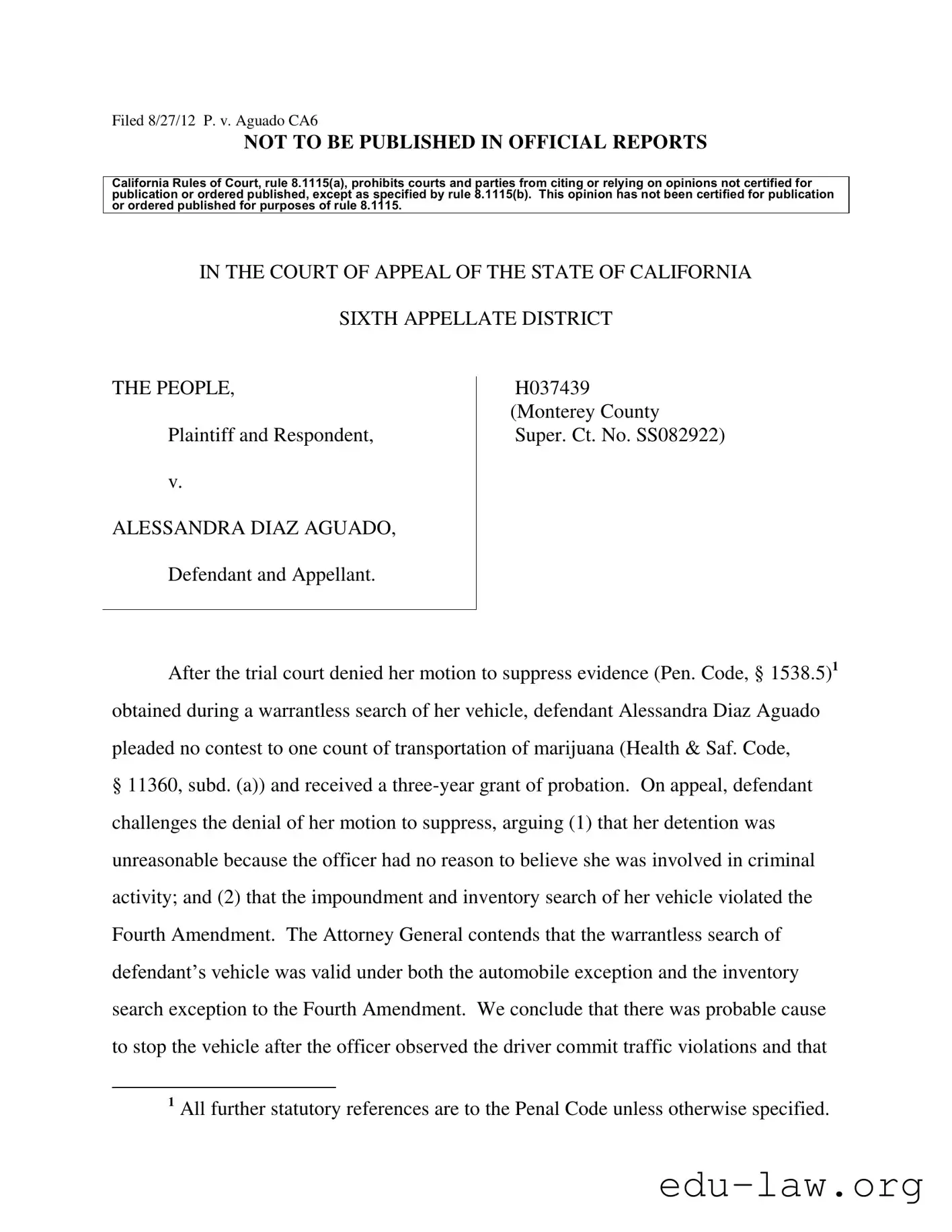
The CHP 180 form plays a crucial role in law enforcement procedures, particularly during the impoundment and inventory search of a vehicle. This standard form is utilized by California Highway Patrol officers to document the physical condition of a vehicle and its contents when the police take possession of it. In the case of Alessandra Diaz Aguado, the form became a focal point of legal scrutiny after a warrantless search of her vehicle led to the discovery of marijuana. The circumstances surrounding the traffic stop, which included observations of traffic violations and the subsequent actions taken by law enforcement, raised significant questions about the legality of the search. Aguado's defense argued that her detention was unreasonable and that the impoundment and inventory search violated her Fourth Amendment rights. The prosecution, however, contended that the search was valid under established exceptions to the warrant requirement. This article will explore the implications of the CHP 180 form in this case, the legal standards governing vehicle searches, and the broader impact of these procedures on individuals' rights and law enforcement practices.

Filed 8/27/12 P. v. Aguado CA6
NOT TO BE PUBLISHED IN OFFICIAL REPORTS
California Rules of Court, rule 8.1115(a), prohibits courts and parties from citing or relying on opinions not certified for publication or ordered published, except as specified by rule 8.1115(b). This opinion has not been certified for publication or ordered published for purposes of rule 8.1115.
IN THE COURT OF APPEAL OF THE STATE OF CALIFORNIA
SIXTH APPELLATE DISTRICT
THE PEOPLE,
Plaintiff and Respondent,
H037439
(Monterey County
Super. Ct. No. SS082922)
v.
ALESSANDRA DIAZ AGUADO,
Defendant and Appellant.
After the trial court denied her motion to suppress evidence (Pen. Code, § 1538.5)1 obtained during a warrantless search of her vehicle, defendant Alessandra Diaz Aguado pleaded no contest to one count of transportation of marijuana (Health & Saf. Code,
§11360, subd. (a)) and received a
Fourth Amendment. The Attorney General contends that the warrantless search of defendant‟s vehicle was valid under both the automobile exception and the inventory search exception to the Fourth Amendment. We conclude that there was probable cause to stop the vehicle after the officer observed the driver commit traffic violations and that
1All further statutory references are to the Penal Code unless otherwise specified.
the search was valid under the automobile exception. We will, therefore, affirm the
judgment.
FACTS
The facts are based on the evidence presented at the hearing on defendant‟s
motion to suppress. The only witness was Officer Edie Anderson of the Marina Police Department. The parties stipulated that there was no arrest or search warrant.
On December 6, 2008, at approximately 12:20 a.m., Officer Anderson was on patrol in a marked car, driving southbound on Del Monte Boulevard in Marina. As Officer Anderson approached the intersection of Del Monte Boulevard and Cosky Drive, he observed a black Toyota Tundra pickup truck turn left from Cosky Drive onto southbound Del Monte Boulevard and accelerate at a high rate of speed. The officer attempted to catch up to the pickup to obtain a
At the intersection of Del Monte Boulevard and Beach Road, the officer saw the pickup slow to five miles per hour and turn right onto westbound Beach Road, without stopping at the stop sign. Officer Anderson followed the pickup onto Beach Road and saw it enter a
Officer Anderson approached the pickup from the driver‟s side and spoke with the driver, Albert Lee. As he talked to the driver, the officer noticed “a mild odor of alcohol and marijuana” coming from inside the truck. Officer Anderson testified that at the time of the incident, he had worked for the Marina Police Department for 11 years and that he had received
2
investigations involving marijuana “quite a few times” and that he could not “begin to estimate” the number of marijuana cases he had worked on.
The driver appeared nervous and told the officer he was giving his female passenger a ride because she was under the influence of alcohol. Officer Anderson identified defendant as the woman who was seated in the passenger seat at the time of the traffic stop.
Officer Anderson asked Lee for his driver‟s license, the vehicle‟s registration, and
proof of insurance. Defendant told the officer the pickup truck belonged to her. However, she could not produce her registration or proof of insurance. At that point, Officer Anderson did not tell defendant she could not leave, but if she had tried to walk away, he would have prevented it.
Instead of a driver‟s license, Lee handed the officer his California identification card. Officer Anderson asked county communications to perform driver‟s license and
warrants checks on both Lee and defendant. The dispatcher told the officer that neither
party had any warrants, that defendant‟s driver‟s license was valid, but that Lee‟s license
had been suspended.
The officer returned to the pickup truck and spoke with Lee. This time, he noticed
the odor of alcohol on Lee‟s breath, which made him suspect Lee was driving under the
influence of alcohol. Officer Anderson asked Lee to step out of the pickup and conducted four or five field sobriety tests on Lee, which Lee passed. The officer also did
a preliminary alcohol screening (PAS) breath test. It indicated that Lee‟s blood alcohol
level was 0.05 percent, which was under the legal limit.
Officer Anderson did not do any field sobriety or PAS testing on defendant. Lee
had said defendant was under the influence and defendant‟s demeanor confirmed that: She was “very talkative” and “seemed to be a little irrational.”
After completing the sobriety testing on Lee, Officer Anderson asked Lee to return to the pickup truck and decided to cite him for failing to stop at the stop sign. Officer
3

Anderson concluded that he could not release the pickup truck to Lee because Lee had a suspended license and that he could not release it to defendant because she was under the influence, so the officer decided to store the vehicle. Officer Anderson asked both defendant and Lee to step out of the pickup and wait by his patrol car. About that time, Officer Baroccio arrived.
Officer Anderson told the court that it is “customary” to do an inventory search
when impounding a vehicle. Officer Baroccio did the inventory search in this case. While conducting the inventory search, Officer Baroccio found a black backpack in the rear seat of the pickup. Officer Anderson looked inside the backpack and saw a large quantity of marijuana, which was packaged in
After the officers discovered the marijuana in the backpack, Officer Anderson searched the pickup further, looking for more marijuana or other contraband. He did not find any more drugs, but did find a digital scale in the backpack.
Officer Anderson testified that the Marina Police Department has a written inventory policy relating to the storage of vehicles. Officer Anderson learned about that
policy on the job. He could not tell the court “exactly what the written policy says” and testified that it “is probably four or five
2Defendant‟s motion sought to suppress 10 items. Items 1 through 4 were
28 grams, 20.5 grams, 55.5 grams, and 330.5 grams of marijuana respectively, for a total of 434.5 grams (15.3 ounces) of marijuana. Items 5 and 6 were cash, totaling $1,357.
Items 7 through 10 were a digital scale, a digital camera, the black backpack, a brown purse, and a “medical marijuana recommendation.” In her moving papers, defendant told the court that the officers seized “[a]dditional marijuana” “from a brown purse in which her checkbook was found.” At the hearing on the motion, neither side elicited any
evidence regarding the purse.
4
Presumably he was referring to the number of pages or paragraphs in the written policy. Officer Anderson testified that the purpose of the inventory search is to inventory the contents of the vehicle to protect the owner from loss and the police from liability for missing items.
Officer Anderson was familiar with California Highway Patrol (CHP) 180 form,
which is a standard CHP form used “to preserve a record of the physical condition of the
vehicle and its contents when police take possession of it.” (People v. Williams (1999) 20 Cal.4th 119, 123.) He said a CHP 180 form was completed in this case. Initially, he could not recall whether he or Officer Baroccio completed the CHP 180 form; he believed it was Officer Baroccio. Later, Officer Anderson stated that the police report indicated that the CHP 180 form was completed by Officer Baroccio. Officer Anderson did not bring a copy of the CHP 180 form to the hearing. Although he had a copy of the police report, he did not print the attachments to the report, which included the CHP 180 form.
At the time of the traffic stop, the pickup was parked in a lawful spot and was not blocking road access.
PROCEDURAL HISTORY
Although a complaint was filed on December 9, 2008, the court did not conduct a preliminary hearing until March 24, 2010, due to multiple requests for continuances by both sides.
At the conclusion of the preliminary hearing, defendant was held to answer. She was subsequently charged by information with one felony count of transportation of marijuana (Health & Saf. Code, § 11360, subd. (a)), one felony count of possession of marijuana for sale (Health & Saf. Code, § 11359), and one misdemeanor count of possession of more than 28.5 grams of marijuana (Health & Saf. Code, § 11357, subd. (c)). All three offenses were alleged to have occurred on December 6, 2008. The information contained enhancement allegations pursuant to section 12022.1 that
5
defendant committed the felony offenses while she was released on bail in a prior matter (Monterey County Superior Court case No. SS081761A) in which she had been charged with cultivation of marijuana (Health & Saf. Code, § 11358) and transportation of marijuana (Health & Saf. Code, § 11360). Those offenses were alleged to have occurred in May 2008.
Defendant filed her motion to suppress in August 2010; the hearings on the motion were held in October and November 2010. In the trial court, defendant challenged the search and seizure on a variety of grounds, including: (1) that there was no probable cause or reasonable suspicion to stop the vehicle; (2) that she was unlawfully detained because the officer lacked reasonable suspicion that she was involved in criminal activity and that there was no reason to continue to hold her after the officer decided to cite Lee; and (3) that the officers did not conduct a valid inventory search. Defendant argued that to justify the search as a valid inventory search, the prosecution must demonstrate (1) that the search was done in accordance with standard policies and procedures, which included a policy or practice regarding the opening of containers, and (2) that the inventory search
was not used as an excuse to “ „rummage‟ ” for evidence.
In its written opposition, the prosecution argued that the inventory search was valid because it was done in accordance with Marina Police Department policy, which required the officer to impound the vehicle when the registered owner (defendant) was intoxicated and the driver had a suspended license. Alternatively, the prosecution argued that even if the inventory search was invalid, there was probable cause to stop the vehicle after Officer Anderson observed Lee commit three traffic violations, that the scope and duration of defendant‟s detention was reasonable, and that the odor of marijuana coming from the pickup truck established sufficient probable cause to detain both occupants and search the vehicle.
The court rejected all of defendant‟s arguments and denied the motion to suppress.
The court stated: “[T]he officer did observe the vehicle speeding and it failed to come to
6

a complete stop. He had reasonable suspicion to detain the vehicle. Upon contacting the occupant of the vehicle, he noticed a mild odor of alcohol and marijuana emitting from the vehicle. That further heightened his suspicions. [¶] He verified that the driver had a
suspended license, which is a misdemeanor violation of the law. Based on the driver‟s
comments that he was giving the passenger a ride because she was under the influence of alcohol and that the car was hers, he at that point had in his mind no other person to give the vehicle to and decided to store the vehicle because the driver was not properly licensed and the passenger was presumably under the influence. [¶] The Court does agree that the defendant who was a passenger in the vehicle
don‟t find that the detention or the seizure was particularly prolonged. I think based on
what happened during that time that the time the car was stopped was reasonable, and
therefore, I don‟t find any Fourth Amendment violations.”
After the court denied the motion to suppress, defendant pleaded no contest to one count of transportation of marijuana (Health & Saf. Code, § 11360, subd. (a)). The court suspended imposition of sentence and placed defendant on probation for three years.
Pursuant to the parties‟ plea agreement the remaining charges and enhancements in both
cases were dismissed.
DISCUSSION
On appeal, defendant contends that her detention was unreasonable because
Officer Anderson had no reason to believe that she was involved in criminal activity. She
also asserts that the search and seizure cannot be justified as an inventory search “because the prosecution did not establish that it was based on or done in compliance with policy.”
3Brendlin v. California (2007) 551 U.S. 249 (Brendlin).
7

The Attorney General responds that the police did not unlawfully detain defendant and that the warrantless search and seizure was justified under both the automobile exception and the inventory exception to the Fourth Amendment.4
Standard of Review
“As the finder of fact in a proceeding to suppress evidence (Pen. Code, § 1538.5),
the superior court is vested with the power to judge the credibility of the witnesses, resolve any conflicts in the testimony, weigh the evidence and draw factual inferences in deciding whether a search is constitutionally unreasonable.” (People v. Woods (1999) 21 Cal.4th 668, 673 (Woods).) On appeal, all factual conflicts must be resolved in the manner most favorable to the trial court‟s disposition. (Ibid.)
“The standard of appellate review of a trial court‟s ruling on a motion to suppress is well established. We defer to the trial court‟s factual findings, express or implied,
where supported by substantial evidence. In determining whether, on the facts so found, the search or seizure was reasonable under the Fourth Amendment, we exercise our independent judgment.” (People v. Glaser (1995) 11 Cal.4th 354, 362; accord, People v. Panah (2005) 35 Cal.4th 395, 465.) In assessing the reasonableness of searches and seizures, we apply federal constitutional standards. (People v. Rogers (2009) 46 Cal.4th
1136, 1156, fn. 8.) In the trial court, the “prosecution has the burden of establishing the reasonableness of a warrantless search” by a preponderance of the evidence. (People v. Jenkins (2000) 22 Cal.4th 900, 972; People v. James (1977) 19 Cal.3d 99, 106, fn. 4, citing United States v. Matlock (1974) 415 U.S. 164,
Cal.4th 704, 718.) We will affirm the trial court‟s ruling if it is correct on any applicable
theory of law. (People v. Zapien (1993) 4 Cal.4th 929, 976.)
4Although the prosecution briefed the issue below and the Attorney General relied on the automobile exception in its respondent‟s brief, defendant did not address this justification in her opening brief or file a reply brief.
8
General Search and Seizure Principles
The Fourth Amendment to the United States Constitution bans all unreasonable searches and seizures. (United States v. Ross (1982) 456 U.S. 798, 825 (Ross).) “The ultimate standard set forth in the Fourth Amendment is reasonableness.” (Cady v.
Dombrowski (1973) 413 U.S. 433, 439; Vernonia School Dist. 47J v. Acton (1995) 515
U.S. 646, 652.) “The test of reasonableness under the Fourth Amendment is not capable
of precise definition or mechanical application. In each case it requires a balancing of the need for the particular search against the invasion of personal rights that the search entails.” (Bell v. Wolfish (1979) 441 U.S. 520, 559.) “The inquiry is substantive in nature, and consists of a subjective and an objective component.” (People v. Ayala
(2000) 23 Cal.4th 225, 255.) To claim Fourth Amendment protection, the defendant
must show “ „a subjective expectation of privacy that was objectively reasonable.‟ [Citation.]” (Ibid.) “ „Whether a search and seizure is unreasonable within the meaning of the Fourth Amendment depends upon the facts and circumstances of each case.‟ ”
(South Dakota v. Opperman (1976) 428 U.S. 364, 375.)
“Where a search is undertaken by law enforcement officials to discover evidence
of criminal wrongdoing, . . . reasonableness generally requires the obtaining of a judicial warrant, [citation].” (Vernonia School Dist. 47J v. Acton, supra, 515 U.S. at p. 653.) Thus, the general rule is that “ „searches conducted outside the judicial process, without prior approval by judge or magistrate, are per se unreasonable under the Fourth
9
Automobile Exception
The automobile exception permits searches for evidence relevant to offenses other than the offense of arrest. (Gant, supra, 556 U.S. at p. 347.) It is rooted in “the historical distinctions between the search of an automobile or other conveyance and the search of a dwelling.” (People v. Superior Court (Nasmeh) (2007) 151 Cal.App.4th 85, 100.) These distinctions recognize a vehicle‟s inherent mobility (ibid.; California v. Carney (1985)
471 U.S. 386, 394, fn. 3) and acknowledge a reduced expectation of privacy in a vehicle compared to a dwelling. (Gant, supra, at p. 345.) “[A]n individual‟s expectation of privacy in a vehicle and its contents may not survive if probable cause is given to believe that the vehicle is transporting contraband.” (Ross, supra, 456 U.S. at p. 823.)
“In this class of cases, a search is not unreasonable if based on facts that would justify the issuance of a warrant, even though a warrant has not actually been obtained.” (Ross, supra, 456 U.S. at p. 809, fn. omitted.) This threshold standard means “ „a fair probability that contraband or evidence of a crime will be found,‟ [citation]. . . .”
(Alabama v. White (1990) 496 U.S. 325, 330.) Probable cause to search thus exists
“where the known facts and circumstances are sufficient to warrant a [person] of
reasonable prudence in the belief that contraband or evidence of a crime will be found,
see [citations].” (Ornelas v. United States (1996) 517 U.S. 690, 696.) Said another way,
“[p]robable cause for a search exists where an officer is aware of facts that would lead a
[person] of ordinary caution or prudence to believe, and conscientiously to entertain, a
strong suspicion that the object of the search is in the particular place to be searched.”
(People v. Dumas (1973) 9 Cal.3d 871, 885.)
Under the automobile exception, “If there is probable cause to believe a vehicle
contains evidence of criminal activity, United States v. Ross . . . authorizes a search of
any area of the vehicle in which the evidence might be found.” (Gant, supra, 556 U.S. at
p. 347, citing Ross, supra, 456 U.S. at pp.
to “every part of the vehicle and its contents that may conceal the object of the search.”
10
| Fact Name | Fact Description |
|---|---|
| Form Purpose | The CHP 180 form is used to document the physical condition of a vehicle and its contents when law enforcement takes possession. |
| Governing Law | The use of the CHP 180 form is governed by California Vehicle Code and California Rules of Court. |
| Completion Requirement | Officers are required to complete the CHP 180 form during an inventory search of a vehicle. |
| Inventory Search | An inventory search is customary when impounding a vehicle to protect the owner’s property and the police from liability. |
| Form Origin | The CHP 180 form is a standard form used by the California Highway Patrol and other law enforcement agencies. |
| Case Reference | The CHP 180 form was referenced in the case of People v. Williams (1999) 20 Cal.4th 119. |
| Form Availability | Copies of the CHP 180 form should be attached to the police report for record-keeping. |
| Officer Training | Officers receive training on how to properly fill out the CHP 180 form as part of their duties. |
| Evidence in Court | The CHP 180 form can serve as evidence in court to support the legality of an inventory search. |
| Non-Publication Rule | Opinions not certified for publication cannot be cited, as per California Rules of Court, rule 8.1115. |
Completing the CHP 180 form is an essential step when law enforcement takes possession of a vehicle. This form documents the condition of the vehicle and its contents at the time of impoundment. To ensure accuracy and completeness, follow the steps outlined below.
Once the form is completed, it should be filed according to your department's procedures. This documentation will serve as a record for both the owner and the police department, protecting against liability and ensuring transparency in the impoundment process.
What is the purpose of the CHP 180 form?
The CHP 180 form is used to document the physical condition of a vehicle and its contents when police take possession of it. This form serves to protect the owner from loss and the police from liability for any missing items. It is a standard form utilized by law enforcement agencies in California during vehicle impoundments and inventory searches.
When is the CHP 180 form completed?
The CHP 180 form is typically completed during the process of impounding a vehicle. Law enforcement officers fill out the form to ensure that there is a record of the vehicle's condition and contents at the time of impoundment. This is done to maintain transparency and accountability during inventory searches, which are customary when a vehicle is impounded.
Who is responsible for completing the CHP 180 form?
Can the CHP 180 form be used in court?
While the CHP 180 form itself may not be directly admissible in court, it can be referenced to establish the circumstances surrounding a vehicle's impoundment and the subsequent inventory search. The form helps to provide context for the legality of the search and any evidence obtained as a result. However, it is important to note that the admissibility of evidence and documentation is subject to legal standards and procedures.
Not reading the instructions thoroughly. Many individuals skip the instructions, which can lead to missing critical details.
Providing incomplete information. Omitting any required details can delay processing or lead to rejection of the form.
Failing to sign the form. A signature is essential for validating the submission, and without it, the form is considered incomplete.
Using incorrect dates. Entering the wrong date can create confusion and may impact the processing of the form.
Not double-checking for errors. Simple typos or mistakes can have significant consequences and should be carefully reviewed before submission.
Neglecting to provide supporting documents. Certain sections may require additional documentation, which should be included to avoid delays.
Choosing the wrong submission method. Understanding whether to submit online, by mail, or in person is crucial for timely processing.
Ignoring deadlines. Each form has specific deadlines that must be adhered to; missing these can jeopardize the entire process.
Using outdated forms. Always ensure that the most current version of the form is being used, as older versions may no longer be accepted.
Not keeping a copy of the submitted form. It's wise to retain a copy for personal records and future reference.
The CHP 180 form is a standard document used by law enforcement to document the condition of a vehicle and its contents when it is taken into police custody. Several other forms and documents are often associated with this form in legal proceedings. Below is a list of these documents, each accompanied by a brief description.
These documents collectively contribute to the legal framework surrounding the incident and ensure that all actions taken by law enforcement are properly recorded and justified. Each plays a role in maintaining transparency and accountability within the legal process.
The CHP 180 form is similar to a police report in that both documents serve to record important details about an incident involving law enforcement. A police report provides a comprehensive account of the events leading up to and following an incident, including statements from witnesses and involved parties. Similarly, the CHP 180 form captures the condition of a vehicle and its contents when it is taken into police custody. Both documents are essential for maintaining accurate records and can be referenced in future legal proceedings.
Another document similar to the CHP 180 form is the inventory list. An inventory list details items found within a vehicle or property during a search or impoundment. Like the CHP 180 form, it aims to protect both the owner’s belongings and the police from liability for lost items. Both documents emphasize transparency and accountability during police operations, ensuring that all items are accounted for and properly documented.
The incident report also shares similarities with the CHP 180 form. An incident report is a broader document that outlines the circumstances of a specific event, including any arrests made or evidence collected. The CHP 180 form, while focused specifically on vehicle condition and contents, complements the incident report by providing additional details about the items discovered during a vehicle search. Together, they create a fuller picture of the police encounter.
Search warrants are another document type that relates to the CHP 180 form. A search warrant authorizes law enforcement to search a specific location for evidence of a crime. While the CHP 180 form is used in situations where a vehicle is impounded without a warrant, both documents share the goal of ensuring that searches are conducted lawfully and that any evidence collected is properly documented. This helps uphold the rights of individuals while allowing law enforcement to perform their duties effectively.
Field interrogation cards are also comparable to the CHP 180 form. These cards are used by officers to document interactions with individuals during stops or investigations. Like the CHP 180 form, field interrogation cards help maintain a record of police activity and can be referenced later if necessary. Both documents are crucial for accountability and provide a framework for understanding police encounters.
Another related document is the vehicle impound form. This form is used when a vehicle is towed or impounded by law enforcement. It includes details about the vehicle's condition and any items found inside, similar to the CHP 180 form. Both documents serve to protect the rights of vehicle owners and ensure that all items are recorded accurately during the impoundment process.
Lastly, the arrest report can be seen as similar to the CHP 180 form. An arrest report documents the circumstances surrounding an arrest, including the charges filed and evidence collected. While the CHP 180 form focuses specifically on the vehicle and its contents, both documents contribute to the overall legal record of an incident. They help ensure that all relevant information is captured and can be used in court if necessary.
When filling out the CHP 180 form, it's essential to follow specific guidelines to ensure accuracy and compliance. Below is a list of actions to take and avoid:
Understanding the CHP 180 form is crucial for anyone involved in a vehicle impoundment or inventory search situation. However, several misconceptions can lead to confusion. Here’s a list of common misunderstandings about the CHP 180 form:
This form is required not just for accidents but also for any situation where a vehicle is impounded or searched, ensuring proper documentation of its condition.
In fact, completing the CHP 180 form is a standard procedure that helps protect both the vehicle owner and the police department from liability.
Regardless of the parking situation, if a vehicle is impounded, the CHP 180 form must be filled out to document its condition and contents.
The CHP 180 form should be completed at the time of the inventory search to ensure accuracy in documenting the vehicle's state and contents.
While it is typically filled out by the officer conducting the search, any officer involved in the process can complete the form as long as they provide accurate information.
The CHP 180 form can be used as evidence in court to support the legality of the search and the handling of the vehicle.
While it is a California-specific form, similar documentation practices exist in other states, though the forms may differ.
It is important for law enforcement to retain the CHP 180 form as part of their records, especially in case of future disputes or legal challenges.
Even if the vehicle owner is present, the form must still be completed to provide an official record of the vehicle's condition and contents at the time of impoundment.
Being aware of these misconceptions can help individuals understand their rights and the procedures involved in vehicle impoundments. Always ensure that proper documentation is completed to protect yourself and your interests.
When filling out and using the CHP 180 form, keep these key points in mind: