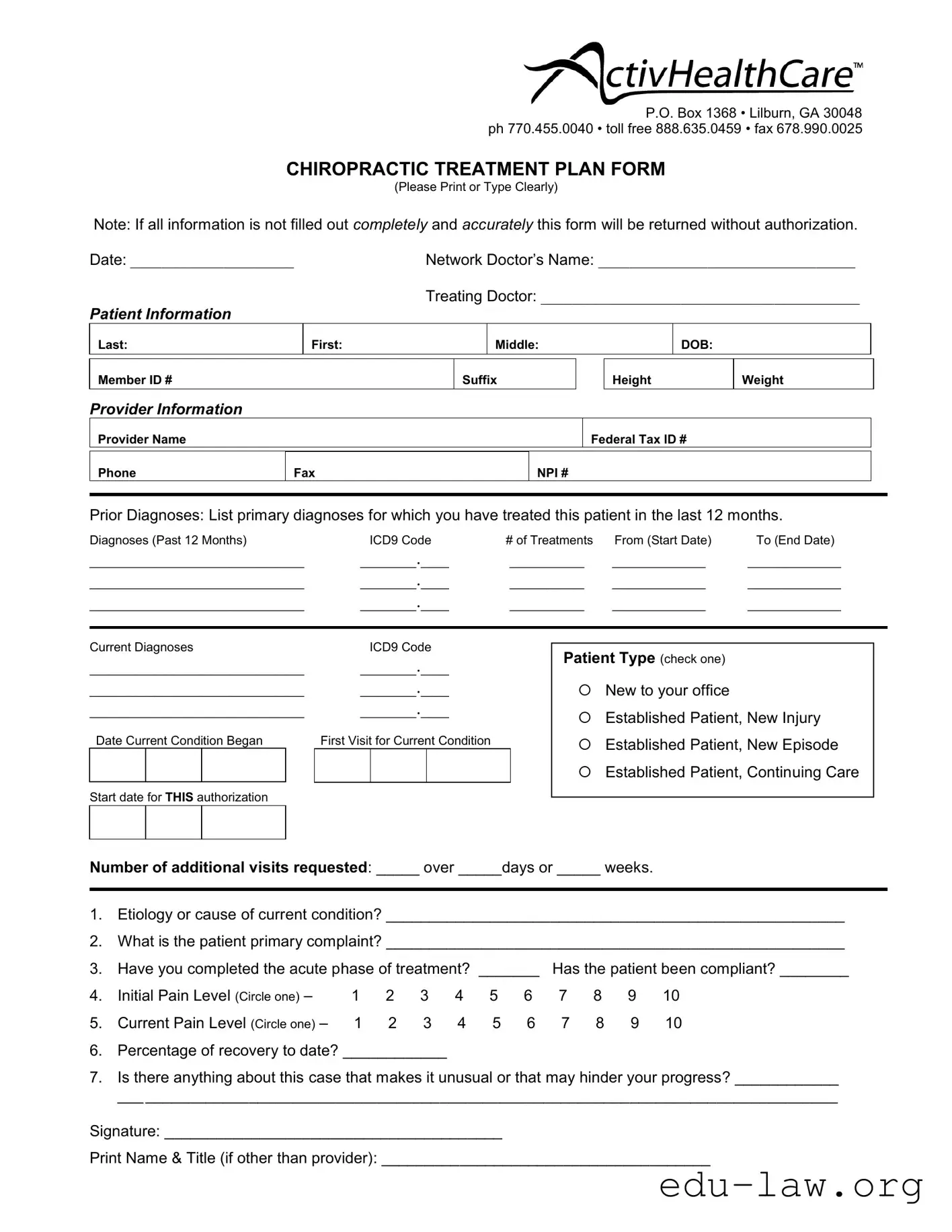
The Chiropractic Treatment Plan form is a crucial document that serves multiple purposes in the patient care process. It begins by collecting essential patient information, such as the patient's name, date of birth, and member ID. This section ensures that healthcare providers can accurately identify and track the patient's treatment history. Next, the form requires the provider's details, including their name, federal tax ID, and contact information. This transparency helps establish accountability and facilitates communication between the provider and the patient. The form also includes sections for prior and current diagnoses, allowing the treating doctor to document the patient's health status over time. This is critical for continuity of care and for justifying treatment plans to insurance providers. Additionally, the form prompts the provider to assess the patient's treatment progress, including pain levels and recovery percentages. It even addresses the patient's compliance and any unusual factors that may affect treatment outcomes. By requiring a detailed account of the patient's condition and treatment history, the Chiropractic Treatment Plan form not only streamlines the authorization process but also enhances the overall quality of care.
P.O. Box 1368 • Lilburn, GA 30048 ph 770.455.0040 • toll free 888.635.0459 • fax 678.990.0025
CHIROPRACTIC TREATMENT PLAN FORM
(Please Print or Type Clearly)
Note: If all information is not filled out completely and accurately this form will be returned without authorization.
Date: _____________________
PATIENT INFORMATION
Last:
Network Doctor’s Name: _________________________________
Treating Doctor: _________________________________________
First: |
Middle: |
DOB: |
|
|
|
Member ID #
Suffix
Height
Weight
PROVIDER INFORMATION
Provider Name
Federal Tax ID #
Phone
Fax
NPI #
Prior Diagnoses: List primary diagnoses for which you have treated this patient in the last 12 months.
Diagnoses (Past 12 Months) |
ICD9 Code |
# of Treatments |
From (Start Date) |
To (End Date) |
||||||
_______________________ |
______.___ |
________ |
__________ |
__________ |
||||||
_______________________ |
______.___ |
________ |
__________ |
__________ |
||||||
_______________________ |
______.___ |
________ |
__________ |
__________ |
||||||
|
|
|
|
|
|
|||||
Current Diagnoses |
ICD9 Code |
|
Patient Type (check one) |
|
||||||
_______________________ |
______.___ |
|
|
|||||||
|
|
|
|
|||||||
_______________________ |
______.___ |
|
New to your office |
|
||||||
_______________________ |
______.___ |
|
Established Patient, New Injury |
|||||||
|
|
|
|
|
|
|
|
|||
Date Current Condition Began |
First Visit for Current Condition |
|
Established Patient, New Episode |
|||||||
|
|
|
|
|
|
|
|
|||
|
|
|
|
|
|
|
|
Established Patient, Continuing Care |
||
Start date for THIS authorization |
|
|
|
|
|
|
|
|||
|
|
|
|
|
||||||
Number of additional visits requested: _____ over _____days or _____ weeks. |
|
|||||||||
|
|
|
|
|
|
|
|
|
|
|
1.Etiology or cause of current condition? _____________________________________________________
2.What is the patient primary complaint? _____________________________________________________
3. |
Have you completed the acute phase of treatment? _______ |
Has the patient been compliant? ________ |
|||||||||
4. |
Initial Pain Level (Circle one) – |
1 |
2 |
3 |
4 |
5 |
6 |
7 |
8 |
9 |
10 |
5. |
Current Pain Level (Circle one) – |
1 |
2 |
3 |
4 |
5 |
6 |
7 |
8 |
9 |
10 |
6.Percentage of recovery to date? ____________
7.Is there anything about this case that makes it unusual or that may hinder your progress? ____________
___________________________________________________________________________________
Signature: _______________________________________
Print Name & Title (if other than provider): ______________________________________
| Fact Name | Details |
|---|---|
| Form Purpose | This form outlines the chiropractic treatment plan for a patient, detailing necessary information for authorization. |
| Patient Information | Patients must provide personal details, including their name, date of birth, and member ID. |
| Provider Information | Chiropractors need to include their name, tax ID, phone number, and NPI number. |
| Prior Diagnoses | Providers list primary diagnoses treated in the past 12 months along with corresponding ICD9 codes. |
| Current Diagnoses | Current conditions must be documented with ICD9 codes and the type of patient indicated. |
| Compliance Questions | Questions regarding treatment completion and patient compliance must be answered to assess progress. |
| Pain Levels | Initial and current pain levels are recorded on a scale from 1 to 10 to track changes over time. |
| Recovery Percentage | Providers must indicate the percentage of recovery achieved to date, aiding in treatment evaluation. |
| Signature Requirement | The form must be signed by the treating doctor or authorized provider to validate the treatment plan. |
Filling out the Chiropractic Treatment Plan form is an important step in ensuring that the necessary information is submitted for patient care. Completing this form accurately helps facilitate a smooth process for treatment authorization. Follow these steps to fill out the form correctly.
What is the purpose of the Chiropractic Treatment Plan form?
The Chiropractic Treatment Plan form is designed to collect essential information about a patient’s medical history, current condition, and treatment needs. This information helps healthcare providers develop an effective treatment plan tailored to the patient's specific circumstances.
What information is required on the form?
The form requires detailed patient information, including the patient's name, date of birth, height, weight, and member ID. Additionally, it asks for prior and current diagnoses, treatment history, and the patient's primary complaint. Accurate completion of all sections is crucial for authorization.
What happens if the form is not filled out completely?
If the form is not filled out completely and accurately, it will be returned without authorization. This means that the treatment plan may face delays, as providers will need to resubmit the form with the necessary information.
How does the form address a patient’s treatment history?
The form includes sections for listing prior diagnoses and the number of treatments received in the last 12 months. This helps the treating doctor understand the patient's medical background and tailor the treatment plan accordingly.
What should a provider do if a patient has unusual circumstances affecting treatment?
The form includes a section where providers can note any unusual circumstances that may hinder the patient's progress. This information is vital for understanding potential challenges and adjusting the treatment plan as needed.
How does the form assess pain levels?
Patients are asked to circle their initial and current pain levels on a scale from 1 to 10. This assessment helps the provider gauge the effectiveness of the treatment and make necessary adjustments to improve patient outcomes.
What is the significance of the recovery percentage?
The recovery percentage indicates how much progress the patient has made toward recovery. This metric is crucial for evaluating the effectiveness of the treatment plan and determining future treatment needs.
What types of patient statuses can be indicated on the form?
The form allows providers to check the patient's status as either new to the office, an established patient with a new injury, an established patient with a new episode, or an established patient continuing care. This classification helps in understanding the patient's treatment journey.
What is the importance of the provider's signature?
The provider's signature on the form signifies that the information provided is accurate and that the treatment plan has been reviewed. It is a critical step for authorization and accountability in the treatment process.
How can patients ensure their form is processed smoothly?
Patients can ensure smooth processing by providing complete and accurate information on the form. They should double-check all entries, especially in sections concerning their medical history and current condition, before submitting the form to the provider.
Not filling out all required fields: It's crucial to complete every section of the form. Missing information can lead to delays or rejection of the treatment plan.
Inaccurate patient information: Double-check the patient's name, date of birth, and other personal details. Errors here can create confusion and affect treatment authorization.
Failing to specify diagnoses: Clearly list all prior and current diagnoses. Incomplete or vague entries can complicate the approval process.
Neglecting to indicate treatment history: Provide accurate details about the number of treatments and dates. This information is essential for assessing the patient's progress.
Ignoring patient compliance: Indicate whether the patient has been compliant with the treatment plan. This can significantly impact the evaluation of their progress.
The Chiropractic Treatment Plan form is essential for documenting a patient's treatment strategy. However, several other forms and documents are commonly used alongside it to ensure comprehensive patient care and proper communication among healthcare providers.
Using these documents in conjunction with the Chiropractic Treatment Plan form enhances patient care and ensures that all relevant information is communicated effectively among healthcare professionals.
The Chiropractic Treatment Plan form shares similarities with the Medical History Form. Both documents aim to gather essential patient information before treatment begins. The Medical History Form typically includes details about the patient’s past medical conditions, medications, and allergies, which helps healthcare providers understand the patient’s overall health. Similarly, the Chiropractic Treatment Plan form collects information on prior diagnoses and current conditions, ensuring that the chiropractor has a comprehensive view of the patient's health history to tailor the treatment effectively.
Another document that aligns closely with the Chiropractic Treatment Plan is the Patient Consent Form. This form is designed to inform patients about the nature of the treatments they will receive and to obtain their consent. Just as the Chiropractic Treatment Plan outlines the specific treatment goals and methods, the Patient Consent Form ensures that patients understand the risks and benefits associated with their care. Both documents emphasize the importance of informed decision-making in the patient-provider relationship.
The Treatment Authorization Request form also bears resemblance to the Chiropractic Treatment Plan. This document is often used to seek approval from insurance providers before commencing treatment. Like the Chiropractic Treatment Plan, it details the patient's condition, the proposed treatment, and the anticipated number of sessions. This similarity ensures that both documents provide a clear justification for the treatment plan, facilitating communication between healthcare providers and insurers.
The Progress Note is another document that shares commonalities with the Chiropractic Treatment Plan. Progress Notes are used to document the patient's response to treatment over time. While the Chiropractic Treatment Plan outlines initial treatment goals and methods, Progress Notes track the patient's progress and any adjustments made to the treatment plan. This ongoing documentation is crucial for assessing the effectiveness of care and making necessary modifications.
The SOAP Note, which stands for Subjective, Objective, Assessment, and Plan, is also similar to the Chiropractic Treatment Plan. SOAP Notes provide a structured way to document patient encounters. The Subjective section captures the patient’s report of their condition, while the Objective section includes clinical findings. The Assessment and Plan sections mirror the goals and methods outlined in the Chiropractic Treatment Plan, making both documents vital for cohesive patient care.
The Referral Form is another document that complements the Chiropractic Treatment Plan. When a chiropractor determines that a patient requires additional specialized care, a Referral Form is often completed. This document typically includes relevant patient information and the reason for referral. Like the Chiropractic Treatment Plan, it ensures that all necessary details are communicated clearly, promoting continuity of care across different healthcare providers.
Similarly, the Insurance Claim Form is aligned with the Chiropractic Treatment Plan. This document is submitted to insurance companies for reimbursement of services rendered. The Insurance Claim Form requires specific details about the treatment provided, including diagnosis codes and treatment dates, much like the information captured in the Chiropractic Treatment Plan. Both documents work together to facilitate financial processes related to patient care.
Lastly, the Discharge Summary is akin to the Chiropractic Treatment Plan in that it summarizes the patient's treatment journey. While the Chiropractic Treatment Plan outlines the intended course of treatment, the Discharge Summary reflects the outcomes and any follow-up recommendations once treatment is completed. Both documents play crucial roles in ensuring that patients receive comprehensive care and understand their health status moving forward.
When filling out the Chiropractic Treatment Plan form, attention to detail is crucial. Here are five things you should and shouldn't do to ensure a smooth process.
By following these guidelines, you can help ensure that the treatment plan is processed efficiently and accurately. Your attention to detail will contribute to the patient's care and the overall effectiveness of the treatment plan.
Misconceptions about the Chiropractic Treatment Plan form can lead to confusion and mistakes. Here are five common misconceptions:
Understanding these misconceptions can help patients and providers alike navigate the Chiropractic Treatment Plan form more effectively.
When filling out the Chiropractic Treatment Plan form, keep the following key takeaways in mind: