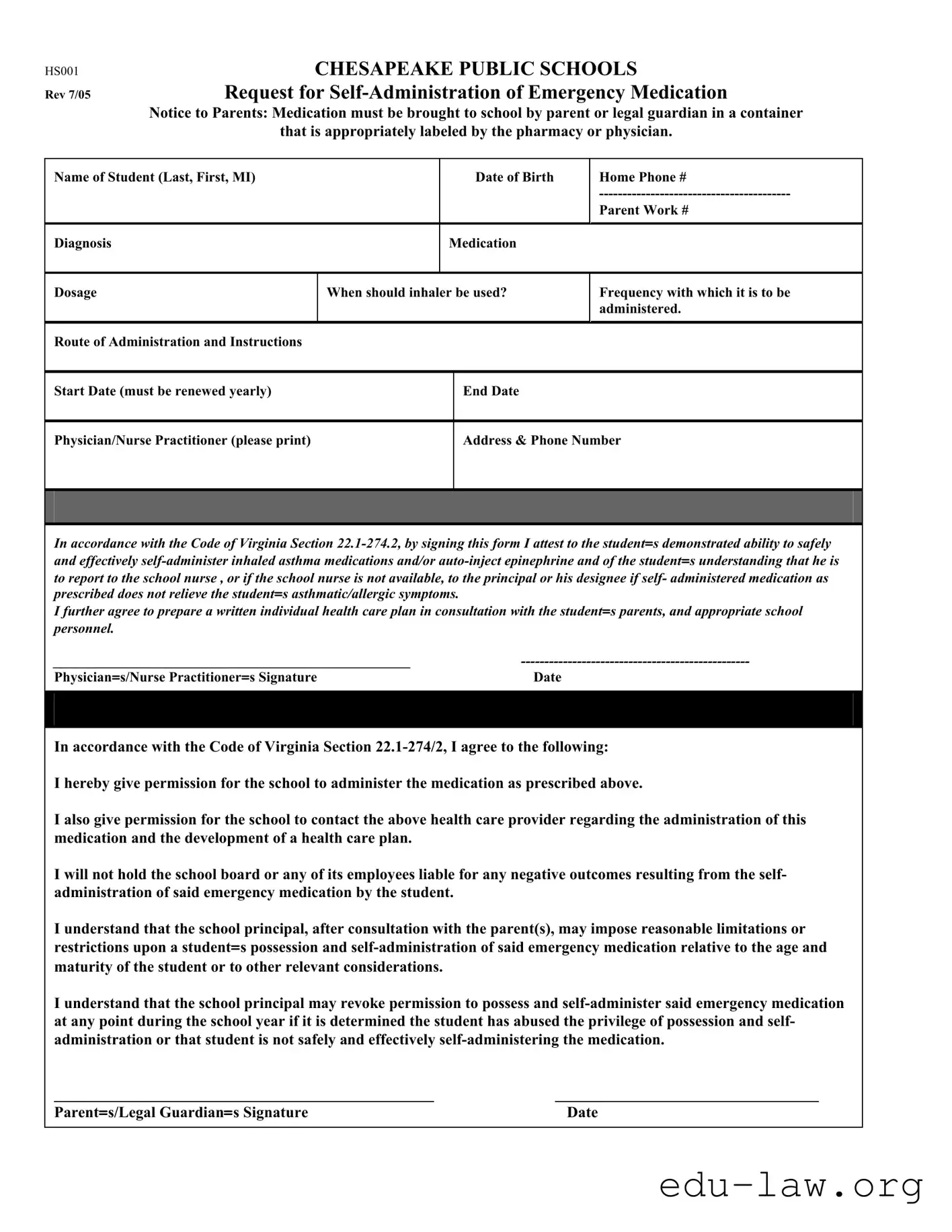
The Chesapeake HS001 form is an essential document designed to facilitate the safe self-administration of emergency medication by students within the Chesapeake Public Schools system. This form is particularly relevant for students who require inhaled asthma medications or auto-inject epinephrine due to allergic reactions. Parents or legal guardians play a crucial role, as they must bring the medication to school in a properly labeled container. The form captures vital information, including the student's name, date of birth, and contact details for parents and healthcare providers. Additionally, it outlines the specific medication, dosage, and instructions for use, ensuring that the school staff is well-informed about the student's needs. By signing the form, parents acknowledge their child's ability to self-administer the medication and agree to collaborate with school personnel in developing an individual health care plan. Importantly, the form also includes provisions that allow school authorities to impose restrictions based on the student's age and maturity, as well as the ability to revoke permission if necessary. This comprehensive approach aims to protect students while promoting their independence in managing their health conditions.
HS001 |
CHESAPEAKE PUBLIC SCHOOLS |
Rev 7/05 |
Request for |
|
Notice to Parents: Medication must be brought to school by parent or legal guardian in a container |
|
that is appropriately labeled by the pharmacy or physician. |
Name of Student (Last, First, MI)
Date of Birth
Home Phone #
Parent Work #
Diagnosis
Medication
Dosage
When should inhaler be used?
Frequency with which it is to be administered.
Route of Administration and Instructions
Start Date (must be renewed yearly)
End Date
Physician/Nurse Practitioner (please print)
Address & Phone Number
In accordance with the Code of Virginia Section
I further agree to prepare a written individual health care plan in consultation with the student=s parents, and appropriate school personnel.
___________________________________________________ |
|
Physician=s/Nurse Practitioner=s Signature |
Date |
In accordance with the Code of Virginia Section
I hereby give permission for the school to administer the medication as prescribed above.
I also give permission for the school to contact the above health care provider regarding the administration of this medication and the development of a health care plan.
I will not hold the school board or any of its employees liable for any negative outcomes resulting from the self- administration of said emergency medication by the student.
I understand that the school principal, after consultation with the parent(s), may impose reasonable limitations or restrictions upon a student=s possession and
I understand that the school principal may revoke permission to possess and
_________________________________________________ |
__________________________________ |
Parent=s/Legal Guardian=s Signature |
Date |
| Fact Name | Fact Description |
|---|---|
| Form Title | HS001 CHESAPEAKE PUBLIC SCHOOLS Request for Self-Administration of Emergency Medication |
| Revision Date | This form was last revised in July 2005. |
| Purpose | The form allows parents to request permission for their child to self-administer emergency medication at school. |
| Required Signatures | Both the physician/nurse practitioner and the parent/legal guardian must sign the form. |
| Student Information | Details such as the student's name, date of birth, and home phone number are required. |
| Medication Details | The form requires information about the diagnosis, medication, dosage, and administration instructions. |
| Governing Law | This form is governed by the Code of Virginia Section 22.1-274.2. |
| Health Care Plan | A written individual health care plan must be prepared in consultation with parents and school personnel. |
| Liability Waiver | Parents agree not to hold the school board or its employees liable for negative outcomes from self-administration of medication. |
| Revocation of Permission | The school principal may revoke permission for self-administration if the student is not following guidelines. |
To complete the Chesapeake HS001 form, follow these steps carefully. This form is essential for ensuring that your child can self-administer emergency medication at school. Make sure to have all necessary information ready before you start filling it out.
What is the Chesapeake HS001 form used for?
The Chesapeake HS001 form is a request for self-administration of emergency medication for students in Chesapeake Public Schools. It allows parents or legal guardians to authorize their child to self-administer medications such as inhaled asthma medications or auto-inject epinephrine while at school.
Who needs to sign the Chesapeake HS001 form?
The form must be signed by both the parent or legal guardian and the physician or nurse practitioner. This ensures that both the medical professional and the parent agree on the student's ability to safely self-administer the prescribed medication.
What information is required on the form?
The form requires several pieces of information, including the student’s name, date of birth, home and work phone numbers, diagnosis, medication details, dosage, frequency of administration, and the route of administration. Additionally, it needs the physician’s or nurse practitioner’s contact information and signatures from both the parent and the medical provider.
How should medication be provided to the school?
Medication must be brought to school by the parent or legal guardian. It should be in a container that is appropriately labeled by the pharmacy or physician. This labeling is essential for ensuring the correct medication is administered to the student.
Is there a specific start and end date for the medication authorization?
Yes, the form requires a start date for when the student is allowed to self-administer the medication, as well as an end date. This authorization must be renewed yearly, ensuring that the school has the most current information regarding the student's medication needs.
What happens if the student does not use the medication as prescribed?
If the student self-administers medication and does not experience relief from their symptoms, they are required to report to the school nurse or, if unavailable, to the principal or their designee. This protocol helps ensure the student receives the necessary support in managing their health condition.
Can the school impose restrictions on the student's medication self-administration?
Yes, the school principal has the authority to impose reasonable limitations or restrictions on a student’s possession and self-administration of emergency medication. These decisions are made in consultation with the parents and take into account the student’s age, maturity, and other relevant factors.
What are the consequences if the student abuses the privilege of self-administration?
If it is determined that the student has abused the privilege of possessing and self-administering their medication, the principal may revoke this permission at any time during the school year. This ensures that the safety and well-being of all students are maintained.
How does the school communicate with the healthcare provider?
By signing the HS001 form, parents give permission for the school to contact the healthcare provider regarding the administration of the medication and the development of a health care plan. This communication is vital for ensuring that the student's health needs are met effectively.
Failing to provide the student's full name as requested. The form requires the last name, first name, and middle initial.
Not including the date of birth of the student. This information is essential for identification purposes.
Leaving the home phone number section blank. This contact information is important for emergencies.
Omitting the diagnosis section. This information helps school personnel understand the medical condition being treated.
Incorrectly stating the dosage of the medication. Accurate dosage is crucial for the safety of the student.
Not specifying when the inhaler should be used. Clear instructions are necessary for proper medication administration.
Failing to indicate the frequency of medication administration. This detail ensures that the medication is given at the right intervals.
Not obtaining the required physician's or nurse practitioner's signature. This signature validates the information provided on the form.
The Chesapeake HS001 form is an essential document for students who require self-administration of emergency medication at school. However, several other forms and documents are often used in conjunction with it to ensure the safety and well-being of the student. Below is a list of these documents, each serving a specific purpose in the process of medication administration and health care planning.
Each of these documents plays a significant role in creating a safe and supportive environment for students requiring medication at school. By ensuring all necessary forms are completed and properly managed, parents, healthcare providers, and school staff can work together effectively to support the health and well-being of the student.
The Emergency Medication Administration Form is a document that allows parents to authorize schools to administer necessary medications to their children during school hours. Similar to the Chesapeake HS001 form, this document requires details about the student, the medication, and instructions for administration. Both forms emphasize the importance of parental involvement in ensuring that medications are safely administered and that the school is informed about the child's health needs.
The Asthma Action Plan is another important document that outlines specific steps to manage a student’s asthma. Like the HS001 form, it includes information about the child’s symptoms, triggers, and prescribed medications. This plan serves as a guide for school staff to recognize when a student needs help and how to respond effectively, ensuring the child’s safety and well-being during school hours.
The Individual Health Care Plan (IHCP) is tailored to meet the unique health needs of a student with chronic conditions. This document, similar to the HS001 form, requires collaboration between parents, healthcare providers, and school personnel. It details the student’s medical needs, emergency contacts, and specific instructions for care, promoting a coordinated approach to health management in the school setting.
The Medication Administration Authorization Form is used by parents to give schools permission to administer prescribed medications. Like the HS001 form, it requires specific information about the medication, dosage, and administration schedule. This form ensures that school staff have the necessary consent and information to safely administer medications to students during school hours.
The Allergy Action Plan is designed for students with known allergies. It includes information about the allergens, symptoms of allergic reactions, and emergency procedures. Similar to the HS001 form, it emphasizes the importance of communication between parents and school staff to ensure that students are protected from potential allergic reactions while at school.
The Seizure Action Plan provides guidance for managing students with seizure disorders. This document outlines the types of seizures the student may experience, triggers, and emergency response steps. Like the HS001 form, it requires parental input and collaboration with healthcare providers to ensure that school staff are prepared to respond appropriately in case of a seizure.
The Diabetes Management Plan is specifically for students with diabetes. This document includes information about blood sugar monitoring, insulin administration, and dietary needs. Similar to the HS001 form, it ensures that school staff are equipped with the knowledge and consent needed to manage the student’s condition effectively throughout the school day.
The Individualized Education Program (IEP) is a comprehensive plan for students with disabilities. It outlines specific educational goals and the support services required. Like the HS001 form, it involves collaboration between parents, educators, and healthcare professionals to ensure that the student's health and educational needs are met in a coordinated manner.
The Consent for Treatment Form is often used in medical settings to authorize treatment for minors. This document, similar to the HS001 form, requires parental consent and provides healthcare providers with the authority to administer necessary care. It underscores the importance of parental involvement in the health and safety of their children, particularly in emergency situations.
When filling out the Chesapeake HS001 form, there are several important dos and don'ts to keep in mind. Following these guidelines will help ensure that the process goes smoothly and that your child's needs are met effectively.
Misconceptions about the Chesapeake HS001 form can lead to confusion and potentially impact student health. Here are five common misconceptions, clarified for better understanding:
Understanding these misconceptions is vital for parents, guardians, and students to ensure that health needs are met effectively while adhering to school policies.
Here are key takeaways about filling out and using the Chesapeake HS001 form: