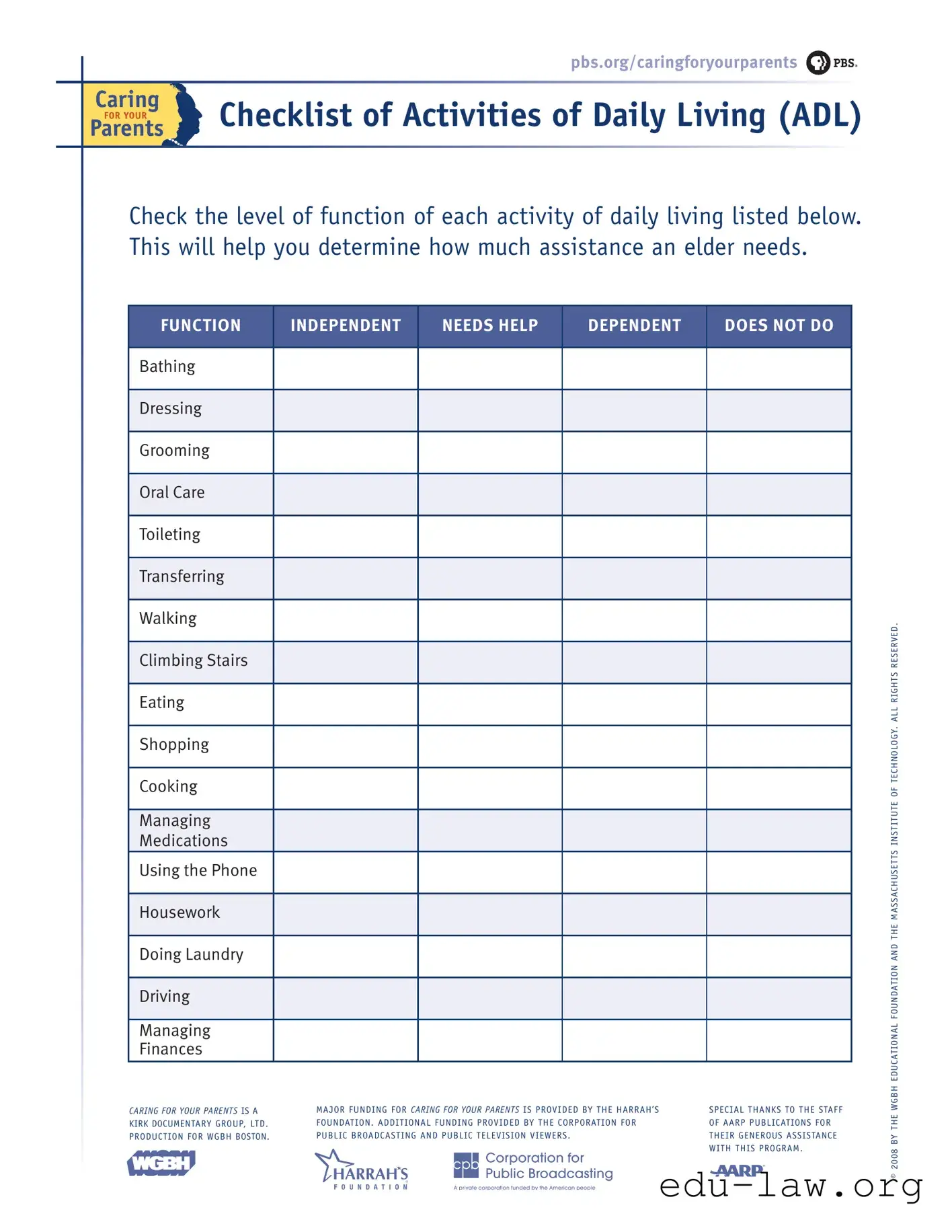
The Checklist Daily Living form serves as a vital tool for assessing the functional abilities of older adults in various everyday activities. By evaluating tasks such as bathing, dressing, grooming, and toileting, caregivers can identify the level of assistance an elder may require. The form categorizes each activity into three distinct levels: independent, needs help, and dependent. This clear classification helps in understanding the specific areas where support is needed. Additionally, the checklist covers essential activities beyond personal care, including managing medications, shopping, cooking, and even driving. By using this form, caregivers can create a comprehensive picture of an elder’s capabilities, ensuring that the right support is provided for their daily living needs. This structured approach not only enhances the quality of care but also promotes the dignity and independence of older adults.
pbs.org/caringforyourparents
Checklist of Activities of Daily Living (ADL)
Check the level of function of each activity of daily living listed below. This will help you determine how much assistance an elder needs.
FUNCTION |
INDEPENDENT |
NEEDS HELP |
DEPENDENT |
DOES NOT DO |
Bathing
Dressing
Grooming
Oral Care
Toileting
Transferring
Walking
Climbing Stairs
Eating
Shopping
Cooking
Managing
Medications
Using the Phone
Housework
Doing Laundry
Driving
Managing
Finances
CARING FOR YOUR PARENTS IS A |
MAJOR FUNDING FOR CARING FOR YOUR PARENTS IS PROVIDED BY THE HARRAH’S |
SPECIAL THANKS TO THE STAFF |
KIRK DOCUMENTARY GROUP, LTD . |
FOUNDATION . ADDITIONAL FUNDING PROVIDED BY THE CORPORATION FOR |
OF AARP PUBLICATIONS FOR |
PRODUCTION FOR WGBH BOSTON. |
PUBLIC BROADCASTING AND PUBLIC TELEVISION VIEWERS . |
THEIR GENEROUS ASSISTANCE |
|
|
WITH THIS PROGRAM . |
© 2008 BY THE WGBH EDUCATIONAL FOUNDATION AND THE MASSACHUSETTS INSTITUTE OF TECHNOLOGY. ALL RIGHTS RESERVED .
| Fact Name | Description |
|---|---|
| Purpose | The Checklist Daily Living form assesses the level of assistance an elder may require for daily activities. |
| Activities Covered | The form includes activities such as bathing, dressing, grooming, and managing medications. |
| Function Levels | Each activity is evaluated based on three levels: Independent, Needs Help, and Dependent. |
| Usefulness | This checklist helps caregivers identify specific areas where support is needed. |
| Legal Framework | In some states, the use of such forms may be governed by elder care laws, including the Older Americans Act. |
| Confidentiality | Information collected through this form must be kept confidential and used solely for care planning. |
| Funding Sources | The program is funded by various organizations, including the Harrah's Foundation and AARP Publications. |
| Target Audience | The checklist is designed for use by family members and caregivers of elderly individuals. |
| Publication Rights | The content is copyrighted by the WGBH Educational Foundation and the Massachusetts Institute of Technology. |
After completing the Checklist Daily Living form, you will have a clearer understanding of the level of assistance needed for daily activities. This can help in making informed decisions about care options and support for the elder in your life.
What is the purpose of the Checklist Daily Living form?
The Checklist Daily Living form is designed to assess the level of assistance an elder may need with daily activities. By evaluating various activities of daily living (ADLs), caregivers can identify areas where support is necessary, ensuring that the elder receives appropriate care and assistance.
What activities are included in the Checklist Daily Living form?
The form includes a range of activities such as bathing, dressing, grooming, oral care, toileting, transferring, walking, climbing stairs, eating, shopping, cooking, managing medications, using the phone, housework, doing laundry, driving, and managing finances. Each activity is crucial for maintaining independence and quality of life.
How do I use the Checklist Daily Living form?
To use the form, review each listed activity and assess the elder's ability to perform it. Mark whether they are independent, need help, or are dependent on others for assistance. This evaluation will provide a clearer picture of their needs and help in planning appropriate support services.
Who can benefit from using this form?
This form can be beneficial for family caregivers, healthcare professionals, and social workers. It helps them understand the elder's capabilities and limitations, allowing for tailored care plans that enhance the elder's well-being and independence.
How often should the Checklist Daily Living form be completed?
It is advisable to complete the form periodically, especially after significant changes in health or living conditions. Regular assessments can help track changes in the elder's abilities and ensure that their care needs are being met effectively.
Is there any training required to fill out the Checklist Daily Living form?
No formal training is required to complete the form. However, caregivers should have a basic understanding of the elder's daily routines and challenges. This familiarity will enable them to make accurate assessments regarding the elder's level of independence.
Where can I find more resources related to the Checklist Daily Living form?
Additional resources can be found on websites dedicated to elder care, such as PBS's Caring for Your Parents. These resources often include guides, articles, and support networks that can assist caregivers in providing the best care possible.
Not understanding the definitions of each activity. Each task, like bathing or managing finances, has specific criteria. Clarity is key.
Failing to assess accurately. It's important to evaluate the elder's true capabilities. Be honest about their needs.
Rushing through the form. Take your time to ensure each section is filled out correctly. Accuracy is crucial.
Overlooking the importance of details. Small nuances can significantly affect the level of assistance needed.
Using vague language. Be specific when indicating the level of independence or assistance required.
Ignoring changes in the elder's condition. Regularly update the form to reflect any new challenges or improvements.
Not involving the elder in the process. Their input is valuable and can provide insights into their daily living needs.
Neglecting to consult with caregivers or family members. They may have observations that can help in filling out the form accurately.
Submitting the form without reviewing it. Double-check for completeness and accuracy before finalizing.
The Checklist Daily Living form is an essential tool for assessing the level of assistance an elder may require in performing daily activities. Alongside this form, several other documents can provide valuable insights and support in caregiving situations. Below is a list of additional forms and documents that are commonly used in conjunction with the Checklist Daily Living form.
Utilizing these documents in conjunction with the Checklist Daily Living form can create a comprehensive approach to caregiving. Each piece of information contributes to a clearer understanding of the elder's needs, ensuring that they receive the best possible support and care.
The Checklist of Activities of Daily Living (ADL) is similar to the Functional Independence Measure (FIM). Both documents assess an individual's ability to perform basic daily tasks. The FIM evaluates a person's functional independence across a broader spectrum of activities, including mobility and communication. Like the ADL checklist, the FIM uses a scoring system to determine the level of assistance required, helping caregivers and healthcare providers identify areas where support is needed. This common goal of measuring functional capacity makes both tools valuable in care planning.
Another document comparable to the Checklist of Activities of Daily Living is the Katz Index of Independence in Activities of Daily Living. This index focuses specifically on six basic activities: bathing, dressing, toileting, transferring, continence, and feeding. Similar to the ADL checklist, the Katz Index categorizes individuals as independent, needing assistance, or dependent in these activities. This straightforward approach provides a clear picture of an elder's functional status, enabling caregivers to tailor their support effectively.
The Barthel Index is also akin to the Checklist of Activities of Daily Living. This tool measures performance in daily activities, specifically in the context of rehabilitation settings. The Barthel Index evaluates ten different tasks, including mobility and self-care activities. Like the ADL checklist, it assigns scores based on the level of assistance required, which helps in determining the appropriate level of care and monitoring progress over time. Both documents serve to enhance understanding of an individual's capabilities and needs.
Lastly, the Lawton Instrumental Activities of Daily Living Scale shares similarities with the Checklist of Activities of Daily Living. While the ADL checklist focuses on basic self-care tasks, the Lawton Scale assesses more complex activities, such as managing finances, shopping, and using the telephone. Both tools aim to gauge an individual's functional ability and need for assistance. They provide caregivers and healthcare professionals with essential insights into the support required for maintaining independence in daily living.
When filling out the Checklist Daily Living form, keep the following tips in mind:
There are several misconceptions surrounding the Checklist Daily Living form that can lead to misunderstandings about its purpose and use. Here are five common misconceptions:
Filling out the Checklist Daily Living form is an important step in understanding the needs of an elder. This form focuses on Activities of Daily Living (ADLs) and helps caregivers assess the level of assistance required. Here are some key takeaways to consider:
By carefully filling out the Checklist Daily Living form, you can better understand the needs of your loved one and ensure they receive the support they deserve.