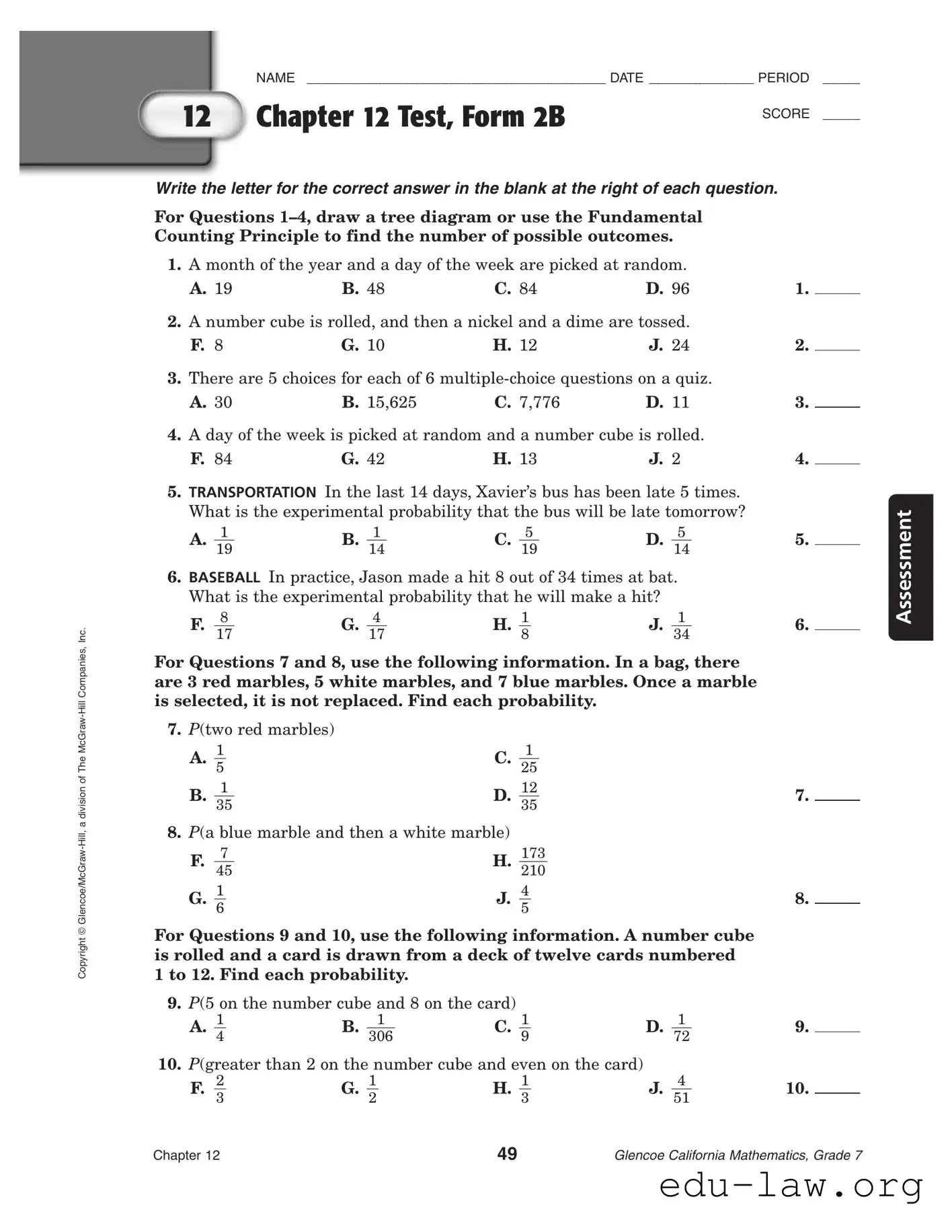
The Chapter 12 Test form is an essential tool designed for assessing students' understanding of probability and statistics, particularly in a seventh-grade mathematics context. This test, identified as Form 2B, includes a variety of questions that challenge students to apply their knowledge in practical scenarios. For example, students are asked to determine the number of possible outcomes when selecting a month and a day of the week, utilizing methods such as tree diagrams or the Fundamental Counting Principle. The form also incorporates real-life applications, such as calculating the experimental probability of a bus being late based on past occurrences and evaluating baseball statistics to predict future performance. Furthermore, the test encourages critical thinking by prompting students to analyze survey data regarding favorite fruit juices and to interpret results from random sampling in the context of elections. Each question is carefully crafted to not only assess mathematical skills but also to foster a deeper understanding of probability in everyday situations.
Copyright ©
|
NAME ________________________________________ DATE ______________ PERIOD |
_____ |
|
12 |
Chapter 12 Test, Form 2B |
SCORE |
_____ |
|
|
||
Write the letter for the correct answer in the blank at the right of each question.
For Questions
1.A month of the year and a day of the week are picked at random.
A. 19 |
B. 48 |
C. 84 |
D. 96 |
1. |
2.A number cube is rolled, and then a nickel and a dime are tossed.
F. 8 |
G. 10 |
H. 12 |
J. 24 |
2. |
3.There are 5 choices for each of 6
A. 30 |
B. 15,625 |
C. 7,776 |
D. 11 |
3. |
4.A day of the week is picked at random and a number cube is rolled.
F. 84 |
G. 42 |
H. 13 |
J. 2 |
4. |
5.TRANSPORTATION In the last 14 days, Xavier’s bus has been late 5 times. What is the experimental probability that the bus will be late tomorrow?
1 |
1 |
C. |
5 |
D. |
5 |
5. |
A. |
B. |
|||||
19 |
14 |
|
19 |
|
14 |
|
6.BASEBALL In practice, Jason made a hit 8 out of 34 times at bat. What is the experimental probability that he will make a hit?
F. |
8 |
4 |
1 |
J. |
1 |
6. |
G. |
H. |
|||||
|
17 |
17 |
8 |
|
34 |
|
For Questions 7 and 8, use the following information. In a bag, there are 3 red marbles, 5 white marbles, and 7 blue marbles. Once a marble is selected, it is not replaced. Find each probability.
7.P(two red marbles)
1 |
C. |
1 |
|
A. |
|
||
5 |
|
25 |
|
1 |
D. |
12 |
7. |
B. |
|||
35 |
|
35 |
|
8.P(a blue marble and then a white marble)
F. |
7 |
|
173 |
|
H. |
|
|||
|
45 |
|
210 |
|
|
1 |
J. |
4 |
8. |
G. |
||||
|
6 |
|
5 |
|
For Questions 9 and 10, use the following information. A number cube is rolled and a card is drawn from a deck of twelve cards numbered 1 to 12. Find each probability.
9.P(5 on the number cube and 8 on the card)
1 |
1 |
|
1 |
|
1 |
|
|
|
A. |
B. |
C. |
D. |
9. |
|
|
||
4 |
306 |
|
9 |
|
72 |
|
|
|
10. P(greater than 2 on the number cube and even on the card) |
|
|
|
|
||||
2 |
1 |
|
1 |
|
4 |
|
|
|
F. |
G. |
H. |
J. |
10. |
|
|
||
3 |
2 |
|
3 |
|
51 |
|
|
|
Chapter 12 |
|
49 |
|
GLENCOE CALIFORNIA MATHEMATICS, GRADE 7 |
||||
ASSESSMENT
|
NAME ________________________________________ DATE ______________ PERIOD _____ |
12 |
Chapter 12 Test, Form 2B (CONTINUED) |
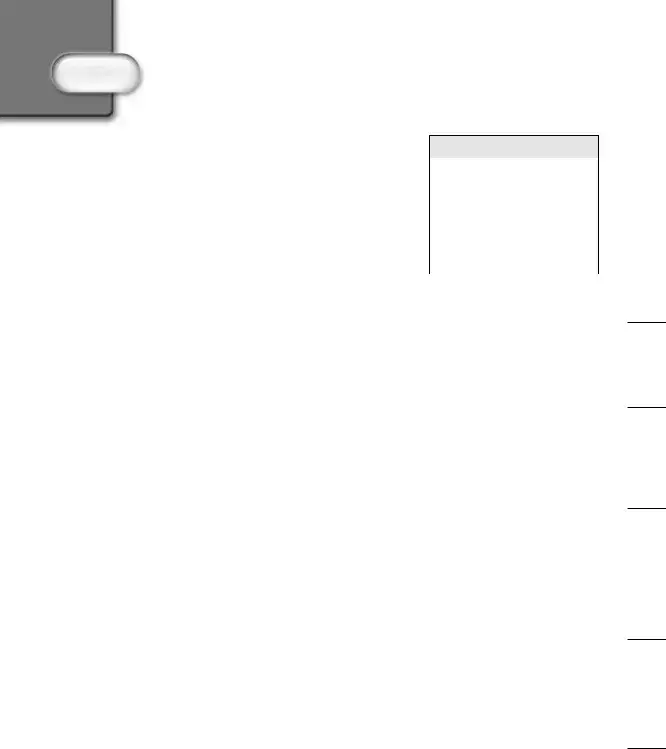
DRINKS For Questions 11 and 12, use the results of a survey of 60 people shown at the right.
Favorite Fruit Juices
orange |
21 |
|
|
grapefruit |
6 |
|
|
pineapple |
10 |
|
|
apple |
15 |
|
|
tomato |
8 |
|
|
11.What is the probability that a person’s favorite juice is apple?
1 |
B. 15 |
C. |
3 |
A. |
|||
4 |
|
|
20 |
12.What is the probability that a person’s favorite juice is
F. |
1 |
H. 10 |
|
|
6 |
|
|
G. |
5 |
J. |
1 |
|
6 |
|
2 |
1
D.
NOT pineapple?
12.
13.BASKETBALL This season, Sue has made 75% of her free throw shots. What
is the probability that she will make her next three free throw shots?
A. |
36 |
C. |
27 |
|
|
||||
|
169 |
|
64 |
|
B. |
15 |
D. |
32 |
13. |
|
37 |
|
49 |
|
14.To evaluate the satisfaction of its customers, a local car dealer selects every tenth customer on its alphabetic customer list. Describe the sample.
F. voluntary response
G. convenience |
|
H. stratified random |
|
J. systematic random |
14. |
ELECTIONS For Questions 15 and 16, use the following information. As voters leave the polling place, 250 voters are surveyed at random.
15.What percent said they voted for the incumbent?
A. 30% |
B. 45% |
C. 50% |
D. 75% |
15. |
16.If 1,400 people vote, how many do you think will vote for the incumbent? F. 420 people
G. 630 people |
|
|
|
|
|
|
H. 700 people |
|
|
|
|
|
|
J. 1,050 people |
|
|
16. |
|
|
|
|
|
|
|
|||
Bonus Each arrangement of the letters in the word BONUS is |
B: |
|
|
|
||
placed on a piece of paper. One paper is selected at |
|
|
|
|
|
|
random. What is the probability that the word ends in OUN? |
||||||
Chapter 12 |
50 |
GLENCOE CALIFORNIA MATHEMATICS, GRADE 7 |
||||
Copyright ©
| Fact Name | Fact Description |
|---|---|
| Form Title | This is the Chapter 12 Test, Form 2B, designed for Grade 7 mathematics. |
| Publisher | The form is published by Glencoe/McGraw-Hill, a division of The McGraw-Hill Companies, Inc. |
| Test Structure | The test consists of multiple-choice questions that assess understanding of probability and outcomes. |
| Question Format | Each question requires students to select the correct answer from given options. |
| Tree Diagrams | Students are encouraged to use tree diagrams or the Fundamental Counting Principle for specific questions. |
| Experimental Probability | Questions include scenarios for calculating experimental probability based on real-life examples. |
| Survey Data | The test incorporates survey results, such as favorite fruit juices, to enhance engagement. |
| Random Sampling | One question focuses on systematic random sampling, illustrating its application in surveys. |
| Election Statistics | Some questions involve interpreting election data, such as percentages of voters supporting candidates. |
| Bonus Question | A bonus question challenges students to calculate the probability of letter arrangements in the word "BONUS." |
Once you have gathered all necessary materials, you can begin filling out the Chapter 12 Test form. This process will help you organize your answers clearly and ensure that all required sections are completed accurately.
What is the purpose of the Chapter 12 Test Form?
The Chapter 12 Test Form is designed to assess students' understanding of various mathematical concepts covered in Chapter 12. It includes questions that require students to apply their knowledge of probability, counting principles, and basic statistics. By completing this test, students can demonstrate their grasp of the material and identify areas where they may need further practice.
How should I complete the test?
To complete the test, write your name, date, and period at the top of the form. For each question, carefully read the prompt and determine the correct answer. Write the letter corresponding to your answer in the blank provided. For questions that require drawing or calculations, ensure you show your work clearly. This will help you understand the concepts better and may earn you partial credit if your final answer is incorrect.
What types of questions are included in the test?
The test includes a variety of question types, such as multiple-choice questions, probability calculations, and application problems. Students will encounter scenarios involving rolling dice, selecting marbles, and analyzing survey data. These questions encourage critical thinking and the application of mathematical principles in real-world contexts.
How is the test scored?
The test is scored based on the number of correct answers. Each question typically has one correct answer, and students should aim to answer as many questions correctly as possible. The total score can be calculated by counting the number of correct responses. Teachers may also provide feedback on specific questions to help students improve their understanding.
What is the experimental probability, and how is it calculated?
Experimental probability refers to the likelihood of an event occurring based on actual results from an experiment or observation. To calculate it, divide the number of times the event occurs by the total number of trials conducted. For example, if a bus is late 5 times out of 14 days, the experimental probability of the bus being late tomorrow is 5 divided by 14.
Can I use a calculator while taking the test?
Whether you can use a calculator depends on your teacher's instructions. Some questions may require simple calculations that can be done mentally, while others may benefit from a calculator for accuracy. Always check with your teacher before the test to clarify their policy on calculator use.
What should I do if I don’t understand a question?
If you encounter a question you don’t understand, take a moment to reread it carefully. Look for keywords that might help clarify what is being asked. If you are still unsure, it’s best to move on to the next question and return to it later if time permits. Asking your teacher for clarification before the test can also be beneficial.
Is there a bonus question on the test?
Yes, there is a bonus question at the end of the test. This question typically challenges students to apply their knowledge in a unique way. It provides an opportunity to earn extra points and demonstrate a deeper understanding of the material. Be sure to attempt the bonus question if you have time!
How can I prepare for the Chapter 12 Test?
To prepare for the Chapter 12 Test, review your class notes, homework assignments, and any practice tests provided by your teacher. Focus on understanding key concepts such as probability and counting principles. Practicing problems similar to those on the test will also help reinforce your skills. Consider forming a study group with classmates to discuss challenging topics and quiz each other.
Failing to write the name and date clearly at the top of the form can lead to confusion about who completed the test.
Not marking the period correctly may result in misplacement of the test in the grading process.
Leaving the score section blank prevents the instructor from easily tracking performance.
Omitting to draw a tree diagram or using the Fundamental Counting Principle for questions 1-4 may lead to incorrect answers.
Not reviewing the probabilities for questions 5-8 thoroughly can result in errors in calculations.
Overlooking the instructions for questions 9-10 regarding the number cube and card can cause misunderstanding.
Failing to calculate the percentages correctly in questions 15-16 may lead to inaccurate conclusions.
Neglecting to check for neatness and legibility can make it difficult for the instructor to read the answers.
The Chapter 12 Test form is a valuable tool for assessing students' understanding of mathematical concepts, particularly those related to probability and outcomes. However, several other forms and documents often accompany it to facilitate a comprehensive educational experience. Below is a list of commonly used forms that complement the Chapter 12 Test.
By utilizing these supplementary documents, educators can create a well-rounded assessment strategy that not only evaluates student performance but also fosters a deeper understanding of the material. This holistic approach ultimately enhances the learning experience for all students.
The Chapter 12 Test form shares similarities with standardized test answer sheets. Both documents require students to mark their answers in designated spaces. Standardized tests often include multiple-choice questions, where students select the correct answer from a list. Like the Chapter 12 Test, these answer sheets are designed for easy scoring, whether by hand or electronically. They also typically include spaces for student information, such as name and date, ensuring that each test is properly attributed to the correct individual.
Another document similar to the Chapter 12 Test form is a classroom quiz. Quizzes often assess the same content areas, such as math or science, and may also include multiple-choice questions. Both documents aim to evaluate student understanding and retention of the material covered in class. Additionally, quizzes often require students to show their work or reasoning, much like the Chapter 12 Test encourages drawing diagrams or applying principles to solve problems.
Practice exams also resemble the Chapter 12 Test form. These documents serve as preparatory tools for students, helping them familiarize themselves with the format and types of questions they may encounter on actual tests. Like the Chapter 12 Test, practice exams often include a variety of question formats, including multiple-choice and probability problems. Both documents emphasize the importance of applying learned concepts to real-world scenarios.
Worksheets used in math classes share characteristics with the Chapter 12 Test form. Worksheets often include problems that require similar skills, such as calculating probabilities or drawing diagrams. Both documents are designed to reinforce concepts taught in class and provide students with opportunities to practice problem-solving. While worksheets may not always be graded, they serve a similar purpose in assessing student understanding.
Lastly, review sheets that summarize key concepts before a test are comparable to the Chapter 12 Test form. Review sheets often highlight important formulas, definitions, and problem types, preparing students for the types of questions they will face. Like the Chapter 12 Test, these documents are structured to guide students in their study efforts and reinforce their learning. Both serve as valuable tools for assessing readiness and comprehension of the subject matter.
When filling out the Chapter 12 Test form, there are several important dos and don'ts to keep in mind to ensure clarity and accuracy in your responses. Below is a list of seven things to consider.
Misconceptions about the Chapter 12 Test form can lead to confusion regarding its purpose and structure. Here are ten common misconceptions, along with explanations to clarify them:
This test is designed for students in grade 7, covering various topics in mathematics, but it can be beneficial for anyone interested in these concepts.
While some questions may involve calculations, many require understanding concepts and applying basic principles rather than complex math.
The format may vary slightly from year to year, but the fundamental concepts assessed remain consistent to ensure students grasp the material.
While students may choose to skip questions, they miss the opportunity to earn points and demonstrate their understanding of the material.
Depending on the teacher's discretion, this test can be graded and contribute to the overall assessment of a student's performance.
Preparation is important. Reviewing the material covered in class can significantly improve performance on the test.
This test evaluates not only memory but also problem-solving skills and the ability to apply mathematical concepts in various scenarios.
While many questions are multiple-choice, some require students to show their work or explain their reasoning, allowing for a deeper understanding of the material.
Students may find that taking time to think through each question leads to better answers and a more comprehensive understanding of the subject matter.
Many questions are designed to reflect real-life scenarios, helping students see the practical application of mathematical concepts.
Filling out and using the Chapter 12 Test form effectively can enhance your understanding of the material. Here are some key takeaways to keep in mind: