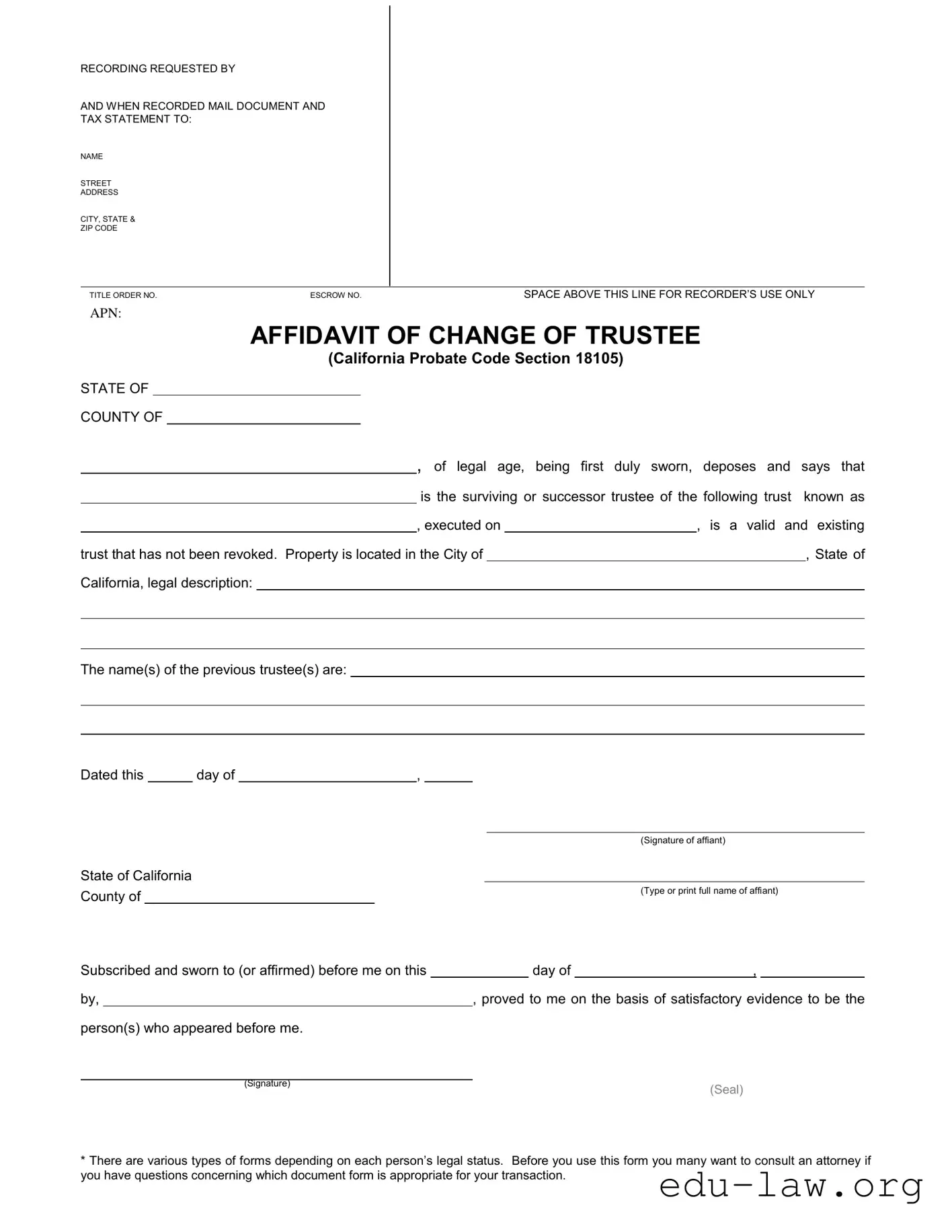
The Change Trustee form serves as an essential document for individuals managing trusts in California. It facilitates the formal process of appointing a new trustee when changes occur, ensuring that the trust's administration continues smoothly. This form is particularly important for maintaining the integrity of the trust, as it provides legal evidence of the change in trusteeship. Key components include the identification of the new trustee, the previous trustee's details, and a declaration affirming the trust's validity. Additionally, it requires the affiant to provide a sworn statement, which adds a layer of authenticity to the document. The form also includes space for recording information, such as the property’s legal description and the county where the trust is situated. Given the complexities involved, individuals may benefit from consulting with an attorney to determine the appropriate form for their specific situation, ensuring compliance with California Probate Code Section 18105.

RECORDING REQUESTED BY
AND WHEN RECORDED MAIL DOCUMENT AND
TAX STATEMENT TO:
NAME
STREET
ADDRESS
CITY, STATE &
ZIP CODE
TITLE ORDER NO. |
ESCROW NO. |
SPACE ABOVE THIS LINE FOR RECORDER’S USE ONLY |
APN:
AFFIDAVIT OF CHANGE OF TRUSTEE
(CALIFORNIA PROBATE CODE SECTION 18105)
STATE OF
COUNTY OF
|
|
, of legal age, |
being first duly sworn, |
deposes and |
says that |
||||
|
|
is the surviving or successor trustee of the following trust |
known as |
||||||
|
, executed on |
, |
is a valid and existing |
||||||
|
|
|
|
|
|
|
|
|
|
trust that has not been revoked. Property is located in the City of |
|
|
|
|
|
, State of |
|||
California, legal description: |
|
|
|
|
|
||||
|
|
|
|
|
|
|
|
|
|
|
|
|
|
|
|
|
|
|
|
The name(s) of the previous trustee(s) are:
Dated this |
|
day of |
|
, |
State of California
County of
Subscribed and sworn to (or affirmed) before me on this by,
person(s) who appeared before me.
(Signature of affiant)
(Type or print full name of affiant)
day of,
, proved to me on the basis of satisfactory evidence to be the
(Signature)
(Seal)
*There are various types of forms depending on each person’s legal status. Before you use this form you many want to consult an attorney if you have questions concerning which document form is appropriate for your transaction.
| Fact Name | Description |
|---|---|
| Purpose | The Change Trustee form is used to officially document a change in the trustee of a trust. |
| Governing Law | This form is governed by the California Probate Code, specifically Section 18105. |
| Affidavit Requirement | An affidavit must be included, confirming the validity of the trust and the authority of the new trustee. |
| Recording | The form must be recorded with the appropriate county recorder's office to be legally recognized. |
| Legal Advice | Consulting an attorney is advisable to ensure the correct form is used for your specific situation. |
Once you have gathered all necessary information, you can proceed to fill out the Change Trustee form. This form is essential for updating the trustee information in relation to a trust. Follow these steps carefully to ensure that all information is accurately recorded.
After completing the form, make sure to review it for accuracy. Once confirmed, you can submit it to the appropriate recording office for processing. This step is crucial in ensuring that the change is officially recognized.
What is the Change Trustee form?
The Change Trustee form is a legal document used in California to officially record the change of a trustee for a trust. It serves as an affidavit that verifies the new trustee's authority and confirms that the trust remains valid and has not been revoked. This form is essential for ensuring that the trust is administered correctly and that the new trustee can manage the trust's assets effectively.
Who needs to fill out the Change Trustee form?
This form is typically filled out by the surviving or successor trustee of a trust. If a trustee has passed away or is no longer able to fulfill their duties, the successor trustee must complete this form to establish their authority. It is important for anyone assuming the role of trustee to ensure that the proper legal documentation is in place to avoid potential disputes or complications in managing the trust.
What information is required on the form?
The Change Trustee form requires several key pieces of information. This includes the names of the trust, the previous trustee(s), the legal description of the property held in the trust, and the date the trust was executed. Additionally, the form must be signed and dated by the new trustee, and it may require notarization to confirm the identity of the person signing the document.
Is notarization necessary for the Change Trustee form?
Yes, notarization is typically required for the Change Trustee form. This step helps to ensure the authenticity of the signatures and provides a layer of protection against fraud. The notary public will verify the identity of the person signing the form and will affix their seal to the document, making it legally binding.
Where should the completed Change Trustee form be filed?
The completed Change Trustee form must be recorded with the county recorder’s office in the county where the property is located. This ensures that the change in trusteeship is officially recognized and can be referenced in public records. It is advisable to keep a copy of the recorded form for personal records and future reference.
Can I use the Change Trustee form without legal assistance?
While it is possible to complete the Change Trustee form without legal assistance, it is highly recommended to consult with an attorney. An attorney can provide guidance on whether this form is appropriate for your specific situation and ensure that all necessary information is included. Legal advice can help prevent errors that could lead to complications in the future.
What happens if the Change Trustee form is not filed?
If the Change Trustee form is not filed, the previous trustee may still be considered the legal trustee, which can lead to confusion and potential disputes regarding the management of the trust. Failure to properly document the change can hinder the new trustee's ability to act on behalf of the trust, affecting the distribution of assets and overall trust administration. Therefore, it is crucial to file the form promptly to avoid such issues.
Incomplete Information: Failing to provide all required details, such as names, addresses, or dates, can lead to delays. Ensure every section is filled out completely.
Incorrect Legal Description: The legal description of the property must be accurate. Mistakes here can cause issues with the trust's validity and property transfer.
Signature Issues: All signatures must be present and correctly executed. Missing signatures or incorrect titles can invalidate the form.
Not Consulting Legal Advice: Many individuals skip the step of seeking legal counsel. Consulting an attorney can help ensure the correct form is used and filled out properly.
When managing a trust, various forms and documents are often utilized alongside the Change Trustee form. Each document serves a specific purpose in ensuring that the transition of trustee responsibilities is handled smoothly and legally. Below is a list of commonly used documents that complement the Change Trustee form.
Each of these documents plays a vital role in the management and transition of trust responsibilities. Understanding their purpose and how they interact with the Change Trustee form can help ensure a seamless process for all parties involved.
The Affidavit of Change of Trustee is a document that serves a similar purpose to the Change Trustee form. It officially records the change in trusteeship and provides a sworn statement confirming the new trustee's authority. This affidavit is particularly useful in California, as it complies with the Probate Code Section 18105. By including essential details such as the trust's name, the previous trustee's names, and the property description, it ensures that all relevant information is documented. This helps to prevent disputes over the trust's management and clarifies the transition of responsibilities.
Another document that shares similarities with the Change Trustee form is the Trustee's Deed. This legal instrument is used when a trustee transfers property from the trust to a beneficiary or another party. Like the Change Trustee form, the Trustee's Deed requires specific information about the trust and the parties involved. It serves to formalize the transfer of ownership and provides a clear record of the transaction. Both documents aim to maintain transparency and protect the interests of all parties involved in the trust.
The Certificate of Trust is also akin to the Change Trustee form, as it verifies the existence of a trust and the authority of the trustee. This document is often used to provide proof of the trust's validity without disclosing the entire trust agreement. By summarizing key details such as the trust's name, date of creation, and the trustee's powers, it streamlines transactions involving trust property. The Certificate of Trust helps facilitate dealings with financial institutions and other entities, ensuring that the trustee can act on behalf of the trust efficiently.
Lastly, the Revocation of Trust is another document that can be compared to the Change Trustee form. This form is utilized when a trust is being terminated or revoked, effectively removing the trustee's authority. While the Change Trustee form focuses on appointing a new trustee, the Revocation of Trust serves to dissolve the existing arrangement. Both documents are crucial in managing trust affairs, but they represent opposite actions. The Revocation of Trust ensures that all parties are aware of the trust's dissolution, preventing any future confusion regarding the management of the trust assets.
When filling out the Change Trustee form, it is important to follow certain guidelines to ensure accuracy and compliance. Here is a list of things you should and shouldn't do:
Understanding the Change Trustee form can be challenging. Here are seven common misconceptions that can lead to confusion:
Clarifying these misconceptions can help individuals navigate the process more effectively and ensure that their trust is managed according to their wishes.
Understanding the Change Trustee form is essential for ensuring a smooth transition of trust management. Here are some key takeaways to keep in mind:
By keeping these points in mind, you can navigate the process of changing a trustee with confidence and clarity.