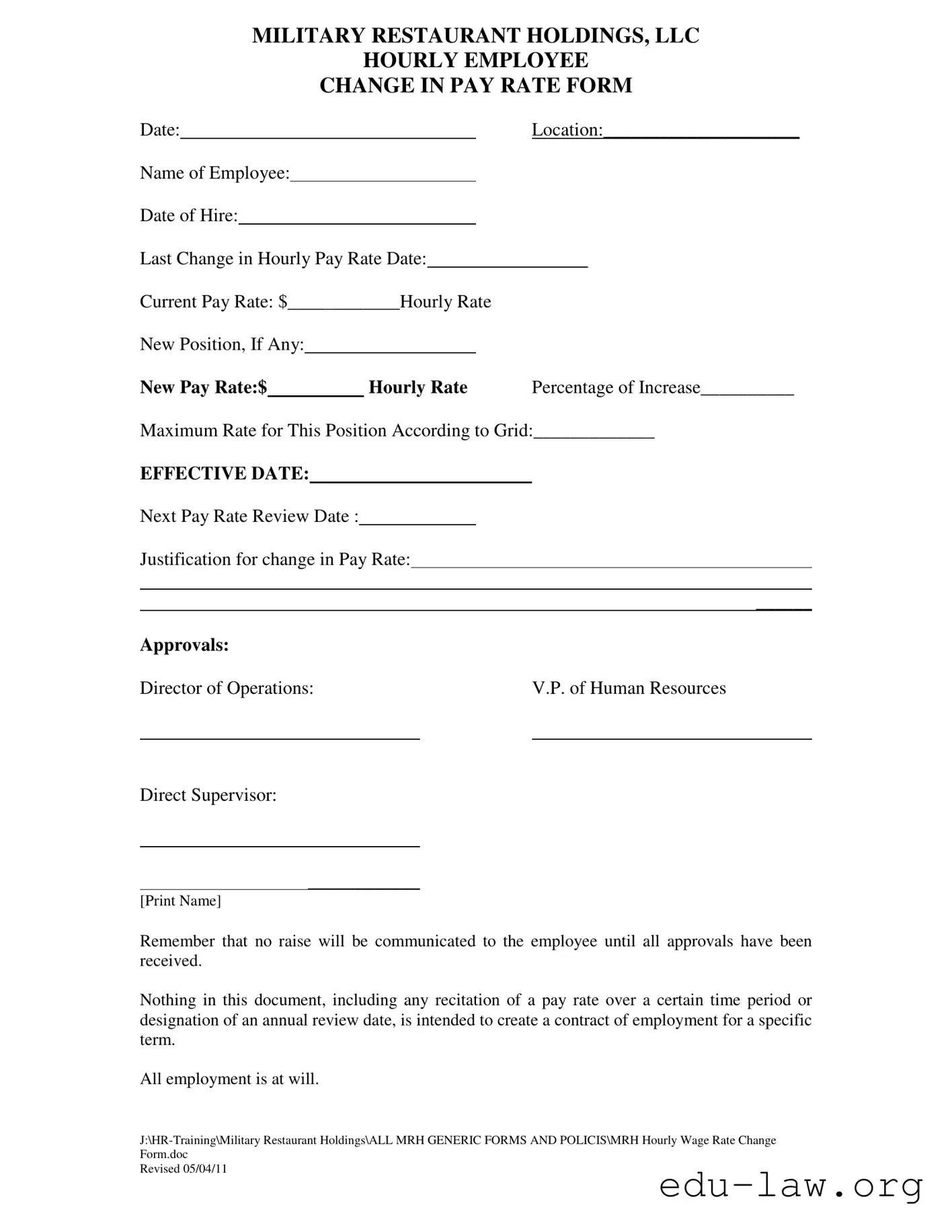
When it comes to managing employee compensation, clarity and accuracy are essential. The Change Pay Rate form is a vital tool for organizations like Military Restaurant Holdings, LLC, ensuring that any adjustments to hourly wages are documented and approved systematically. This form captures important details, including the employee's name, current pay rate, and any new position they may be transitioning into. It also outlines the percentage of increase in pay and the maximum rate for the position according to the established grid. The effective date of the new pay rate and the next review date are crucial for both the employee and management. Justifications for the pay change must be provided, and several key approvals are required before any raise is communicated to the employee. It’s important to remember that while this form outlines pay changes, it does not create a contract of employment for a specific term, as all employment is at will. Understanding how to properly fill out and utilize this form can help ensure a smooth process for both employees and employers.

|
|
MILITARY RESTAURANT HOLDINGS, LLC |
|||||||||
|
|
|
|
|
HOURLY EMPLOYEE |
||||||
|
|
|
|
|
CHANGE IN PAY RATE FORM |
||||||
Date: |
|
|
|
|
|
|
Location:_____________________ |
||||
Name of Employee: |
|
|
|
|
|
|
|
|
|||
Date of Hire: |
|
|
|
|
|
|
|
|
|||
Last Change in Hourly Pay Rate Date: |
|
|
|
||||||||
Current Pay Rate: $____________Hourly Rate |
|
|
|||||||||
New Position, If Any: |
|
|
|
|
|
|
|
||||
New Pay Rate:$ |
|
|
Hourly Rate |
Percentage of Increase__________ |
|||||||
Maximum Rate for This Position According to Grid:_____________
EFFECTIVE DATE:
Next Pay Rate Review Date :
Justification for change in Pay Rate:
______
Approvals:
Director of Operations: |
|
V.P. of Human Resources |
|
|
|
Direct Supervisor:
____________
[Print Name]
Remember that no raise will be communicated to the employee until all approvals have been received.
Nothing in this document, including any recitation of a pay rate over a certain time period or designation of an annual review date, is intended to create a contract of employment for a specific term.
All employment is at will.
Form.doc
Revised 05/04/11
| Fact Name | Description |
|---|---|
| Purpose of the Form | The Change Pay Rate form is used to document any changes in the hourly pay rate of employees, ensuring that all adjustments are properly recorded and approved. |
| Approval Process | Before any pay raise is communicated to the employee, the form must receive approvals from the Director of Operations, V.P. of Human Resources, and the employee's direct supervisor. |
| Effective Date | The form specifies an effective date for the new pay rate, which is crucial for payroll processing and employee communication. |
| At-Will Employment | This form includes a disclaimer stating that nothing in the document creates a contract of employment for a specific term, reinforcing the at-will nature of employment. |
| State-Specific Regulations | Depending on the state, various labor laws may govern the process of changing pay rates. It's essential to consult state-specific regulations to ensure compliance. |
After completing the Change Pay Rate form, it will be submitted for approval. This process involves several steps to ensure that all necessary information is accurately provided and that the appropriate parties have reviewed the request before any changes are communicated to the employee.
What is the purpose of the Change Pay Rate form?
The Change Pay Rate form is used by Military Restaurant Holdings, LLC to document any changes in an employee's hourly pay rate. This includes increases or adjustments due to a new position or other factors. The form ensures that all necessary approvals are obtained before communicating any changes to the employee.
What information do I need to provide on the form?
You will need to fill out several key details on the form. This includes the employee's name, date of hire, current pay rate, new pay rate, and justification for the change. Additionally, you must indicate the effective date of the new pay rate and the next review date. It is also important to include the maximum rate for the position according to the pay grid.
Who needs to approve the Change Pay Rate form?
The form requires approval from several individuals before any pay rate change is communicated to the employee. Specifically, the Director of Operations, the Vice President of Human Resources, and the employee's direct supervisor must all sign off on the change. This multi-level approval process helps ensure that pay adjustments are fair and justified.
Will the employee be informed of the pay rate change immediately?
No, the employee will not be informed of any pay rate change until all necessary approvals have been received. This ensures that the company maintains a consistent and organized approach to pay adjustments. It is important to wait for the complete approval process to avoid any misunderstandings.
Failing to include the effective date of the pay rate change can lead to confusion. Make sure to specify when the new rate will take effect.
Omitting the justification for the change can hinder the approval process. Clearly explain the reasons for the adjustment.
Not completing all required signatures can delay the implementation of the new pay rate. Ensure that all necessary approvals are obtained before submission.
Leaving the current pay rate blank is a common oversight. Always fill in the existing hourly rate to provide context for the change.
Forgetting to specify the new position, if applicable, can lead to misunderstandings. Clearly indicate if the employee is transitioning to a different role.
Not calculating the percentage of increase correctly can create discrepancies. Double-check your math to ensure accuracy.
Failing to review the maximum rate for the position according to the grid can result in non-compliance. Always verify that the new pay rate aligns with company policies.
When an organization decides to change an employee's pay rate, several other forms and documents may be required to ensure a smooth and compliant process. Each of these documents plays a crucial role in maintaining clear communication and proper record-keeping within the organization. Below is a list of commonly used forms that often accompany the Change Pay Rate form.
Utilizing these forms and documents alongside the Change Pay Rate form can help streamline the process and ensure that all necessary information is collected and communicated effectively. This approach not only fosters transparency but also supports a positive work environment where employees feel valued and informed about their compensation.
The Employee Evaluation Form serves a similar purpose as the Change Pay Rate form. It documents an employee's performance and can provide justification for pay adjustments. Both forms require specific details about the employee, such as their name and position, and both are used in conjunction with managerial approvals. The evaluation form may include feedback on performance metrics, which can influence decisions about salary changes.
The Promotion Request Form is another document that shares similarities with the Change Pay Rate form. When an employee is promoted, their pay rate often changes. This form outlines the request for promotion and typically includes the employee's current position, the new position they are seeking, and the proposed new salary. Like the Change Pay Rate form, it also requires managerial signatures to finalize the decision.
The Salary Adjustment Request Form is also comparable. This document is used to request a change in an employee’s salary due to various factors such as market adjustments or internal equity. It includes the employee’s current salary, proposed new salary, and justification for the change. Both forms emphasize the importance of approval from higher management before any changes are communicated to the employee.
The Job Offer Letter is another related document. When a new employee is hired, the job offer letter outlines the terms of employment, including the salary. This document, like the Change Pay Rate form, requires clear communication of pay rates and may include conditions for salary adjustments based on performance or tenure. Both documents serve to formalize the terms of employment.
The Termination Letter can also be compared to the Change Pay Rate form in terms of documenting employment status. While the Change Pay Rate form communicates changes in pay, the termination letter communicates the end of employment. Each document requires careful consideration and approval from management, ensuring that all necessary protocols are followed.
The Time-Off Request Form bears similarities as well. While it primarily addresses an employee's request for leave, it can impact pay rates, especially for hourly employees. This form requires details about the employee and the time requested off, similar to how the Change Pay Rate form requires specific employee information and justification for changes. Both documents necessitate managerial approval before finalizing any changes.
The Benefits Enrollment Form is another document that relates to employee compensation. While it focuses on benefits rather than direct pay, it can affect an employee's overall compensation package. This form collects information about the employee and their chosen benefits, paralleling the Change Pay Rate form's requirement for employee details and managerial approval.
The Payroll Deduction Authorization Form is similar in that it involves changes to an employee's compensation structure. This document allows employees to authorize deductions from their paychecks for various reasons, such as retirement contributions or health insurance premiums. Both forms require careful attention to detail and proper approvals to ensure compliance with company policies.
Finally, the Annual Compensation Review Form is relevant. This document is used to evaluate and document annual salary adjustments for employees. It includes performance metrics and justifications for any changes in pay, similar to the Change Pay Rate form. Both forms highlight the importance of management input and the need for clear communication regarding pay changes.
When filling out the Change Pay Rate form, keep these important guidelines in mind:
There are several misconceptions surrounding the Change Pay Rate form used by Military Restaurant Holdings, LLC. Understanding these can help clarify the process and expectations for employees and supervisors alike.
Submitting the Change Pay Rate form does not guarantee that an employee will receive a pay increase. The form is simply a request that requires approvals from various levels of management.
Changes in pay rates are not effective until all necessary approvals have been obtained. Employees will not be informed of any pay changes until this process is complete.
Nothing in the Change Pay Rate form establishes a contract for employment. Employment remains at will, meaning either the employee or employer can terminate the relationship at any time.
The Change Pay Rate form can be used for various reasons, including changes in position or adjustments to pay rates for other reasons, not just raises.
While there is a section for the next pay rate review date, it does not mean that all employees will receive a review. Reviews are subject to company policy and management discretion.
A justification for the change in pay rate is necessary. This helps ensure that all changes are based on valid reasons and are in line with company policies.
When utilizing the Change Pay Rate form, it is essential to keep several key points in mind to ensure a smooth process.
By adhering to these guidelines, the process of changing an employee's pay rate can be managed effectively and transparently.