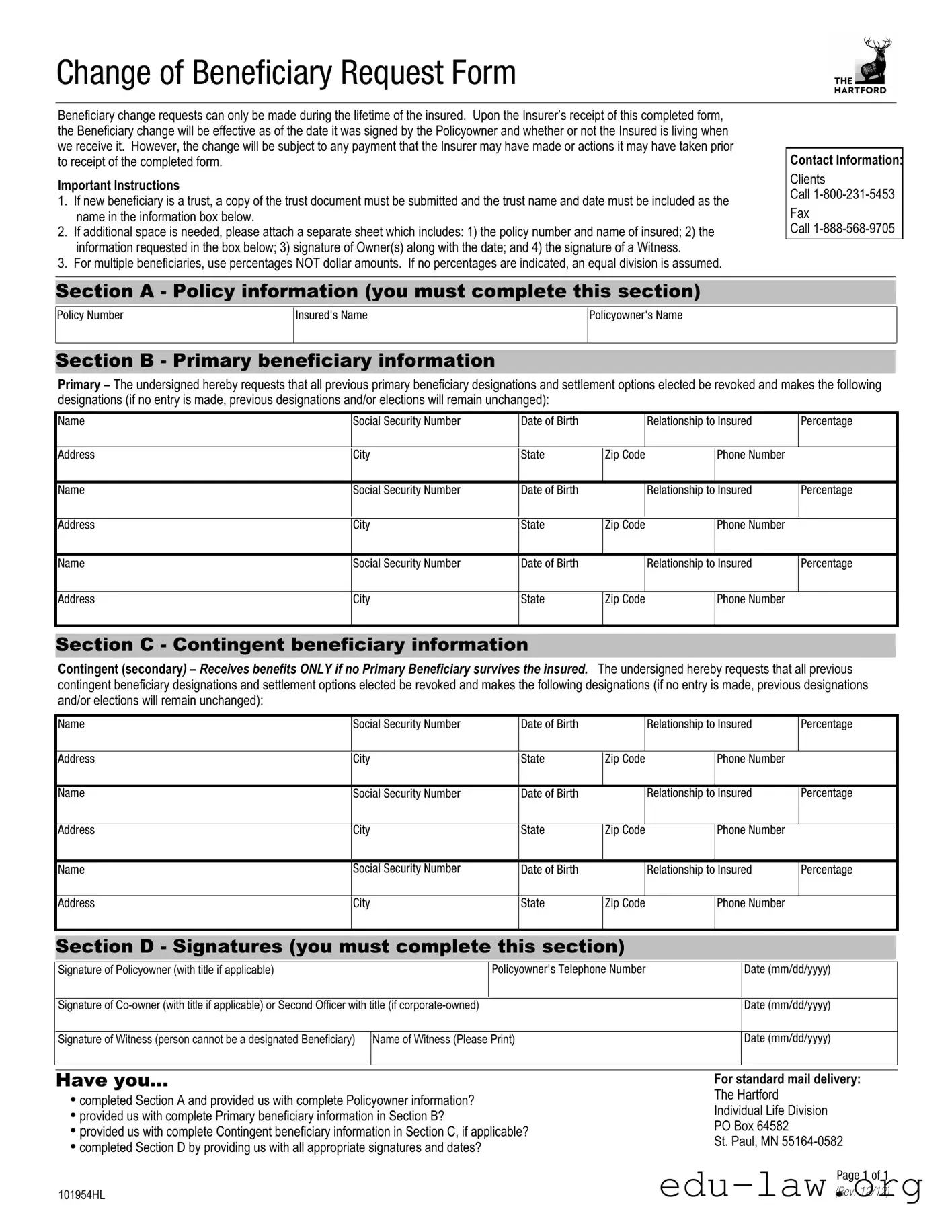
The Change of Beneficiary Request form is a crucial document for anyone looking to update their beneficiary designations on an insurance policy. This form allows policyholders to designate new primary and contingent beneficiaries, ensuring that their benefits are distributed according to their wishes. It is important to note that changes can only be made while the insured is alive. Once the insurer receives the completed form, the changes take effect from the date it was signed, regardless of the insured's status at that time. However, any payments made by the insurer before receiving the form will still be honored. The form includes several sections that require specific information, such as policy details, beneficiary names, social security numbers, and relationships to the insured. If a new beneficiary is a trust, a copy of the trust document must accompany the request. For multiple beneficiaries, it is essential to indicate percentages rather than dollar amounts to ensure proper distribution. Additionally, the form must be signed by the policyowner and a witness, with clear instructions provided to avoid any complications. This process is designed to be straightforward, but attention to detail is necessary to ensure that your intentions are clearly communicated and legally recognized.

Change of Beneficiary Request Form
Beneficiary change requests can only be made during the lifetime of the insured. Upon the Insurer’s receipt of this completed form, the Beneficiary change will be effective as of the date it was signed by the Policyowner and whether or not the Insured is living when we receive it. However, the change will be subject to any payment that the Insurer may have made or actions it may have taken prior to receipt of the completed form.
Important Instructions
1.If new beneficiary is a trust, a copy of the trust document must be submitted and the trust name and date must be included as the name in the information box below.
2.If additional space is needed, please attach a separate sheet which includes: 1) the policy number and name of insured; 2) the information requested in the box below; 3) signature of Owner(s) along with the date; and 4) the signature of a Witness.
3.For multiple beneficiaries, use percentages NOT dollar amounts. If no percentages are indicated, an equal division is assumed.
Contact Information:
Clients
Call
Fax
Call
Section A - Policy information (you must complete this section)
Policy Number
Insured's Name
Policyowner's Name
Section B - Primary beneficiary information
Primary – The undersigned hereby requests that all previous primary beneficiary designations and settlement options elected be revoked and makes the following designations (if no entry is made, previous designations and/or elections will remain unchanged):
Name |
Social Security Number |
Date of Birth |
|
Relationship to Insured |
Percentage |
|
|
|
|
|
|
|
|
Address |
City |
State |
Zip Code |
|
Phone Number |
|
|
|
|
|
|
|
|
Name |
Social Security Number |
Date of Birth |
|
Relationship to Insured |
Percentage |
|
|
|
|
|
|
|
|
Address |
City |
State |
Zip Code |
|
Phone Number |
|
|
|
|
|
|
|
|
Name |
Social Security Number |
Date of Birth |
|
Relationship to Insured |
Percentage |
|
|
|
|
|
|
|
|
Address |
City |
State |
Zip Code |
|
Phone Number |
|
|
|
|
|
|
|
|
Section C - Contingent beneficiary information
Contingent (secondary) – Receives benefits ONLY if no Primary Beneficiary survives the insured. The undersigned hereby requests that all previous contingent beneficiary designations and settlement options elected be revoked and makes the following designations (if no entry is made, previous designations and/or elections will remain unchanged):
Name |
Social Security Number |
Date of Birth |
|
Relationship to Insured |
Percentage |
|
|
|
|
|
|
|
|
Address |
City |
State |
Zip Code |
|
Phone Number |
|
|
|
|
|
|
|
|
Name |
Social Security Number |
Date of Birth |
|
Relationship to Insured |
Percentage |
|
|
|
|
|
|
|
|
Address |
City |
State |
Zip Code |
|
Phone Number |
|
|
|
|
|
|
|
|
Name |
Social Security Number |
Date of Birth |
|
Relationship to Insured |
Percentage |
|
|
|
|
|
|
|
|
Address |
City |
State |
Zip Code |
|
Phone Number |
|
|
|
|
|
|
|
|
Section D - Signatures (you must complete this section)
Signature of Policyowner (with title if applicable) |
|
Policyowner's Telephone Number |
Date (mm/dd/yyyy) |
|
|
|
|
Signature of |
Date (mm/dd/yyyy) |
||
|
|
|
|
Signature of Witness (person cannot be a designated Beneficiary) |
Name of Witness (Please Print) |
Date (mm/dd/yyyy) |
|
|
|
|
|
|
|
|
|
Have you...
•completed Section A and provided us with complete Policyowner information?
•provided us with complete Primary beneficiary information in Section B?
•provided us with complete Contingent beneficiary information in Section C, if applicable?
•completed Section D by providing us with all appropriate signatures and dates?
101954HL
For standard mail delivery:
The Hartford
Individual Life Division
PO Box 64582
St. Paul, MN
Page 1 of 1
(REV. 12/12)
| Fact Name | Details |
|---|---|
| Eligibility for Change | Beneficiary change requests can only be made while the insured is alive. |
| Effective Date | The change will be effective as of the date the Policyowner signs the form, regardless of the insured's status at that time. |
| Payment Considerations | The change is subject to any payments made or actions taken by the Insurer before the completed form is received. |
| Trusts as Beneficiaries | If the new beneficiary is a trust, a copy of the trust document must be submitted along with the trust's name and date. |
| Additional Information | For more beneficiaries, attach a separate sheet with required information including policy number and signatures. |
| Percentage Distribution | Use percentages for multiple beneficiaries. If none are indicated, an equal division will be assumed. |
| Contact Information | Clients can call 1-800-231-5453 or fax at 1-888-568-9705 for assistance. |
| Signature Requirements | Section D must be completed with appropriate signatures and dates from the Policyowner and any co-owners. |
After completing the Change Of Beneficiary Request form, you will need to submit it to the insurer for processing. The change will take effect as of the date you signed the form, regardless of the insured's status at that time. Ensure that all sections are filled out accurately to avoid delays.
What is the Change of Beneficiary Request form?
The Change of Beneficiary Request form is a document used by policyowners to update the beneficiaries designated to receive benefits from a life insurance policy. This form allows individuals to revoke previous beneficiary designations and specify new ones, ensuring that their wishes are accurately reflected in the policy.
When can I submit a Change of Beneficiary Request?
Beneficiary change requests can only be made while the insured individual is alive. It is essential to submit the completed form during this time to ensure that the changes are valid. Once the insurer receives the form, the changes will be effective as of the date the policyowner signed it, regardless of whether the insured is living at that moment.
What if the new beneficiary is a trust?
If the new beneficiary is a trust, you must include a copy of the trust document with your request. Additionally, the trust's name and date must be clearly indicated in the designated information box on the form. This ensures that the insurer has all necessary documentation to process the change appropriately.
How should I list multiple beneficiaries?
When designating multiple beneficiaries, it is crucial to use percentages rather than dollar amounts. If you do not specify percentages, the insurer will assume an equal division among the listed beneficiaries. This method ensures clarity in how the benefits will be distributed among multiple parties.
What information is required in the form?
The form requires several key pieces of information. In Section A, you must complete details about the policy, including the policy number, insured's name, and policyowner's name. Sections B and C require information about primary and contingent beneficiaries, respectively, such as their names, Social Security numbers, dates of birth, relationships to the insured, percentages of benefits, and contact information.
What if I need more space to list beneficiaries?
If you require additional space to list beneficiaries, you can attach a separate sheet. This sheet must include the policy number, the insured's name, the requested information, and the signatures of the owner(s) along with the date. Additionally, a witness signature is required on this sheet if it includes beneficiary designations.
What is the role of a witness on the form?
A witness is required to sign the form to validate the request. Importantly, the witness cannot be a designated beneficiary. This requirement helps to ensure that the process is transparent and that the policyowner's intentions are clearly documented without any conflicts of interest.
How can I contact the insurer if I have questions?
If you have questions regarding the Change of Beneficiary Request form or the process, you can contact the insurer directly. For client inquiries, call 1-800-231-5453. If you need to send documents via fax, the number is 1-888-568-9705. These resources are available to assist you with any concerns or clarifications you may need.
Where should I send the completed form?
The completed Change of Beneficiary Request form should be sent to the Hartford Individual Life Division at the following address: PO Box 64582, St. Paul, MN 55164-0582. Ensure that you send it through standard mail delivery to ensure it reaches the insurer promptly.
Neglecting to Complete All Required Sections: It's crucial to fill out every section of the Change of Beneficiary Request form. Missing even one part, such as Section A, can lead to processing delays or the request being deemed incomplete.
Using Dollar Amounts Instead of Percentages: When designating multiple beneficiaries, individuals often mistakenly indicate dollar amounts instead of percentages. If no percentages are provided, the insurer will assume an equal division among the beneficiaries, which may not reflect the policyowner's intentions.
Failing to Provide Necessary Documentation for Trusts: If the new beneficiary is a trust, it's essential to attach a copy of the trust document. Additionally, the trust's name and date must be included in the designated information box. Omitting this documentation can cause delays in processing the request.
Not Including Witness Signatures: The form requires a witness signature, which cannot be from a designated beneficiary. Failing to have this signature can invalidate the request, so it’s important to ensure that a qualified witness is present to sign.
Overlooking the Importance of Contact Information: Providing accurate contact information is essential. If the insurer needs to reach out for clarification or additional information, having the correct phone number can expedite the process and prevent unnecessary complications.
When submitting a Change of Beneficiary Request form, several other documents may be necessary to ensure the process goes smoothly. Each of these documents serves a specific purpose and can help clarify the intent of the policyowner. Here’s a brief overview of these commonly required forms.
Having these documents ready can help streamline the beneficiary change process. Ensure that all required forms are complete and accurate to avoid any delays. Proper documentation is key to protecting the interests of all parties involved.
The Change of Beneficiary Request form shares similarities with a Will, as both documents dictate the distribution of assets upon a person's passing. A Will outlines who will receive your property and assets after you die, while the Change of Beneficiary Request form specifies who will receive the benefits from a life insurance policy. Both documents require clear identification of beneficiaries and often need to be signed and witnessed to be valid. However, a Will typically goes through probate, whereas changes made through the beneficiary form take effect immediately upon submission to the insurer.
Another document that resembles the Change of Beneficiary Request form is a Power of Attorney (POA). A POA allows an individual to designate someone else to make decisions on their behalf, particularly regarding financial or medical matters. Like the beneficiary form, it requires clear identification of the parties involved and must be signed and dated. Both documents are crucial for ensuring that a person's wishes are honored, though the POA focuses on decision-making authority during a person's lifetime, while the beneficiary form deals with asset distribution after death.
The Living Trust also has similarities with the Change of Beneficiary Request form. A Living Trust allows individuals to place their assets into a trust during their lifetime, specifying how those assets should be managed and distributed upon their death. Both documents require detailed information about beneficiaries and can streamline the transfer of assets. However, a Living Trust may help avoid probate, while the beneficiary form directly affects life insurance payouts and is generally simpler in structure.
The Assignment of Benefits form is another document that resembles the Change of Beneficiary Request form. This form allows an insured person to assign their insurance benefits to another party, such as a healthcare provider. Both documents require the insured to identify beneficiaries clearly and provide signatures. The key difference lies in the purpose; the Assignment of Benefits form is often used for immediate claims, while the Change of Beneficiary Request form pertains to future payouts from life insurance policies.
A similar document is the Transfer on Death (TOD) designation. This designation allows individuals to transfer ownership of assets, like bank accounts or securities, directly to a beneficiary upon their death. Both the TOD and the Change of Beneficiary Request form require the identification of beneficiaries and can be updated or revoked as needed. However, the TOD is generally used for specific assets, while the Change of Beneficiary Request form is focused on life insurance policies.
The Revocable Living Trust is akin to the Change of Beneficiary Request form in that both documents allow individuals to specify how their assets should be distributed. The Revocable Living Trust can be altered during the grantor's lifetime, similar to how a beneficiary designation can be changed. Both require clear beneficiary information and can help avoid probate, but the trust is broader in scope, covering various assets, while the beneficiary form is specific to life insurance policies.
Lastly, the Health Care Proxy is similar to the Change of Beneficiary Request form in that it designates someone to make health care decisions on behalf of another person. Both documents require specific identification of the parties involved and must be signed and witnessed. However, the Health Care Proxy is focused on medical decisions, while the Change of Beneficiary Request form deals with financial benefits related to life insurance, highlighting different aspects of planning for the future.
When filling out the Change Of Beneficiary Request form, there are important steps to follow. Here’s a list of what you should and shouldn't do:
Understanding the Change of Beneficiary Request form is crucial for ensuring that your wishes are honored. However, there are several misconceptions that often lead to confusion. Here are five common myths debunked:
It is essential to be aware of these misconceptions to avoid any issues with your beneficiary designations. Take action now to ensure your intentions are clearly documented and legally binding.
Filling out the Change of Beneficiary Request form is a crucial step in ensuring that your benefits are directed to the right individuals. Here are some key takeaways to keep in mind:
By keeping these points in mind, you can navigate the process of changing your beneficiary with confidence and clarity.