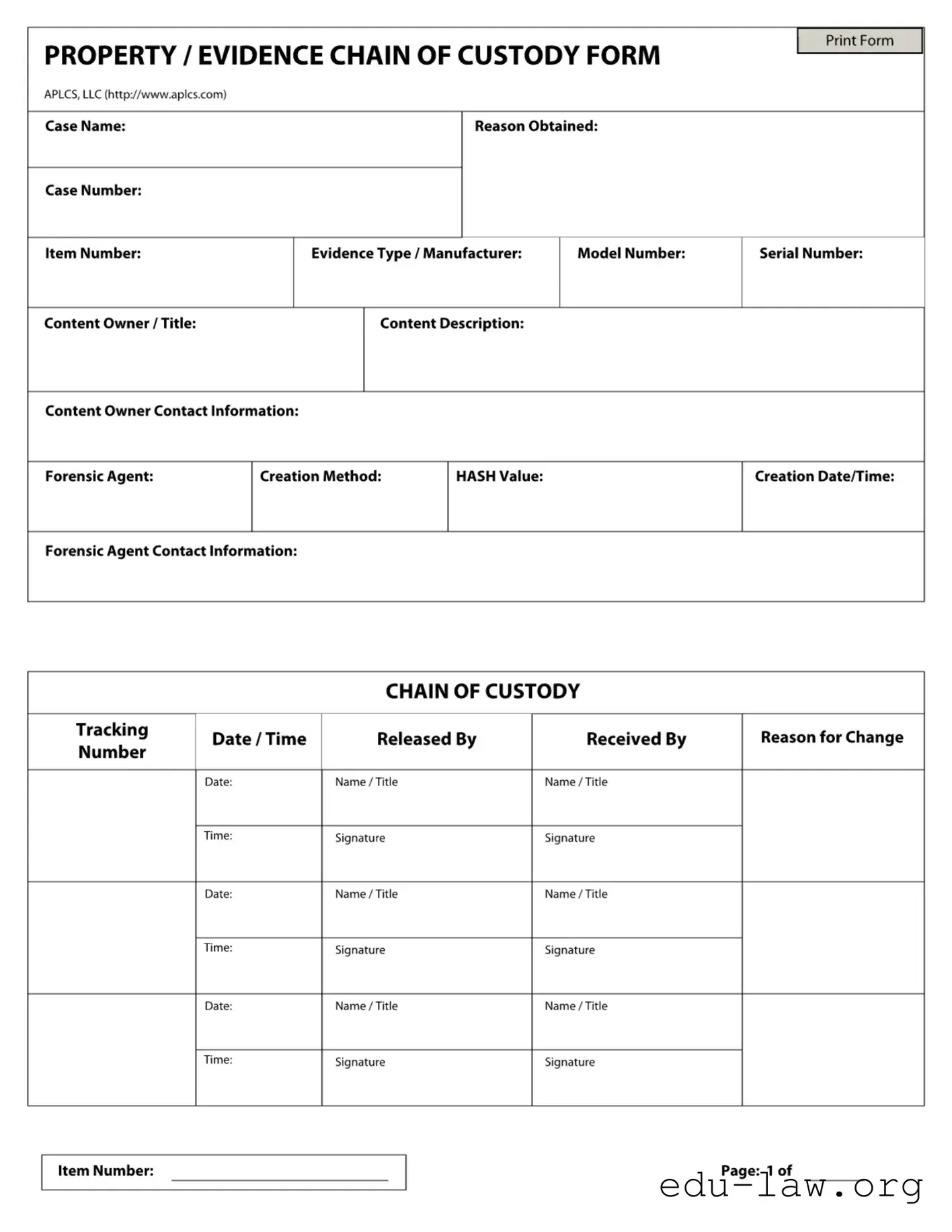
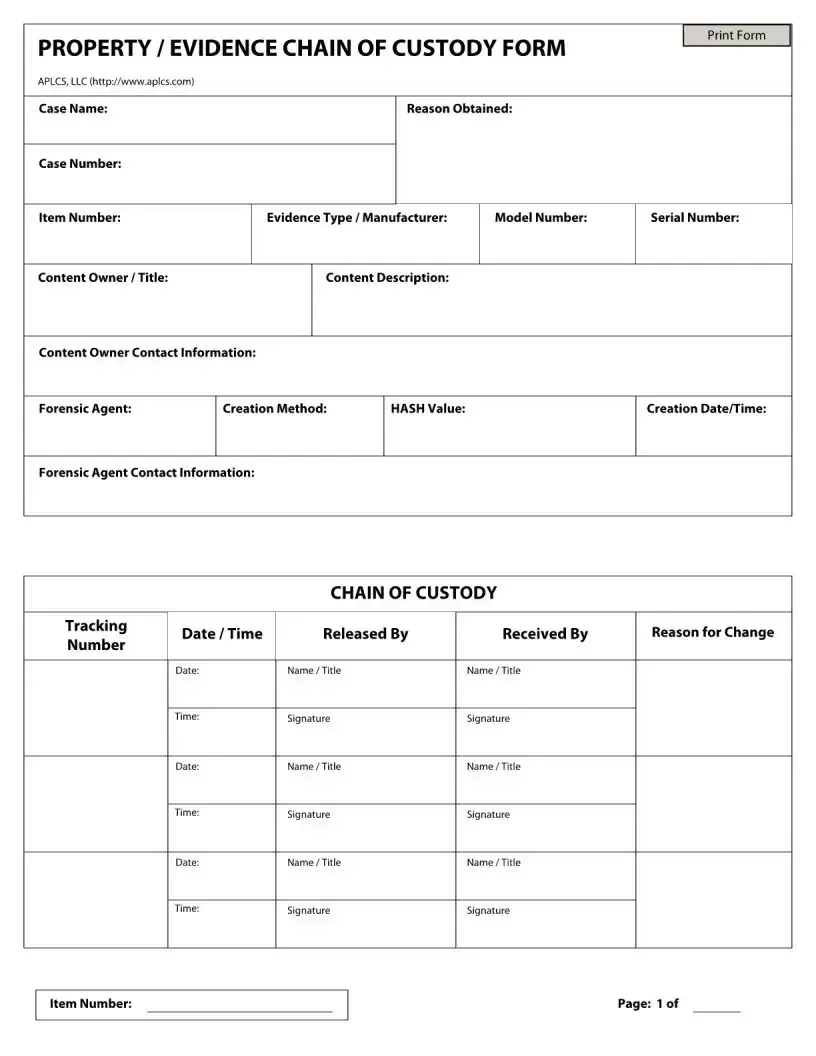
In the realm of legal proceedings, the integrity of evidence is paramount, and the Chain of Custody form plays a critical role in maintaining that integrity. This document meticulously tracks the handling of evidence from the moment it is collected until it is presented in court. Each entry on the form serves a purpose, detailing essential information such as the case name, case number, and item number, which provide context for the evidence. Furthermore, it identifies the type of evidence, along with its manufacturer, model number, and serial number, ensuring that every piece can be accurately referenced. The form also includes contact information for the content owner and the forensic agent, facilitating communication and accountability. Additionally, it records the creation method and HASH value, which are vital for verifying the evidence's authenticity. As the evidence changes hands, the Chain of Custody form captures each transaction, documenting the date, time, and reason for the transfer, along with the signatures of the individuals involved. This comprehensive tracking not only bolsters the credibility of the evidence but also reinforces the legal process, ensuring that justice is served fairly and transparently.

| Fact Name | Description |
|---|---|
| Purpose | The Chain of Custody form is used to document the handling of evidence from the time it is collected until it is presented in court. This ensures integrity and accountability. |
| Key Components | Essential information includes case name, case number, item number, evidence type, and signatures of individuals who handled the evidence. |
| State-Specific Laws | Different states may have specific laws governing the use of Chain of Custody forms. For instance, California Evidence Code Section 1410 outlines requirements for evidence handling. |
| Importance of Accuracy | Accurate completion of the form is critical. Any discrepancies can lead to challenges in court regarding the validity of the evidence. |
Filling out the Chain of Custody form is a crucial step in maintaining the integrity of evidence. This process ensures that all details regarding the evidence are accurately recorded and that the chain of possession is clearly documented. Following these steps will help ensure that the form is completed correctly.
What is a Chain of Custody form?
A Chain of Custody form is a document used to track the handling of evidence in legal cases. It records who has possession of the evidence at any given time, ensuring that it has not been altered or tampered with. This form is crucial for maintaining the integrity of evidence throughout the legal process.
Why is the Chain of Custody important?
The Chain of Custody is vital because it establishes a clear record of who handled the evidence, when, and for what purpose. This documentation helps prevent challenges to the evidence's authenticity and reliability in court. A well-maintained Chain of Custody can significantly impact the outcome of a case.
What information is typically included in a Chain of Custody form?
A Chain of Custody form usually includes details such as the case name, case number, item number, evidence type, model number, serial number, content description, and contact information for the content owner. It also records the dates and times of transfers, signatures of individuals involved, and reasons for any changes in custody.
Who is responsible for completing the Chain of Custody form?
How does one ensure the integrity of the evidence?
To ensure the integrity of evidence, individuals must follow strict protocols when handling it. This includes wearing gloves, using proper packaging, and documenting every transfer of custody. The Chain of Custody form serves as a log of these actions, helping to maintain the evidence's integrity.
What happens if the Chain of Custody is broken?
If the Chain of Custody is broken, it can lead to questions about the evidence's authenticity. In a legal context, this may result in the evidence being deemed inadmissible in court. Therefore, maintaining a complete and accurate Chain of Custody is essential for the prosecution or defense of a case.
Can the Chain of Custody form be used for digital evidence?
Yes, the Chain of Custody form is applicable to digital evidence as well. It should include specific details relevant to digital items, such as the creation method, hash value, and any software used to analyze the evidence. Proper documentation is crucial for digital forensics.
How long should the Chain of Custody records be kept?
The retention period for Chain of Custody records can vary depending on jurisdiction and the nature of the case. Generally, these records should be kept for as long as the evidence is retained, often until the conclusion of any appeals or related legal matters.
What should I do if I notice an error on the Chain of Custody form?
If you notice an error on the Chain of Custody form, it is important to correct it immediately. This should be done by drawing a line through the incorrect information, writing the correct information next to it, and initialing the change. Documentation of changes helps maintain the integrity of the Chain of Custody.
Is the Chain of Custody form a public document?
The Chain of Custody form is typically not a public document. It is considered part of the case file and may be subject to privacy laws and regulations. Access to these records is usually limited to authorized personnel involved in the legal proceedings.
When filling out the Chain of Custody form, individuals may encounter several common mistakes. Being aware of these errors can help ensure the integrity of the evidence is maintained. Below is a list of eight mistakes to avoid:
Failing to provide all required fields, such as the case name, case number, or item number, can lead to confusion later.
Entering the wrong date or time can create discrepancies in the timeline of evidence handling.
Not obtaining necessary signatures from individuals who released or received the evidence may invalidate the chain of custody.
Writing that is difficult to read can result in misinterpretation of critical information.
Providing vague or inaccurate descriptions of the evidence can complicate identification and retrieval later on.
Failing to include contact information for the content owner or forensic agent can hinder communication if questions arise.
Neglecting to record changes in custody or the reason for those changes can lead to gaps in the chain of custody.
Not calculating or documenting the HASH value can compromise the integrity of the evidence.
By avoiding these mistakes, individuals can help ensure that the Chain of Custody form is completed accurately and effectively, preserving the reliability of the evidence throughout the legal process.
The Chain of Custody form is crucial for documenting the handling of evidence in various cases. Alongside this form, several other documents play important roles in ensuring the integrity and accountability of evidence management. Below are four commonly used forms that complement the Chain of Custody form.
Using these documents in conjunction with the Chain of Custody form enhances the reliability of evidence management. Proper documentation is vital in upholding the integrity of the investigative process and ensuring that all actions taken are transparent and accountable.
The Incident Report is similar to the Chain of Custody form in that it documents important details surrounding a specific event. Both forms capture essential information like dates, times, and individuals involved. The Incident Report focuses on the event itself, providing context and background, while the Chain of Custody form tracks the handling of evidence. Together, they create a comprehensive record that helps maintain the integrity of the investigation.
The Evidence Log serves a similar purpose to the Chain of Custody form by tracking items collected during an investigation. Both documents detail what evidence was collected, who collected it, and when it was collected. The Evidence Log is often more straightforward, listing items in a simple format, while the Chain of Custody form emphasizes the transfer and handling of each piece of evidence, ensuring accountability throughout the process.
The Forensic Analysis Report is another document that aligns with the Chain of Custody form. It provides detailed results of examinations conducted on the evidence. Both documents require accurate information about the evidence, such as serial numbers and descriptions. The Chain of Custody form ensures that the evidence remains untampered, while the Forensic Analysis Report interprets what the evidence reveals, making them both vital in building a case.
The Receipt for Evidence is closely related to the Chain of Custody form as it serves as proof of the transfer of evidence from one party to another. Both documents require signatures to confirm that the evidence has been received. The Receipt for Evidence is typically more concise, focusing solely on the transfer, while the Chain of Custody form provides a broader context by documenting the entire history of the evidence.
The Affidavit of Witness is another document that shares similarities with the Chain of Custody form. Both can be used in legal proceedings to establish credibility and reliability. The Affidavit of Witness captures a person's testimony regarding the evidence or event, while the Chain of Custody form focuses on the evidence itself. Together, they help to create a stronger case by ensuring that all aspects of the evidence and witness accounts are properly documented.
The Inventory List also resembles the Chain of Custody form as it catalogs items related to a case. Both documents require precise details about each item, including descriptions and identification numbers. The Inventory List is often used for organizational purposes, while the Chain of Custody form emphasizes the chain of handling and transfer of evidence, ensuring that it can be tracked throughout the investigation.
Finally, the Case File Summary provides an overview of the entire case, including evidence and witness statements. It is similar to the Chain of Custody form in that it aims to maintain a clear and organized record. While the Case File Summary may include a broader range of information, the Chain of Custody form specifically focuses on the handling and transfer of evidence, making both documents essential for a complete understanding of the case.
When filling out the Chain of Custody form, attention to detail is crucial. Here are five important dos and don'ts to keep in mind:
Understanding the Chain of Custody form is crucial for ensuring the integrity of evidence in legal proceedings. However, several misconceptions can lead to confusion. Below is a list of ten common misconceptions about the Chain of Custody form, along with clarifications for each.
By addressing these misconceptions, individuals can better understand the significance of the Chain of Custody form and its role in preserving the integrity of evidence.
Understanding the Chain of Custody form is crucial for maintaining the integrity of evidence in legal proceedings. Here are seven key takeaways to consider when filling out and using this important document:
By adhering to these guidelines, individuals can ensure that the Chain of Custody form serves its purpose effectively, thereby upholding the integrity of the legal process.