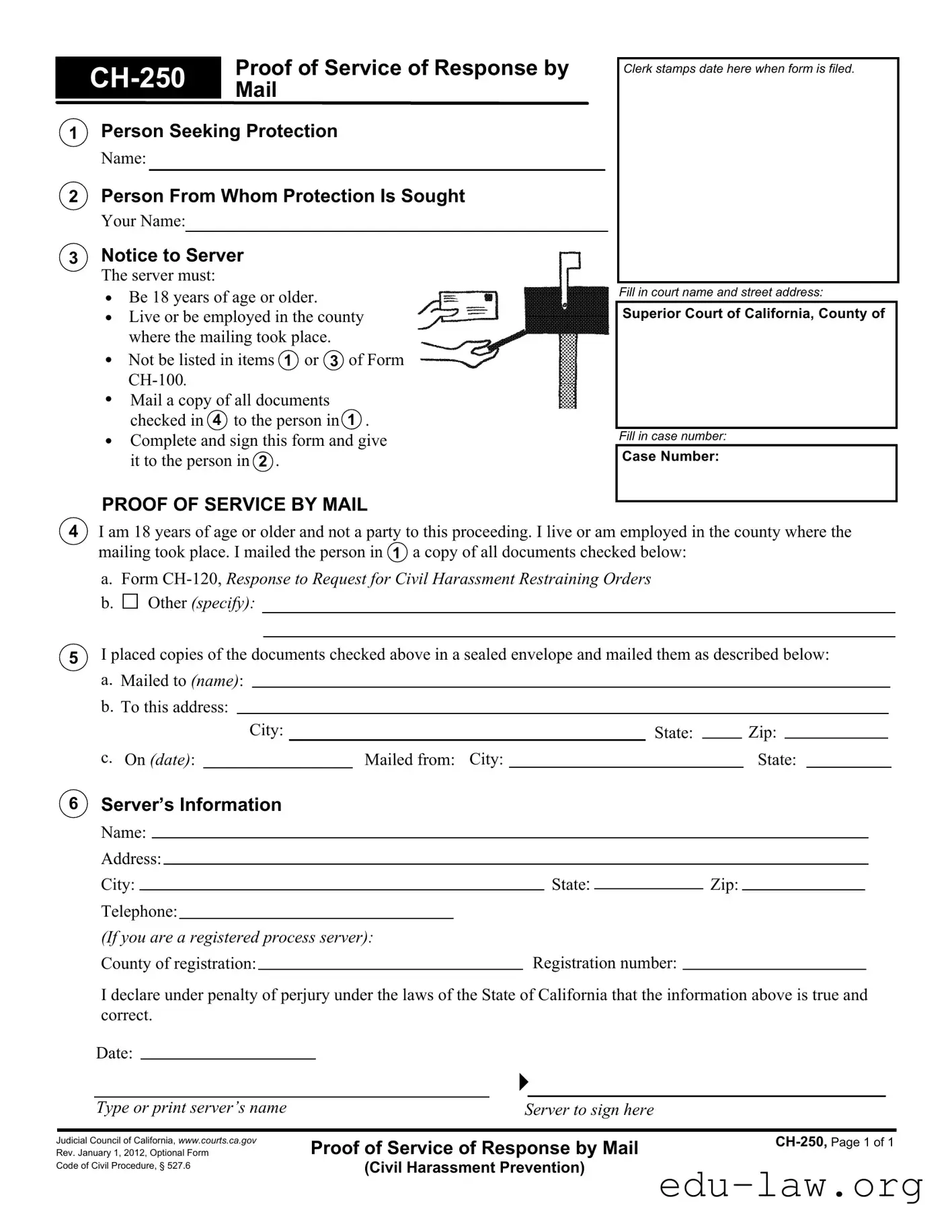
The CH-250 form, officially known as the Proof of Service of Response by Mail, plays a crucial role in the legal process for individuals seeking protection under civil harassment laws in California. This form is designed to confirm that the necessary documents have been properly mailed to the individual from whom protection is sought. It outlines specific responsibilities for the server, who must be at least 18 years old, reside or be employed in the same county where the mailing occurs, and cannot be a party involved in the case. Essential details include the names of both parties involved, the court information, and the case number. The server must indicate which documents were mailed, such as the Response to Request for Civil Harassment Restraining Orders, and provide the recipient's address, the date of mailing, and their own information. By signing the form, the server affirms that all provided information is accurate, thereby ensuring that the legal process moves forward smoothly. Understanding the CH-250 form is vital for anyone involved in civil harassment cases, as it serves as proof that the necessary steps have been taken to inform all parties involved.
Proof of Service of Response by |
||
|
||
|
|
1Person Seeking Protection
Name:
2Person From Whom Protection Is Sought
Your Name:
3Notice to Server
The server must:
•Be 18 years of age or older.
•Live or be employed in the county where the mailing took place.
•Not be listed in items 1 or 3 of Form
•Mail a copy of all documents
checked in 4 to the person in 1 .
•Complete and sign this form and give it to the person in 2 .
PROOF OF SERVICE BY MAIL
Clerk stamps date here when form is filed.
Fill in court name and street address:
Superior Court of California, County of
Fill in case number:
Case Number:
4I am 18 years of age or older and not a party to this proceeding. I live or am employed in the county where the mailing took place. I mailed the person in 1 a copy of all documents checked below:
a.Form
b. Other (specify):
5I placed copies of the documents checked above in a sealed envelope and mailed them as described below: a. Mailed to (name):
b. |
To this address: |
|
|
|
|
|
|
|
|
|
|
|
|
|
|
|
|
|
|
|
City: |
|
|
|
|
|
|
|
|
|
|
||||
|
|
|
State: |
|
|
|
Zip: |
|
|
|
|
||||||
c. On (date): |
|
|
|
|
|
|
|
||||||||||
|
|
|
|
|
|
|
|
|
|
|
|
|
|
||||
|
|
Mailed from: City: |
|
|
|
|
|
|
|
||||||||
|
|
|
|
|
|
|
State: |
|
|
||||||||
|
|
|
|
|
|
|
|
|
|
|
|
|
|
|
|
|
|
6Server’s Information
Name:
Address:
City: |
|
State: |
|
Zip: |
|
|
Telephone:
(If you are a registered process server):
County of registration: |
|
Registration number: |
I declare under penalty of perjury under the laws of the State of California that the information above is true and correct.
Date:
|
|
|
|
|
|
Type or print server’s name |
Server to sign here |
|
Judicial Council of California, www.courts.ca.gov Rev. January 1, 2012, Optional Form
Code of Civil Procedure, § 527.6
Proof of Service of Response by Mail |
|
|
|
(Civil Harassment Prevention) |
|
| Fact Name | Details |
|---|---|
| Form Purpose | The CH-250 form is used to provide proof of service of a response by mail in civil harassment cases. |
| Governing Law | This form is governed by the California Code of Civil Procedure, specifically Section 527.6. |
| Server Requirements | The server must be at least 18 years old, reside or be employed in the mailing county, and cannot be a party to the case. |
| Mailing Process | The server is responsible for mailing a copy of all documents to the individual seeking protection. |
| Filing Date | The court clerk will stamp the form with the date when it is filed. |
| Signature Requirement | The server must complete and sign the form, declaring the information is true under penalty of perjury. |
| Optional Form Status | The CH-250 is an optional form, meaning it is not mandatory but is recommended for proper documentation. |
After gathering the necessary information, you are ready to fill out the CH-250 form. This form is essential for documenting the service of response by mail in a legal proceeding. Follow these steps carefully to ensure accuracy.
Once completed, review the form for accuracy. Ensure that all necessary sections are filled out completely before submitting it to the court. Proper documentation is crucial in legal matters.
What is the purpose of the CH-250 form?
The CH-250 form, known as the Proof of Service of Response by Mail, is used in California to document that a response to a request for civil harassment restraining orders has been properly mailed to the involved parties. This form ensures that all parties are informed of the proceedings and helps maintain transparency in the legal process. By completing this form, the server confirms that they have sent the necessary documents to the person seeking protection, which is crucial for the court's records.
Who can serve documents using the CH-250 form?
To serve documents and complete the CH-250 form, the server must meet specific criteria. They must be at least 18 years old and not a party to the case, meaning they cannot be directly involved in the proceedings. Additionally, the server must live or work in the same county where the mailing occurs. This requirement ensures that the server is familiar with the local area and can reliably carry out the service of documents.
What information needs to be included on the CH-250 form?
The CH-250 form requires several key pieces of information. First, it asks for the names of the individuals involved, including the person seeking protection and the person from whom protection is sought. Next, the server must provide details about themselves, including their name, address, and contact information. They must also indicate the documents that were mailed, such as the Response to Request for Civil Harassment Restraining Orders. Lastly, the server needs to include the date of mailing and the address to which the documents were sent. This comprehensive information helps the court verify that the service was completed correctly.
What happens after the CH-250 form is completed?
Once the CH-250 form is filled out and signed by the server, it must be submitted to the court. The court will then stamp the date when the form is filed, creating an official record of the service. This form serves as proof that the response was mailed and ensures that all parties are aware of the ongoing legal proceedings. It is essential for maintaining the integrity of the legal process, as it demonstrates that the person seeking protection was given the opportunity to respond to the allegations made against them.
Failing to provide the correct names in the designated fields. Ensure that the names of both the person seeking protection and the person from whom protection is sought are accurate.
Not verifying the age requirement of the server. The server must be at least 18 years old and not involved in the case.
Overlooking the county residency requirement. The server must live or work in the county where the mailing occurs.
Forgetting to check all necessary documents in section 4. It’s crucial to include all relevant documents when mailing.
Not properly completing the mailing details. Include the recipient's full name, address, city, state, and zip code accurately.
Failing to include the date of mailing. This information is essential for the proof of service.
Neglecting to provide the server’s information. Complete the server's name, address, and contact details as required.
Not signing the form. The server must sign the form to validate the proof of service.
Submitting the form without a court stamp. Ensure the form is filed with the court and receives the necessary stamp.
Ignoring the penalty of perjury statement. The server must declare that the information provided is true and correct.
When dealing with legal matters, especially those involving civil harassment, several forms and documents are often used alongside the CH-250 form. Each document serves a specific purpose in the legal process, ensuring that all parties are informed and that the court has the necessary information to make decisions. Below is a list of commonly associated documents.
Understanding these documents is crucial for anyone involved in a civil harassment case. Each form plays a vital role in ensuring that the legal process runs smoothly and that all parties are adequately protected and informed.
The CH-250 form, which serves as proof of service of a response by mail, is similar to the FL-335 form, known as the Proof of Service by Mail in family law cases. Both documents require the server to confirm that they are not a party to the case and that they are at least 18 years old. They both necessitate that the server provides details about the mailing, including the recipient's name and address, and the date of mailing. This ensures that the court has a record of the service, which is crucial in family law matters, just as it is in civil harassment cases.
Another document comparable to the CH-250 is the UD-140, or Proof of Service of Summons. This form is used in unlawful detainer actions, which involve eviction proceedings. Like the CH-250, the UD-140 requires the server to declare their age and non-involvement in the case. It also includes information about the documents served and the method of service. Both forms aim to provide the court with verification that the necessary parties have been notified, ensuring due process is followed.
The PLD-050 form, which is a Proof of Service by Mail in general civil cases, shares similarities with the CH-250. Both forms require the server to provide specific details about the mailing process and to confirm their eligibility to serve the documents. The PLD-050 is used in a broader range of civil cases, but the essential purpose remains the same: to document that service has been properly executed and to maintain transparency in legal proceedings.
The SC-104 form, or Proof of Service of Summons, is also akin to the CH-250. This document is used in small claims cases and requires similar information from the server. Both forms emphasize the importance of documenting the service of legal documents, including the recipient's information and the date of mailing. This is vital for the court to verify that all parties have been properly informed of the proceedings.
The MC-030 form, known as the Declaration of Service by Mail, shares key features with the CH-250. Both require the server to affirm their age and non-involvement in the case. They also necessitate a declaration regarding the service details. The MC-030 can be used in various civil matters, and like the CH-250, it serves to confirm that the required parties have been notified, thereby upholding the integrity of the legal process.
The EFS-001 form, or Proof of Service of Electronic Filing, is another document that bears similarities to the CH-250. While the EFS-001 pertains to electronic filings, both forms require the server to provide verification of service. They both include details about the recipient and the date of service, ensuring that the court has a reliable record of the communication. This is particularly important in today’s digital landscape, where electronic communication is increasingly common.
The GC-020 form, which is a Proof of Service of Notice of Hearing, also resembles the CH-250. This form is used to confirm that a notice of hearing has been served to the necessary parties. Both documents require the server to provide their information and details about the service. The objective is the same: to ensure that all parties are aware of upcoming legal proceedings, maintaining fairness in the judicial process.
Lastly, the FL-335 form, known as the Proof of Service of Response by Mail, is similar to the CH-250 in that it is specifically designed for family law cases. Both forms require the server to confirm their age and non-involvement in the case. They also demand details about the documents served and the mailing process. The primary goal is to provide the court with a record that the necessary parties have been informed, ensuring that everyone has the opportunity to participate in the legal process.
When filling out the CH-250 form, attention to detail is essential. Here are some guidelines to help ensure that the process goes smoothly.
Following these do's and don'ts can help facilitate the proper handling of the CH-250 form and ensure compliance with the necessary legal requirements.
Here are six common misconceptions about the CH-250 form, which is used for proof of service by mail in civil harassment cases.
Filling out and using the CH-250 form is an important step in the process of seeking protection from civil harassment. Here are key takeaways to consider:
By following these key points, you can ensure that the CH-250 form is filled out correctly and used effectively in your legal proceedings.