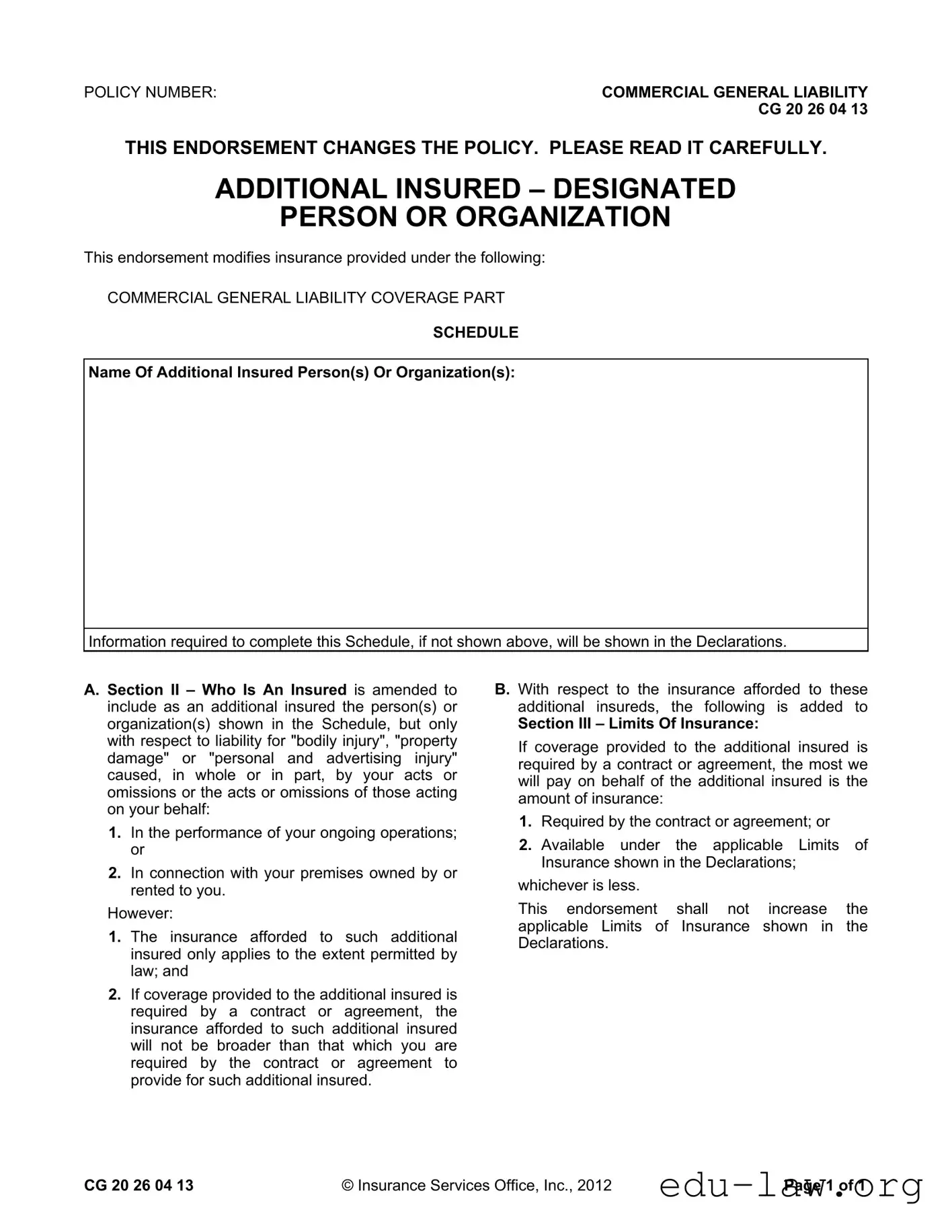
The CG 20 26 04 13 form plays a crucial role in commercial general liability insurance by designating specific individuals or organizations as additional insureds. This endorsement modifies the existing insurance policy, ensuring that the named additional insureds are covered for certain liabilities. These liabilities typically include bodily injury, property damage, or personal and advertising injury. However, this coverage is only applicable when the incidents arise from the policyholder's actions or omissions, or those of their representatives, during ongoing operations or related to premises they own or rent. It's important to note that the extent of coverage for these additional insureds is limited by law and must align with any contractual obligations. If a contract specifies a required level of insurance for the additional insured, the coverage provided will not exceed that limit. Additionally, the endorsement does not increase the overall limits of insurance outlined in the policy declarations, making it essential for policyholders to understand their responsibilities and the implications of this form.

POLICY NUMBER: |
COMMERCIAL GENERAL LIABILITY |
|
CG 20 26 04 13 |
THIS ENDORSEMENT CHANGES THE POLICY. PLEASE READ IT CAREFULLY.
ADDITIONAL INSURED – DESIGNATED
PERSON OR ORGANIZATION
This endorsement modifies insurance provided under the following:
COMMERCIAL GENERAL LIABILITY COVERAGE PART
SCHEDULE
Name Of Additional Insured Person(s) Or Organization(s):
Information required to complete this Schedule, if not shown above, will be shown in the Declarations.
A. Section II – Who Is An Insured is amended to include as an additional insured the person(s) or organization(s) shown in the Schedule, but only with respect to liability for "bodily injury", "property damage" or "personal and advertising injury" caused, in whole or in part, by your acts or omissions or the acts or omissions of those acting on your behalf:
1.In the performance of your ongoing operations; or
2.In connection with your premises owned by or rented to you.
However:
1.The insurance afforded to such additional insured only applies to the extent permitted by law; and
2.If coverage provided to the additional insured is required by a contract or agreement, the insurance afforded to such additional insured will not be broader than that which you are required by the contract or agreement to provide for such additional insured.
B. With respect to the insurance afforded to these additional insureds, the following is added to
Section III – Limits Of Insurance:
If coverage provided to the additional insured is required by a contract or agreement, the most we will pay on behalf of the additional insured is the amount of insurance:
1.Required by the contract or agreement; or
2.Available under the applicable Limits of Insurance shown in the Declarations;
whichever is less.
This endorsement shall not increase the applicable Limits of Insurance shown in the Declarations.
CG 20 26 04 13 |
© Insurance Services Office, Inc., 2012 |
Page 1 of 1 |
| Fact Name | Description |
|---|---|
| Purpose | This form serves as an endorsement to a Commercial General Liability policy, adding designated persons or organizations as additional insureds. |
| Coverage Scope | It provides coverage for bodily injury, property damage, or personal and advertising injury caused by the named insured's actions or omissions. |
| Limitations | The coverage for additional insureds is limited to the extent required by law or as specified in a contract or agreement. |
| Applicable Law | This endorsement is governed by state-specific laws, which may vary by jurisdiction, affecting the enforceability and scope of coverage. |
Completing the CG 20 26 04 13 form involves providing specific details about the additional insured parties under a commercial general liability policy. Follow these steps carefully to ensure accuracy and compliance with the requirements.
After filling out the form, submit it to your insurance provider for processing. They will review the information and make the necessary updates to your policy. Keep a copy of the completed form for your records.
What is the purpose of the CG 20 26 04 13 form?
The CG 20 26 04 13 form serves as an endorsement to a Commercial General Liability (CGL) policy. Its primary purpose is to add specific individuals or organizations as additional insureds under the policy. This means that those named in the endorsement will have some coverage for liabilities related to bodily injury, property damage, or personal and advertising injury that may arise from the actions of the policyholder or their representatives.
Who qualifies as an additional insured under this endorsement?
Individuals or organizations specified in the endorsement schedule qualify as additional insureds. Their inclusion is limited to liabilities that stem from the policyholder's ongoing operations or the premises owned or rented by the policyholder. It is important to note that the coverage is contingent upon the actions or omissions of the policyholder or their agents.
What limitations exist for the coverage provided to additional insureds?
Coverage for additional insureds is subject to several limitations. First, the coverage only applies to the extent permitted by law. Second, if the additional insured status is required by a contract, the insurance provided cannot exceed the coverage that the policyholder is obligated to provide under that contract. Therefore, additional insureds should be aware that their coverage may not be as broad as they might expect.
How does the endorsement affect the limits of insurance?
The endorsement does not increase the overall limits of insurance specified in the policy’s declarations. Instead, if the coverage for an additional insured is mandated by a contract, the maximum amount payable will be the lesser of the amount required by the contract or the limits available under the policy. This ensures that the policyholder's financial exposure remains within the defined limits.
What types of injuries or damages are covered for additional insureds?
Additional insureds are covered for liabilities related to bodily injury, property damage, and personal and advertising injury. This coverage applies only if these incidents are caused, in whole or in part, by the acts or omissions of the policyholder or those acting on their behalf, particularly in relation to ongoing operations or the use of premises owned or rented by the policyholder.
Is there a need to notify the insurance company when adding an additional insured?
Yes, it is essential to notify the insurance company when adding an additional insured. The endorsement must be properly completed and submitted to ensure that the additional insured is recognized under the policy. This process helps prevent any gaps in coverage and ensures compliance with contractual obligations.
Can the coverage for additional insureds be modified or removed?
Yes, the coverage for additional insureds can be modified or removed. This typically requires an endorsement to the policy, which must be agreed upon by both the policyholder and the insurance provider. Policyholders should review their coverage regularly and communicate any changes to their insurance company to maintain appropriate coverage levels.
What should policyholders do if they have questions about the endorsement?
Policyholders should reach out to their insurance agent or broker for clarification on the endorsement. They can provide detailed information about how the CG 20 26 04 13 form applies to the specific policy and help address any concerns regarding coverage, limits, and additional insured status. Open communication with the insurance provider is key to understanding the implications of this endorsement.
Not providing the correct policy number. Ensure that the policy number is accurate and matches the documentation.
Failing to list all additional insured persons or organizations. Make sure to include every entity that needs to be covered.
Leaving out the required information in the Schedule section. If there are any missing details, it can lead to confusion or denial of coverage.
Not understanding the scope of coverage. Read the endorsement carefully to know what is and isn’t covered for additional insureds.
Ignoring the contract requirements. If coverage is mandated by a contract, ensure that the form reflects those specific terms.
Misunderstanding the limits of insurance. Be aware of the limits outlined in the Declarations and how they apply to additional insureds.
Not signing or dating the form. A signature and date are essential for the form to be valid.
Failing to keep a copy of the completed form. Always retain a copy for your records to ensure you have proof of submission.
Submitting the form after the deadline. Timeliness is crucial; ensure that the form is submitted on time to avoid issues with coverage.
The CG 20 26 04 13 form is essential for adding additional insured parties to a commercial general liability policy. However, several other documents often accompany this form to ensure comprehensive coverage and compliance with contractual obligations. Below is a list of related forms and documents that may be used in conjunction with the CG 20 26 04 13.
Understanding these documents can help ensure that all parties are adequately protected and that compliance with contractual obligations is maintained. Each document plays a specific role in the overall insurance framework, contributing to effective risk management.
The CG 20 26 04 13 form is similar to the CG 20 10 form, which also addresses additional insured status. Both forms serve to extend coverage to third parties, typically clients or partners, for liabilities arising from the named insured's operations. However, the CG 20 10 form is broader in scope, covering all operations rather than being limited to ongoing operations or specific premises. This distinction can be crucial for businesses seeking to ensure comprehensive protection for their additional insureds.
Another document that shares similarities is the CG 20 37 form. This endorsement, like the CG 20 26 04 13, provides additional insured status but is specifically tailored for ongoing operations. The key difference lies in the inclusion of coverage for completed operations in the CG 20 37 form. This means that if a project is finished and a claim arises from it, the additional insured may still be covered, whereas the CG 20 26 04 13 focuses solely on ongoing activities.
The CG 20 33 form is also relevant, as it offers additional insured coverage for specific projects or locations. This endorsement is often used in construction contracts, where the additional insured status is tied to a particular job site. While both the CG 20 26 04 13 and CG 20 33 forms grant additional insured status, the latter is more project-specific, making it essential for contractors and subcontractors to understand the nuances of each endorsement when drafting contracts.
Similarly, the CG 20 28 form provides additional insured status but is designed for lessors of equipment. This endorsement extends coverage to the lessor for liabilities arising from the use of the rented equipment. While the CG 20 26 04 13 focuses on general liability related to ongoing operations and premises, the CG 20 28 form is specifically tailored for equipment rental scenarios, highlighting the importance of context in determining the appropriate endorsement.
The CG 20 37 04 13 form is another closely related document, which combines elements of both the CG 20 26 and CG 20 10 forms. It offers additional insured coverage for both ongoing and completed operations, providing a broader safety net for the additional insured. Businesses may choose this form when they want to ensure that their partners or clients are protected throughout the duration of a project and even after its completion, making it a versatile option.
The CG 24 04 form is noteworthy as it addresses additional insured status for contractors and subcontractors. This endorsement is particularly useful in construction and similar industries where multiple parties are involved. While the CG 20 26 04 13 focuses on general liability, the CG 24 04 form emphasizes coverage specifically for contractors, ensuring that all parties involved in a project are adequately protected against potential claims.
Lastly, the CG 20 01 form is relevant as it serves as the base form for commercial general liability policies. While it does not specifically address additional insured status, it sets the foundation for coverage, including bodily injury, property damage, and personal injury. Understanding this base form is crucial for interpreting additional endorsements like the CG 20 26 04 13, as they build upon the coverage outlined in the CG 20 01 form.
When filling out the CG 20 26 04 13 form, it is crucial to follow specific guidelines to ensure accuracy and compliance. Here are ten important dos and don’ts to consider:
Taking these steps seriously can help avoid complications and ensure that the form is processed smoothly. Timeliness and attention to detail are essential in this process.
Understanding the CG 20 26 04 13 form is crucial for both policyholders and additional insured parties. However, several misconceptions can lead to confusion. Below is a list of common misunderstandings regarding this endorsement:
By addressing these misconceptions, parties involved can better navigate their insurance policies and ensure appropriate coverage. It is essential to read the endorsement carefully and consult with an insurance professional if there are any uncertainties.
When filling out and using the CG 20 26 04 13 form, consider the following key takeaways: