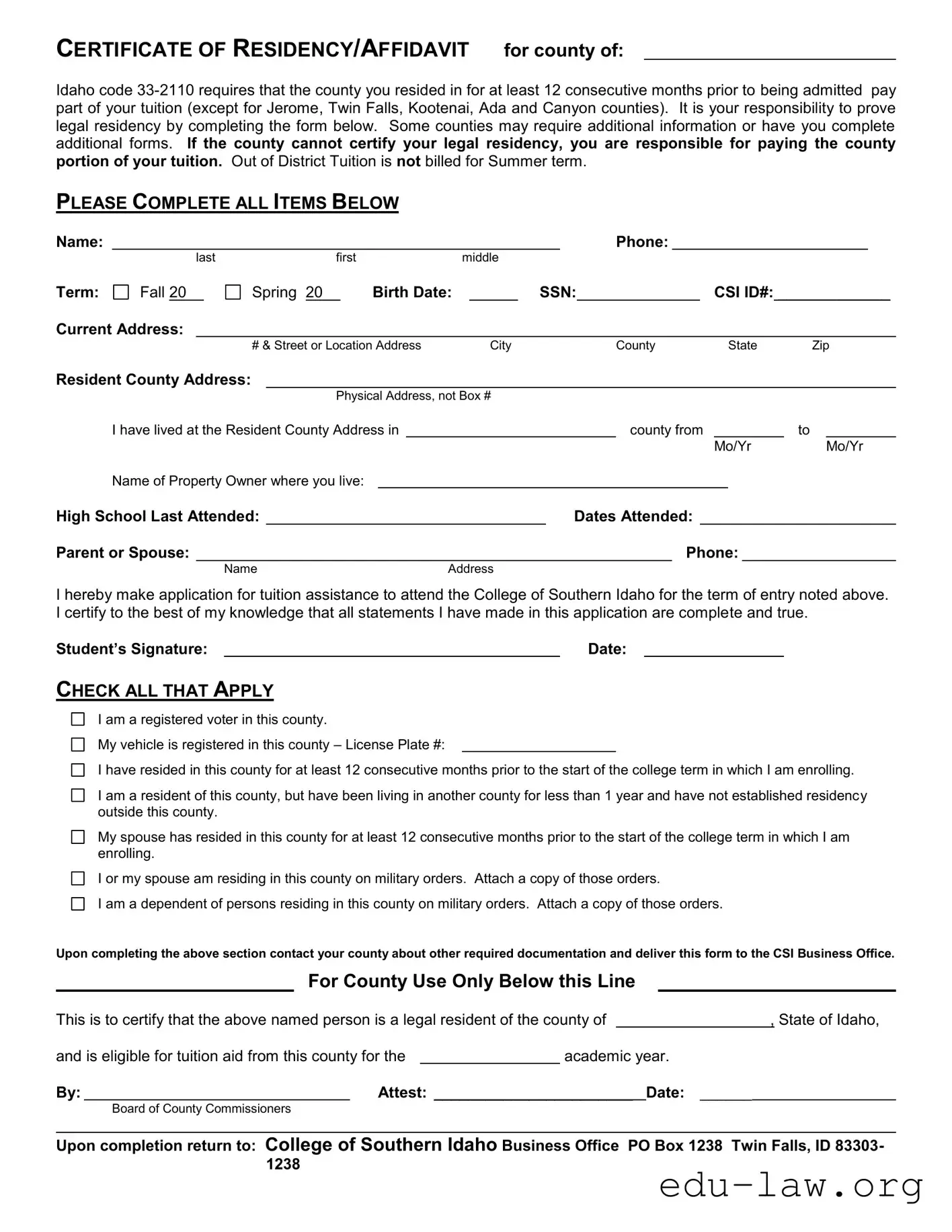
The Certificate of Residency form is an essential document for students seeking tuition assistance at the College of Southern Idaho. This form is required to prove legal residency in a specific county for at least 12 consecutive months before enrollment. While most counties participate in this program, there are exceptions, such as Jerome, Twin Falls, Kootenai, Ada, and Canyon counties, which do not contribute to tuition payments. Students must fill out various personal details, including their name, contact information, and current address, as well as the address where they have resided for the required period. Additionally, applicants need to provide information about their high school attendance and any relevant military orders if applicable. The form also includes a checklist to confirm residency status, voter registration, and vehicle registration. Completing this form accurately is crucial, as failure to certify legal residency may result in the student being responsible for the county's portion of tuition. Once filled out, students should check with their county for any additional documentation before submitting the form to the College of Southern Idaho Business Office. This process ensures that eligible students receive the financial support they need to pursue their education.

CERTIFICATE OF RESIDENCY/AFFIDAVIT for county of:
Idaho code
PLEASE COMPLETE ALL ITEMS BELOW
Name:
Term:
last
Fall 20
Phone:
firstmiddle
Spring 20 |
Birth Date: |
|
SSN: |
|
CSI ID#: _____________ |
|
|
|
|
|
|
|
|
Current Address:
# & Street or Location Address CityCounty State Zip
Resident County Address:
Physical Address, not Box # |
|
|
|
|
|
||
I have lived at the Resident County Address in |
county from |
to |
|||||
|
|
|
|
Mo/Yr |
|
Mo/Yr |
|
Name of Property Owner where you live: |
|
|
|
|
|
|
|
High School Last Attended: |
|
Dates Attended: |
|
|||
Parent or Spouse: |
|
|
|
Phone: |
|
|
|
Name |
Address |
||||
I hereby make application for tuition assistance to attend the College of Southern Idaho for the term of entry noted above. I certify to the best of my knowledge that all statements I have made in this application are complete and true.
Student’s Signature: |
|
Date: |
CHECK ALL THAT APPLY
I am a registered voter in this county.
My vehicle is registered in this county – License Plate #:
I have resided in this county for at least 12 consecutive months prior to the start of the college term in which I am enrolling.
I am a resident of this county, but have been living in another county for less than 1 year and have not established residency outside this county.
My spouse has resided in this county for at least 12 consecutive months prior to the start of the college term in which I am enrolling.
I or my spouse am residing in this county on military orders. Attach a copy of those orders.
I am a dependent of persons residing in this county on military orders. Attach a copy of those orders.
Upon completing the above section contact your county about other required documentation and deliver this form to the CSI Business Office.
For County Use Only Below this Line
This is to certify that the above named person is a legal resident of the county of |
|
|
, State of Idaho, |
|||||
|
|
|
|
|
|
|
|
|
and is eligible for tuition aid from this county for the |
|
academic year. |
|
|
|
|||
By: |
|
Attest: _______________________ Date: |
______ |
|
|
|||
|
Board of County Commissioners |
|
|
|
|
|
|
|
Upon completion return to: College of Southern Idaho Business Office PO Box 1238 Twin Falls, ID 83303- 1238
| Fact Name | Description |
|---|---|
| Eligibility Requirement | To qualify for tuition assistance, a student must have resided in the county for at least 12 consecutive months prior to enrollment. |
| Exempt Counties | Jerome, Twin Falls, Kootenai, Ada, and Canyon counties are exempt from the requirement to pay part of the tuition. |
| Governing Law | This form is governed by Idaho Code 33-2110, which outlines residency requirements for tuition assistance. |
| Additional Documentation | Some counties may request additional information or forms to verify residency before certifying eligibility. |
After gathering the necessary information, you can begin filling out the Certificate of Residency form. Completing this form accurately is crucial for your eligibility for tuition assistance. Once you have filled out the form, you will need to submit it along with any required documentation to the appropriate county office and the College of Southern Idaho Business Office.
What is a Certificate of Residency?
A Certificate of Residency is a form that verifies your legal residency in a specific county in Idaho. It is required to qualify for reduced tuition rates at the College of Southern Idaho (CSI). This form is essential for students who have lived in a county for at least 12 consecutive months before enrolling in college.
Who needs to complete the Certificate of Residency form?
Any student who wishes to receive tuition assistance from their county while attending CSI must complete the Certificate of Residency form. This applies to students who have resided in the county for at least 12 months prior to their enrollment. However, some counties may have additional requirements.
What information do I need to provide on the form?
The form requires personal details such as your name, birth date, Social Security number, CSI ID number, and current address. You will also need to provide information about your residency, including how long you have lived at your current address and the name of the property owner. Additional details about your high school and a parent or spouse may also be necessary.
What if I have lived in another county for less than a year?
If you are a resident of one county but have been living in another county for less than a year, you can still apply for tuition assistance. You will need to indicate this on the form and provide any necessary documentation to support your claim.
Are there counties that do not qualify for tuition assistance?
Yes, students from Jerome, Twin Falls, Kootenai, Ada, and Canyon counties are not eligible for county tuition assistance. If you reside in one of these counties, you will be responsible for paying the full tuition amount.
What should I do if my county cannot certify my residency?
If your county cannot certify your legal residency, you will be responsible for paying the county portion of your tuition. It is crucial to ensure that you provide accurate and complete information on your form to avoid this situation.
Do I need to submit any additional documents with the form?
Some counties may require additional documentation or forms to verify your residency. It is advisable to contact your county office to find out if any extra information is needed before submitting your Certificate of Residency form.
How do I submit the Certificate of Residency form?
Once you have completed the form and gathered any necessary documentation, you should deliver it to the CSI Business Office. The address is PO Box 1238, Twin Falls, ID 83303-1238. Ensure that you follow any specific instructions provided by your county regarding submission.
What happens after I submit the form?
After you submit the Certificate of Residency form, your county will review it to verify your residency status. If approved, you will be eligible for tuition assistance for the academic year. You will receive confirmation from the county regarding your eligibility.
Can I apply for tuition assistance every term?
Yes, you can apply for tuition assistance each term you enroll at CSI, as long as you meet the residency requirements. However, ensure that you have lived in the county for at least 12 consecutive months prior to the start of each term for which you are applying.
Failing to provide a complete name. Make sure to include your full name as it appears on official documents.
Not indicating the correct term. Specify whether you are applying for the Fall or Spring term.
Leaving out your Social Security Number. This information is crucial for processing your application.
Using a P.O. Box instead of a physical address. The form requires your actual residence address.
Not providing the dates of residency. Clearly state the months and years you have lived at your current address.
Overlooking the property owner's name. This detail is necessary to verify your residence.
Neglecting to check the appropriate boxes that apply to your situation. This can affect your eligibility for tuition assistance.
Failing to sign and date the form. Without your signature, the application cannot be processed.
The Certificate of Residency form is essential for students seeking tuition assistance based on their residency status. In addition to this form, several other documents may be required to establish residency or support the application process. Below are some commonly used forms and documents that may accompany the Certificate of Residency.
Gathering these documents can streamline the application process for tuition assistance. Ensuring that all required forms are completed and submitted will help in verifying residency and securing the necessary financial support for education.
The Certificate of Residency form shares similarities with a Voter Registration form. Both documents require individuals to provide proof of residency within a specific county. Just as the Certificate of Residency helps establish eligibility for tuition assistance, the Voter Registration form confirms that a person resides in a certain area, allowing them to vote in local elections. Both documents may ask for personal information such as name, address, and identification details, making them essential for civic participation.
Another document that resembles the Certificate of Residency is the Driver's License Application. This application also requires proof of residency, as individuals must show where they live to obtain a valid driver's license. Just like the Certificate of Residency, the Driver's License Application may ask for supporting documents, such as utility bills or lease agreements, to verify the applicant's address. Both documents play a crucial role in confirming a person's legal residence.
The Lease Agreement is another similar document. It serves as a legal contract between a landlord and tenant, outlining the terms of residency at a specific address. Like the Certificate of Residency, a Lease Agreement provides evidence of where a person lives and can be used to establish residency for various purposes, including tuition assistance. Both documents require signatures and may include details about the duration of residency.
The Tax Return is also comparable to the Certificate of Residency. When filing taxes, individuals often need to provide their current address, which can confirm their residency in a particular state or county. Similar to the Certificate of Residency, tax returns may require additional documentation to verify residency status, such as W-2 forms or other income statements. Both documents reflect an individual's commitment to their legal residence.
Another document that aligns with the Certificate of Residency is the Utility Bill. Utility bills typically show the name of the resident and the address where services are provided. This document can serve as proof of residency, much like the Certificate of Residency does for tuition purposes. Both documents are vital for establishing where a person lives, and they often include dates that indicate how long the individual has resided at that address.
The Military Orders form is also similar. For individuals who are stationed in a different location due to military service, these orders can help establish residency claims. Just as the Certificate of Residency allows for tuition assistance based on residency, Military Orders can affect eligibility for certain benefits. Both documents require specific information about the individual's situation and may need to be submitted alongside other forms.
The Affidavit of Residency is another document that serves a similar purpose. This sworn statement confirms that an individual resides at a particular address, similar to the Certificate of Residency. It often requires the same type of information, such as the individual's name and address, and may need to be notarized. Both documents aim to verify residency for legal or financial reasons.
Lastly, the Application for Financial Aid is comparable to the Certificate of Residency. This application often requires proof of residency to determine eligibility for various financial assistance programs. Just like the Certificate of Residency, the financial aid application may ask for personal details and supporting documentation to confirm where the applicant lives. Both forms help individuals access essential resources for education and support.
When filling out the Certificate of Residency form, keep these important guidelines in mind:
Misconceptions about the Certificate of Residency form can lead to confusion and potentially impact your tuition assistance. Here are nine common misunderstandings:
Understanding these misconceptions can help you navigate the Certificate of Residency form more effectively and ensure you meet all requirements for tuition assistance.
Understanding the Certificate of Residency form is essential for students seeking tuition assistance. Here are key takeaways to guide you through the process:
By following these key points, you can navigate the Certificate of Residency form with confidence and ensure that you meet the necessary requirements for tuition assistance.