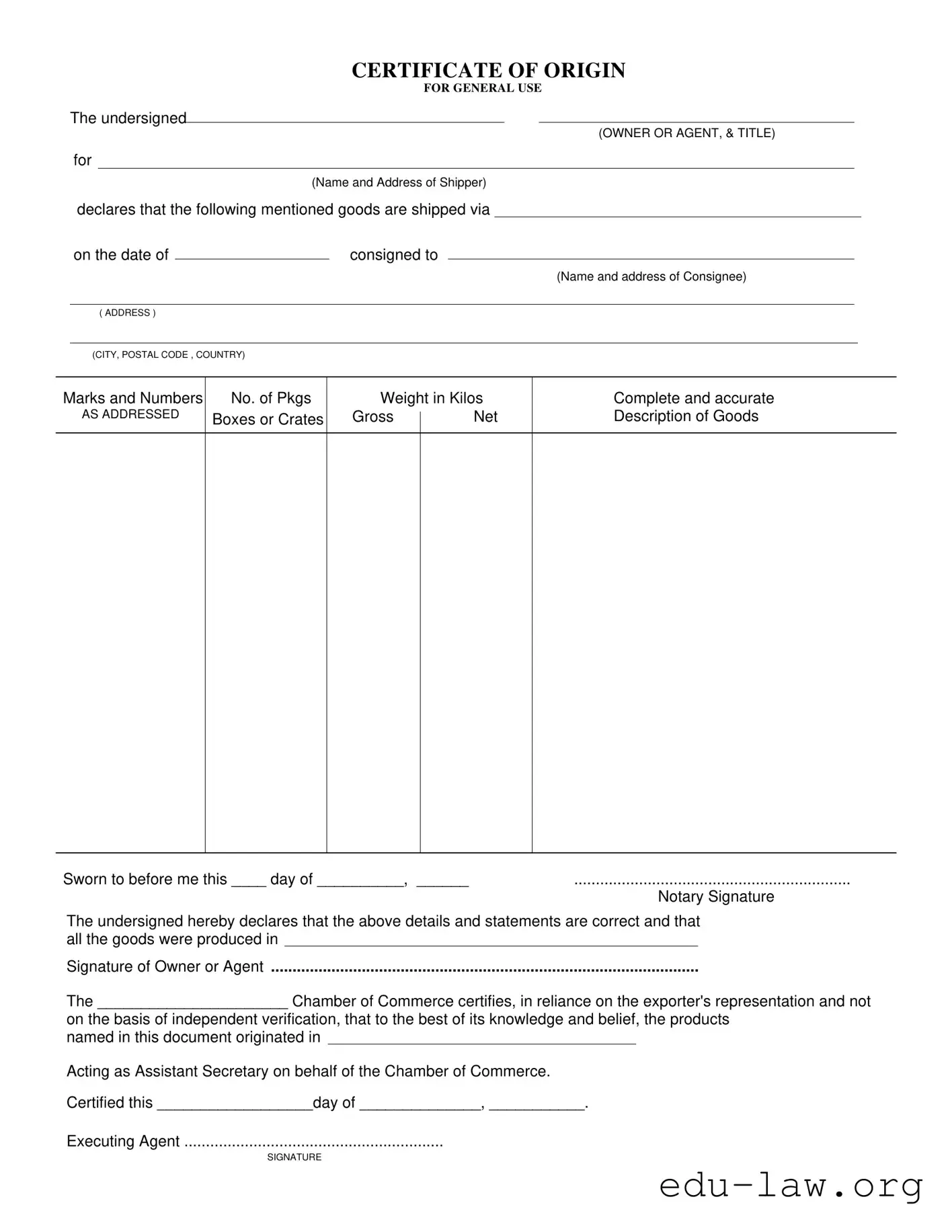
The Certificate of Origin form plays a crucial role in international trade by certifying the origin of goods being exported. This document is essential for customs clearance and can impact tariffs and trade agreements. Typically, it includes details such as the name and address of the shipper and consignee, a description of the goods, and their packaging information. The form must be signed by the owner or agent, affirming that the information provided is accurate and that the goods were produced in the stated country. Additionally, a notary public often validates the document, enhancing its credibility. The Chamber of Commerce may also certify the form, relying on the exporter’s declarations without independent verification. This multifaceted document not only facilitates smoother transactions but also ensures compliance with trade regulations.

CERTIFICATE OF ORIGIN
FOR GENERAL USE
The undersigned
(OWNER OR AGENT, & TITLE)
for
(Name and Address of Shipper)
declares that the following mentioned goods are shipped via
on the date of |
|
consigned to |
|
(Name and address of Consignee)
( ADDRESS )
(CITY, POSTAL CODE , COUNTRY)
Marks and Numbers
AS ADDRESSED
No. of Pkgs Boxes or Crates
Weight in Kilos
GrossNet
Complete and accurate Description of Goods
Sworn to before me this ____ day of __________, ______................................................................
Notary Signature
The undersigned hereby declares that the above details and statements are correct and that all the goods were produced in
Signature of Owner or Agent ...................................................................................................
The ______________________ Chamber of Commerce certifies, in reliance on the exporter's representation and not
on the basis of independent verification, that to the best of its knowledge and belief, the products named in this document originated in
Acting as Assistant Secretary on behalf of the Chamber of Commerce.
Certified this __________________day of ______________, ___________.
Executing Agent ............................................................
SIGNATURE
| Fact Name | Description |
|---|---|
| Definition | A Certificate of Origin is a document that certifies the country of origin of goods being exported. |
| Purpose | This form helps customs authorities determine duties and tariffs based on where the goods were produced. |
| Parties Involved | The form requires signatures from the owner or agent and a notary public to verify the information provided. |
| Governing Law | In the U.S., the Certificate of Origin is often governed by the Uniform Commercial Code (UCC) and specific state regulations. |
| Usage | Commonly used in international trade, the Certificate of Origin may be required by customs in the importing country. |
| Information Required | Shippers must provide details such as the description of goods, weight, and consignee information on the form. |
| Chamber of Commerce Role | The local Chamber of Commerce often certifies the document, confirming the goods' origin based on the exporter’s representation. |
Once the Certificate of Origin form is completed, it must be submitted to the appropriate authority for certification. Ensure all information is accurate and legible to avoid delays in processing.
What is a Certificate of Origin?
A Certificate of Origin is an important document used in international trade. It certifies that the goods being shipped are produced in a specific country. This document is often required by customs authorities in the importing country to determine duties and tariffs. It helps ensure that the products meet the necessary regulations and standards for importation.
Who needs to complete a Certificate of Origin?
The Certificate of Origin is typically completed by the exporter or their agent. This includes the owner of the goods or a designated representative. It is crucial that the information provided is accurate, as it can affect the shipment's clearance and the duties assessed by customs officials.
What information is required on the Certificate of Origin?
The form requires several key pieces of information. This includes the name and address of the shipper, the consignee, and a detailed description of the goods. Additionally, the number of packages, weight, and any identifying marks must be included. Finally, the document must be signed by the owner or agent and may need notarization, depending on the requirements of the importing country.
How is the Certificate of Origin verified?
The verification process typically involves the Chamber of Commerce in the exporter’s country. They certify the document based on the exporter’s declarations, rather than conducting independent verification of the information provided. This certification is crucial for ensuring that the goods are recognized as originating from the stated country, which can impact tariffs and trade agreements.
Failing to provide complete and accurate information about the shipper and consignee. This includes not including the full name, address, and contact details. Incomplete details can lead to delays or issues with customs.
Incorrectly describing the goods being shipped. The description must be detailed and precise. A vague or inaccurate description can result in complications during transit or customs clearance.
Not signing the form where required. Both the owner or agent and the notary must provide their signatures. Omitting a signature can invalidate the certificate and delay the shipping process.
Neglecting to verify the origin of the goods. The declaration that goods were produced in a specific location must be accurate. Misrepresenting the origin can lead to legal repercussions and penalties.
The Certificate of Origin is a crucial document in international trade, affirming the origin of goods being exported. However, it is often accompanied by other important forms and documents that facilitate the shipping process and ensure compliance with regulations. Below is a list of these commonly used documents.
Each of these documents plays a vital role in ensuring a smooth and compliant shipping process. Understanding their purpose can help businesses navigate the complexities of international trade more effectively.
The Bill of Lading is a crucial document in the shipping process, similar to the Certificate of Origin. It serves as a contract between the shipper and the carrier, detailing the type, quantity, and destination of the goods being transported. Just like the Certificate of Origin, it includes information about the shipper and the consignee, ensuring that all parties are clear on the shipment's details. While the Certificate of Origin focuses on the origin of the goods, the Bill of Lading emphasizes the terms of transport and the responsibilities of each party involved.
The Commercial Invoice is another document that shares similarities with the Certificate of Origin. This invoice outlines the transaction between the buyer and seller, including details such as item descriptions, quantities, and prices. Both documents require accurate information about the goods being shipped. While the Certificate of Origin verifies the origin of the goods, the Commercial Invoice serves as a record for financial and customs purposes, providing evidence of the sale and the value of the goods.
A Packing List is also akin to the Certificate of Origin, providing detailed information about the contents of a shipment. This document typically includes the dimensions, weight, and packaging specifics of the items. Like the Certificate of Origin, it ensures that all parties understand what is included in the shipment. The Packing List helps in verifying the contents upon arrival, while the Certificate of Origin establishes the goods' provenance.
The Export License is another document that bears similarities to the Certificate of Origin. An Export License is a government-issued authorization that allows the export of certain goods. Both documents are essential for international trade, ensuring compliance with regulations. While the Certificate of Origin certifies where the goods were produced, the Export License confirms that the shipment meets legal requirements for exportation.
The Import Permit is closely related to the Certificate of Origin as well. This document is issued by the importing country, allowing the entry of specific goods. It often requires information similar to that found in the Certificate of Origin, such as product descriptions and origin details. Both documents work together to facilitate smooth customs clearance, ensuring that the goods meet the importing country's regulations.
The Certificate of Free Sale is another document that shares characteristics with the Certificate of Origin. This certificate indicates that the goods are legally sold in the country of origin and meet local health and safety standards. Like the Certificate of Origin, it provides assurance to foreign buyers about the quality and legality of the products. Both documents help in building trust and ensuring compliance in international transactions.
The Certificate of Compliance is similar in function to the Certificate of Origin, as it verifies that products meet specific standards and regulations. This document is often required for goods entering certain markets, ensuring they adhere to safety and quality requirements. While the Certificate of Origin focuses on the origin of the goods, the Certificate of Compliance emphasizes their conformity to industry standards.
Lastly, the Affidavit of Origin is a document that parallels the Certificate of Origin in its purpose. This affidavit is a sworn statement by the exporter affirming the origin of the goods. Both documents serve to establish the legitimacy of the goods' origin, which is essential for customs clearance and trade compliance. While the Certificate of Origin is typically issued by a Chamber of Commerce, the Affidavit of Origin is often created by the exporter themselves, reinforcing the importance of accurate documentation in international trade.
When filling out the Certificate of Origin form, attention to detail is crucial. Here’s a list of things to keep in mind:
On the flip side, there are also things to avoid:
Misconception 1: The Certificate of Origin is only necessary for international shipments.
While it is commonly associated with exports, this document can also be required for certain interstate transactions, depending on the regulations of specific states.
Misconception 2: Anyone can fill out a Certificate of Origin.
Only the owner or an authorized agent of the goods should complete this form. Accurate representation is crucial for compliance and to avoid penalties.
Misconception 3: The Certificate of Origin guarantees the quality of the goods.
This document solely certifies the origin of the goods. It does not provide any assurance regarding their quality or safety.
Misconception 4: A Certificate of Origin is the same as a bill of lading.
These two documents serve different purposes. The bill of lading is a contract for the transportation of goods, while the Certificate of Origin verifies where the goods were produced.
Misconception 5: A Certificate of Origin can be created after the shipment has been sent.
This form must be completed before the goods are shipped. Retroactive completion can lead to legal issues and complications during customs clearance.
Misconception 6: All countries require the same format for a Certificate of Origin.
Different countries have their own specific requirements and formats. It is essential to check the regulations of the destination country to ensure compliance.
Misconception 7: The Certificate of Origin is optional.
In many cases, this document is mandatory for customs clearance and to benefit from trade agreements. Failing to provide it can result in delays or additional tariffs.
When filling out and using the Certificate of Origin form, consider the following key takeaways: