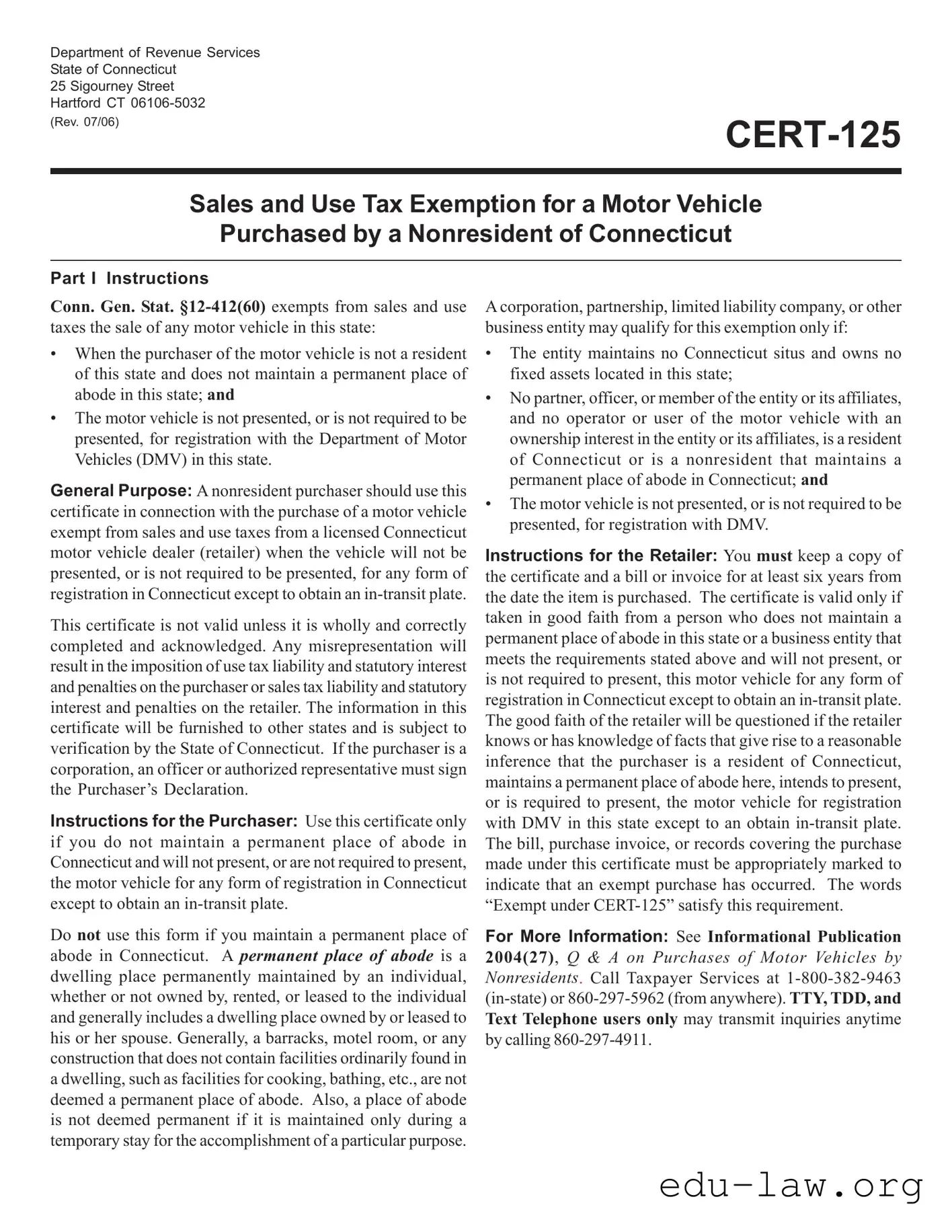
The Cert 125 form is an essential document for nonresidents of Connecticut looking to purchase a motor vehicle without incurring sales and use taxes. Designed specifically for individuals or entities that do not maintain a permanent place of abode in the state, this form serves as a declaration that the vehicle will not be registered in Connecticut, except for obtaining an in-transit plate. To qualify for this exemption, the purchaser must ensure that the form is fully and accurately completed. Misrepresentations can lead to significant tax liabilities and penalties. The form outlines specific instructions for both purchasers and retailers, detailing the necessary criteria to establish eligibility for the exemption. It is important for purchasers to understand what constitutes a permanent place of abode, which includes any dwelling maintained in Connecticut, regardless of ownership status. Retailers are also required to retain copies of the form and associated invoices for a minimum of six years to comply with state regulations. By following the guidelines provided in the Cert 125 form, nonresidents can navigate the purchase process while adhering to Connecticut's tax laws.

Department of Revenue Services
State of Connecticut
25 Sigourney Street
Hartford CT
(Rev. 07/06)
Sales and Use Tax Exemption for a Motor Vehicle
Purchased by a Nonresident of Connecticut
Part I Instructions
Conn. Gen. Stat.
•When the purchaser of the motor vehicle is not a resident of this state and does not maintain a permanent place of abode in this state; and
•The motor vehicle is not presented, or is not required to be presented, for registration with the Department of Motor Vehicles (DMV) in this state.
General Purpose: A nonresident purchaser should use this certificate in connection with the purchase of a motor vehicle exempt from sales and use taxes from a licensed Connecticut motor vehicle dealer (retailer) when the vehicle will not be presented, or is not required to be presented, for any form of registration in Connecticut except to obtain an
This certificate is not valid unless it is wholly and correctly completed and acknowledged. Any misrepresentation will result in the imposition of use tax liability and statutory interest and penalties on the purchaser or sales tax liability and statutory interest and penalties on the retailer. The information in this certificate will be furnished to other states and is subject to verification by the State of Connecticut. If the purchaser is a corporation, an officer or authorized representative must sign the Purchaser’s Declaration.
Instructions for the Purchaser: Use this certificate only if you do not maintain a permanent place of abode in Connecticut and will not present, or are not required to present, the motor vehicle for any form of registration in Connecticut except to obtain an
Do not use this form if you maintain a permanent place of abode in Connecticut. A permanent place of abode is a dwelling place permanently maintained by an individual, whether or not owned by, rented, or leased to the individual and generally includes a dwelling place owned by or leased to his or her spouse. Generally, a barracks, motel room, or any construction that does not contain facilities ordinarily found in a dwelling, such as facilities for cooking, bathing, etc., are not deemed a permanent place of abode. Also, a place of abode is not deemed permanent if it is maintained only during a temporary stay for the accomplishment of a particular purpose.
Acorporation, partnership, limited liability company, or other business entity may qualify for this exemption only if:
•The entity maintains no Connecticut situs and owns no fixed assets located in this state;
•No partner, officer, or member of the entity or its affiliates, and no operator or user of the motor vehicle with an ownership interest in the entity or its affiliates, is a resident of Connecticut or is a nonresident that maintains a permanent place of abode in Connecticut; and
•The motor vehicle is not presented, or is not required to be presented, for registration with DMV.
Instructions for the Retailer: You must keep a copy of the certificate and a bill or invoice for at least six years from the date the item is purchased. The certificate is valid only if taken in good faith from a person who does not maintain a permanent place of abode in this state or a business entity that meets the requirements stated above and will not present, or is not required to present, this motor vehicle for any form of registration in Connecticut except to obtain an
For More Information: See Informational Publication 2004(27), Q & A on Purchases of Motor Vehicles by Nonresidents. Call Taxpayer Services at

Part II Retailer and Purchaser - Read instructions first, then complete Parts II, III, IV, and V.
Retailer Information
Name of retailer _____________________________________________________________________ |
CT Tax Registration No. _____________________ |
Street address _______________________________________________________________________ |
Date of sale ________________________________ |
City or town, State, ZIP Code __________________________________________________________ |
Telephone No. _____________________________ |
Purchaser Information
Name of Purchaser ________________________________________________ |
Daytime Telephone No. _________________________________________ |
||||||||||||
If an individual: |
|
|
|
|
|
|
If corporation, partnership, limited liability company, or other business entity: |
||||||
Home address |
___________________________________________________ |
Business address |
_______________________________________________ |
||||||||||
|
___________________________________________________ |
|
|
_______________________________________________ |
|||||||||
Name and address ________________________________________________ |
Name and address ______________________________________________ |
||||||||||||
of employer |
________________________________________________ |
of partners, |
______________________________________________ |
||||||||||
|
|
|
|
|
|
|
officers, |
|
|
|
|
|
|
|
________________________________________________ |
members, and |
______________________________________________ |
||||||||||
|
________________________________________________ |
operator(s) of |
______________________________________________ |
||||||||||
|
|
|
|
|
|
|
motor vehicle |
|
|
|
|
|
|
|
|
|
|
|
|
|
|
|
|
|
|
||
Driver’s License Number |
|
State |
|
Expiration Date |
|
Driver’s License Number |
|
State |
|
Expiration Date |
|||
(Attach copy of each
Part III Motor Vehicle Identification Data
Year _________________ Model __________________ Make of vehicle _____________________________________ Color ______________
Vehicle identification number ___________________________________ State of registration and number __________________________________
Computation of Price |
|
Gross sales price* ____________________________ |
Year ________________ Make ___________________ Model __________________ |
State of registration and plate number _________________________________________ |
|
Net sales price ______________________________ |
Vehicle identification number ________________________________________________ |
* Do not deduct manufacturer’s rebates from the gross sales price.
Part IV Purchaser’s Declaration
Please initial:
_______ I, the purchaser, or person authorized to sign on behalf of the purchaser named in Part II, acknowledge that the retailer has explained to me the
meaning of a permanent place of abode as defined in Part I (or the requirements for business entities as described in Part I) and I declare that I do not maintain such a permanent place of abode in Connecticut.
I, the purchaser, or person authorized to sign on behalf of the purchaser named in Part II, declare that I purchased the motor vehicle described in Part III from the retailer named in Part II. The purchaser is not a Connecticut resident and does not maintain a permanent place of abode in Connecticut, or the business entity meets the requirements described in Part I. The purchaser is a resident of (or the business entity is located in) the State of __________________ . This motor
vehicle will not be presented, or is not required to be presented, for registration with the Connecticut DMV. I declare under the penalty of false statement that I have examined this certificate and to the best of my knowledge and belief it is true, complete, and correct. I understand the penalty for wilfully delivering a false return or document to the Department of Revenue Services (DRS) is a fine of not more than $5,000, or imprisonment for not more than five years, or both.
Signature of purchaser
or authorized person ________________________________________________ Date ________________________________________________________
If corporation, partnership, limited liability company, or other business entity:
Print name of purchaser
or authorized person ________________________________________________ Title _____________________________________ Date ___________
If jointly purchased,
signature of other purchaser __________________________________________ Print name of other purchaser ___________________________________
Part V |
Retailer’s Declaration |
Please initial: |
|
_______ |
I, an authorized agent of the retailer named in Part II, declare that I have explained to the purchaser that owning, leasing or otherwise maintaining |
|
a permanent place of abode in Connecticut, even if it is not permanently occupied by the purchaser, subjects this purchase to Connecticut sales tax |
|
and prohibits the use of this certificate. If the purchaser is a business entity, I have explained the exemption requirements for business entities set forth |
|
in Part I, or if pertinent, I have explained the requirement for business entities to use this certificate as described in Part I. |
I, an authorized agent of the retailer named in Part II, declare under the penalty of false statement that I have examined this certificate and to the best of my knowledge and belief it is true, complete, and correct. I understand the penalty for wilfully delivering a false return or document to DRS is a fine of not more than $5,000, or imprisonment for not more than five years, or both.
Print name of retailer’s authorized agent _________________________________________________________ Date _______________________________
Signature of retailer’s authorized agent ___________________________________________________________ Title _______________________________
| Fact Name | Fact Description |
|---|---|
| Governing Law | The Cert 125 form is governed by Conn. Gen. Stat. §12-412(60). |
| Purpose | This form allows nonresidents to purchase a motor vehicle in Connecticut without paying sales and use tax. |
| Eligibility | The purchaser must not be a resident of Connecticut and must not maintain a permanent place of abode in the state. |
| Registration Requirement | The vehicle must not be presented for registration with the Connecticut DMV, except for obtaining an in-transit plate. |
| Completion Requirement | The form must be fully completed and acknowledged to be valid. |
| Misrepresentation Penalties | Any false information can lead to tax liability and penalties for both the purchaser and retailer. |
| Record Keeping | Retailers must keep a copy of the certificate and a bill or invoice for at least six years. |
| Good Faith Requirement | The retailer must act in good faith and cannot knowingly sell to someone who is a resident of Connecticut. |
| Business Entity Eligibility | Business entities must not have a Connecticut situs and must meet specific ownership criteria to qualify. |
| Contact Information | For more details, contact Taxpayer Services at 1-800-382-9463 or 860-297-5962. |
Filling out the Cert 125 form is a straightforward process that requires attention to detail. Make sure to provide accurate information, as any errors can lead to complications. Once completed, this form will need to be presented to the retailer when purchasing a motor vehicle in Connecticut.
After completing the form, ensure all sections are filled out correctly. Both the purchaser and the retailer should keep copies for their records. This will help in case of any future inquiries or issues regarding the purchase.
What is the purpose of the Cert 125 form?
The Cert 125 form serves as a Sales and Use Tax Exemption certificate for nonresidents purchasing motor vehicles in Connecticut. It allows individuals who do not reside in the state and do not maintain a permanent place of abode there to buy a vehicle without incurring sales and use taxes. The form ensures that the vehicle will not be registered in Connecticut, except for obtaining an in-transit plate.
Who is eligible to use the Cert 125 form?
Eligibility for the Cert 125 form is limited to nonresidents of Connecticut. This includes individuals who do not have a permanent place of abode in the state. A permanent place of abode is defined as a dwelling that is maintained permanently, regardless of ownership. Additionally, business entities can qualify if they meet specific criteria, such as having no Connecticut situs and ensuring that no partners or members are residents of Connecticut.
What constitutes a permanent place of abode?
A permanent place of abode is a dwelling that an individual maintains, whether owned or rented. It typically includes homes or apartments but excludes temporary accommodations like hotel rooms or barracks. If someone stays in Connecticut only for a short time to accomplish a specific purpose, that residence would not be considered permanent.
What are the responsibilities of retailers when using the Cert 125 form?
Retailers must keep a copy of the Cert 125 form along with the purchase invoice for at least six years. They must ensure that the certificate is filled out completely and accurately. Retailers should also be vigilant; if they have reason to believe that a purchaser is a resident of Connecticut or maintains a permanent place of abode there, they should not accept the certificate. Proper documentation must indicate that the purchase is exempt, using the phrase “Exempt under CERT-125.”
What happens if the information on the Cert 125 form is misrepresented?
Misrepresentation on the Cert 125 form can lead to serious consequences. If a purchaser falsely claims to be a nonresident or misstates their residency status, they may incur use tax liability along with statutory interest and penalties. Retailers could also face sales tax liability if they knowingly accept a misrepresented certificate.
How can nonresidents obtain more information about the Cert 125 form?
For more information, nonresidents can refer to the Informational Publication 2004(27), which provides answers to frequently asked questions about motor vehicle purchases by nonresidents. Additionally, they can contact Taxpayer Services at 1-800-382-9463 for in-state inquiries or 860-297-5962 for calls from outside Connecticut. There is also a TTY service available for users who need assistance.
What should purchasers do if they are purchasing a vehicle jointly?
If the vehicle is being purchased jointly, both purchasers must sign the Cert 125 form. Each individual should provide their name and details as required. It is important for all parties involved to ensure that they meet the eligibility criteria and that the form is accurately completed to avoid any potential tax implications.
Not Understanding Permanent Place of Abode: Many people mistakenly believe they qualify as nonresidents without fully understanding what constitutes a permanent place of abode. If you maintain a dwelling in Connecticut, even if you don’t live there full-time, you may not be eligible for the exemption.
Incomplete Information: Failing to fill out all required fields can lead to delays or denial of the exemption. Ensure that every section is completed accurately, including names, addresses, and identification numbers.
Incorrect Signatures: The form must be signed by the purchaser or an authorized representative. If the signature does not match the name listed or lacks proper authorization, it may invalidate the certificate.
Ignoring the Vehicle Registration Requirement: Some individuals overlook the stipulation that the vehicle must not be presented for registration in Connecticut, except for an in-transit plate. Ensure you understand this requirement before submitting the form.
Not Attaching Required Documentation: Failing to attach copies of out-of-state driver’s licenses can result in rejection of the form. Make sure to include all necessary documentation to support your application.
Misunderstanding the Trade-in Allowance: Some people mistakenly deduct manufacturer’s rebates from the gross sales price. Remember, the gross sales price should reflect the total amount before any rebates or discounts are applied.
The CERT-125 form is an essential document for nonresidents purchasing a motor vehicle in Connecticut, allowing them to claim an exemption from sales and use taxes. However, several other forms and documents often accompany this certificate to ensure compliance and proper processing. Below is a list of these related documents, each serving a specific purpose in the transaction process.
Understanding these accompanying documents is crucial for a smooth transaction. Each form plays a vital role in ensuring compliance with state regulations and protecting the interests of both the buyer and the seller. Be proactive in gathering these documents to avoid any delays or complications in the purchase process.
The IRS Form 8843 serves as a declaration for individuals who are non-residents for tax purposes. Similar to the Cert 125, it allows individuals to assert their non-resident status, which can exempt them from certain tax obligations. Both forms require detailed personal information and a declaration that the individual does not maintain a permanent residence in the respective state. This shared purpose of confirming non-resident status highlights the importance of proper documentation in tax matters.
The W-9 form, used for providing taxpayer identification information, is another document that shares similarities with the Cert 125. While the W-9 is generally used for individuals or entities to certify their taxpayer identification number to a requester, it also emphasizes the need for accurate representation of residency status. Both forms require the signer to affirm their status, which can have significant implications for tax liabilities.
The Form 1099, specifically the 1099-MISC, is issued to report various types of income received by non-residents. Like the Cert 125, it requires accurate information regarding residency status. Non-residents may receive a 1099-MISC if they earn income in the United States but do not reside here. Both documents play a role in ensuring compliance with tax obligations based on residency status, thus protecting both the taxpayer and the state.
The Certificate of Exemption from Withholding, often referred to as Form W-4, allows individuals to claim exemption from federal income tax withholding. This form, like the Cert 125, requires individuals to affirm their non-resident status and the conditions under which they qualify for the exemption. Both forms are designed to prevent unnecessary tax burdens on those who do not have a permanent residence in the taxing jurisdiction.
The Form 1040-NR is the U.S. Nonresident Alien Income Tax Return, which non-residents use to report their income. Similar to the Cert 125, it is essential for confirming non-resident status and ensuring compliance with tax laws. Both forms require careful completion to avoid misrepresentation, which could lead to penalties or tax liabilities.
The Sales Tax Exemption Certificate is another document that shares similarities with the Cert 125. This certificate allows purchasers to claim exemptions from sales tax for certain transactions. Both documents require the purchaser to affirm their eligibility for exemption based on residency status and specific conditions. The emphasis on accurate completion and honesty in both forms underlines the importance of proper documentation in tax-related matters.
The Form 8288-B is used by foreign investors to apply for a withholding certificate. This document, like the Cert 125, requires detailed information about the individual's residency status. Both forms serve as tools for non-residents to navigate tax obligations and exemptions, emphasizing the necessity for accurate reporting to avoid future complications.
Finally, the Form 8833, Treaty-Based Return Position Disclosure, is utilized by non-residents to disclose positions taken under a tax treaty. Similar to the Cert 125, it requires individuals to confirm their non-resident status and the basis for claiming treaty benefits. Both forms underscore the importance of clarity and accuracy in tax matters, ensuring that non-residents are appropriately recognized under the law.
When filling out the Cert 125 form, it’s essential to ensure accuracy and compliance with the instructions provided. Here are four key things to remember:
By following these guidelines, you can help facilitate a smoother process when using the Cert 125 form.
Misconceptions about the Cert 125 form can lead to confusion and potential legal issues. Here are nine common misunderstandings:
Key Takeaways for Filling Out and Using the Cert 125 Form