When faced with a situation where an individual or organization believes their rights are being violated, a Cease and Desist Letter serves as a crucial tool for addressing the issue. This formal document is typically sent to the offending party, demanding that they halt their actions that infringe upon the sender's rights, whether those pertain to intellectual property, harassment, or other legal matters. The letter outlines the specific behavior that is objectionable, provides evidence supporting the claim, and sets a deadline for compliance. Importantly, it often includes a warning that failure to comply may result in further legal action. By clearly communicating the sender's position and intentions, a Cease and Desist Letter can facilitate a resolution without the need for litigation. Understanding how to properly draft and utilize this letter can empower individuals and businesses to protect their interests effectively and assertively.
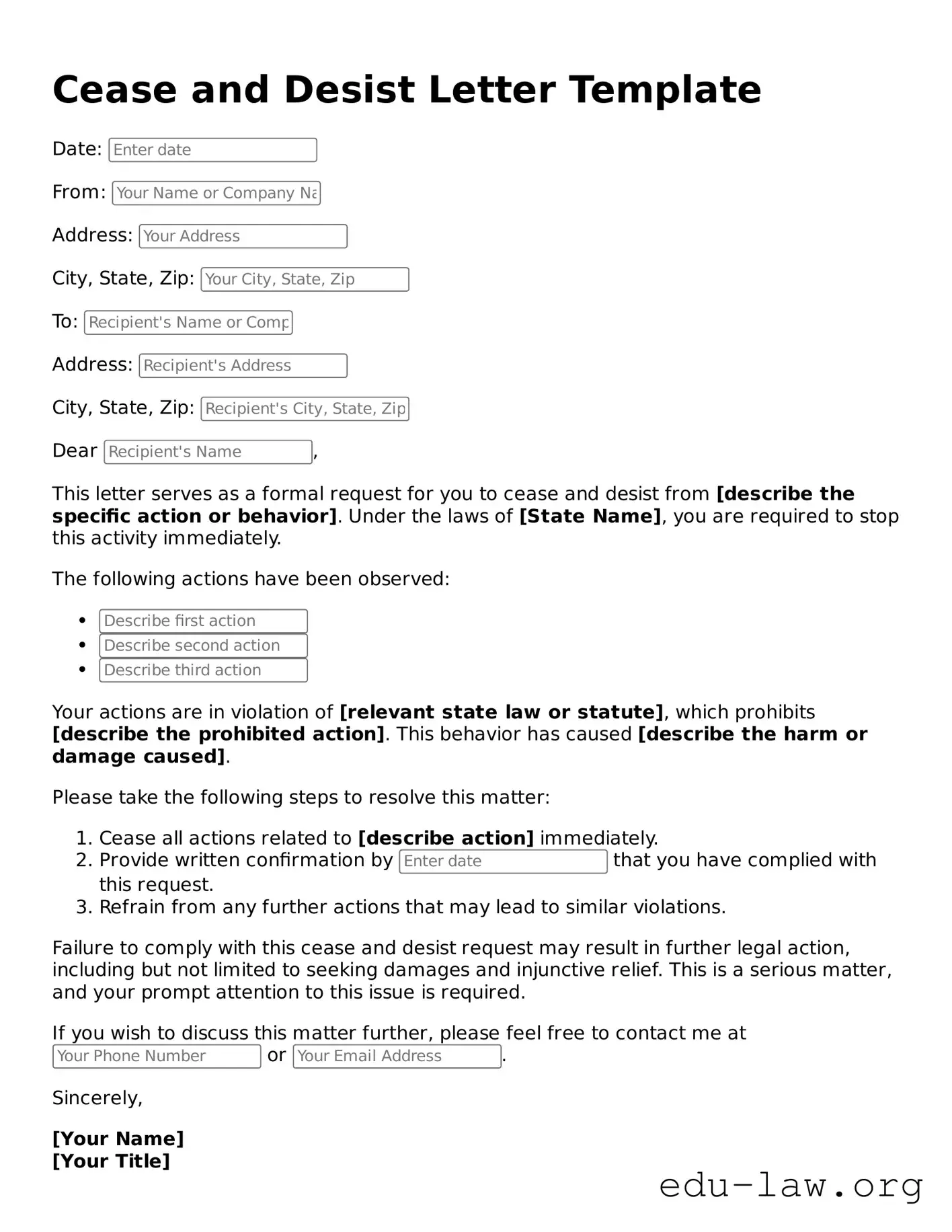
Cease and Desist Letter Template
Date:
From:
Address:
City, State, Zip:
To:
Address:
City, State, Zip:
Dear ,
This letter serves as a formal request for you to cease and desist from [describe the specific action or behavior]. Under the laws of [State Name], you are required to stop this activity immediately.
The following actions have been observed:
Your actions are in violation of [relevant state law or statute], which prohibits [describe the prohibited action]. This behavior has caused [describe the harm or damage caused].
Please take the following steps to resolve this matter:
Failure to comply with this cease and desist request may result in further legal action, including but not limited to seeking damages and injunctive relief. This is a serious matter, and your prompt attention to this issue is required.
If you wish to discuss this matter further, please feel free to contact me at or .
Sincerely,
[Your Name]
[Your Title]
[Your Company Name]
| Fact Name | Description |
|---|---|
| Definition | A Cease and Desist Letter is a formal request to stop an activity that infringes on rights or causes harm. |
| Purpose | It aims to inform the recipient of alleged unlawful behavior and to request that they cease such actions. |
| Legal Standing | While it is not a legally binding document, it serves as a warning and can be used in court if necessary. |
| Format | The letter typically includes the sender's information, recipient's information, a description of the issue, and a request to stop. |
| Delivery Method | It can be delivered via mail, email, or even in person, depending on the situation and urgency. |
| State-Specific Forms | Some states have specific requirements or forms for Cease and Desist Letters, such as California and New York. |
| Governing Laws | California's Civil Code Section 3344 governs false advertising, while New York's General Business Law Section 349 addresses deceptive practices. |
| Response Time | Recipients are generally expected to respond within a reasonable time frame, often 10 to 30 days. |
| Consequences of Ignoring | Failure to comply may result in legal action, including lawsuits or further legal notices. |
| Importance of Documentation | Keeping a copy of the letter and any correspondence is crucial for potential future legal actions. |
After gathering the necessary information, you are ready to proceed with filling out the Cease and Desist Letter form. Completing this form accurately is crucial for ensuring your concerns are addressed appropriately. Below are the steps to guide you through the process.
Once you have completed the form, review it carefully for any errors or omissions. It is advisable to keep a copy for your records before sending it to the intended recipient.
What is a Cease and Desist Letter?
A Cease and Desist Letter is a formal document sent to an individual or organization to demand that they stop engaging in a specific activity. This activity is often unlawful or infringing on someone’s rights. The letter serves as a warning and outlines the reasons for the request, as well as the potential consequences of not complying.
When should I send a Cease and Desist Letter?
You should consider sending a Cease and Desist Letter when you believe that your rights are being violated. This could involve copyright infringement, trademark violations, harassment, or other unlawful actions. It is often a good first step before taking legal action, as it provides the recipient an opportunity to correct their behavior.
Who can send a Cease and Desist Letter?
Any individual or entity can send a Cease and Desist Letter. This includes business owners, artists, and individuals who feel their rights are being compromised. While you can draft and send the letter yourself, consulting with a lawyer may help ensure that it is effective and properly worded.
What should be included in a Cease and Desist Letter?
A well-crafted Cease and Desist Letter should include several key elements. Start with a clear statement of the issue. Include details about the infringing activity, your rights, and any relevant laws. Specify what you want the recipient to do, such as stopping the activity or taking corrective action. Finally, include a deadline for compliance and mention possible legal actions if they do not comply.
Is a Cease and Desist Letter legally binding?
A Cease and Desist Letter is not a legally binding document on its own. However, it serves as a formal notice and can be an important step in documenting your claims. If the issue escalates to a lawsuit, the letter can demonstrate that you attempted to resolve the matter amicably before seeking legal remedies.
What happens if the recipient ignores the letter?
If the recipient ignores the Cease and Desist Letter, you may need to consider further action. This could involve filing a lawsuit or seeking mediation. The letter can serve as evidence that you made a good faith effort to resolve the issue before taking more serious steps.
Can a Cease and Desist Letter be challenged?
Yes, the recipient of a Cease and Desist Letter can challenge it. They may respond with their own letter disputing your claims or arguing that their actions are lawful. In some cases, they may even counterclaim for damages if they believe the letter was sent in bad faith.
How long does it take to get a response to a Cease and Desist Letter?
The response time can vary widely. Typically, you should allow at least a week or two for the recipient to respond. If you do not receive a reply within that timeframe, you may want to follow up or consider your next steps.
Can I send a Cease and Desist Letter via email?
Yes, you can send a Cease and Desist Letter via email, but it is generally recommended to send it through certified mail or another trackable method. This provides proof of delivery and ensures that the recipient has received the letter. If sending by email, consider following up with a hard copy.
What are the potential consequences of ignoring a Cease and Desist Letter?
Ignoring a Cease and Desist Letter can lead to serious consequences. The sender may escalate the matter by taking legal action, which could result in a lawsuit. This can lead to costly legal fees, damages, or even an injunction that legally prevents the recipient from continuing the infringing activity.
Not Clearly Identifying the Parties: It is essential to specify who is sending the letter and who it is addressed to. Failing to include full names and addresses can lead to confusion.
Vague Description of the Issue: Clearly outline the behavior or action that needs to stop. A vague description may not effectively convey the seriousness of the situation.
Omitting Relevant Dates: Including dates related to the incidents or actions in question can provide context. Without these details, the letter may lack clarity.
Failure to State Legal Basis: It is important to mention the legal grounds for the request. Not doing so can weaken the letter’s authority and effectiveness.
Not Specifying Desired Actions: Clearly state what actions the recipient needs to take. Ambiguity about what is expected can lead to misunderstandings.
Ignoring the Tone: The tone of the letter should be firm yet professional. An overly aggressive tone may provoke a negative reaction.
Neglecting to Include a Deadline: Providing a reasonable timeframe for compliance is crucial. Without a deadline, the recipient may not feel urgency to address the issue.
A Cease and Desist Letter is often a critical first step in addressing disputes or conflicts, particularly regarding intellectual property or harassment issues. However, it is frequently accompanied by other important documents that can help clarify the situation and provide additional legal backing. Below are some commonly used forms and documents that may accompany a Cease and Desist Letter.
Incorporating these documents can enhance the effectiveness of a Cease and Desist Letter, providing a clearer path toward resolution. Each serves a unique purpose and can contribute significantly to the legal strategy surrounding a dispute.
A Demand Letter is similar to a Cease and Desist Letter in that both documents aim to resolve a dispute before escalating to legal action. A Demand Letter typically outlines the grievances of one party and requests specific actions from the other party, such as payment for damages or compliance with a contract. While a Cease and Desist Letter focuses on stopping certain actions, a Demand Letter often seeks compensation or a resolution to a specific issue. Both serve as formal communications that can establish a record of the dispute.
An Intent to Sue Letter also shares similarities with a Cease and Desist Letter. This document notifies the recipient that legal action may be pursued if the issue at hand is not resolved. It often includes a summary of the situation and a deadline for response. Like a Cease and Desist Letter, the Intent to Sue Letter serves as a warning and encourages the recipient to take corrective action to avoid litigation.
A Settlement Agreement is another document that can be compared to a Cease and Desist Letter. While a Cease and Desist Letter demands an end to certain actions, a Settlement Agreement outlines the terms under which parties agree to resolve their disputes amicably. This document often includes concessions from both sides and aims to prevent future conflicts. Both documents seek to bring about resolution but differ in their approach and intent.
An Arbitration Demand is akin to a Cease and Desist Letter in that it initiates a formal dispute resolution process. While a Cease and Desist Letter requests that a party stop an action, an Arbitration Demand outlines the desire to resolve a dispute through arbitration instead of litigation. Both documents can serve as preliminary steps to address conflicts, but the Arbitration Demand signals a willingness to engage in a structured resolution process.
A Non-Disclosure Agreement (NDA) can also be related to a Cease and Desist Letter, especially in cases involving the protection of confidential information. An NDA is a legal contract that prevents parties from disclosing certain information. If one party breaches the NDA, a Cease and Desist Letter may be issued to demand that the offending party stop sharing the confidential information. Both documents aim to protect rights and interests, albeit in different contexts.
A Letter of Reprimand, often used in employment situations, can be similar to a Cease and Desist Letter in that it formally addresses unacceptable behavior. This letter typically outlines specific actions that must cease and may include consequences for non-compliance. Both documents serve as a warning and provide an opportunity for the recipient to correct their behavior before further action is taken.
A Notice of Violation is comparable to a Cease and Desist Letter in the context of regulatory compliance. This document informs an individual or organization that they are in violation of certain laws or regulations and must take corrective action. Like a Cease and Desist Letter, it emphasizes the need for immediate action to avoid further penalties or legal consequences.
A Release of Liability is another document that can be associated with a Cease and Desist Letter. While a Cease and Desist Letter demands that a party stop a specific action, a Release of Liability protects one party from future claims related to certain actions. Both documents are used to manage risks and protect interests, although they operate in different capacities.
Lastly, a Notice to Quit is similar to a Cease and Desist Letter in the realm of landlord-tenant relationships. This document is used to inform a tenant that they must vacate the premises due to a lease violation. Like a Cease and Desist Letter, it serves as a formal notice that requires immediate action to avoid further legal proceedings. Both documents highlight the importance of adhering to agreements and the consequences of non-compliance.
When filling out a Cease and Desist Letter form, it is important to approach the task with care. Below are ten things you should and shouldn't do to ensure that your letter is effective and appropriate.
Many people have misunderstandings about cease and desist letters. Here are some common misconceptions:
Understanding these misconceptions can help you respond appropriately if you ever receive a cease and desist letter.
When dealing with a situation that requires a Cease and Desist Letter, it’s essential to understand how to properly fill out and utilize this form. Here are some key takeaways to keep in mind:
By following these guidelines, you can effectively communicate your concerns and protect your rights.