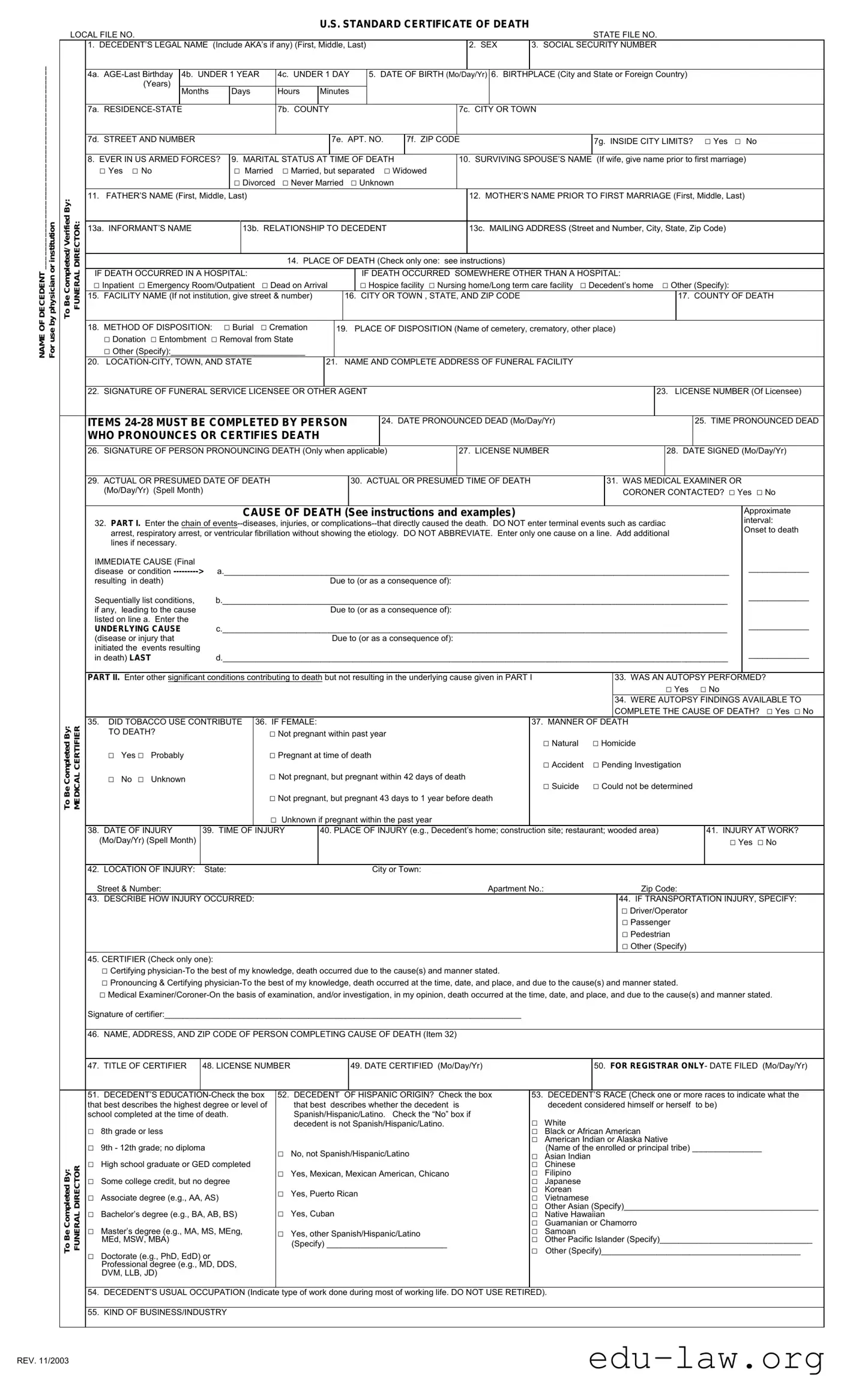
The CDC U.S. Standard Certificate of Death form serves as a critical document in the process of recording and reporting vital statistics in the United States. This form captures essential information about the deceased, including personal details such as name, date of birth, and place of residence, which help establish identity and provide context for the circumstances surrounding the death. Additionally, it includes sections dedicated to the cause of death, which are vital for public health data collection and analysis. By documenting both immediate and underlying causes, the form aids health officials in identifying trends and patterns that can influence healthcare policies and initiatives. Furthermore, the certificate requires input from medical professionals, ensuring that the information is accurate and reliable. The completion of this form is not merely a bureaucratic step; it plays a significant role in honoring the deceased and providing closure for their families. Understanding its components and importance can help individuals navigate the often challenging process of dealing with loss while fulfilling legal and social responsibilities.

NAME OF DECEDENT ____________________________________________ For use by physician or institution
U.S. STANDARD CERTIFICATE OF DEATH
LOCAL FILE NO. |
|
|
|
|
|
|
|
|
|
|
STATE FILE NO. |
|||
1. |
DECEDENT’S LEGAL NAME (Include AKA’s if any) (First, Middle, Last) |
|
|
|
2. SEX |
3. SOCIAL SECURITY NUMBER |
||||||||
|
|
|
|
|
|
|
|
|
|
|
|
|
|
|
|
4a. |
4b. UNDER 1 YEAR |
4c. UNDER 1 DAY |
5. DATE OF BIRTH (Mo/Day/Yr) |
6. BIRTHPLACE (City and State or Foreign Country) |
|||||||||
|
|
(Years) |
|
|
|
|
|
|
|
|
|
|
|
|
|
|
|
Months |
Days |
Hours |
Minutes |
|
|
|
|
|
|
|
|
|
|
|
|
|
|
|
|
|
|
|
|
|
||
|
7a. |
|
|
7b. COUNTY |
|
|
7c. CITY OR TOWN |
|||||||
|
|
|
|
|
|
|
|
|
|
7g. INSIDE CITY LIMITS? □ Yes □ No |
||||
|
7d. |
STREET AND NUMBER |
|
|
|
7e. APT. NO. |
7f. ZIP CODE |
|
|
|||||
|
|
|
|
|
|
|
(If wife, give name prior to first marriage) |
|||||||
8. |
EVER IN US ARMED FORCES? |
9. MARITAL STATUS AT |
TIME OF DEATH |
|
10. SURVIVING SPOUSE’S NAME |
|||||||||
|
|
□ Yes □ No |
□ Married |
□ Married, but separated □ Widowed |
|
|
||||||||
□Divorced □ Never Married □ Unknown
By: |
11. |
FATHER’S NAME (First, Middle, Last) |
|
|
|
|
|
12. MOTHER’S NAME PRIOR TO FIRST MARRIAGE (First, Middle, Last) |
||||
|
|
|
|
|
|
|
|
|
|
|
|
|
VerifiedCompleted/BeTo DIRECTOR:FUNERAL |
|
|
|
|
|
|
|
|
|
|
|
|
13a. INFORMANT’S NAME |
|
13b. RELATIONSHIP TO DECEDENT |
|
13c. MAILING ADDRESS (Street and Number, City, State, Zip Code) |
||||||||
|
|
|
||||||||||
|
|
|
|
|
|
|
|
|
|
|
||
|
|
|
|
|
14. PLACE OF DEATH (Check only one: see instructions) |
|
|
|||||
|
IF DEATH OCCURRED IN A HOSPITAL: |
|
|
|
IF DEATH OCCURRED SOMEWHERE OTHER THAN A HOSPITAL: |
|
|
|||||
|
□ Inpatient □ Emergency Room/Outpatient |
□ Dead on Arrival |
|
|
□ Hospice facility |
□ Nursing home/Long term care facility □ Decedent’s home |
□ Other (Specify): |
|||||
|
15. |
FACILITY NAME (If not institution, give street & number) |
|
16. |
CITY OR TOWN , STATE, AND ZIP CODE |
|
17. COUNTY OF DEATH |
|||||
|
|
|
|
|
|
|
|
|
||||
|
18. |
METHOD OF DISPOSITION: |
□ Burial |
□ Cremation |
19. PLACE OF DISPOSITION (Name of cemetery, crematory, other place) |
|
|
|||||
□Donation □ Entombment □ Removal from State
□Other (Specify):_____________________________
|
|
|
|
|
|
|
|
|
|
|
|
|
|
|
|
|
|
|
|
|
|
|
|
|
|
20. |
|
21. NAME AND COMPLETE ADDRESS OF FUNERAL FACILITY |
|
|
|
|
|
|
|
|
|
|
|||||||||||
|
|
|
|
|
|
|
|
|
|
|
|
|
|
|
|
|
|
|
|
|||||
|
22. SIGNATURE OF FUNERAL SERVICE LICENSEE OR OTHER AGENT |
|
|
|
|
|
|
|
|
23. LICENSE NUMBER (Of Licensee) |
||||||||||||||
|
|
|
|
|
|
|
|
|
|
|
|
|
|
|
|
|
|
|
||||||
|
ITEMS |
|
24. DATE PRONOUNCED DEAD (Mo/Day/Yr) |
|
|
|
|
|
|
25. TIME PRONOUNCED DEAD |
||||||||||||||
|
WHO PRONOUNCES OR CERTIFIES DEATH |
|
|
|
|
|
|
|
|
|
|
|
|
|
|
|
|
|
|
|||||
|
26. SIGNATURE OF PERSON PRONOUNCING DEATH (Only when applicable) |
|
27. LICENSE NUMBER |
|
|
|
|
|
28. DATE SIGNED (Mo/Day/Yr) |
|||||||||||||||
|
|
|
|
|
|
|
|
|
|
|
|
|
|
|
|
|
||||||||
|
29. ACTUAL OR PRESUMED DATE OF DEATH |
|
|
|
30. ACTUAL OR PRESUMED |
TIME OF DEATH |
|
31. WAS MEDICAL EXAMINER OR |
||||||||||||||||
|
(Mo/Day/Yr) (Spell Month) |
|
|
|
|
|
|
|
|
|
|
|
|
|
CORONER CONTACTED? □ Yes □ No |
|||||||||
|
|
|
|
|
|
|
|
|
|
|
|
|
|
|
|
|
|
|
|
|||||
|
|
|
|
|
CAUSE OF DEATH |
(See instructions and examples) |
|
|
|
|
|
|
|
|
|
Approximate |
||||||||
|
32. PART I. Enter the chain of |
|
|
|
interval: |
|||||||||||||||||||
|
|
|
|
Onset to death |
||||||||||||||||||||
|
arrest, respiratory arrest, or ventricular fibrillation without showing the etiology. DO NOT ABBREVIATE. Enter only one cause on a line. Add additional |
|
|
|
||||||||||||||||||||
|
lines if necessary. |
|
|
|
|
|
|
|
|
|
|
|
|
|
|
|
|
|
|
|
|
|
||
|
IMMEDIATE CAUSE (Final |
|
|
|
|
|
|
|
|
|
|
|
|
|
|
|
|
|
|
|
|
_____________ |
||
|
disease or condition |
a._____________________________________________________________________________________________________________ |
|
|||||||||||||||||||||
|
|
|
||||||||||||||||||||||
|
resulting in death) |
|
|
|
|
Due to (or as a consequence of): |
|
|
|
|
|
|
|
|
|
|
|
|
||||||
|
Sequentially list conditions, |
|
b._____________________________________________________________________________________________________________ |
|
_____________ |
|||||||||||||||||||
|
if any, |
leading to the cause |
|
|
|
|
Due to (or as a consequence of): |
|
|
|
|
|
|
|
|
|
|
|
|
|||||
|
listed on line a. Enter the |
|
|
|
|
|
|
|
|
|
|
|
|
|
|
|
|
|
|
|
|
_____________ |
||
|
UNDERLYING CAUSE |
|
c._____________________________________________________________________________________________________________ |
|
||||||||||||||||||||
|
|
|
|
|||||||||||||||||||||
|
(disease or injury that |
|
|
|
|
Due to (or as a consequence of): |
|
|
|
|
|
|
|
|
|
|
|
|
||||||
|
initiated the events resulting |
|
|
|
|
|
|
|
|
|
|
|
|
|
|
|
|
|
|
|
|
_____________ |
||
|
in death) LAST |
|
|
d._____________________________________________________________________________________________________________ |
|
|||||||||||||||||||
|
|
|
|
|
||||||||||||||||||||
|
|
|
|
|
|
|
|
|
|
|
|
|||||||||||||
|
PART II. Enter other significant conditions contributing to death but not resulting in the underlying cause given in PART I |
|
|
33. WAS AN AUTOPSY PERFORMED? |
||||||||||||||||||||
|
|
|
|
|
|
|
|
|
|
|
|
|
|
|
|
|
|
|
|
□ Yes |
□ No |
|
|
|
|
|
|
|
|
|
|
|
|
|
|
|
|
|
|
|
|
34. WERE AUTOPSY FINDINGS AVAILABLE TO |
|||||||
|
|
|
|
|
|
|
|
|
|
|
|
|
|
|
|
|
COMPLETE THE CAUSE OF DEATH? □ Yes □ No |
|||||||
To Be Completed By: MEDICAL CERTIFIER |
35. DID TOBACCO USE CONTRIBUTE |
36. IF FEMALE: |
|
|
|
|
|
|
|
37. MANNER OF DEATH |
|
|
|
|
||||||||||
TO DEATH? |
|
|
□ Not pregnant within past year |
|
□ Natural |
□ Homicide |
|
|
|
|
||||||||||||||
□ |
Yes □ |
|
|
|
□ Pregnant at time of death |
|
|
|
|
|
|
|
||||||||||||
Probably |
|
|
|
|
|
□ Accident □ Pending Investigation |
|
|
|
|
||||||||||||||
|
|
|
|
|
□ Not pregnant, but pregnant within 42 days of death |
|
|
|
|
|||||||||||||||
□ |
No □ |
Unknown |
|
|
□ Suicide □ Could not be determined |
|
|
|
|
|||||||||||||||
|
|
|
|
|
□ Not pregnant, but pregnant 43 days to 1 year before death |
|
|
|
|
|||||||||||||||
|
|
|
|
|
|
|
|
|
|
|
|
|
|
|
|
|||||||||
|
|
|
|
|
|
|
|
|
|
|
|
|
|
|
|
|
|
|
|
|
|
|
|
|
|
|
|
|
|
|
□ Unknown if pregnant within the past year |
|
|
|
|
|
|
|
|
|
|
|
|
||||||
|
38. DATE OF INJURY |
39. TIME OF |
INJURY |
40. PLACE OF INJURY (e.g., Decedent’s home; construction site; restaurant; wooded area) |
|
41. INJURY AT WORK? |
||||||||||||||||||
|
(Mo/Day/Yr) (Spell Month) |
|
|
|
|
|
|
|
|
|
|
|
|
|
|
|
|
|
|
|
□ Yes □ No |
|||
|
|
|
|
|
|
|
|
|
|
|
|
|
|
|
|
|
|
|
|
|
||||
|
42. LOCATION OF INJURY: |
|
State: |
|
|
|
|
City or Town: |
|
|
|
|
|
|
|
|
|
|
|
|
||||
|
Street & Number: |
|
|
|
|
|
|
|
|
|
Apartment No.: |
|
|
|
Zip Code: |
|
|
|
|
|||||
|
43. DESCRIBE HOW INJURY OCCURRED: |
|
|
|
|
|
|
|
|
|
|
|
44. IF TRANSPORTATION INJURY, SPECIFY: |
|||||||||||
|
|
|
|
|
|
|
|
|
|
|
|
|
|
|
|
|
|
□ Driver/Operator |
|
|
|
|
||
|
|
|
|
|
|
|
|
|
|
|
|
|
|
|
|
|
|
□ Passenger |
|
|
|
|
||
|
|
|
|
|
|
|
|
|
|
|
|
|
|
|
|
|
|
□ Pedestrian |
|
|
|
|
||
|
|
|
|
|
|
|
|
|
|
|
|
|
|
|
|
|
|
□ Other (Specify) |
|
|
|
|
||
45.CERTIFIER (Check only one):
□Certifying
□Pronouncing & Certifying
□Medical
|
Signature of certifier:_____________________________________________________________________________ |
|
|
|
||||
|
|
|
|
|
|
|
|
|
|
46. NAME, ADDRESS, AND ZIP CODE OF PERSON COMPLETING CAUSE OF DEATH (Item 32) |
|
|
|
||||
|
|
|
|
|
|
|
|
|
|
47. TITLE OF CERTIFIER |
48. LICENSE NUMBER |
|
49. DATE CERTIFIED (Mo/Day/Yr) |
|
|
50. FOR REGISTRAR ONLY- DATE FILED (Mo/Day/Yr) |
|
|
|
|
|
|
|
|
||
|
51. DECEDENT’S EDUCATION |
52. DECEDENT OF HISPANIC ORIGIN? Check the box |
53. DECEDENT’S RACE (Check one or more races to indicate what the |
|||||
|
that best describes the highest degree or level of |
|
that best describes whether the decedent is |
|
decedent considered himself or herself to be) |
|||
|
school completed at the time of death. |
|
Spanish/Hispanic/Latino. Check the “No” box if |
□ White |
||||
|
□ 8th grade or less |
|
decedent is not Spanish/Hispanic/Latino. |
|||||
|
|
|
|
□ |
Black or African American |
|||
|
□ 9th - 12th grade; no diploma |
|
|
|
□ |
American Indian or Alaska Native |
||
|
□ |
No, not Spanish/Hispanic/Latino |
□ |
(Name of the enrolled or principal tribe) _______________ |
||||
|
□ High school graduate or GED completed |
Asian Indian |
||||||
To Be Completed By: FUNERAL DIRECTOR |
□ |
|
|
□ |
Chinese |
|||
□ Some college credit, but no degree |
Yes, Mexican, Mexican American, Chicano |
□ |
Filipino |
|||||
|
|
|
□ |
Japanese |
||||
□ Associate degree (e.g., AA, AS) |
□ |
Yes, Puerto Rican |
□ |
Korean |
||||
□ |
Vietnamese |
|||||||
□ Bachelor’s degree (e.g., BA, AB, BS) |
□ |
Yes, Cuban |
□ |
Other Asian (Specify)__________________________________________ |
||||
□ |
Native Hawaiian |
|||||||
□ Master’s degree (e.g., MA, MS, MEng, |
□ |
|
|
□ |
Guamanian or Chamorro |
|||
Yes, other Spanish/Hispanic/Latino |
□ |
Samoan |
||||||
MEd, MSW, MBA) |
|
(Specify) __________________________ |
□ |
Other Pacific Islander (Specify)_________________________________ |
||||
□ Doctorate (e.g., PhD, EdD) or |
|
□ |
Other (Specify)___________________________________________ |
|||||
|
|
|
||||||
|
Professional degree (e.g., MD, DDS, |
|
|
|
|
|
|
|
|
DVM, LLB, JD) |
|
|
|
|
|
|
|
|
|
|
|
|
|
|
|
|
54.DECEDENT’S USUAL OCCUPATION (Indicate type of work done during most of working life. DO NOT USE RETIRED).
55.KIND OF BUSINESS/INDUSTRY
REV. 11/2003

MEDICAL CERTIFIER INSTRUCTIONS for selected items on U.S. Standard Certificate of Death
(See Physicians’ Handbook or Medical Examiner/Coroner Handbook on Death Registration for instructions on all items)
ITEMS ON WHEN DEATH OCCURRED
Items
ITEMS
Spell out the name of the month. If the exact date of death is unknown, enter the approximate date. If the date cannot be approximated, enter the date the body is found and identify as date found. Date pronounced and actual date may be the same. Enter the exact hour and minutes according to a
ITEM 32 – CAUSE OF DEATH (See attached examples)
Take care to make the entry legible. Use a computer printer with high resolution, typewriter with good black ribbon and clean keys, or print legibly using permanent black ink in completing the CAUSE OF DEATH Section. Do not abbreviate conditions entered in section.
Part I (Chain of events leading directly to death)
•Only one cause should be entered on each line. Line (a) MUST ALWAYS have an entry. DO NOT leave blank. Additional lines may be added if necessary.
•If the condition on Line (a) resulted from an underlying condition, put the underlying condition on Line (b), and so on, until the full sequence is reported. ALWAYS enter the underlying cause of death on the lowest used line in Part I.
•For each cause indicate the best estimate of the interval between the presumed onset and the date of death. The terms “unknown” or “approximately” may be used. General terms, such as minutes, hours, or days, are acceptable, if necessary. DO NOT leave blank.
•The terminal event (for example, cardiac arrest or respiratory arrest) should not be used. If a mechanism of death seems most appropriate to you for line (a), then you must always list its cause(s) on the line(s) below it (for example, cardiac arrest due to coronary artery atherosclerosis or cardiac arrest due to blunt impact to chest).
• If an organ system failure such as congestive heart failure, hepatic failure, renal failure, or respiratory failure is listed as a cause of death, always report its etiology on the line(s) beneath it (for example, renal failure due to Type I diabetes mellitus).
•When indicating neoplasms as a cause of death, include the following: 1) primary site or that the primary site is unknown, 2) benign or malignant, 3) cell type or that the cell type is unknown, 4) grade of neoplasm, and 5) part or lobe of organ affected. (For example, a primary well- differentiated squamous cell carcinoma, lung, left upper lobe.)
•Always report the fatal injury (for example, stab wound of chest), the trauma (for example, transection of subclavian vein), and impairment of function (for example, air embolism).
PART II (Other significant conditions)
•Enter all diseases or conditions contributing to death that were not reported in the chain of events in Part I and that did not result in the underlying cause of death. See attached examples.
•If two or more possible sequences resulted in death, or if two conditions seem to have added together, report in Part I the one that, in your opinion, most directly caused death. Report in Part II the other conditions or diseases.
CHANGES TO CAUSE OF DEATH
Should additional medical information or autopsy findings become available that would change the cause of death originally reported, the original death certificate should be amended by the certifying physician by immediately reporting the revised cause of death to the State Vital Records Office.
ITEMS
•33 - Enter “Yes” if either a partial or full autopsy was performed. Otherwise enter “No.”
•34 - Enter “Yes” if autopsy findings were available to complete the cause of death; otherwise enter “No”. Leave item blank if no autopsy was performed.
ITEM 35 - DID TOBACCO USE CONTRIBUTE TO DEATH?
Check “yes” if, in your opinion, the use of tobacco contributed to death. Tobacco use may contribute to deaths due to a wide variety of diseases; for example, tobacco use contributes to many deaths due to emphysema or lung cancer and some heart disease and cancers of the head and neck. Check “no” if, in your clinical judgment, tobacco use did not contribute to this particular death.
ITEM 36 - IF FEMALE, WAS DECEDENT PREGNANT AT TIME OF DEATH OR WITHIN PAST YEAR?
This information is important in determining
ITEM 37 - MANNER OF DEATH
•Always check Manner of Death, which is important: 1) in determining accurate causes of death; 2) in processing insurance claims; and 3) in statistical studies of injuries and death.
•Indicate “Pending investigation” if the manner of death cannot be determined whether due to an accident, suicide, or homicide within the statutory time limit for filing the death certificate. This should be changed later to one of the other terms.
•Indicate “Could not be Determined” ONLY when it is impossible to determine the manner of death.
ITEMS
•38 - Enter the exact month, day, and year of injury. Spell out the name of the month. DO NOT use a number for the month. (Remember, the date of injury may differ from the date of death.) Estimates may be provided with “Approx.” placed before the date.
•39 - Enter the exact hour and minutes of injury or use your best estimate. Use a
•40 - Enter the general place (such as restaurant, vacant lot, or home) where the injury occurred. DO NOT enter firm or organization names. (For example, enter “factory”, not “Standard Manufacturing, Inc.” )
•41 - Complete if anything other than natural disease is mentioned in Part I or Part II of the medical certification, including homicides, suicides, and accidents. This includes all motor vehicle deaths. The item must be completed for decedents ages 14 years or over and may be completed for those less than 14 years of age if warranted. Enter “Yes” if the injury occurred at work. Otherwise enter “No”. An injury may occur at work regardless of whether the injury occurred in the course of the decedent’s “usual” occupation. Examples of injury at work and injury not at work follow:
Injury at work |
Injury not at work |
Injury while working or in vocational training on job premises |
Injury while engaged in personal recreational activity on job premises |
Injury while on break or at lunch or in parking lot on job premises |
Injury while a visitor (not on official work business) to job premises |
Injury while working for pay or compensation, including at home |
Homemaker working at homemaking activities |
Injury while working as a volunteer law enforcement official etc. |
Student in school |
Injury while traveling on business, including to/from business contacts |
Working for self for no profit (mowing yard, repairing own roof, hobby) |
|
Commuting to or from work |
•42 - Enter the complete address where the injury occurred including zip code.
•43 - Enter a brief but specific and clear description of how the injury occurred. Explain the circumstances or cause of the injury. Specify type of gun or type of vehicle (e.g., car, bulldozer, train, etc.) when relevant to circumstances. Indicate if more than one vehicle involved; specify type of vehicle decedent was in.
•44
Rationale: Motor vehicle accidents are a major cause of unintentional deaths; details will help determine effectiveness of current safety features and laws.
REFERENCES
For more information on how to complete the medical certification section of the death certificate, refer to tutorial at http://www.TheNAME.org and resources including instructions and handbooks available by request from NCHS, Room 7318, 3311 Toledo Road, Hyattsville, Maryland 20782- 2003 or at www.cdc.gov/nchs/about/major/dvs/handbk.htm
REV. 11/2003

Accurate cause of death information is important
•to the public health community in evaluating and improving the health of all citizens, and •often to the family, now and in the future, and to the person settling the decedent’s estate.
The
Examples of properly completed medical certifications
|
|
CAUSE OF DEATH (See instructions and examples) |
|
|
Approximate interval: |
32. PART I. Enter the chain of |
|
Onset to death |
|||
|
|
||||
arrest, respiratory arrest, or ventricular fibrillation without showing the etiology. DO NOT ABBREVIATE. Enter only one cause on a line. Add additional |
|
|
|||
lines if necessary. |
|
|
|
|
|
IMMEDIATE CAUSE (Final |
a. Rupture of myocardium __________________________________________________________________________________ |
Minutes |
|||
disease |
or condition |
||||
resulting |
in death) |
Due to (or as a consequence of): |
|
|
|
Sequentially list conditions, |
b. Acute myocardial infarction_______________________________________________________________________________ |
6 days |
|||
if any, leading to the cause |
Due to (or as a consequence of): |
|
|
|
|
listed on line a. Enter the |
c. Coronary artery thrombosis_______________________________________________________________________________ |
5 years |
|||
UNDERLYING CAUSE |
|||||
(disease or injury that |
Due to (or as a consequence of): |
|
|
|
|
initiated the events resulting |
d. Atherosclerotic coronary artery disease__________________________________________________________________ |
7 years |
|||
in death) LAST |
|||||
|
|
|
|||
PART II. Enter other significant conditions contributing to death but not resulting in the underlying cause given in PART I |
33. WAS AN AUTOPSY PERFORMED? |
|
|||
Diabetes, Chronic obstructive pulmonary disease, smoking |
■ Yes |
No |
|
||
34. WERE AUTOPSY FINDINGS AVAILABLE TO |
|||||
|
|
|
COMPLETE THE CAUSE OF DEATH? |
■ Yes No |
|
35.DID TOBACCO USE CONTRIBUTE TO DEATH?
■Yes Probably
No Unknown
36.IF FEMALE:
■Not pregnant within past year Pregnant at time of death
Not pregnant, but pregnant within 42 days of death
Not pregnant, but pregnant 43 days to 1 year before death Unknown if pregnant within the past year
37. MANNER OF DEATH
■ Natural |
Homicide |
Accident |
Pending Investigation |
Suicide |
Could not be determined |
|
|
|
CAUSE OF DEATH (See instructions and examples) |
|
|
|
|
|
|
|
Approximate interval: |
||
32. PART I. Enter the chain of |
|
|
|
Onset to death |
|||||||||
arrest, respiratory arrest, or ventricular fibrillation without showing the etiology. DO NOT ABBREVIATE. Enter only one cause on a line. Add additional |
|
|
|
|
|||||||||
lines if necessary. |
|
|
|
|
|
|
|
|
|
|
|
|
|
IMMEDIATE CAUSE (Final |
|
a. Aspiration pneumonia_______________________________________________________________ |
|
2 Days |
|||||||||
disease or condition |
|
|
|||||||||||
resulting |
in death) |
|
Due to (or as a consequence of): |
|
|
|
|
|
|
|
|
||
Sequentially list conditions, |
|
b. Complications of coma___________________________________________________________________________________ |
|
7 weeks |
|||||||||
if any, leading to the cause |
|
Due to (or as a consequence of): |
|
|
|
|
|
|
|
|
|||
listed on line a. Enter the |
|
c. Blunt force injuries________________________________________________________________________________________ |
|
7 weeks |
|||||||||
UNDERLYING CAUSE |
|
|
|||||||||||
(disease or injury that |
|
Due to (or as a consequence of): |
|
|
|
|
|
|
|
|
|||
initiated the events resulting |
|
d. Motor vehicle accident____________________________________________________________________________________ |
|
|
|||||||||
in death) LAST |
|
|
7 weeks |
||||||||||
|
|
|
|
|
|
|
|
|
|||||
PART II. Enter other significant conditions contributing to death but not resulting in the underlying cause given in PART I |
|
33. WAS AN AUTOPSY PERFORMED? |
|
||||||||||
|
|
|
|
|
|
|
|
|
■ Yes |
No |
|
|
|
|
|
|
|
|
|
|
34. WERE AUTOPSY FINDINGS AVAILABLE TO |
||||||
|
|
|
|
|
|
|
COMPLETE THE CAUSE OF DEATH? ■ Yes No |
||||||
35. DID TOBACCO USE CONTRIBUTE TO DEATH? |
36. IF FEMALE: |
37. |
MANNER OF DEATH |
|
|
|
|
||||||
Yes |
Probably |
|
|
Not pregnant within past year |
Natural |
Homicide |
|
|
|
|
|||
|
|
Pregnant at time of death |
|
|
|
|
|||||||
■ No |
Unknown |
|
|
Not pregnant, but pregnant within 42 days of death |
■ Accident |
Pending Investigation |
|
|
|||||
|
|
Not pregnant, but pregnant 43 days to 1 year before death |
Suicide |
Could not be determined |
|||||||||
|
|
|
|
Unknown if pregnant within the past year |
|
|
|
|
|
|
|
|
|
38. DATE OF INJURY |
|
39. TIME OF INJURY |
|
40. PLACE OF INJURY (e.g., Decedent’s home; construction site; restaurant; wooded area) |
|
41. INJURY AT WORK? |
|||||||
(Mo/Day/Yr) (Spell Month) |
|
Approx. 2320 |
|
road side near state highway |
|
|
|
|
|
|
|
|
|
August 15, 2003 |
|
|
|
|
|
|
|
|
Yes ■ No |
||||
|
|
|
|
|
|
|
|
|
|
||||
|
|
|
|
|
|
|
|
|
|
|
|
||
|
|
|
|
|
|
|
|
|
|
|
|
|
|
42. LOCATION OF INJURY: |
State: Missouri |
|
City or Town: near Alexandria |
|
|
|
|
|
|
|
|
||
Street & Number: mile marker 17 on state route 46a |
|
Apartment No.: |
Zip Code: |
|
|
|
|
|
|||||
43. DESCRIBE HOW INJURY OCCURRED: |
|
|
|
|
44. IF TRANSPORTATION INJURY, SPECIFY: |
||||||||
Decedent driver of van, ran off road into tree |
|
|
■ Driver/Operator |
|
|
|
|
||||||
|
|
|
|
|
|
|
|
Passenger |
|
|
|
|
|
|
|
|
|
|
|
|
|
Pedestrian |
|
|
|
|
|
|
|
|
|
|
|
|
|
Other (Specify) |
|
|
|
|
|
|
|
|
|
|
|
|
|
|
|
|
|
|
|
Common problems in death certification
The elderly decedent should have a clear and distinct etiological sequence for cause of death, if possible. Terms such as senescence, infirmity, old age, and advanced age have little value for public health or medical research. Age is recorded elsewhere on the certificate. When a number of conditions resulted in death, the physician should choose the single sequence that, in his or her opinion, best describes the process leading to death, and place any other pertinent conditions in Part II. If after careful consideration the physician cannot determine a sequence that ends in death, then the medical examiner or coroner should be consulted about conducting an investigation or providing assistance in completing the cause of death.
The infant decedent should have a clear and distinct etiological sequence for cause of death, if possible. “Prematurity” should not be entered without explaining the etiology of prematurity. Maternal conditions may have initiated or affected the sequence that resulted in infant death, and such maternal causes should be reported in addition to the infant causes on the infant’s death certificate (e.g., Hyaline membrane disease due to prematurity, 28 weeks due to placental abruption due to blunt trauma to mother’s abdomen).
When SIDS is suspected, a complete investigation should be conducted, typically by a medical examiner or coroner. If the infant is under 1 year of age, no cause of death is determined after scene investigation, clinical history is reviewed, and a complete autopsy is performed, then the death can be reported as Sudden Infant Death Syndrome.
When processes such as the following are reported, additional information about the etiology should be reported: |
|
|
||
Abscess |
Carcinomatosis |
Disseminated intra vascular |
Hyponatremia |
Pulmonary arrest |
Abdominal hemorrhage |
Cardiac arrest |
coagulopathy |
Hypotension |
Pulmonary edema |
Adhesions |
Cardiac dysrhythmia |
Dysrhythmia |
Immunosuppression |
Pulmonary embolism |
Adult respiratory distress syndrome |
Cardiomyopathy |
Increased intra cranial pressure |
Pulmonary insufficiency |
|
Acute myocardial infarction |
Cardiopulmonary arrest |
Intra cranial hemorrhage |
Renal failure |
|
Altered mental status |
Cellulitis |
Epidural hematoma |
Malnutrition |
Respiratory arrest |
Anemia |
Cerebral edema |
Exsanguination |
Metabolic encephalopathy |
Seizures |
Anoxia |
Cerebrovascular accident |
Failure to thrive |
Sepsis |
|
Anoxic encephalopathy |
Cerebellar tonsillar herniation |
Fracture |
Septic shock |
|
Arrhythmia |
Chronic bedridden state |
Gangrene |
Myocardial infarction |
Shock |
Ascites |
Cirrhosis |
Gastrointestinal hemorrhage |
Necrotizing |
Starvation |
Aspiration |
Coagulopathy |
Heart failure |
Old age |
Subdural hematoma |
Atrial fibrillation |
Compression fracture |
Hemothorax |
Open (or closed) head injury |
Subarachnoid hemorrhage |
Bacteremia |
Congestive heart failure |
Hepatic failure |
Paralysis |
Sudden death |
Bedridden |
Convulsions |
Hepatitis |
Pancytopenia |
Thrombocytopenia |
Biliary obstruction |
Decubiti |
Hepatorenal syndrome |
Perforated gallbladder |
Uncal herniation |
Bowel obstruction |
Dehydration |
Hyperglycemia |
Peritonitis |
Urinary tract infection |
Brain injury |
Dementia (when not |
Hyperkalemia |
Pleural effusions |
Ventricular fibrillation |
Brain stem herniation |
otherwise specified) |
Hypovolemic shock |
Pneumonia |
Ventricular tachycardia |
Carcinogenesis |
Diarrhea |
|
|
Volume depletion |
If the certifier is unable to determine the etiology of a process such as those shown above, the process must be qualified as being of an unknown, undetermined, probable, presumed, or unspecified etiology so it is clear that a distinct etiology was not inadvertently or carelessly omitted.
The following conditions and types of death might seem to be specific or natural but when the medical history is examined further may be found to be complications of an injury or poisoning (possibly occurring long ago).
Such cases should be reported to the medical examiner/coroner. |
|
|
|
|
Asphyxia |
Epidural hematoma |
Hip fracture |
Pulmonary emboli |
Subdural hematoma |
Bolus |
Exsanguination |
Hyperthermia |
Seizure disorder |
Surgery |
Choking |
Fall |
Hypothermia |
Sepsis |
Thermal burns/chemical burns |
Drug or alcohol overdose/drug or |
Fracture |
Open reduction of fracture |
Subarachnoid hemorrhage |
|
alcohol abuse |
|
|
|
|
REV. 11/2003
FUNERAL DIRECTOR INSTRUCTIONS for selected items on U.S.
Standard Certificate of Death (For additional information concerning all items on certificate see Funeral Directors’ Handbook on Death Registration)
ITEM 1. DECEDENT’S LEGAL NAME
Include any other names used by decedent, if substantially different from the legal name, after the abbreviation AKA (also known as) e.g. Samuel Langhorne Clemens AKA Mark Twain, but not Jonathon Doe AKA John Doe
ITEM 5. DATE OF BIRTH
Enter the full name of the month (January, February, March etc.) Do not use a number or abbreviation to designate the month.
ITEM
Residence of decedent is the place where the decedent actually resided. The place of residence is not necessarily the same as “home state” or “legal residence”. Never enter a temporary residence such as one used during a visit, business trip, or vacation. Place of residence during a tour of military duty or during attendance at college is considered permanent and should be entered as the place of residence. If the decedent had been living in a facility where an individual usually resides for a long period of time, such as a group home, mental institution, nursing home, penitentiary, or hospital for the chronically ill, report the location of that facility in item 7. If the decedent was an infant who never resided at home, the place of residence is that of the parent(s) or legal guardian. Never use an acute care hospital’s location as the place of residence for any infant. If Canadian residence, please specify Province instead of State.
ITEM 10. SURVIVING SPOUSE’S NAME
If the decedent was married at the time of death, enter the full name of the surviving spouse. If the surviving spouse is the wife, enter her name prior to first marriage. This item is used in establishing proper insurance settlements and other survivor benefits.
ITEM 12. MOTHER’S NAME PRIOR TO FIRST MARRIAGE
Enter the name used prior to first marriage, commonly known as the maiden name. This name is useful because it remains constant throughout life.
ITEM 14. PLACE OF DEATH
The place where death is pronounced should be considered the place where death occurred. If the place of death is unknown but the body is found in your State, the certificate of death should be completed and filed in accordance with the laws of your State. Enter the place where the body is found as the place of death.
ITEM 51. DECEDENT’S EDUCATION (Check appropriate box on death certificate)
Check the box that corresponds to the highest level of education that the decedent completed. Information in this section will not appear on the certified copy of the death certificate. This information is used to study the relationship between mortality and education (which roughly corresponds with socioeconomic status). This information is valuable in medical studies of causes of death and in programs to prevent illness and death.
ITEM 52. WAS DECEDENT OF HISPANIC ORIGIN? (Check “No” or appropriate “Yes” box)
Check “No” or check the “Yes” box that best corresponds with the decedent’s ethnic Spanish identity as given by the informant. Note that “Hispanic” is not a race and item 53 must also be completed. Do not leave this item blank. With respect to this item, “Hispanic” refers to people whose origins are from Spain, Mexico, or the
ITEM 53. RACE (Check appropriate box or boxes on death certificate)
Enter the race of the decedent as stated by the informant. Hispanic is not a race; information on Hispanic ethnicity is collected separately in item
52.American Indian and Alaska Native refer only to those native to North and South America (including Central America) and does not include Asian Indian. Please specify the name of enrolled or principal tribe (e.g., Navajo, Cheyenne, etc.) for the American Indian or Alaska Native. For Asians check Asian Indian, Chinese, Filipino, Japanese, Korean, Vietnamese, or specify other Asian group; for Pacific Islanders check Guamanian or Chamorro, Samoan, or specify other Pacific Island group. If the decedent was of mixed race, enter each race (e.g., Samoan-
Race is essential for identifying specific mortality patterns and leading causes of death among different racial groups. It is also used to determine if specific health programs are needed in particular areas and to make population estimates.
ITEMS 54 AND 55. OCCUPATION AND INDUSTRY
Questions concerning occupation and industry must be completed for all decedents 14 years of age or older. This information is useful in studying deaths related to jobs and in identifying any new risks. For example, the link between lung disease and lung cancer and asbestos exposure in jobs such as shipbuilding or construction was made possible by this sort of information on death certificates. Information in this
section will not appear on the certified copy of the death certificate.
ITEM 54. DECEDENT’S USUAL OCCUPATION
Enter the usual occupation of the decedent. This is not necessarily the last occupation of the decedent. Never enter “retired”. Give kind of work decedent did during most of his or her working life, such as claim adjuster, farmhand, coal miner, janitor, store manager, college professor, or civil engineer. If the decedent was a homemaker at the time of death but had worked outside the household during his or her working life, enter that occupation. If the decedent was a homemaker during most of his or her working life, and never worked outside the household, enter “homemaker”. Enter “student” if the decedent was a student at the time of death and was never regularly employed or employed full time during his or her working life. Information in this section will not appear on the certified copy of the death certificate.
ITEM 55. KIND OF BUSINESS/INDUSTRY
Kind of business to which occupation in item 54 is related, such as insurance, farming, coal mining, hardware store, retail clothing, university, or government. DO NOT enter firm or organization names. If decedent was a homemaker as indicated in item 54, then enter either “own home” or “someone else’s home” as appropriate. If decedent was a student as indicated in item 54, then enter type of school, such as high school or college, in item 55. Information in this section will not appear on the certified copy of the death certificate.
NOTE: This recommended standard death certificate is the result of an extensive evaluation process. Information on the process and resulting
recommendations as well as plans for future activities is available on the Internet at: http://www.cdc.gov/nchs/vital_certs_rev.htm.
REV. 11/2003
| Fact Name | Description |
|---|---|
| Purpose | The CDC U.S. Standard Certificate of Death form is used to officially document the cause of death and other vital statistics. |
| Standardization | This form provides a uniform method for reporting deaths across all states in the U.S. |
| Required Information | It requires details such as the deceased's name, date of birth, date of death, and cause of death. |
| State-Specific Forms | Each state may have its own variations of the form that comply with local laws and regulations. |
| Governing Laws | State laws govern the use of the certificate, including who can access and file it. |
| Filing Deadline | Most states require the death certificate to be filed within a specific timeframe, often within 5-10 days after death. |
| Access | Access to the completed death certificate is typically restricted to immediate family members and legal representatives. |
| Importance | This certificate is crucial for settling estates, claiming life insurance, and other legal matters following a death. |
Filling out the CDC U.S. Standard Certificate of Death form is an important task that requires careful attention to detail. Once completed, this form will be submitted to the appropriate authorities for processing. It’s essential to ensure that all information is accurate and complete to avoid any delays.
After completing the form, make sure to review all entries for accuracy. It may be helpful to have another person check the information as well. Once verified, submit the form to the relevant local office or agency as required.
What is the CDC U.S. Standard Certificate of Death form?
The CDC U.S. Standard Certificate of Death form is a vital record used to document the details surrounding a person's death. It serves as an official record that includes essential information such as the deceased's name, date of birth, date of death, cause of death, and other relevant details. This form is crucial for legal, medical, and statistical purposes, ensuring that accurate data is collected and maintained.
Who is responsible for completing the death certificate?
How can I obtain a copy of a death certificate?
What information is required to complete the death certificate?
Why is the death certificate important?
Failing to provide accurate personal information about the deceased. This includes the full name, date of birth, and social security number. Incomplete or incorrect details can lead to issues with record-keeping.
Omitting the cause of death. It is essential to include both the immediate cause and any underlying conditions. This information is crucial for public health data and may affect life insurance claims.
Not obtaining the necessary signatures. The form must be signed by the attending physician or medical examiner, as well as the funeral director. Without these signatures, the certificate may be deemed invalid.
Using unclear handwriting or abbreviations. Clarity is vital when filling out the form. If information is illegible, it could lead to misunderstandings or delays in processing.
Neglecting to check for state-specific requirements. Each state may have additional guidelines or forms that need to be completed. Familiarizing oneself with these requirements can prevent complications.
The CDC U.S. Standard Certificate of Death form is a crucial document that officially records a person's death. However, it is often accompanied by other forms and documents that serve various purposes in the process of managing a deceased individual's affairs. Below is a list of commonly used documents that may accompany the death certificate.
Understanding these documents can help families navigate the complexities that arise after a death. Each one plays a significant role in ensuring that legal and personal matters are addressed appropriately and efficiently.
The CDC U.S. Standard Certificate of Death form serves as an official record of an individual's death, but it shares similarities with several other important documents. One such document is the Death Certificate from a state vital records office. Like the CDC form, this state-issued certificate provides essential details such as the deceased's name, date of birth, date of death, and cause of death. Both documents are crucial for legal purposes, including settling estates and claiming life insurance benefits.
An Autopsy Report is another document that bears resemblance to the CDC death certificate. This report is generated when a post-mortem examination is conducted to determine the cause of death. While the CDC form summarizes this information, the autopsy report provides a detailed analysis. Both documents can be used in legal contexts, especially in cases of suspicious deaths or when the cause of death is contested.
The Cremation Authorization form is also similar in that it deals with the final arrangements of the deceased. This form must be signed by the next of kin or legal representative to authorize the cremation process. While the CDC death certificate records the death itself, the cremation form ensures that the body is handled according to the wishes of the family, highlighting the connection between death documentation and post-death procedures.
A Funeral Home Contract is another related document. This contract outlines the services provided by the funeral home, including transportation, embalming, and burial or cremation. While the CDC certificate officially declares a death, the funeral home contract deals with the logistics and arrangements that follow. Both documents play vital roles in the process of honoring a deceased loved one.
Power of Attorney documents may also be relevant in discussions about death. If an individual had granted someone power of attorney prior to their passing, this document may influence decisions made on their behalf. While the CDC death certificate confirms the death, the power of attorney outlines the authority someone had to act for the deceased while they were alive.
The Life Insurance Policy is another document that relates to the death certificate. This policy outlines the benefits payable upon the death of the insured. The CDC death certificate serves as proof of death, enabling beneficiaries to claim the insurance benefits. Both documents are vital in ensuring that the deceased's financial matters are settled according to their wishes.
Finally, the Medical Records of the deceased may also share similarities with the CDC death certificate. These records provide comprehensive information about the individual's health history and medical conditions leading up to their death. While the death certificate summarizes the cause of death, medical records can provide context and detail, which may be necessary for legal or insurance purposes. Both documents are important for understanding the circumstances surrounding a person's death.
When filling out the CDC U.S. Standard Certificate of Death form, attention to detail is crucial. Here are some guidelines to follow and some common pitfalls to avoid.
By adhering to these guidelines, you can help ensure that the form is completed correctly and efficiently.
The CDC U.S. Standard Certificate of Death form is a crucial document in the realm of public health and statistics. However, several misconceptions surround it. Here is a list of seven common misunderstandings about this important form:
While the data collected on the death certificate contributes to vital statistics, it also serves legal and administrative functions, such as settling estates and obtaining death benefits.
Only authorized individuals, typically medical professionals or funeral directors, can complete the form to ensure accuracy and compliance with legal requirements.
Although the CDC provides a standard template, each state has the authority to modify the form to meet local needs, resulting in variations across the country.
An autopsy is not always necessary. In many cases, a physician can determine the cause of death based on medical history and circumstances surrounding the death.
Access to death certificates is often restricted. Depending on state laws, only certain individuals, such as family members or legal representatives, may obtain copies.
The completion of a death certificate can be time-consuming. It requires careful consideration and accurate information to avoid complications later on.
Corrections can be made if errors are discovered after the certificate is filed. However, the process for making changes varies by state and may require additional documentation.
Understanding these misconceptions can help individuals navigate the complexities associated with the CDC U.S. Standard Certificate of Death form more effectively.
Filling out the CDC U.S. Standard Certificate of Death form is a crucial task that requires attention to detail. Here are some key takeaways to keep in mind: