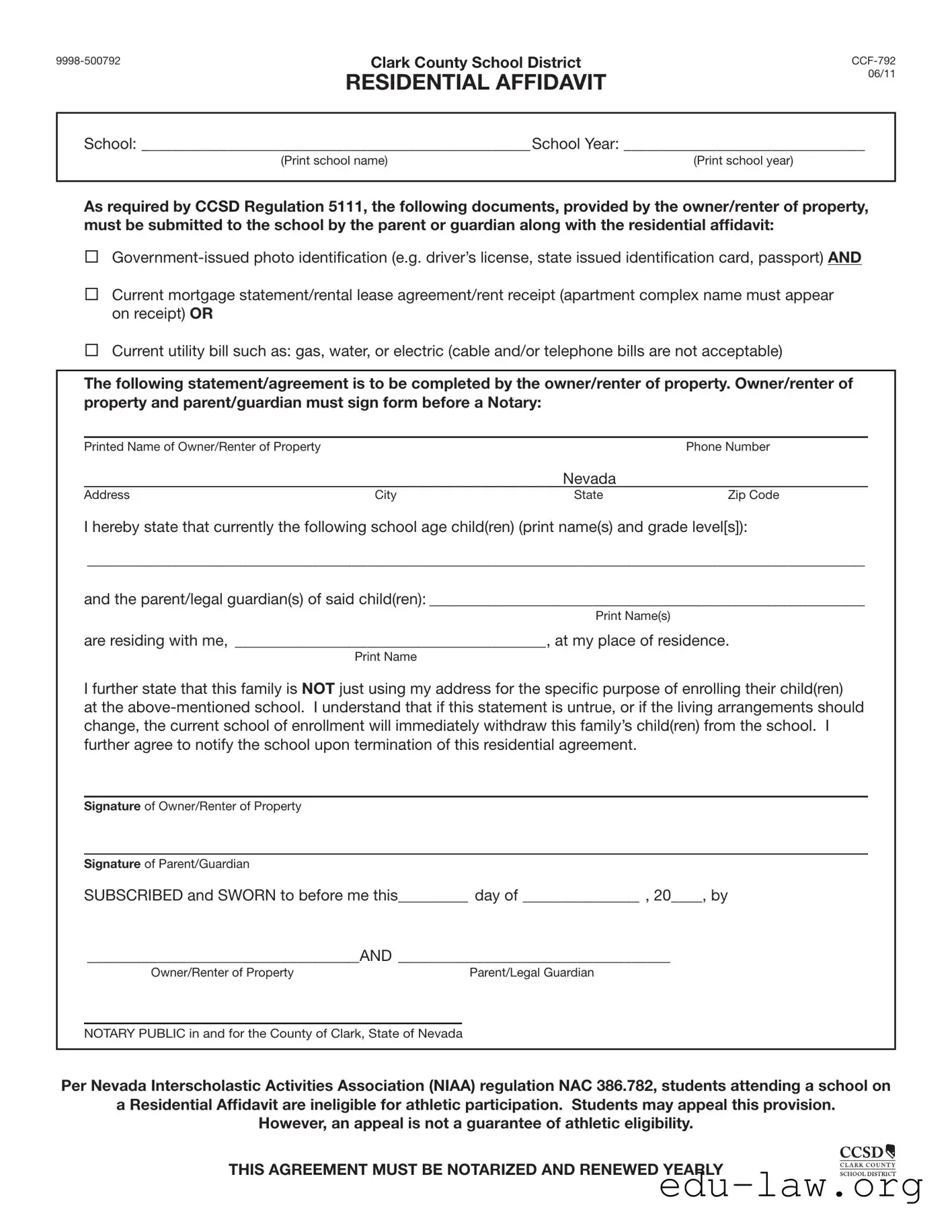
The CCSD Residential Affidavit form is a crucial document for families seeking to enroll their children in schools within the Clark County School District. This form ensures that students reside at a verified address, thereby maintaining the integrity of school enrollment processes. To complete the affidavit, parents or guardians must provide specific documentation from the property owner or renter. Required documents include a government-issued photo ID and either a current mortgage statement, rental lease agreement, or utility bill, with certain restrictions on acceptable utility bills. The affidavit also includes a statement that must be signed by both the property owner or renter and the parent or guardian in the presence of a notary public. This agreement must be renewed annually and is essential for confirming that the living arrangements are legitimate and not solely for the purpose of school enrollment. Additionally, students attending school under this affidavit are ineligible for athletic participation unless they appeal this provision, which does not guarantee eligibility. Understanding the requirements and implications of the CCSD Residential Affidavit form is vital for families navigating the school enrollment process.

RESIDENTIAL AFFIDAVIT
School: __________________________________________________ School Year: _______________________________
(Print school name) |
(Print school year) |
As required by CCSD Regulation 5111, the following documents, provided by the owner/renter of property, must be submitted to the school by the parent or guardian along with the residential affidavit:
Current mortgage statement/rental lease agreement/rent receipt (apartment complex name must appear on receipt) OR
Current utility bill such as: gas, water, or electric (cable and/or telephone bills are not acceptable)
The following statement/agreement is to be completed by the owner/renter of property. Owner/renter of property and parent/guardian must sign form before a Notary:
Printed Name of Owner/Renter of PropertyPhone Number
|
|
Nevada |
|
Address |
City |
State |
Zip Code |
I hereby state that currently the following school age child(ren) (print name(s) and grade level[s]):
____________________________________________________________________________________________________
and the parent/legal guardian(s) of said child(ren): ________________________________________________________
Print Name(s)
are residing with me, ________________________________________, at my place of residence.
Print Name
I further state that this family is NOT just using my address for the specific purpose of enrolling their child(ren)
at the
Signature of Owner/Renter of Property
Signature of Parent/Guardian
SUBSCRIBED and SWORN to before me this_________ day of _______________ , 20____, by
___________________________________AND ___________________________________
Owner/Renter of Property |
Parent/Legal Guardian |
NOTARY PUBLIC in and for the County of Clark, State of Nevada
Per Nevada Interscholastic Activities Association (NIAA) regulation NAC 386.782, students attending a school on
a Residential Affidavit are ineligible for athletic participation. Students may appeal this provision.
However, an appeal is not a guarantee of athletic eligibility.
THIS AGREEMENT MUST BE NOTARIZED AND RENEWED YEARLY

DECLARACIÓN JURADA DE DOMICILIO
Escuela: _________________________________________________ Año Escolar: _______________________________
(Escribir en letra de molde el nombre de la escuela) |
(Escriba en letra de molde el año escolar) |
Como se exige en el Reglamento 5111 de CCSD, los siguientes documentos, proporcionados por el dueño/arrendatario de una propiedad, deben ser presentados en la escuela por el padre o tutor junto con la declaración jurada de residencia:
Identificación con foto emitida por el gobierno (por ejemplo, licencia de conducir, tarjeta de identificación del estado emitida por el gobierno, pasaporte) Y
Declaración actual de la hipoteca/Contrato de arrendamiento del alquiler/recibo del alquiler (el nombre del complejo de apartamentos debe aparecer en el recibo) O
Recibo de un servicio actual como: gas, agua o electricidad (no se aceptan recibos del cable y/o teléfono)
La siguiente declaración/acuerdo debe ser completada por el dueño/arrendatario de una propiedad. El dueño/ arrendatario de una propiedad y el padre/tutor deben firmar el formulario ante la presencia de un notario:
Escribir el Nombre del Dueño/Arrendatario de la Propiedad en Letra de Molde Número de Teléfono
|
|
Nevada |
|
Domicilio |
Ciudad |
Estado |
Código Postal |
Por la presente afirmo que el siguiente niño(s) en edad escolar (escriba su nombre(s) y su nivel de grado(s) en Letra de Molde):
____________________________________________________________________________________________________
Y el padre/tutor(s) legal(es) del niño(s) mencionado: ______________________________________________________
Escriba su Nombre(s) en Letra de Molde
residen conmigo,___________________________________________ , en mi lugar de residencia.
Escriba el Nombre en Letra de Molde
Yo a continuación informo que esta familia NO está utilizando mi dirección con el propósito específico de inscribir a su hijo(s) en la escuela mencionada anteriormente. Entiendo que si esta declaración no es verdadera, o si la situación de la vivienda cambia, la escuela de inscripción actual inmediatamente dará de baja de la escuela al niño(s) de esta familia. A continuación estoy de acuerdo con notificar a la escuela al terminar este acuerdo de residencia.
Firma del Dueño/Arrendatario de la Propiedad
Firma del Padre/Tutor
FIRMADO Y JURADO ante mi este _________ día de ________________ , 20____, por
_____________________________________ Y ___________________________________
Dueño/Arrendatario de la Propiedad |
Padre/Tutor Legal |
NOTARIO PÚBLICO en y para el Condado de Clark, Estado de Nevada
Por la Asociación de Actividades Interescolares de Nevada (NIAA) reglamento NAC 386.782, los estudiantes asistiendo a la escuela bajo una Declaración Jurada de Residencia no cumplen con los requisitos para la participación atlética. Los estudiantes pueden apelar para esta disposición. Sin embargo, apelar no garantiza la elegibilidad atlética.
ESTE ACUERDO DEBE ESTAR NOTARIZADO Y SE DEBE RENOVAR ANUALMENTE
| Fact Name | Details |
|---|---|
| Governing Regulation | The CCSD Residential Affidavit is governed by CCSD Regulation 5111. |
| Required Documents | Parents or guardians must submit a government-issued photo ID and either a current mortgage statement, rental lease agreement, or utility bill. |
| Notarization Requirement | The form must be signed by both the owner/renter and the parent/guardian in the presence of a notary public. |
| Annual Renewal | The Residential Affidavit must be renewed each year to remain valid. |
| Athletic Eligibility | Students attending school on a Residential Affidavit are ineligible for athletic participation as per NIAA regulation NAC 386.782. |
| False Information Consequences | If the affidavit contains false information, the school will withdraw the child(ren) immediately. |
Completing the CCSD Residential Affidavit form is an important step in ensuring that your child is enrolled in the correct school. After filling out the form, the owner or renter of the property and the parent or guardian must sign it in the presence of a notary public. Make sure to gather all required documents before submitting the form to the school.
What is the purpose of the CCSD Residential Affidavit form?
The CCSD Residential Affidavit form is used to verify the residency of students who are enrolling in Clark County School District schools. It ensures that students are attending the correct school based on their actual place of residence.
Who needs to complete the Residential Affidavit form?
The form must be completed by the owner or renter of the property where the student resides, as well as the parent or legal guardian of the student. Both parties must sign the form in the presence of a notary public.
What documents are required to submit with the Residential Affidavit form?
Parents or guardians must provide a government-issued photo identification, along with one of the following: a current mortgage statement, rental lease agreement, rent receipt, or a current utility bill (gas, water, or electric). Cable and telephone bills are not acceptable.
Is the Residential Affidavit form valid for more than one school year?
No, the agreement must be renewed every year. Families need to submit a new Residential Affidavit form and the required documents each school year.
What happens if the living arrangements change?
If the living arrangements change, the owner or renter must notify the school immediately. The school will then withdraw the student from enrollment if the information provided is no longer accurate.
Can students enrolled under a Residential Affidavit participate in athletics?
According to NIAA regulations, students attending a school on a Residential Affidavit are not eligible for athletic participation. However, students may appeal this provision, though an appeal does not guarantee eligibility.
What is the role of the notary public in this process?
A notary public must witness the signatures of both the owner or renter and the parent or guardian on the form. This step is crucial for verifying the authenticity of the agreement.
What information must be included about the students on the form?
The form requires the printed names and grade levels of all school-age children residing at the address. This information helps the school verify that the students are eligible for enrollment.
What should I do if I have questions about the form?
If you have questions about the Residential Affidavit form or the required documentation, you should contact the school directly for assistance. They can provide guidance and clarify any concerns.
Where can I obtain the Residential Affidavit form?
The Residential Affidavit form can typically be obtained from the Clark County School District website or directly from the school where the student is enrolling.
Failing to provide government-issued photo identification. This is a crucial requirement. Without it, the affidavit cannot be processed.
Not including a current mortgage statement, rental lease agreement, or rent receipt. Ensure that the apartment complex name appears on any receipts submitted.
Using utility bills that are not acceptable. Remember, only gas, water, or electric bills are valid. Cable and telephone bills will not suffice.
Forgetting to print the school name and school year clearly. These details are essential for proper identification of the student’s enrollment.
Neglecting to have both the owner/renter and the parent/guardian sign the form. Signatures must be present before a Notary.
Overlooking the need for the form to be notarized. This is a mandatory step in the process.
Not updating the affidavit yearly. This agreement must be renewed every year for continued enrollment.
Providing incorrect or incomplete contact information for the owner/renter. Accurate phone numbers and addresses are necessary for verification.
Failing to disclose if the living arrangements change. If circumstances shift, it’s important to notify the school immediately.
Assuming that the affidavit guarantees athletic eligibility. Students using a Residential Affidavit are not automatically eligible for sports participation.
The CCSD Residential Affidavit form is an essential document for establishing residency for school enrollment. To complete the process effectively, several other forms and documents are often required. Each of these documents serves a specific purpose in verifying residency and ensuring compliance with school district regulations.
Gathering these documents is crucial for a smooth enrollment process. Ensure that all forms are completed accurately and submitted promptly to avoid any delays in your child's education.
The CCSD Residential Affidavit form shares similarities with the Affidavit of Support. Both documents require a declaration of residency and often involve a notary. In the Affidavit of Support, a sponsor confirms that they will provide financial support to a relative or friend seeking to immigrate. Similarly, the CCSD form confirms that a student resides at a specific address, ensuring they are eligible to attend a particular school. Both documents help establish a legitimate relationship and the authenticity of the living situation.
Another related document is the Lease Agreement. This legal document outlines the terms under which one party agrees to rent property owned by another party. Like the CCSD Residential Affidavit, a lease agreement serves to confirm residency. It typically includes details such as the address of the property, the names of the parties involved, and the duration of the lease. When parents submit a lease agreement alongside the Residential Affidavit, it provides additional proof of the student’s living arrangements, reinforcing the claim of residency.
The Utility Bill is also comparable to the CCSD Residential Affidavit. A utility bill serves as a form of identification that verifies an individual’s address. When parents submit a recent utility bill, it helps confirm that they reside at the address listed on the Residential Affidavit. Both documents are essential in establishing residency and ensuring that students are enrolled in the correct school based on their actual living situation.
The Government-Issued Photo Identification is another document similar to the Residential Affidavit. This identification can include a driver's license or a passport and is used to verify the identity of the individual submitting the affidavit. Just as the Residential Affidavit requires the owner or renter to provide identification, the photo ID helps schools confirm that the person enrolling the child is indeed the legal guardian or parent. This overlap ensures that the information provided is accurate and trustworthy.
The Power of Attorney document also bears resemblance to the CCSD Residential Affidavit. A Power of Attorney allows one person to act on behalf of another, often in legal or financial matters. In cases where a child’s legal guardian is not the parent, this document can be crucial. It establishes that the person signing the Residential Affidavit has the authority to do so, thereby validating the residency claim. Both documents work together to clarify the living situation of the student.
The Custody Agreement is another document that aligns with the CCSD Residential Affidavit. This legal document outlines the arrangements for the care and control of a child. When a parent submits a custody agreement, it can support their claim of residency, especially in cases of shared custody. The agreement helps schools understand the child’s living arrangements and ensures that the correct parent or guardian is making educational decisions.
Furthermore, the Proof of Residency Affidavit is similar to the CCSD Residential Affidavit. This document is often used in various contexts to affirm that an individual resides at a specified address. It may not require as many supporting documents as the CCSD form, but it serves a similar purpose. By submitting a Proof of Residency Affidavit, parents can assert their child’s eligibility for enrollment in a particular school, just as they do with the Residential Affidavit.
Lastly, the School Enrollment Form is another document that shares characteristics with the CCSD Residential Affidavit. This form is typically required when a student is enrolling in a new school. It asks for information about the student’s residency, similar to the Residential Affidavit. Both forms are essential in the enrollment process, ensuring that students are placed in the appropriate school based on their current living situation.
When filling out the CCSD Residential Affidavit form, keep the following guidelines in mind:
Misconceptions about the CCSD Residential Affidavit form can lead to confusion and potential issues during the enrollment process. Here are seven common misconceptions:
Understanding these misconceptions can help ensure a smoother enrollment process for students and their families.
Filling out and using the CCSD Residential Affidavit form is an important process for parents and guardians. Here are key takeaways to consider: