In the realm of contractor onboarding at Cleveland Clinic, the Ccf Silk Road form plays a pivotal role in streamlining the process. This form is essential for those looking to obtain a badge, whether they are new contractors or renewing their existing credentials. To initiate the badge request, specific information is required, including legal names, badge ID numbers, and the email address of the individual who will receive the badge. Additionally, details such as the company name, the office manager or supervisor's name, and a contact phone number must be provided. It is also crucial to indicate the start date for working onsite and the primary location of the contractor. Once all necessary information is submitted via email to the designated support address, a Cleveland Clinic Coordinator will take the lead in processing the request through the RedCarpet/Silkroad system. Applicants can expect to receive email notifications that guide them through each step of the onboarding workflow, culminating in the final approval of their badge. The entire process is designed to be completed within five business days, ensuring that contractors can start their assignments promptly after fulfilling all required tasks and training.
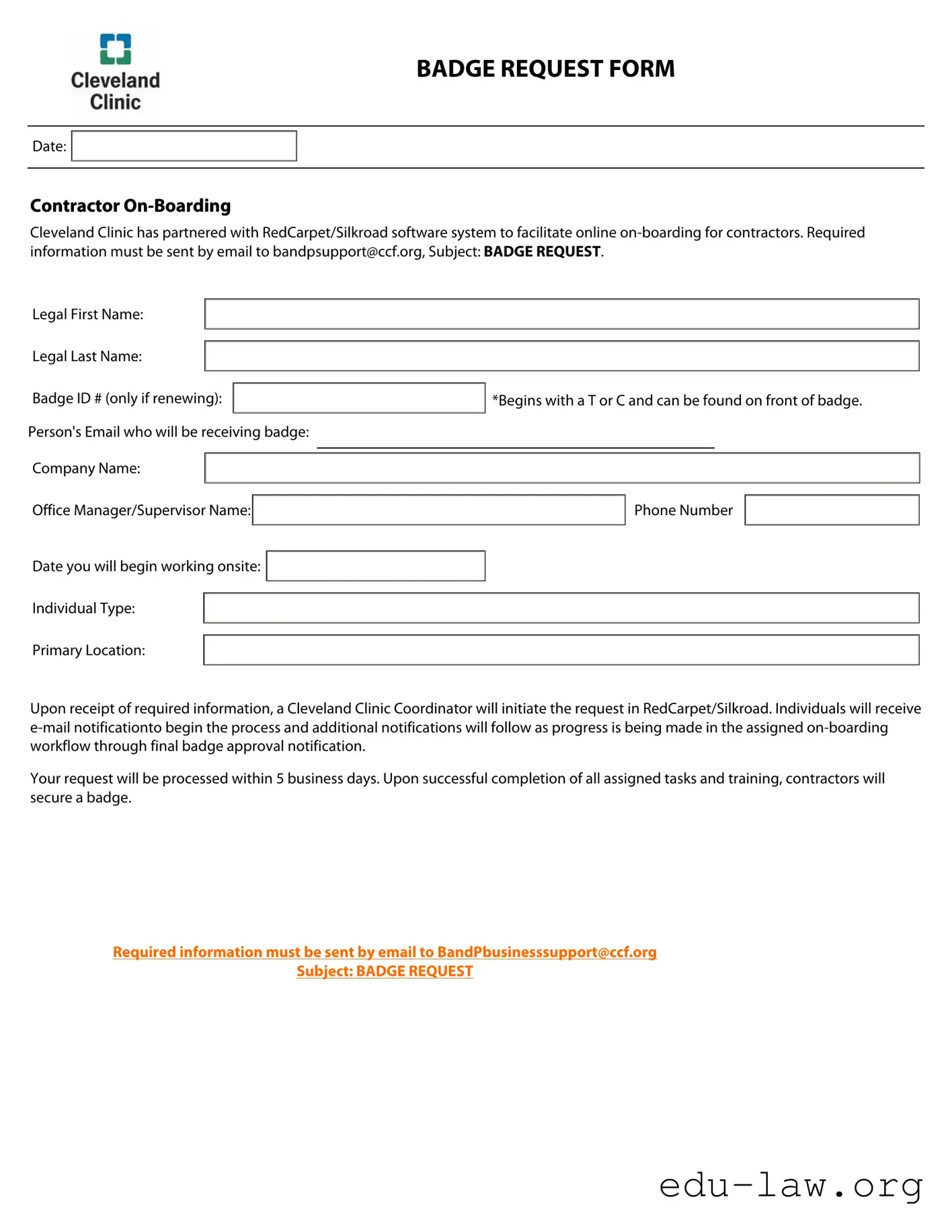
BADGE REQUEST FORM
Date:
Contractor
Cleveland Clinic has partnered with RedCarpet/Silkroad software system to facilitate online
Legal First Name:
Legal Last Name:
Badge ID # (only if renewing): |
*Begins with a T or C and can be found on front of badge. |
Person's Email who will be receiving badge:
Company Name:
Office Manager/Supervisor Name: Phone Number
Date you will begin working onsite:
Individual Type:
Primary Location:
Upon receipt of required information, a Cleveland Clinic Coordinator will initiate the request in RedCarpet/Silkroad. Individuals will receive
Your request will be processed within 5 business days. Upon successful completion of all assigned tasks and training, contractors will secure a badge.
Required information must be sent by email to [email protected]
Subject: BADGE REQUEST
| Fact Name | Details |
|---|---|
| Form Purpose | This form is used for contractors to request a badge for on-boarding at Cleveland Clinic. |
| Partnership | Cleveland Clinic collaborates with RedCarpet/Silkroad to streamline the on-boarding process. |
| Required Information | Contractors must provide legal first and last names, email, company name, and other details. |
| Email Submission | All required information should be emailed to [email protected] with the subject "BADGE REQUEST." |
| Processing Time | The badge request will be processed within 5 business days after submission. |
| Notification System | Contractors will receive email notifications regarding the progress of their badge request. |
| Badge Issuance | Upon completing all tasks and training, contractors will receive their badge. |
Filling out the Ccf Silk Road form is a straightforward process that requires specific information to ensure your badge request is processed efficiently. After submitting your completed form, a Cleveland Clinic Coordinator will initiate your request. You will receive email notifications throughout the process, leading to the final badge approval.
What is the purpose of the Ccf Silk Road form?
The Ccf Silk Road form is designed to facilitate the on-boarding process for contractors at Cleveland Clinic. By using this online system, contractors can easily submit their necessary information to receive a badge, which is essential for accessing the facility. The form streamlines the request process and ensures that all required details are collected efficiently.
What information is required to complete the form?
To complete the Ccf Silk Road form, you must provide several key pieces of information. This includes your legal first and last name, badge ID number (if renewing), email address, company name, office manager or supervisor’s name, phone number, start date for working onsite, individual type, and primary location. Ensuring that all these details are accurate is crucial for a smooth on-boarding experience.
How long does it take to process the badge request?
Your badge request will typically be processed within 5 business days after submitting the required information. Once the request is received, a Cleveland Clinic Coordinator will initiate the process in the RedCarpet/Silkroad system. You will receive email notifications throughout the process, keeping you informed of your progress until final badge approval.
What should I do if I have questions or need assistance?
If you have any questions or require assistance with the Ccf Silk Road form, you can reach out via email to [email protected]. Make sure to include "BADGE REQUEST" in the subject line for proper routing. This support team is available to help you navigate any issues or clarify any uncertainties regarding the badge request process.
Incomplete Information: Failing to provide all required fields can lead to delays. Ensure that every section, such as Legal First Name and Company Name, is filled out completely.
Incorrect Email Subject: Using an incorrect subject line when emailing the form can result in your request being overlooked. Always use "BADGE REQUEST" as the subject.
Missing Badge ID: If renewing, omitting the Badge ID can cause confusion. This ID is essential for processing your request, so double-check that it begins with a T or C.
Wrong Email Address: Sending the form to the wrong email address can lead to a complete halt in the process. Always use [email protected] for submitting your information.
Ignoring Deadlines: Submitting your request late can delay your badge approval. Aim to send your information as soon as possible to avoid any issues.
The Ccf Silk Road form is a key document for contractors onboarding at Cleveland Clinic. However, several other forms and documents are often required to complete the process effectively. Understanding these documents can help streamline the onboarding experience.
Each of these documents plays an important role in the onboarding process. Having them ready can help ensure a smoother transition into your new role at Cleveland Clinic.
The Ccf Silk Road form shares similarities with the Employment Application form. Both documents collect essential personal information from individuals seeking to engage in a professional capacity. Employment applications typically ask for the applicant's legal name, contact information, and previous employment history, which parallels the Ccf Silk Road form's requirement for legal names and email addresses. Additionally, both forms serve as initial steps in a process that leads to formal engagement, whether it be employment or contractor onboarding.
Another similar document is the Contractor Agreement. This document outlines the terms and conditions under which a contractor will operate. Like the Ccf Silk Road form, it requires specific details about the contractor, including their name and contact information. The Contractor Agreement formalizes the relationship and expectations, while the Ccf Silk Road form initiates the onboarding process, ensuring that both parties have a clear understanding of their roles.
The New Hire Checklist is also comparable to the Ccf Silk Road form. This checklist is used to ensure that all necessary documents and tasks are completed before a new employee starts. Both documents emphasize the importance of timely submission of required information and tasks. The New Hire Checklist often includes items such as background checks and training, similar to the tasks outlined in the Ccf Silk Road form that must be completed for badge approval.
The I-9 Employment Eligibility Verification form is another document that shares similarities with the Ccf Silk Road form. Both forms require personal identification details and are crucial for compliance with legal requirements. The I-9 form ensures that employees are authorized to work in the U.S., while the Ccf Silk Road form facilitates the onboarding of contractors, ensuring that they meet the necessary criteria to work on-site.
The W-9 form, which is used for tax purposes, also has commonalities with the Ccf Silk Road form. Both documents require the contractor's legal name and other identifying information. The W-9 form is essential for tax reporting, while the Ccf Silk Road form is focused on onboarding contractors. Each document plays a critical role in ensuring proper identification and compliance with regulations.
The Background Check Authorization form is similar in that it collects personal information necessary for verifying an individual’s qualifications. Like the Ccf Silk Road form, this document is often required before a contractor can begin work. Both forms highlight the importance of gathering accurate information to facilitate a smooth onboarding process.
The Direct Deposit Authorization form is another document that parallels the Ccf Silk Road form. This form collects banking information to ensure that contractors receive timely payments. While the Ccf Silk Road form focuses on onboarding and badge issuance, both documents require precise personal information to facilitate financial and operational processes.
Lastly, the Non-Disclosure Agreement (NDA) shares similarities with the Ccf Silk Road form in that both require personal information and signatures. The NDA protects sensitive information shared during the contractor's engagement. While the Ccf Silk Road form initiates the onboarding process, the NDA serves to protect the interests of the organization and the contractor, ensuring confidentiality throughout their working relationship.
When filling out the Ccf Silk Road form, keep these important guidelines in mind:
Following these steps will help ensure a smooth on-boarding process.
Here are four common misconceptions about the Ccf Silk Road form that you should be aware of:
This is not true. All required fields must be completed for your badge request to be processed. Missing information can lead to delays.
In reality, processing your request takes time. Expect it to take up to five business days after all information is submitted.
Receiving your badge is contingent upon completing assigned tasks and training. Only after these steps are finalized will you secure your badge.
Once submitted, changes may not be easy to implement. It’s best to double-check all information before sending your request.
Here are some key takeaways regarding the Ccf Silk Road form for badge requests: