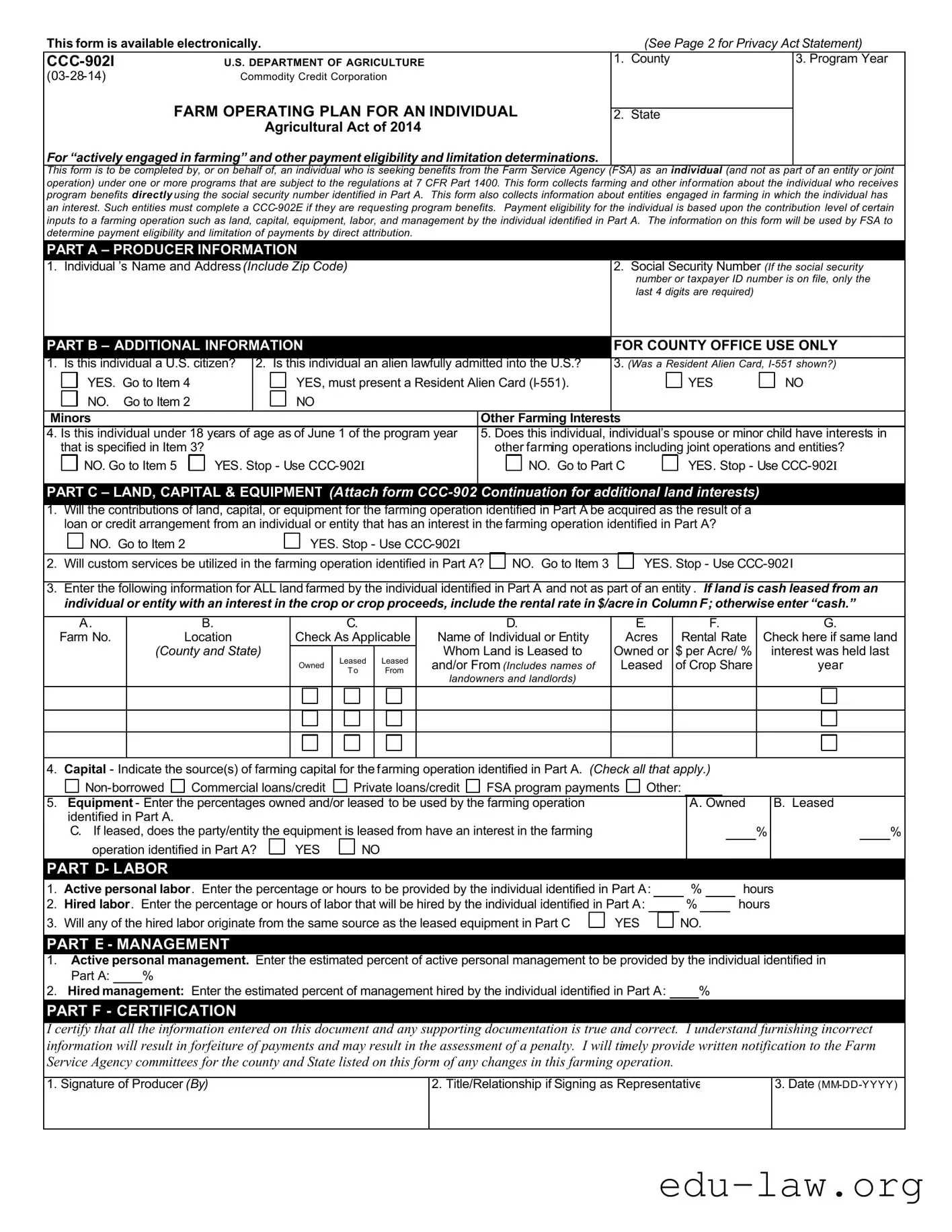
The CCC-902I form is a crucial document for individuals seeking benefits from the Farm Service Agency (FSA) under various agricultural programs. This form is specifically designed for those who are actively engaged in farming and wish to establish their eligibility for program payments. It requires detailed information about the individual, including their name, address, and social security number, as well as additional data regarding their farming operation. The form assesses contributions of land, capital, equipment, labor, and management by the individual to determine payment eligibility. It also collects information about any other farming interests the individual may have, which is essential for accurate eligibility determination. Completing this form accurately is vital, as it directly impacts the individual's ability to receive benefits. Furthermore, the CCC-902I form is available electronically, streamlining the application process. Individuals must ensure that all information provided is truthful and up to date, as discrepancies can lead to penalties or forfeiture of payments. This form serves not only as a means of applying for assistance but also as a verification tool for the FSA to uphold program integrity.
This form is available electronically. |
|
(See Page 2 for Privacy Act Statement) |
||
U.S. DEPARTMENT OF AGRICULTURE |
1. |
County |
3. Program Year |
|
Commodity Credit Corporation |
|
|
|
|
|
FARM OPERATING PLAN FOR AN INDIVIDUAL |
|
|
|
|
2. |
State |
|
|
|
Agricultural Act of 2014 |
|
|
|
For “actively engaged in farming” and other payment eligibility and limitation determinations. |
|
|
|
|
This form is to be completed by, or on behalf of, an individual who is seeking benefits from the Farm Service Agency (FSA) as an individual (and not as part of an entity or joint operation) under one or more programs that are subject to the regulations at 7 CFR Part 1400. This form collects farming and other information about the individual who receives program benefits directly using the social security number identified in Part A. This form also collects information about entities engaged in farming in which the individual has an interest. Such entities must complete a
PART A – PRODUCER INFORMATION
1. Individual ’s Name and Address(Include Zip Code) |
2. Social Security Number (If the social security |
|
number or taxpayer ID number is on file, only the |
|
last 4 digits are required) |
|
PART B – ADDITIONAL INFORMATION |
|
|
|
|
|
|
|
|
|
|
|
|
FOR COUNTY OFFICE USE ONLY |
||||||||||||||||||||||||||||||||
|
|
|
|
|
|
|
|
|
|
|
|
|
|
|
|
|
|
|
|
|
|
|
|
|
|
|
|
|
|
|
|
|
|
|
|
|
|
|
|
|
|
|
|
|
|
|
1. |
Is this individual a U.S. citizen? |
2. |
Is this individual an alien lawfully admitted into the U.S.? |
3. (Was a Resident Alien Card, |
||||||||||||||||||||||||||||||||||||||||||
|
|
YES. Go to Item 4 |
|
|
YES, must present a Resident Alien Card |
|
|
|
|
|
|
|
|
|
|
YES |
|
|
|
|
|
NO |
||||||||||||||||||||||||
|
|
NO. |
Go to Item 2 |
|
|
NO |
|
|
|
|
|
|
|
|
|
|
|
|
|
|
|
|
|
|
|
|
|
|
|
|
|
|
|
|
|
|
|
|
|
|
|
|||||
|
|
|
|
|
|
|
|
|
|
|
|
|
|
|
|
|
|
|
|
|
|
|
|
|
|
|
|
|
|
|
|
|
|
|
|
|
|
|
|
|
|
|
|
|
||
|
Minors |
|
|
|
|
|
|
|
|
|
|
|
|
|
|
|
|
|
Other Farming Interests |
|
|
|
|
|
|
|
|
|
|
|
|
|
|
|
|
|
|
|
|
|
||||||
4. |
Is this individual under 18 years of age as of June 1 of the program year |
5. Does this individual, individual’s spouse or minor child have interests in |
||||||||||||||||||||||||||||||||||||||||||||
|
|
that is specified in Item 3? |
|
|
|
|
|
|
|
|
|
|
|
|
|
|
other farming operations including joint operations and entities? |
|||||||||||||||||||||||||||||
|
|
NO. Go to Item 5 |
YES. Stop - Use |
|
|
|
|
|
|
|
NO. Go to Part C |
|
|
|
|
|
|
|
|
YES. Stop - Use |
||||||||||||||||||||||||||
|
|
|
|
|
|
|
|
|
|
|
|
|
|
|
|
|
|
|
|
|
|
|
|
|
|
|
|
|
|
|
|
|
|
|
|
|
|
|||||||||
|
PART C – LAND, CAPITAL & EQUIPMENT (Attach form |
|
|
|
|
|
||||||||||||||||||||||||||||||||||||||||
|
|
|
|
|
|
|
|
|
|
|
|
|
|
|
|
|
|
|
|
|
|
|
|
|
|
|
|
|
|
|
|
|
|
|
|
|
|
|
|
|
|
|
|
|
|
|
1. |
Will the contributions of land, capital, or equipment for the farming operation identified in Part A be acquired as the result of a |
|
|
|
|
|
||||||||||||||||||||||||||||||||||||||||
|
|
loan or credit arrangement from an individual or entity that has an interest in the farming operation identified in Part A? |
|
|
|
|
|
|
|
|
|
|
||||||||||||||||||||||||||||||||||
|
|
NO. Go to Item 2 |
|
|
YES. Stop - Use |
|
|
|
|
|
|
|
|
|
|
|
|
|
|
|
|
|
|
|
|
|
|
|
|
|
|
|
||||||||||||||
2. |
Will custom services be utilized in the farming operation identified in Part A? |
|
|
NO. Go to Item 3 |
|
|
|
YES. Stop - Use |
||||||||||||||||||||||||||||||||||||||
|
|
|
|
|
|
|
|
|
|
|
|
|
|
|
|
|
|
|
|
|
|
|
|
|
|
|
|
|
|
|
|
|
||||||||||||||
3. |
Enter the following information for ALL land farmed by the individual identified in Part A and not as part of an entity . If land is cash leased from an |
|||||||||||||||||||||||||||||||||||||||||||||
|
|
individual or entity with an interest in the crop or crop proceeds, include the rental rate in $/acre in Column F; otherwise enter “cash.” |
||||||||||||||||||||||||||||||||||||||||||||
|
|
|
|
|
|
|
|
|
|
|
|
|
|
|
|
|
|
|
|
|
|
|
|
|
|
|
|
|
|
|
|
|
|
|
|
|
|
|
|
|
|
|
|
|
|
|
|
|
A. |
|
|
|
B. |
|
|
|
|
|
C. |
|
|
|
|
|
|
|
D. |
|
|
|
E. |
|
|
|
|
|
F. |
|
|
|
|
|
|
G. |
|||||||||
|
|
Farm No. |
|
|
|
Location |
|
Check As Applicable |
Name of Individual or Entity |
|
|
Acres |
|
Rental Rate |
Check here if same land |
|||||||||||||||||||||||||||||||
|
|
|
|
|
(County and State) |
|
|
|
|
Leased |
|
Leased |
Whom Land is Leased to |
Owned or |
$ per Acre/ % |
|
interest was held last |
|||||||||||||||||||||||||||||
|
|
|
|
|
|
|
|
|
Owned |
|
and/or From (Includes names of |
|
Leased |
of Crop Share |
|
year |
||||||||||||||||||||||||||||||
|
|
|
|
|
|
|
|
|
|
To |
|
From |
|
|
||||||||||||||||||||||||||||||||
|
|
|
|
|
|
|
|
|
|
|
|
|
|
landowners and landlords) |
|
|
|
|
|
|
|
|
|
|
|
|
|
|
|
|
|
|
|
|
|
|
|
|||||||||
|
|
|
|
|
|
|
|
|
|
|
|
|
|
|
|
|
|
|
|
|
|
|
|
|
|
|
|
|
|
|
|
|
|
|
|
|
|
|
|
|
|
|||||
|
|
|
|
|
|
|
|
|
|
|
|
|
|
|
|
|
|
|
|
|
|
|
|
|
|
|
|
|
|
|
|
|
|
|||||||||||||
|
|
|
|
|
|
|
|
|
|
|
|
|
|
|
|
|
|
|
|
|
|
|
|
|
|
|
|
|
|
|
|
|
|
|
|
|
|
|
|
|
|
|
|
|
|
|
|
|
|
|
|
|
|
|
|
|
|
|
|
|
|
|
|
|
|
|
|
|
|
|
|
|
|
|
|||||||||||||||||||
|
|
|
|
|
|
|
|
|
|
|
|
|
|
|
|
|
|
|
|
|
|
|
|
|
|
|
|
|||||||||||||||||||
4. |
Capital - Indicate the source(s) of farming capital for the farming operation identified in Part A. (Check all that apply.) |
|
|
|
|
|
|
|
|
|
|
|||||||||||||||||||||||||||||||||||
|
|
Commercial loans/credit |
|
Private loans/credit |
|
FSA program payments |
|
Other: |
|
|
|
|
|
|
|
|
|
|
||||||||||||||||||||||||||||
5. |
Equipment - Enter the percentages owned and/or leased to be used by the farming operation |
|
|
|
|
|
|
|
|
|
|
A. Owned |
B. Leased |
|||||||||||||||||||||||||||||||||
|
|
identified in Part A. |
|
|
|
|
|
|
|
|
|
|
|
|
|
|
|
|
|
|
|
|
|
|
|
|
|
|
|
|
|
|
|
|
|
|
|
|
|
|
|
|
|
|||
|
|
C. If leased, does the party/entity the equipment is leased from have an interest in the farming |
|
|
|
|
|
|
|
|
|
|
|
|
|
% |
% |
|||||||||||||||||||||||||||||
|
|
operation identified in Part A? |
|
YES |
|
|
NO |
|
|
|
|
|
|
|
|
|
|
|
|
|
|
|
|
|
|
|
|
|
|
|
|
|
|
|
|
|
|
|
||||||||
|
|
|
|
|
|
|
|
|
|
|
|
|
|
|
|
|
|
|
|
|
|
|
|
|
|
|
|
|
|
|
|
|
|
|
|
|
|
|
|
|
|
|
|
|||
|
PART D- LABOR |
|
|
|
|
|
|
|
|
|
|
|
|
|
|
|
|
|
|
|
|
|
|
|
|
|
|
|
|
|
|
|
|
|
|
|
|
|
|
|
|
|
||||
1. |
Active personal labor. Enter the percentage or hours to be provided by the individual identified in Part A: |
|
|
% |
|
|
|
|
hours |
|||||||||||||||||||||||||||||||||||||
2. |
Hired labor. Enter the percentage or hours of labor that will be hired by the individual identified in Part A: |
|
|
% |
|
|
|
|
|
hours |
|
|
|
|
|
|||||||||||||||||||||||||||||||
3. |
Will any of the hired labor originate from the same source as the leased equipment in Part C |
YES |
|
NO. |
|
|
|
|
|
|
|
|
|
|
||||||||||||||||||||||||||||||||
|
|
|
|
|
|
|
|
|
|
|
|
|
|
|
|
|
|
|
|
|
|
|
|
|
|
|
|
|
|
|
|
|
|
|
|
|
|
|
|
|
|
|||||
|
PART E - MANAGEMENT |
|
|
|
|
|
|
|
|
|
|
|
|
|
|
|
|
|
|
|
|
|
|
|
|
|
|
|
|
|
|
|
|
|
|
|
|
|
|
|
||||||
1. |
Active personal management. Enter the estimated percent of active personal management to be provided by the individual identified in |
|||||||||||||||||||||||||||||||||||||||||||||
|
|
Part A: |
|
% |
|
|
|
|
|
|
|
|
|
|
|
|
|
|
|
|
|
|
|
|
|
|
|
|
|
|
|
|
|
|
|
|
|
|
|
|
|
|
|
|
|
|
2. |
Hired management: Enter the estimated percent of management hired by the individual identified in Part A: |
|
|
% |
|
|
|
|
|
|
|
|
|
|
||||||||||||||||||||||||||||||||
PART F - CERTIFICATION
I certify that all the information entered on this document and any supporting documentation is true and correct. I understand furnishing incorrect information will result in forfeiture of payments and may result in the assessment of a penalty. I will timely provide written notification to the Farm Service Agency committees for the county and State listed on this form of any changes in this farming operation.
1. Signature of Producer (By) |
2. Title/Relationship if Signing as Representative |
3. Date |
|
|
|

Page 2 of 2 |
DEFINITIONS
The following definitions apply to Form
1.ACTIVELY ENGAGED IN FARMING – means providing both: 1) significant contributions of capital, equipment, or land, or combination thereof to the farming operation; and 2) significant contributions of active personal labor or active personal management, or a combination thereof, to the farming operation as described. Further, for a person or legal entity to be considered actively engaged in farming for program payment purposes, the contributions of the person or legal entity must be
2.INTEREST IN A FARMING OPERATION– a person or legal entity is considered to have an interest in a particular farming operation if the person or legal entity owns or rents land to or from that farming operation; has an interest in the agricultural commodities produced on the operation; or is a member of a joint operation that either owns or rents land to or from the farming operation, or has an interest in the agricultural commodities produced on that operation.
3.JOINT OPERATION- is a general partnership, joint venture, or similar organization.
4.PERSON – is a natural person (an individual) and does not include a legal entity.
5.ACTIVE PERSONAL LABOR – a person is considered to be providing active personal labor with respect to a farming operation if that person is directly and personally providing physical activities necessary to conduct the farming operation, including land preparation, planting, cultivating, harvesting, and marketing of agricultural commodities. Other qualifying physical activities include establishing and maintaining conserving covers and those physical activities necessary for livestock production for the farming operation.
6.ACTIVE PERSONAL MANAGEMENT– a person is considered to be providing active personal management with respect to a farming operation if that person is directly and personally providing the general supervision and direction of activities and labor involved in the farming operation; or providing services (whether performed
7.CAPITAL – with respect to afarming operation is the funding provided by a person or legal entity to the farming operation in order for such operation to conduct farming activities. To be considered a countable contribution for a person or legal entity, the capital must have been derived from a fund or account separate and distinct from that of any other person or entity involved in such operation. Countable capital does not include the value of any labor or management which is contributed to the farming operation. A capital contribution may be a direct
8.CONTRIBUTION – with respect to a farming operation isthe provision of land, capital or equipment assets, and providing active personal labor, or active personal management to the farming operation in exchange for, or the expectation of, deriving benefits based solely on the success of the farming operation.
9.CUSTOM SERVICES – with respect to a farming operation is the hiring of a contractor or vendor that is in the business of providing such specialized services to perform services for the farming operation in exchange for the payment of a fee for such services performed.
10.ENTITY - is a corporation, joint stock company, limited liability company, association, limited partnership, limited liability partnership, irrevocable trust, revocable trust, estate, charitable organization, or other similar organization including any such organization participating in the farming operation as a partner in a general partnership, participant in a joint venture, a grantor of a revocable trust, or as a participant in a similar organization.
11.EQUIPMENT – with respect to a farming operation is the machinery and implements needed to conduct activities of the farming operation including machinery and implements used for land preparation, planting, cultivating, harvesting or marketing crops. Equipment also includes machinery and implements needed to establish and maintain conserving covers.
12.FAMILY MEMBER – a person is considered to be a family member of another person in the farming operation of that person is related to the other as a lineal ancestor, lineal descendant, sibling, spouse, or otherwise by marriage.
13.FARMING OPERATION - is a business enterprise engaged in the production of agricultural products which is operated by a person or a formal or informal entity which is eligible to receive payments, directly or indirectly.
14.LAND – with a respect to a contribution to a farming operation is farmland consisting of cropland, pastureland, wetland, or rangeland which meets the specific requirements of the applicable program for which payments or benefits are sought.
15.SUPPORTING DOCUMENTATION– is any information that supports the relevant representations made such as, but not limited to: articles of incorporation; corporate meeting minutes; stock certificates; organizational papers; trust agreement; last will or testament or a deceased individual; affidavit of heirship approved by Office of General Counsel; partnership agreement; property lease agreement; purchase agreement; land deed; lending security agreement; and financial statement.
16.All other terms utilized in this form shall be defined pursuant to 7 CFR Part 1400.
NOTE: The following statement is made in accordance with the Privacy Act of 1974 (5 USC 552a – as amended). The authority for requesting the information identified on this form is 7 CFR Part 1400, the Commodity Credit Corporation Charter Act (15 U.S.C. 714 et seq.), and the Agricultural Act of 2014 (Pub. L.
information will be used to identify the farm operating plan data needed to determine an individual’s eligibility for program benefits. The information collected on this form may be disclosed to other Federal, State, Local government agencies, Tribal agencies, and nongovernmental entities that have been authorized access to the information by statute or regulation and/or as described in applicable Routine Uses identified in the System of Records Notice for
This information collection is exempted from the Paperwork Reduction Act as specified in the Agricultural Act of 2014 (Pub. L.
FORM TO YOUR COUNTY FSA OFFICE.
The U.S. Department of Agriculture (USDA) prohibits discrimination against its customers, employees, and applicants for employment on the basis of race, color, national origin, age, disability, sex, gender identity, religion, reprisal, and where applicable, political beliefs, marital status, familial or parental status, sexual orientation, or all or part of an individual’s income is derived from any public assistance program, or protected genetic information in employment or in any program or activity conducted or funded by the Department. (Not all prohibited bases will apply to all programs and/or employment activities.) Persons with disabilities, who wish to file a program complaint, write to the addres s below or if you require alternative means of communication for program information (e.g., Braille, large print, audiotape, etc.) please contact USDA’s TARGET Center at (202)
If you wish to file a Civil Rights program complaint of discrimination, complete the USDA Program Discrimination Complaint Form, found online at http://www.ascr.usda.gov/complaint_filing_cust.html, or at any USDA office, or call (866)
| Fact Name | Details |
|---|---|
| Form Availability | This form is available electronically. |
| Governing Law | Regulated under the Agricultural Act of 2014. |
| Purpose | Used for payment eligibility and limitation determinations for individuals engaged in farming. |
| Information Collected | Gathers farming and personal information from individuals seeking benefits from the Farm Service Agency (FSA). |
| Eligibility Determination | Eligibility is based on the individual's contributions of land, capital, equipment, labor, and management. |
| Supporting Entities | Entities with interests in farming must complete a separate CCC-902E form. |
| Age Requirement | Individuals under 18 years of age as of June 1 of the program year must follow specific guidelines. |
| Certification Requirement | Producers must certify the accuracy of the information provided on the form. |
| Privacy Statement | Information collected is subject to the Privacy Act of 1974 and may be disclosed to authorized entities. |
Completing the CCC-902I form is an important step for individuals seeking benefits from the Farm Service Agency (FSA). This form collects essential information regarding your farming operation and eligibility for various programs. Once filled out, ensure you return the completed form to your county FSA office for processing.
What is the CCC-902I form used for?
The CCC-902I form serves as a Farm Operating Plan specifically for individuals seeking benefits from the Farm Service Agency (FSA). This form collects essential information about the individual’s farming activities, including contributions of land, capital, labor, and management. It is crucial for determining eligibility for various agricultural programs under the Agricultural Act of 2014.
Who needs to fill out the CCC-902I form?
This form must be completed by individuals who are actively engaged in farming and wish to receive program benefits directly. It is designed for those who are not part of an entity or joint operation. If an individual has interests in other farming operations, they may need to use additional forms, such as the CCC-902E.
What information is required on the CCC-902I form?
To complete the CCC-902I form, individuals must provide personal information, including their name, address, and Social Security number. Additionally, the form requires details about land, capital, equipment contributions, labor, and management activities related to the farming operation. This comprehensive information helps the FSA assess eligibility for program benefits.
What happens if incorrect information is provided on the form?
Furnishing incorrect information can have serious consequences. Individuals may face the forfeiture of payments and could be subject to penalties. It is essential to ensure that all information is accurate and truthful to avoid any complications with eligibility or benefits.
Can the CCC-902I form be submitted electronically?
Yes, the CCC-902I form is available electronically, making it easier for individuals to complete and submit their applications. This option streamlines the process and allows for quicker access to necessary benefits.
What is the significance of the Privacy Act Statement on the form?
The Privacy Act Statement informs individuals about how their personal information will be used and protected. It outlines the authority under which the information is collected and clarifies that the data may be shared with authorized entities as required by law. Understanding this statement is crucial for ensuring privacy and compliance.
Where should the completed CCC-902I form be submitted?
Once completed, the CCC-902I form should be returned to the local county FSA office. It is important to ensure that the form is submitted to the correct office to facilitate the processing of benefits and eligibility determinations.
Incomplete Personal Information: One common mistake is not providing complete personal details. Ensure that the individual's name, address, and social security number are fully filled out. Omitting any of these can lead to delays or rejection of the application.
Incorrect Age Declaration: Failing to accurately indicate the age of the individual can result in complications. If the individual is under 18 years old, this must be clearly stated. Misrepresenting age may lead to ineligibility for certain programs.
Not Reporting Other Farming Interests: Individuals often forget to disclose any interests in other farming operations. If the individual or their family members have stakes in other operations, this information must be included. Neglecting this can affect payment eligibility.
Failure to Sign and Date: A frequent oversight is not signing or dating the form. The certification section is crucial. Without a signature, the application is incomplete and cannot be processed.
The CCC-902I form is a key document for individuals seeking benefits from the Farm Service Agency (FSA). Alongside this form, several other documents may be required to complete the application process. Below is a list of commonly used forms and documents that often accompany the CCC-902I form.
Each of these documents serves a specific purpose in the context of agricultural program applications. They help ensure that individuals and entities comply with regulatory requirements and provide the necessary information for the FSA to make informed decisions regarding eligibility and benefits.
The CCC-902E form is closely related to the CCC-902I form as both are used by individuals seeking benefits from the Farm Service Agency (FSA). While the CCC-902I is designed for individual farmers, the CCC-902E is intended for entities such as partnerships or corporations. It collects similar information regarding contributions to farming operations, including land, capital, and labor, but emphasizes the collective contributions of multiple individuals within an entity. Both forms aim to determine eligibility for program benefits under the Agricultural Act of 2014.
The CCC-901 form serves a similar purpose to the CCC-902I by establishing eligibility for certain agricultural programs. This form is used for producers to report their farming operations, but it focuses more on the overall farming entity rather than individual contributions. It collects data on various aspects of the farming operation, such as crop production and financial information. Like the CCC-902I, it plays a crucial role in determining eligibility for federal assistance.
The CCC-902S form is another document that parallels the CCC-902I, as it is utilized for individuals who are part of a joint operation. This form collects information about the individual's contributions to the joint farming venture, similar to how the CCC-902I gathers data on an individual’s farming activities. It ensures that the contributions of each member are accounted for when determining eligibility for benefits, reinforcing the importance of accurate reporting in collaborative farming efforts.
The FSA-578 form is also related to the CCC-902I form, focusing on the reporting of crop acreage. While the CCC-902I gathers information about an individual's overall farming operation, the FSA-578 specifically collects details about the types and amounts of crops planted. This document is essential for compliance with program requirements and ensures that the FSA has accurate data to assess eligibility for various agricultural programs.
The AD-1026 form is similar in its purpose of ensuring compliance with federal regulations. This form is used to report highly erodible land and wetland conservation practices. Like the CCC-902I, it is essential for determining eligibility for certain USDA programs. Both forms emphasize the importance of responsible land management and environmental stewardship, reflecting the USDA's commitment to sustainable agriculture.
The FSA-850 form is another document that aligns with the CCC-902I in terms of eligibility determination. This form is used for requesting benefits under the Non-Insured Crop Disaster Assistance Program (NAP). It collects information about the producer's farming practices and crop production, similar to the data gathered in the CCC-902I. Both forms are vital for ensuring that producers receive the support they need during challenging agricultural conditions.
The CCC-941 form is related to the CCC-902I as it is used to report the production of certain commodities for program eligibility. This form collects information about the quantity and type of crops produced, which is crucial for assessing eligibility for various USDA programs. Both forms work together to provide a comprehensive view of an individual's farming activities, ensuring that the FSA has the necessary information to make informed decisions regarding benefits.
The FSA-569 form, which is used to report farm operating plans, is similar to the CCC-902I as it gathers information about the operational aspects of a farming business. This form focuses on the specific plans and goals of the farming operation, while the CCC-902I emphasizes individual contributions. Together, they provide a complete picture of both the operational strategy and the individual’s role within the farming enterprise.
Lastly, the CCC-204 form is comparable to the CCC-902I in that it is used to report changes in farming operations. This form ensures that the FSA has up-to-date information about the producer's situation, which is essential for maintaining eligibility for benefits. Both forms highlight the importance of accurate and timely reporting to ensure that producers receive the assistance they need in a changing agricultural landscape.
When filling out the CCC-902I form, it is essential to follow specific guidelines to ensure accuracy and compliance. Here is a list of things you should and shouldn't do:
Understanding the CCC-902I form is crucial for individuals seeking benefits from the Farm Service Agency (FSA). However, several misconceptions can lead to confusion. Here are eight common misunderstandings about this form:
By clarifying these misconceptions, individuals can better navigate the process of applying for benefits through the CCC-902I form.
When filling out and using the CCC-902I form, several key points should be considered to ensure a smooth application process. Here are nine important takeaways: