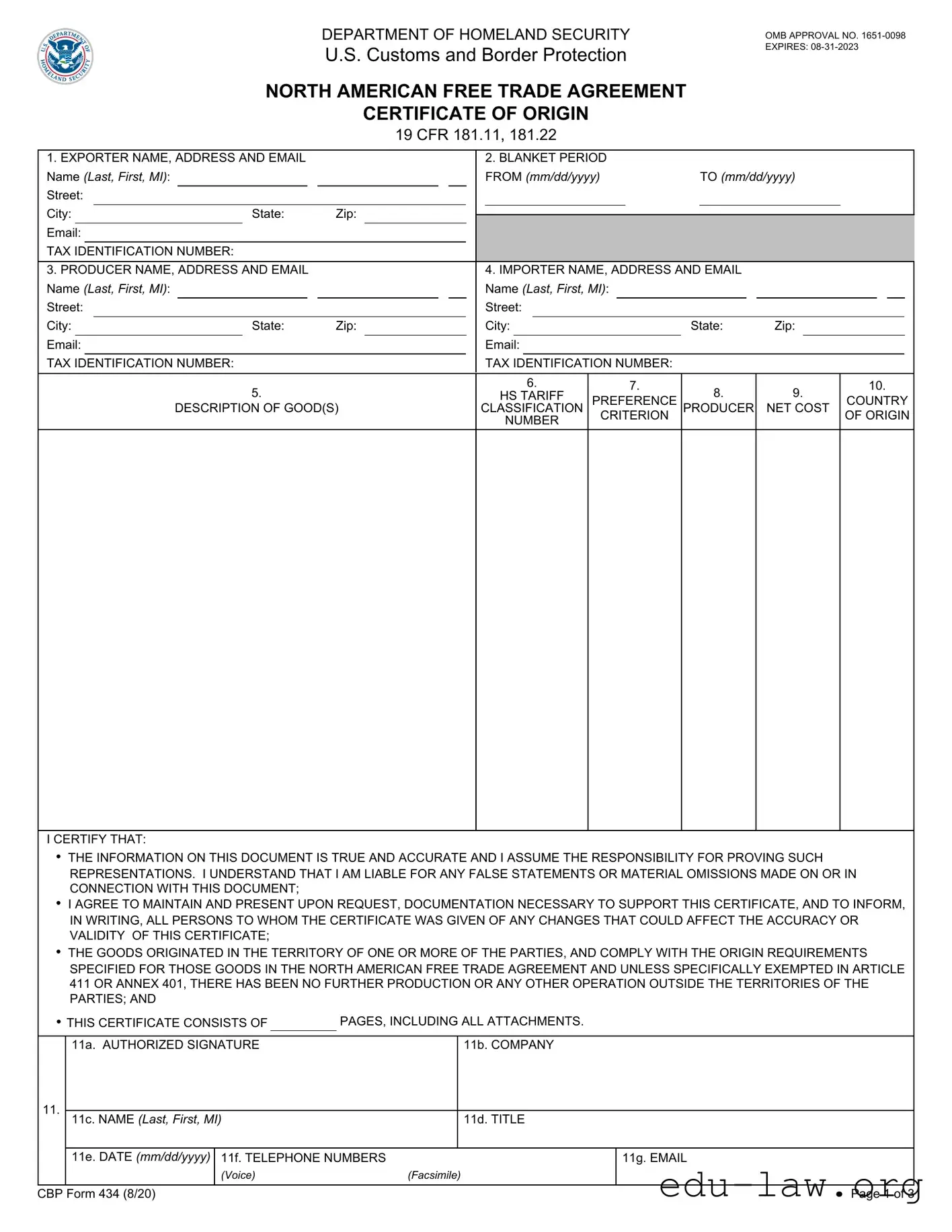
The CBP Form 434, known as the North American Free Trade Agreement (NAFTA) Certificate of Origin, plays a crucial role in international trade between the United States, Canada, and Mexico. This form is essential for exporters seeking preferential tariff treatment under NAFTA. It requires detailed information about the exporter, producer, and importer, including names, addresses, and tax identification numbers. Additionally, the form outlines the blanket period during which the certificate is applicable, allowing for multiple shipments of identical goods. Importantly, it mandates a comprehensive description of the goods, including their Harmonized System (HS) classification and the criteria of origin that determine their eligibility for preferential treatment. The exporter must certify the accuracy of the information provided and assume responsibility for any false statements. Understanding the requirements and properly completing the CBP Form 434 is vital for ensuring compliance and facilitating smooth cross-border transactions.
DEPARTMENT OF HOMELAND SECURITY
U.S. Customs and Border Protection
NORTH AMERICAN FREE TRADE AGREEMENT
CERTIFICATE OF ORIGIN
19 CFR 181.11, 181.22
OMB APPROVAL NO.
1. EXPORTER NAME, ADDRESS AND EMAIL |
|
|
|
|
|
|
|
2. BLANKET PERIOD |
|
|
|
|
|
|
|
|
|
||||||||||||
Name (Last, First, MI): |
|
|
|
|
|
|
|
|
|
FROM (mm/dd/yyyy) |
|
TO (mm/dd/yyyy) |
|
|
|
|
|||||||||||||
|
|
|
|
|
|
|
|
|
|
|
|
|
|
|
|
|
|
|
|
|
|
|
|
|
|
|
|
|
|
Street: |
|
|
|
|
|
|
|
|
|
|
|
|
|
|
|
|
|
|
|
|
|
|
|
|
|
||||
|
|
|
|
|
|
|
|
|
|
|
|
|
|
|
|
|
|
|
|
|
|
|
|
|
|
|
|
|
|
City: |
State: |
Zip: |
|
|
|
|
|
|
|
|
|
|
|
|
|
|
|
|
|
||||||||||
|
|
|
|
|
|
|
|
|
|
|
|
|
|
|
|
|
|||||||||||||
|
|
|
|
|
|
|
|
|
|
|
|
|
|
|
|
|
|
|
|
|
|
|
|
|
|
|
|
||
Email: |
|
|
|
|
|
|
|
|
|
|
|
|
|
|
|
|
|
|
|
|
|
|
|
|
|
||||
|
|
|
|
|
|
|
|
|
|
|
|
|
|
|
|
|
|
|
|
|
|
|
|
|
|
|
|||
TAX IDENTIFICATION NUMBER: |
|
|
|
|
|
|
|
|
|
|
|
|
|
|
|
|
|
|
|
|
|
|
|
|
|
||||
3. PRODUCER NAME, ADDRESS AND EMAIL |
|
|
|
|
|
|
|
4. IMPORTER NAME, ADDRESS AND EMAIL |
|
|
|
|
|
|
|||||||||||||||
Name (Last, First, MI): |
|
|
|
|
|
|
|
|
|
Name (Last, First, MI): |
|
|
|
|
|
|
|
|
|
||||||||||
|
|
|
|
|
|
|
|
|
|
|
|
|
|
|
|
|
|
|
|
|
|
|
|
|
|
|
|||
Street: |
|
|
|
|
|
|
|
|
|
Street: |
|
|
|
|
|
|
|
|
|
|
|
|
|||||||
|
|
|
|
|
|
|
|
|
|
|
|
|
|
|
|
|
|
|
|
|
|||||||||
City: |
State: |
Zip: |
|
City: |
|
|
|
State: |
Zip: |
|
|
|
|
||||||||||||||||
|
|
|
|
|
|
|
|
|
|
|
|
|
|
|
|
|
|
|
|
|
|
|
|
|
|
|
|||
Email: |
|
|
|
|
|
|
|
|
|
Email: |
|
|
|
|
|
|
|
|
|
|
|
|
|||||||
|
|
|
|
|
|
|
|
|
|
|
|
|
|
|
|
|
|
|
|
|
|
|
|
|
|||||
TAX IDENTIFICATION NUMBER: |
|
|
|
|
|
|
|
|
|
TAX IDENTIFICATION NUMBER: |
|
|
|
|
|
|
|
|
|
||||||||||
|
|
|
|
|
|
|
|
|
|
|
|
|
|
|
|
|
|
|
|
|
|
|
|
|
|
|
|
|
|
|
|
|
|
|
5. |
|
|
|
|
|
|
|
6. |
7. |
8. |
|
9. |
10. |
|
|
|||||||||
|
|
|
|
|
|
|
|
|
|
|
|
|
HS TARIFF |
PREFERENCE |
|
COUNTRY |
|||||||||||||
|
|
|
DESCRIPTION OF GOOD(S) |
CLASSIFICATION |
PRODUCER |
NET COST |
|||||||||||||||||||||||
|
|
|
CRITERION |
OF ORIGIN |
|||||||||||||||||||||||||
|
|
|
|
|
|
|
|
|
|
|
|
|
|
NUMBER |
|
|
|
|
|
|
|
|
|
|
|
|
|||
|
|
|
|
|
|
|
|
|
|
|
|
|
|
|
|
|
|
|
|
|
|
|
|
|
|
|
|
|
|
I CERTIFY THAT:
•THE INFORMATION ON THIS DOCUMENT IS TRUE AND ACCURATE AND I ASSUME THE RESPONSIBILITY FOR PROVING SUCH REPRESENTATIONS. I UNDERSTAND THAT I AM LIABLE FOR ANY FALSE STATEMENTS OR MATERIAL OMISSIONS MADE ON OR IN CONNECTION WITH THIS DOCUMENT;
•I AGREE TO MAINTAIN AND PRESENT UPON REQUEST, DOCUMENTATION NECESSARY TO SUPPORT THIS CERTIFICATE, AND TO INFORM, IN WRITING, ALL PERSONS TO WHOM THE CERTIFICATE WAS GIVEN OF ANY CHANGES THAT COULD AFFECT THE ACCURACY OR VALIDITY OF THIS CERTIFICATE;
•THE GOODS ORIGINATED IN THE TERRITORY OF ONE OR MORE OF THE PARTIES, AND COMPLY WITH THE ORIGIN REQUIREMENTS SPECIFIED FOR THOSE GOODS IN THE NORTH AMERICAN FREE TRADE AGREEMENT AND UNLESS SPECIFICALLY EXEMPTED IN ARTICLE 411 OR ANNEX 401, THERE HAS BEEN NO FURTHER PRODUCTION OR ANY OTHER OPERATION OUTSIDE THE TERRITORIES OF THE PARTIES; AND
• THIS CERTIFICATE CONSISTS OF
11a. AUTHORIZED SIGNATURE
11.
11c. NAME (Last, First, MI)
11e. DATE (mm/dd/yyyy) 11f. TELEPHONE NUMBERS |
11g. EMAIL |
(Voice)(Facsimile)
CBP Form 434 (8/20) |
Page 1 of 3 |
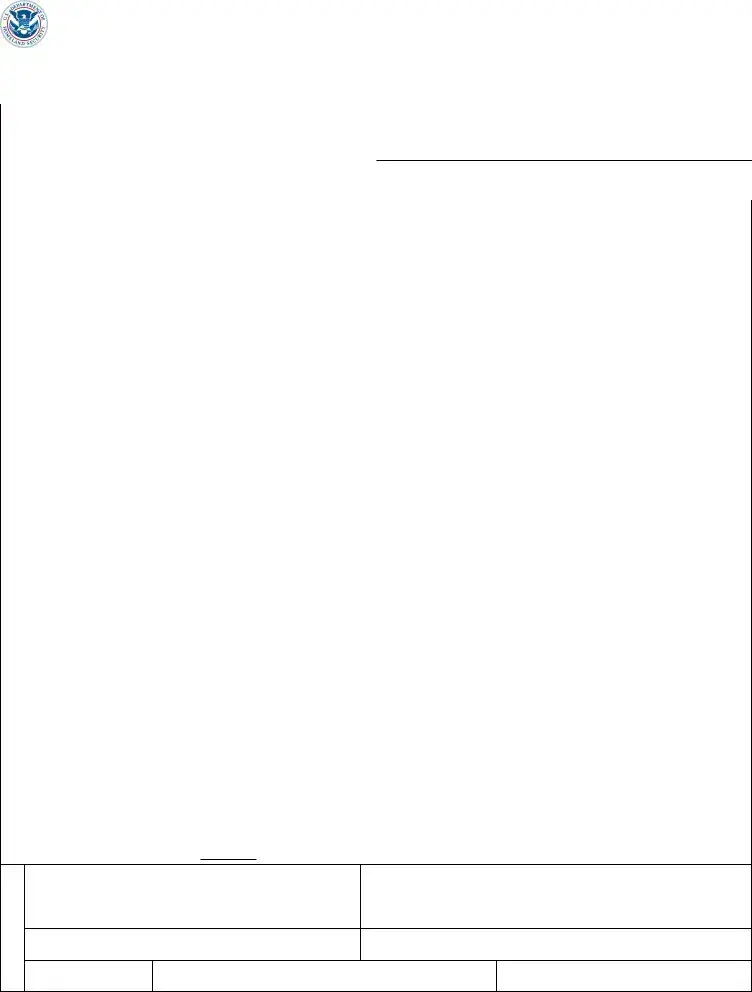
CONTINUATION SHEET
5. |
6. |
7. |
8. |
9. |
10. |
|
HS TARIFF |
PREFERENCE |
COUNTRY |
||||
DESCRIPTION OF GOOD(S) |
CLASSIFICATION |
PRODUCER |
NET COST |
|||
CRITERION |
OF ORIGIN |
|||||
|
NUMBER |
|
|
|
|
|
|
|
|
|
|
|
CBP Form 434 (8/20) |
Page 2 of 3 |

PAPERWORK REDUCTION ACT STATEMENT: An agency may not conduct or sponsor an information collection and a person is not required to respond to this information unless it displays a current valid OMB control number and an expiration date. The control number for this collection is
NORTH AMERICAN FREE TRADE AGREEMENT CERTIFICATE OF ORIGIN INSTRUCTIONS
For purposes of obtaining preferential tariff treatment, this document must be completed legibly and in full by the exporter and be in the possession of the importer at the time the declaration is made. This document may also be completed voluntarily by the producer for use by the exporter. Please print or type:
FIELD 1: State the full legal name, address (including country), email and legal tax identification number of the exporter. Legal taxation number is: in Canada, employer number or importer/exporter number assigned by Revenue Canada; in Mexico, federal taxpayer's registry number (RFC); and in the United States, employer's identification number or Social Security Number.
FIELD 2: Complete field if the Certificate covers multiple shipments of identical goods as described in Field #5 that are imported into a NAFTA country for a specified period of up to one year (the blanket period). "FROM" is the date upon which Certificate becomes applicable to the good covered by the blanket Certificate (it may be prior to the date of signing this Certificate). "TO" is the date upon which the blanket period expires. The importation of a good for which preferential treatment is claimed based on this Certificate must occur between these dates.
FIELD 3: State the full legal name, address (including country), email and legal tax identification number, as defined in Field #1, of the producer. If more than one producer's good is included on the Certificate, attach a list of additional producers, including the legal name, address (including country) and legal tax identification number,
FIELD 4: State the full legal name, address (including country), email and legal tax identification number, as defined in Field #1, of the importer. If the importer is not known, state "UNKNOWN"; if multiple importers, state "VARIOUS".
FIELD 5: Provide a full description of each good. The description should be sufficient to relate it to the invoice description and to the Harmonized System (H.S.) description of the good. If the Certificate covers a single shipment of a good, include the invoice number as shown on the commercial invoice. If not known, indicate another unique reference number, such as the shipping order number.
FIELD 6: For each good described in Field #5, identify the H.S. tariff classification to six digits. If the good is subject to a specific rule of origin in Annex 401 that requires eight digits, identify to eight digits, using the H.S. tariff classification of the country into whose territory the good is imported.
FIELD 7: For each good described in Field #5, state which criterion (A through F) is applicable. The rules of origin are contained in Chapter Four and Annex 401. Additional rules are described in Annex 703.2 (certain agricultural goods), Annex
Preference Criteria
AThe good is "wholly obtained or produced entirely" in the territory of one or more of the NAFTA countries as referenced in Article 415. Note: The purchase of a good in the territory does not necessarily render it "wholly obtained or produced". If the good is an agricultural good, see also criterion F and Annex 703.2. (Reference: Article 401(a) and 415).
BThe good is produced entirely in the territory of one or more of the NAFTA countries and satisfies the specific rule of origin, set out in Annex 401, that applies to its tariff classification. The rule may include a tariff classification change, regional
CThe good is produced entirely in the territory of one or more of the NAFTA countries exclusively from originating materials. Under this criterion, one or more of the materials may not fall within the definition of "wholly produced or obtained", as set out in article 415. All materials used in the production of the good must qualify as "originating" by meeting the rules of Article 401(a) through (d). If the good is an agricultural good, see also criterion F and Annex 703.2. Reference: Article 401(c).
DGoods are produced in the territory of one or more of the NAFTA countries but do not meet the applicable rule of origin, set out in Annex 401, because certain
1.The good was imported into the territory of a NAFTA country in an unassembled or disassembled form but was classified as an assembled good, pursuant to H.S. General Rule of Interpretation 2(a), or
2.The good incorporated one or more
NOTE: This criterion does not apply to Chapters 61 through 63 of H.S. (REFERENCE: ARTICLE 401(D)).
ECertain automatic data processing goods and their parts, specified in Annex 308.1, that do not originate in the territory are considered originating upon importation into the territory of a NAFTA country from the territory of another NAFTA country when the
FThe good is an originating agricultural good under preference criterion A, B, or C above and is not subject to a quantitative restriction in the importing NAFTA country because it is a "qualifying good" as defined in Annex 703.2, Section A or B (please specify). A good listed in Appendix 703.2B.7 is also exempt from quantitative restrictions and is eligible for NAFTA preferential tariff treatment if it meets the definition of "qualifying good" in Section A of Annex 703.2. NOTE 1: This criterion does not apply to goods that wholly originate in Canada or the United States and are imported into either country. NOTE 2: A tariff rate quota is not a quantitative restriction.
FIELD 8: For each good described in Field #5, state "YES" if you are the producer of the good. If you are not the producer of the good, state "NO" followed by (1), (2), or (3), depending on whether this certificate was based upon: (1) your knowledge of whether the good qualifies as an originating good; (2) your reliance on the producer's written representation (other than a Certificate of Origin) that the good qualifies as an originating good; or (3) a completed and signed Certificate for the good, voluntarily provided to the exporter by the producer.
FIELD 9: For each good described in field #5, where the good is subject to a regional value content (RVC) requirement, indicate "NC" if the RVC is calculated according to the net cost method; otherwise, indicate "NO". If the RVC is calculated over a period of time, further identify the beginning and ending dates (MM/DD/YYYY) of that period. (Reference: Article 402.1, 402.5).
FIELD 10: Identify the name of the country ("MX" or "US" for agricultural and textile goods exported to Canada; "US" or "CA" for all goods exported to Mexico; or "CA" or "MX" for all goods exported to the United States) to which the preferential rate of CBP duty applies, as set out in Annex 302.2, in accordance with the Marking Rules or in each party's schedule of tariff elimination.
For all other originating goods exported to Canada, indicate appropriately "MX" or "US" if the goods originate in that NAFTA country, within the meaning of the NAFTA Rules of Origin Regulations, and any subsequent processing in the other NAFTA country does not increase the transaction value of the goods by more than seven percent; otherwise indicate "JNT" for joint production. (Reference: Annex 302.2)
FIELD 11: This field must be completed, signed, and dated by the exporter. When the Certificate is completed by the producer for use by the exporter, it must be completed, signed, and dated by the producer. The date must be the date the Certificate was completed and signed.
CBP Form 434 (8/20) |
Page 3 of 3 |
| Fact Name | Description |
|---|---|
| Form Purpose | The CBP Form 434 is used to certify the origin of goods for preferential tariff treatment under the North American Free Trade Agreement (NAFTA). |
| Governing Law | This form is governed by 19 CFR 181.11 and 181.22. |
| Expiration Date | The OMB approval for this form expires on August 31, 2023. |
| Completion Requirement | The exporter must complete the form legibly and in full for it to be valid. |
| Blanket Period | The form can cover multiple shipments of identical goods for a specified period of up to one year. |
| Tax Identification | Exporters must provide their legal tax identification number, which varies by country. |
| Signature Requirement | The form must be signed and dated by the exporter or the producer if completed for the exporter. |
| Documentation | Exporters must maintain documentation to support the claims made on the certificate and present it upon request. |
Completing the CBP Form 434 is essential for businesses involved in importing goods under the North American Free Trade Agreement (NAFTA). This form serves as a certificate of origin, which helps in claiming preferential tariff treatment. To ensure accurate completion, follow the steps outlined below.
What is the CBP Form 434?
The CBP Form 434 is a certificate used to claim preferential tariff treatment for goods imported into the United States, Canada, or Mexico under the North American Free Trade Agreement (NAFTA). This form certifies that the goods meet the rules of origin requirements set by NAFTA, allowing importers to benefit from reduced tariffs.
Who needs to complete the CBP Form 434?
The exporter is responsible for completing the CBP Form 434. However, producers can also fill it out for use by the exporter. It is essential that the exporter has this form in their possession at the time of the customs declaration.
What information is required on the CBP Form 434?
The form requires detailed information, including the names, addresses, and tax identification numbers of the exporter, producer, and importer. Additionally, it asks for a description of the goods, their tariff classification, and the criteria under which they qualify as originating goods. The form must be filled out completely and accurately to be valid.
What is the blanket period on the CBP Form 434?
A blanket period allows exporters to cover multiple shipments of identical goods over a specified time frame, up to one year. The form must indicate the start and end dates of this period. All goods imported during this time must meet the origin requirements to qualify for preferential treatment.
What happens if the information on the CBP Form 434 is incorrect?
If any information on the CBP Form 434 is found to be false or misleading, the exporter may be held liable for any penalties or duties owed. It is crucial to ensure that all details provided are accurate and that supporting documentation is available upon request.
How long does it take to complete the CBP Form 434?
On average, it takes about two hours to complete the CBP Form 434. This time can vary based on the complexity of the information being provided and the number of goods being included in the certificate.
Is there a specific format for the descriptions of goods on the CBP Form 434?
Yes, the description of goods must be clear and detailed enough to relate to the invoice description and the Harmonized System (H.S.) classification. If applicable, include invoice numbers or unique reference numbers to assist with identification.
What should be done if the producer of the goods is unknown?
If the producer is not known, it is acceptable to indicate "UNKNOWN" on the form. Alternatively, if there are multiple producers, you can state "VARIOUS" and provide additional details as necessary.
Failing to provide complete contact information for the exporter, producer, or importer. This includes missing names, addresses, emails, or tax identification numbers.
Not specifying the blanket period correctly. Ensure that the "FROM" and "TO" dates are accurate and indicate the correct time frame for the certificate.
Omitting the HS tariff classification. Each good must have its classification clearly stated, either to six or eight digits as required.
Providing vague or incomplete descriptions of goods. The description should be detailed enough to relate to the invoice and Harmonized System description.
Incorrectly identifying the criteria of origin for each good. Make sure to select the appropriate criterion (A through F) that applies to the goods being certified.
Not signing or dating the certificate in Field 11. The exporter or producer must complete, sign, and date the certificate to make it valid.
Failing to maintain and present supporting documentation upon request. It is essential to keep records that support the claims made in the certificate.
The CBP Form 434, also known as the North American Free Trade Agreement (NAFTA) Certificate of Origin, is an important document for exporters and importers involved in trade between the United States, Canada, and Mexico. It certifies that goods meet the origin requirements necessary for preferential tariff treatment under NAFTA. Along with this form, several other documents may be required to facilitate the import and export process. Below is a list of commonly used forms and documents.
These documents collectively facilitate international trade by ensuring compliance with legal requirements and providing necessary information for customs clearance. Each document plays a specific role in the process, and understanding their importance can help streamline the import and export activities.
The CBP Form 434, also known as the North American Free Trade Agreement (NAFTA) Certificate of Origin, shares similarities with the NAFTA Certificate of Origin (Form 1). Both documents serve the purpose of certifying the origin of goods being imported into a NAFTA country. They require detailed information about the exporter, producer, and importer, as well as a description of the goods and their tariff classification. The key difference lies in the specific requirements of each form, with Form 1 being used for goods imported under different trade agreements or for different purposes. However, the fundamental goal remains the same: to facilitate preferential tariff treatment based on the origin of the goods.
Another document similar to the CBP Form 434 is the Certificate of Origin for the Generalized System of Preferences (GSP). This certificate is used to claim preferential tariff treatment for eligible products imported from designated developing countries. Like the CBP Form 434, it requires information about the exporter, producer, and importer, as well as a description of the goods. The GSP certificate, however, focuses on the eligibility of goods based on their country of origin and adherence to specific GSP guidelines, while the CBP Form 434 emphasizes compliance with NAFTA regulations.
The Certificate of Free Sale is another document that bears resemblance to the CBP Form 434. This certificate is often required for products being exported to certain countries, indicating that the goods are legally sold in the U.S. market. Both documents require detailed descriptions of the goods and information about the exporter and producer. However, the Certificate of Free Sale primarily serves to assure foreign governments that the products meet local safety and quality standards, whereas the CBP Form 434 is focused on tariff preferences under NAFTA.
The Commercial Invoice is also similar to the CBP Form 434 in that it is a crucial document in international trade. It outlines the details of the transaction, including the buyer, seller, description of goods, and payment terms. While the CBP Form 434 is specifically designed to certify the origin of goods for tariff purposes, the Commercial Invoice serves as a record of the sale and is often required by customs authorities for clearance. Both documents must be accurate and complete to avoid delays in the importation process.
Lastly, the Importer’s Declaration is akin to the CBP Form 434 in that it is a statement made by the importer regarding the nature of the goods being imported. This declaration may include information about the origin, classification, and value of the goods. While the CBP Form 434 is focused on certifying the origin for tariff benefits under NAFTA, the Importer’s Declaration provides customs authorities with essential information needed to assess duties and compliance with import regulations. Both documents play a vital role in ensuring smooth customs clearance and adherence to trade agreements.
When filling out the CBP 434 form, it is essential to be thorough and accurate. Here are some important dos and don'ts to keep in mind:
This form is designed for any exporter, regardless of size. Small businesses can and should use it to take advantage of tariff benefits under the North American Free Trade Agreement (NAFTA).
If you are exporting multiple shipments of identical goods, you can use a blanket period on the form. However, it must be filled out for each new shipment or when the blanket period expires.
Completing the form is just one step. The goods must meet specific origin criteria to qualify for preferential tariff treatment. Simply having the form does not automatically ensure benefits.
This form is critical for compliance with U.S. Customs regulations. Failing to complete it accurately can lead to penalties or denial of entry for your goods.
Understanding how to properly fill out and use the CBP Form 434 is essential for exporters and importers who wish to benefit from the North American Free Trade Agreement (NAFTA). Here are some key takeaways:
By following these guidelines, you can navigate the process of filling out and using the CBP Form 434 with confidence. This form is a vital tool for facilitating trade and ensuring compliance with NAFTA regulations.