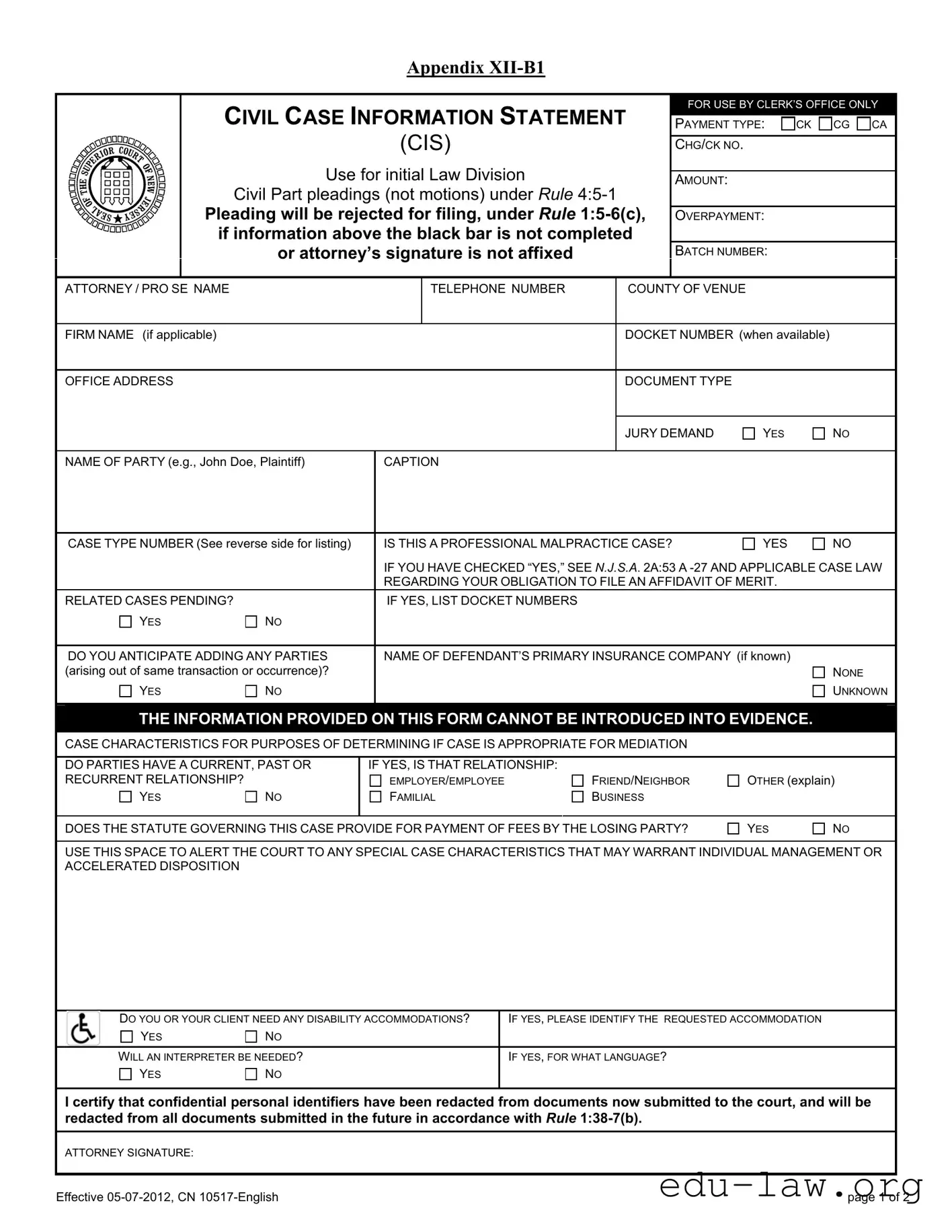
The Case Information Statement (CIS) is an essential form used in the initial stages of civil litigation within the Law Division. It serves as a critical tool for attorneys and pro se litigants alike, ensuring that all necessary information is submitted for the court's consideration. This form must be filled out completely, including details such as the attorney's name, contact information, and the county of venue. It also requires the identification of the case type, which dictates the timeline for discovery, ranging from 150 to 450 days, depending on the complexity of the case. Notably, the CIS includes specific questions regarding the nature of the case, such as whether it involves professional malpractice or if there are related cases pending. Additionally, it addresses the need for disability accommodations or interpreters, emphasizing the court's commitment to accessibility. By accurately completing the CIS, parties can avoid potential delays in the filing process, as incomplete submissions may be rejected. The urgency of this form cannot be overstated; it sets the stage for how the case will be managed and resolved in the judicial system.
Appendix
CIVIL CASE INFORMATION STATEMENT
(CIS)
Use for initial Law Division
Civil Part pleadings (not motions) under RULE
Pleading will be rejected for filing, under RULE
FOR USE BY CLERK’S OFFICE ONLY
PAYMENT TYPE: |
CK CG CA |
CHG/CK NO. |
|
|
|
AMOUNT: |
|
|
|
OVERPAYMENT: |
|
|
|
BATCH NUMBER: |
|
ATTORNEY / PRO SE NAME
TELEPHONE NUMBER
COUNTY OF VENUE
FIRM NAME (if applicable)
DOCKET NUMBER (when available)
OFFICE ADDRESS
DOCUMENT TYPE
JURY DEMAND
YES
NO
NAME OF PARTY (e.g., John Doe, Plaintiff) |
CAPTION |
CASE TYPE NUMBER (See reverse side for listing) |
IS THIS A PROFESSIONAL MALPRACTICE CASE? |
YES |
NO |
|
|
|
IF YOU HAVE CHECKED “YES,” SEE N.J.S.A. 2A:53 A |
||
|
|
REGARDING YOUR OBLIGATION TO FILE AN AFFIDAVIT OF MERIT. |
|
|
RELATED CASES PENDING? |
|
IF YES, LIST DOCKET NUMBERS |
|
|
YES |
NO |
|
|
|
|
|
|
||
DO YOU ANTICIPATE ADDING ANY PARTIES |
NAME OF DEFENDANT’S PRIMARY INSURANCE COMPANY (if known) |
|
||
(arising out of same transaction or occurrence)? |
|
|
NONE |
|
YES |
NO |
|
|
UNKNOWN |
THE INFORMATION PROVIDED ON THIS FORM CANNOT BE INTRODUCED INTO EVIDENCE.
CASE CHARACTERISTICS FOR PURPOSES OF DETERMINING IF CASE IS APPROPRIATE FOR MEDIATION
DO PARTIES HAVE A CURRENT, PAST OR RECURRENT RELATIONSHIP?
YES NO
IF YES, IS THAT RELATIONSHIP:
EMPLOYER/EMPLOYEE
FAMILIAL
FRIEND/NEIGHBOR BUSINESS
OTHER (explain)
DOES THE STATUTE GOVERNING THIS CASE PROVIDE FOR PAYMENT OF FEES BY THE LOSING PARTY?
YES
NO
USE THIS SPACE TO ALERT THE COURT TO ANY SPECIAL CASE CHARACTERISTICS THAT MAY WARRANT INDIVIDUAL MANAGEMENT OR ACCELERATED DISPOSITION
DO YOU OR YOUR CLIENT NEED ANY DISABILITY ACCOMMODATIONS? |
IF YES, PLEASE IDENTIFY THE REQUESTED ACCOMMODATION |
|
YES |
NO |
|
WILL AN INTERPRETER BE NEEDED? |
IF YES, FOR WHAT LANGUAGE? |
|
YES |
NO |
|
|
|
|
I certify that confidential personal identifiers have been redacted from documents now submitted to the court, and will be redacted from all documents submitted in the future in accordance with RULE
ATTORNEY SIGNATURE:
Effective |
page 1 of 2 |

Side 2
CIVIL CASE INFORMATION STATEMENT
(CIS)
Use for initial pleadings (not motions) under RULE
CASE TYPES (Choose one and enter number of case type in appropriate space on the reverse side.)
Track I - 150 days' discovery
151NAME CHANGE
175FORFEITURE
302TENANCY
399REAL PROPERTY (other than Tenancy, Contract, Condemnation, Complex Commercial or Construction)
502BOOK ACCOUNT (debt collection matters only)
505OTHER INSURANCE CLAIM (including declaratory judgment actions)
506PIP COVERAGE
510UM or UIM CLAIM (coverage issues only)
511ACTION ON NEGOTIABLE INSTRUMENT
512LEMON LAW
801SUMMARY ACTION
802OPEN PUBLIC RECORDS ACT (summary action)
999OTHER (briefly describe nature of action)
Track II - 300 days' discovery
305 CONSTRUCTION
509EMPLOYMENT (other than CEPA or LAD)
599CONTRACT/COMMERCIAL TRANSACTION
603N AUTO NEGLIGENCE – PERSONAL INJURY
605PERSONAL INJURY
610AUTO NEGLIGENCE – PROPERTY DAMAGE
621UM or UIM CLAIM (includes bodily injury)
699TORT – OTHER
Track III - 450 days' discovery
005CIVIL RIGHTS
301CONDEMNATION
602ASSAULT AND BATTERY
604MEDICAL MALPRACTICE
606PRODUCT LIABILITY
607PROFESSIONAL MALPRACTICE
608TOXIC TORT
609DEFAMATION
616WHISTLEBLOWER / CONSCIENTIOUS EMPLOYEE PROTECTION ACT (CEPA) CASES
617INVERSE CONDEMNATION
618LAW AGAINST DISCRIMINATION (LAD) CASES
Track IV - Active Case Management by Individual Judge / 450 days' discovery
156ENVIRONMENTAL/ENVIRONMENTAL COVERAGE LITIGATION
303MT. LAUREL
508COMPLEX COMMERCIAL
513COMPLEX CONSTRUCTION
514INSURANCE FRAUD
620FALSE CLAIMS ACT
701ACTIONS IN LIEU OF PREROGATIVE WRITS
Centrally Managed Litigation (Track IV)
285 |
STRYKER TRIDENT HIP IMPLANTS |
291 |
PELVIC MESH/GYNECARE |
288 |
PRUDENTIAL TORT LITIGATION |
292 |
PELVIC MESH/BARD |
289 |
REGLAN |
293 |
DEPUY ASR HIP IMPLANT LITIGATION |
290 |
POMPTON LAKES ENVIRONMENTAL LITIGATION |
295 |
ALLODERM REGENERATIVE TISSUE MATRIX |
|
|
623 |
PROPECIA |
Mass Tort (Track IV)
266 |
HORMONE REPLACEMENT THERAPY (HRT) |
281 |
|
271 |
ACCUTANE/ISOTRETINOIN |
282 |
FOSAMAX |
274 |
RISPERDAL/SEROQUEL/ZYPREXA |
284 |
NUVARING |
278 |
ZOMETA/AREDIA |
286 |
LEVAQUIN |
279 |
GADOLINIUM |
287 |
YAZ/YASMIN/OCELLA |
|
|
601 |
ASBESTOS |
If you believe this case requires a track other than that provided above, please indicate the reason on Side 1, in the space under "Case Characteristics.
Please check off each applicable category
Putative Class Action
Title 59
Effective |
page 2 of 2 |
| Fact Name | Fact Description |
|---|---|
| Purpose | The Civil Case Information Statement (CIS) is used for initial pleadings in the Law Division Civil Part. |
| Governing Rule | This form is governed by Rule 4:5-1 of the New Jersey Court Rules. |
| Filing Requirement | Pleadings will be rejected if the required information above the black bar is incomplete or if the attorney's signature is missing. |
| Clerk's Use | The form includes a section designated for use by the Clerk's Office only. |
| Case Types | The CIS categorizes cases into different types, including personal injury, medical malpractice, and environmental litigation. |
| Jury Demand | The form allows the party to indicate whether a jury demand is made, with options for 'Yes' or 'No.' |
| Professional Malpractice | If the case involves professional malpractice, the filer must comply with N.J.S.A. 2A:53A-27 and related case law regarding an affidavit of merit. |
| Disability Accommodations | The form asks whether any disability accommodations are needed, allowing for a description of the requested accommodations. |
| Confidentiality Certification | The attorney must certify that confidential personal identifiers have been redacted from submitted documents in accordance with Rule 1:38-7(b). |
Filling out the Case Information Statement (CIS) is a crucial step in initiating a civil case. Once the form is completed, it must be submitted to the appropriate court for processing. Below are the steps to guide you through filling out the form accurately.
After completing the form, review all entries for accuracy before submission. This ensures that your case is processed without unnecessary delays. Once submitted, the court will take the next steps in managing your case.
What is the Case Information Statement (CIS) form used for?
The Case Information Statement (CIS) form is essential for initiating civil cases in the Law Division. It provides the court with critical information about the case, including the parties involved, the nature of the dispute, and any related cases. This helps streamline the court's processes and ensures that your case is handled efficiently. Remember, this form is not for motions; it's specifically designed for initial pleadings under Rule 4:5-1.
What happens if I don’t complete the information above the black bar on the form?
Completing the information above the black bar is mandatory. If you fail to do so, the court will reject your pleading for filing, as stated in Rule 1:5-6(c). This means your case could be delayed or even dismissed, so it’s crucial to ensure all required fields are filled out accurately and completely before submission.
Can I submit the CIS form without an attorney?
Yes, individuals can submit the CIS form pro se, meaning without an attorney. However, it’s important to understand that while you can represent yourself, navigating the legal system can be complex. If you choose to go this route, make sure you carefully read all instructions and complete the form accurately to avoid any issues with your case.
What should I do if my case involves professional malpractice?
If your case is classified as professional malpractice, you need to check "YES" on the CIS form. This classification comes with specific obligations, including the requirement to file an Affidavit of Merit in accordance with N.J.S.A. 2A:53 A-27. This affidavit serves as a statement from an expert confirming that there is a legitimate claim, which is crucial for your case to proceed.
Is it necessary to indicate if I need any disability accommodations on the CIS form?
Yes, if you or your client require any disability accommodations, it is essential to indicate this on the CIS form. The court needs this information to ensure that appropriate arrangements are made to facilitate your participation in the legal process. Be specific about the type of accommodation needed to help the court assist you effectively.
What information should I provide if my case has related cases pending?
If there are related cases pending, you should indicate this on the CIS form by checking "YES" and listing the corresponding docket numbers. This information is vital for the court to understand the context of your case and to manage any potential overlaps or conflicts with existing cases. Providing this detail helps ensure a more organized and coherent legal process.
Neglecting Required Information: Failing to complete all sections above the black bar is a common mistake. This information is crucial for the court to process the case.
Omitting the Attorney’s Signature: If the form is filed without the attorney's signature, it will be rejected. This signature is a necessary affirmation of the information provided.
Incorrect Case Type Selection: Choosing the wrong case type can lead to significant delays. Each case type has specific requirements and timelines, so it’s important to select the correct one.
Ignoring the Affidavit of Merit Requirement: In professional malpractice cases, failing to acknowledge the need for an affidavit of merit can jeopardize the case. This is a legal obligation that must be fulfilled.
Not Listing Related Cases: If there are related cases, they should be listed. This helps the court understand the context and connections between cases, which can be important for management.
Forgetting to Indicate Jury Demand: Not specifying whether a jury demand is present can lead to confusion. This detail affects how the case will be handled moving forward.
Overlooking Special Case Characteristics: Failing to use the space provided to alert the court to any special case characteristics can limit the court’s ability to manage the case appropriately.
Neglecting Disability Accommodations: If accommodations are needed, they must be clearly stated. This ensures that all parties have equal access to the court process.
Not Redacting Personal Identifiers: It's crucial to certify that confidential personal identifiers have been redacted. Failing to do so can lead to privacy violations and potential legal issues.
The Case Information Statement (CIS) is an essential document used in civil litigation to provide the court with preliminary details about a case. When filing a CIS, several other forms and documents may also be necessary to ensure a smooth legal process. Below is a list of commonly used forms that often accompany the CIS.
Understanding the various forms and documents that accompany the Case Information Statement is crucial for navigating the legal process effectively. Each document plays a specific role in ensuring that the case is presented clearly and comprehensively to the court. By preparing these forms accurately, you can help facilitate a more efficient legal process.
The Complaint form is similar to the Case Information Statement (CIS) in that both documents are essential for initiating a civil lawsuit. A Complaint outlines the plaintiff's allegations and the basis for the court's jurisdiction, while the CIS provides critical information about the case, such as the parties involved and the nature of the dispute. Both forms require specific details to be filled out accurately, as incomplete submissions can lead to delays or rejections in the filing process.
The Summons is another document that parallels the CIS, as it is also used at the beginning of a legal action. A Summons serves as a notice to the defendant that they are being sued and provides them with instructions on how to respond. Like the CIS, the Summons must be filled out correctly to ensure that the defendant receives proper notification of the legal proceedings against them.
The Civil Case Cover Sheet is similar to the CIS in that it gathers essential information about the case for the court's administrative purposes. This document typically includes details such as the type of case, the parties involved, and any related cases. Both the Civil Case Cover Sheet and the CIS help streamline the court's process by providing necessary data upfront.
The Notice of Motion is akin to the CIS in that it is a formal document submitted to the court to request a specific action or ruling. While the CIS is used for initial pleadings, the Notice of Motion is often utilized later in the process. Both documents require clear and concise information to facilitate the court's understanding of the issues at hand.
The Affidavit of Merit is another document that shares similarities with the CIS, particularly in cases involving professional malpractice. This affidavit, which must be filed in conjunction with the CIS, provides evidence that the plaintiff has consulted with an expert who supports their claims. Both documents work together to establish the legitimacy of the case before it proceeds.
The Case Management Order is similar to the CIS in that it outlines the timeline and procedures for a case. Issued by the court after the initial filings, this order helps manage the case's progress and ensures that all parties adhere to deadlines. Like the CIS, it is crucial for maintaining the organization of the case within the court system.
The Pretrial Order is comparable to the CIS, as it sets forth the requirements and expectations for the parties before trial. This document outlines what evidence and witnesses will be presented, similar to how the CIS provides an overview of the case's nature. Both documents are vital for ensuring that the trial process is efficient and organized.
The Discovery Request is another document that has similarities with the CIS in that it is part of the pretrial process. This request seeks specific information or documents from the opposing party to prepare for trial. While the CIS provides initial case details, the Discovery Request delves deeper into the facts and evidence needed to support each party's claims.
The Settlement Agreement is similar to the CIS in that it represents a resolution to a case, although it comes at a later stage. This document outlines the terms agreed upon by both parties to avoid going to trial. While the CIS initiates the case, the Settlement Agreement concludes it, showcasing the importance of both documents in the litigation process.
Finally, the Trial Brief is akin to the CIS in that it presents the arguments and evidence that each party intends to rely on during the trial. While the CIS lays the groundwork for the case, the Trial Brief articulates the specific legal theories and factual support that will be argued in court. Both documents are integral to the overall litigation process.
Filling out the Case Information Statement (CIS) form accurately is crucial for a smooth legal process. Here are seven important dos and don'ts to keep in mind:
Understanding the Case Information Statement (CIS) form is essential for anyone involved in civil litigation. However, several misconceptions can lead to confusion. Here are seven common misunderstandings about the CIS form:
Clarifying these misconceptions can help ensure that the CIS is completed accurately and submitted correctly, ultimately facilitating a smoother legal process.
Filling out the Case Information Statement (CIS) form is a critical step in initiating civil litigation. Here are some key takeaways to keep in mind:
By paying close attention to these details, you can help ensure a smoother process as your case moves forward.