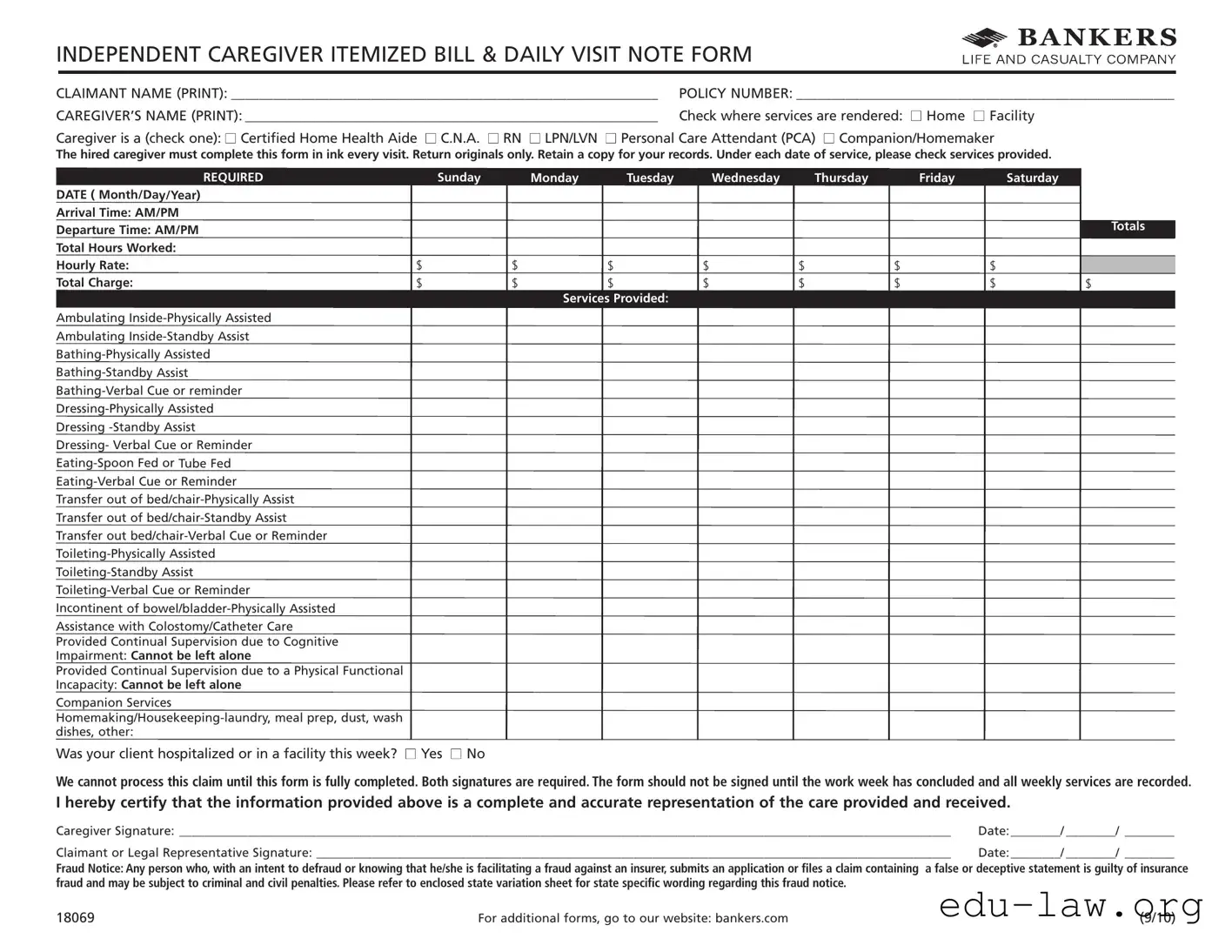
The Caregiver Daily Log form serves as a crucial tool for documenting the services provided by caregivers to individuals in need of assistance. This form is designed for use by various types of caregivers, including Certified Home Health Aides, Certified Nursing Assistants (C.N.A.), Registered Nurses (RN), Licensed Practical Nurses (LPN/LVN), Personal Care Attendants (PCA), and Companions or Homemakers. It requires caregivers to fill out essential details, such as the claimant's name, policy number, and caregiver's name, ensuring that all parties involved are clearly identified. Each visit necessitates the recording of specific services rendered, which can range from assistance with bathing and dressing to supervision for those with cognitive impairments. Caregivers must also document arrival and departure times, total hours worked, and the applicable hourly rate to calculate the total charge for the services rendered. Additionally, the form includes a section to indicate if the client was hospitalized or in a facility during the week, which is vital for accurate billing and care assessment. Both the caregiver and the claimant or legal representative must sign the form to certify its accuracy, reinforcing accountability and compliance with insurance requirements. The form also includes a fraud notice, underscoring the importance of honesty in reporting services provided. By maintaining detailed records through this log, caregivers can ensure that they meet both the care needs of their clients and the administrative requirements of insurance claims.
INDEPENDENT CAREGIVER ITEMIZED BILL & DAILY VISIT NOTE FORM
CLAIMANT NAME (PRINT): _____________________________________________________________ |
POLICY NUMBER: ______________________________________________________ |
CAREGIVER’S NAME (PRINT): ___________________________________________________________ |
Check where services are rendered: n Home n Facility |
Caregiver is a (check one): n Certified Home Health Aide n C.N.A. n RN n LPN/LVN n Personal Care Attendant (PCA) n Companion/Homemaker
The hired caregiver must complete this form in ink every visit. Return originals only. Retain a copy for your records. Under each date of service, please check services provided.
REQUIRED
DATE ( Month/Day/Year)
Arrival Time: AM/PM
Departure Time: AM/PM
Total Hours Worked:
Hourly Rate:
Total Charge:
Sunday |
Monday |
Tuesday |
Wednesday |
Thursday |
Friday |
Saturday |
|
|
|
|
|
|
|
Totals |
$ |
$ |
$ |
$ |
$ |
$ |
$ |
|
$ |
$ |
$ |
$ |
$ |
$ |
$ |
$ |
|
|
Services Provided: |
|
|
|
|
|
Ambulating
Assistance with Colostomy/Catheter Care Provided Continual Supervision due to Cognitive Impairment: Cannot be left alone Provided Continual Supervision due to a Physical Functional Incapacity: Cannot be left alone
Companion Services
meal prep, dust, wash |
Was your client hospitalized or in a facility this week? n Yes n No
We cannot process this claim until this form is fully completed. Both signatures are required. The form should not be signed until the work week has concluded and all weekly services are recorded.
I hereby certify that the information provided above is a complete and accurate representation of the care provided and received.
Caregiver Signature: ____________________________________________________________________________________________________________________________ |
Date: ________/ ________/ |
________ |
Claimant or Legal Representative Signature: ______________________________________________________________________________________________________ |
Date: ________/ ________/ |
________ |
Fraud Notice: Any person who, with an intent to defraud or knowing that he/she is facilitating a fraud against an insurer, submits an application or files a claim containing a false or deceptive statement is guilty of insurance fraud and may be subject to criminal and civil penalties. Please refer to enclosed state variation sheet for state specific wording regarding this fraud notice.
18069 |
For additional forms, go to our website: bankers.com |
(9/10) |
| Fact Name | Description |
|---|---|
| Purpose | The Caregiver Daily Log form is designed to document the services provided by caregivers to clients, ensuring accurate billing and record-keeping. |
| Completion Requirement | The caregiver must fill out the form in ink during each visit, recording details of services rendered and time worked. |
| Service Types | Various services can be checked off, including assistance with bathing, dressing, eating, and toileting, among others. |
| Signatures | Both the caregiver and the claimant or legal representative must sign the form to certify the accuracy of the information provided. |
| Fraud Notice | A warning is included on the form, indicating that submitting false information can result in criminal and civil penalties. |
| Retention of Copies | Caregivers are advised to retain a copy of the completed form for their records, while only originals should be submitted. |
| State-Specific Regulations | The form may include variations based on state laws. Caregivers should refer to the enclosed state variation sheet for specific requirements. |
Completing the Caregiver Daily Log form is an essential step in documenting the care provided to a client. Following these steps will ensure that all necessary information is accurately recorded. This process will help maintain clear communication between caregivers, clients, and insurance providers.
Once the form is completed, it should be returned in its original form, while keeping a copy for personal records. This careful documentation is crucial for processing claims accurately and efficiently.
What is the purpose of the Caregiver Daily Log form?
The Caregiver Daily Log form is designed to document the services provided by caregivers during their visits. It helps keep track of the care given, including the hours worked, types of services rendered, and the caregiver's and claimant's signatures. This documentation is essential for billing and insurance claims.
Who is required to fill out this form?
The caregiver who provides the services must complete the form. This includes certified home health aides, CNAs, RNs, LPNs/LVNs, personal care attendants, and companions/homemakers. Accurate completion ensures that all necessary information is captured for billing purposes.
What information must be included on the form?
Caregivers need to provide the claimant's name, policy number, their own name, and the dates of service. They must also record arrival and departure times, total hours worked, hourly rate, and total charge. Additionally, caregivers should check off the services provided during each visit.
Can the form be signed before the week of service is complete?
No, the form should not be signed until the entire week of services has concluded. This ensures that all services provided during that week are accurately recorded. Both the caregiver and the claimant or legal representative must sign the form to validate the information.
What should be done if the client was hospitalized during the week?
If the client was hospitalized or in a facility during the week, caregivers must check the appropriate box on the form. This information is crucial for processing claims and may affect billing. Claims cannot be processed until the form is fully completed, including this detail.
What happens if the form is not completed correctly?
If the form is incomplete or contains errors, it may delay the processing of the claim. It is essential to double-check all entries for accuracy and completeness before submission. Retaining a copy for personal records is also advisable.
What are the consequences of submitting false information on this form?
Submitting false information can lead to serious consequences, including criminal and civil penalties for insurance fraud. It is important to provide accurate and truthful information to avoid these legal issues. Caregivers should be aware of the fraud notice included on the form.
Not Filling in All Required Information: Many people overlook the necessity of completing every section of the form. Missing details like the claimant's name or policy number can delay processing.
Using Ink vs. Pencil: The instructions specify that the form must be completed in ink. Using pencil can lead to forms being rejected or considered invalid.
Incorrectly Reporting Service Dates: It's crucial to accurately enter the date of service. Errors in dates can create confusion and may lead to claim denials.
Failing to Check All Services Provided: Caregivers sometimes forget to check all applicable services. This omission can result in underreporting the care given and affect reimbursement.
Not Signing the Form: Both the caregiver and the claimant must sign the form. Neglecting this step can halt the claim process entirely.
Submitting Copies Instead of Originals: The instructions state to return only original forms. Submitting copies can lead to processing delays.
Not Retaining a Copy: Caregivers often forget to keep a copy of the completed form for their records. This can be problematic if there are questions or disputes later.
The Caregiver Daily Log form serves as a crucial document for tracking the services provided by caregivers. In addition to this form, several other documents are commonly utilized to ensure comprehensive care management and proper billing. Each of these forms plays a specific role in the caregiving process, facilitating communication and documentation between caregivers, clients, and insurance providers.
Utilizing these documents alongside the Caregiver Daily Log form enhances the overall quality of care and supports effective communication among all parties involved. Proper documentation is vital for accountability and ensures that caregivers can provide the best possible support to their clients.
The Caregiver Daily Log form shares similarities with the Patient Care Report (PCR) used by emergency medical services. Both documents require detailed documentation of services rendered, including the times of service and the specific assistance provided. The PCR also emphasizes the need for accurate reporting of patient conditions and interventions, ensuring that all care is recorded comprehensively. This focus on precise documentation helps maintain continuity of care and provides a legal record of services delivered.
Another comparable document is the Home Health Aide Daily Activity Log. This log captures the daily activities and services provided by home health aides, much like the Caregiver Daily Log. It includes sections for noting the time of arrival and departure, as well as specific tasks performed. Both forms aim to track the caregiver's activities and ensure that clients receive the appropriate level of care, while also serving as a tool for billing purposes.
The Weekly Caregiver Summary Report is also similar, providing an overview of care provided over a week. This document aggregates daily logs into a single report, allowing for easier review and assessment of the caregiver's performance. Both forms emphasize the importance of accountability and transparency in caregiving, making it easier for families and agencies to monitor the quality of care delivered.
The Daily Nursing Notes form is another document that aligns closely with the Caregiver Daily Log. Nurses use this form to record patient assessments, interventions, and responses to care. Similar to the Caregiver Daily Log, it requires precise documentation of the services provided, including times and specific actions taken. This consistency in documentation helps ensure that all healthcare providers are informed about the patient's status and care plan.
The Service Delivery Record used in rehabilitation settings also mirrors the Caregiver Daily Log. This record details the services provided to patients during therapy sessions, including the duration and type of interventions. Both documents require caregivers to detail the services rendered and track the time spent, ensuring that billing aligns with the care provided and that patients receive the necessary support for their recovery.
Another related document is the Client Care Plan, which outlines the specific needs and services required for a client. While the Caregiver Daily Log tracks day-to-day activities, the Care Plan provides a broader overview of the client's long-term care goals. Both documents work together to ensure that caregivers are aligned with the client's needs and that services are delivered consistently and effectively.
Lastly, the Activity and Service Log for Assisted Living Facilities serves a similar purpose. This log records daily activities and services provided to residents, including assistance with daily living tasks. Like the Caregiver Daily Log, it requires caregivers to document the time spent and the nature of the services provided. This consistency in documentation supports effective communication among staff and ensures that residents receive the care they need.
When filling out the Caregiver Daily Log form, it is important to follow certain guidelines to ensure accuracy and compliance. Here are some things to do and not do:
Misconceptions about the Caregiver Daily Log form can lead to confusion and improper use. Here are four common misunderstandings:
Filling out the Caregiver Daily Log form is an essential process for documenting the care provided to individuals. Here are some key takeaways to ensure that the form is completed accurately and effectively:
By following these guidelines, caregivers can ensure that the Caregiver Daily Log form is completed properly, facilitating timely processing of claims and providing a clear record of the care provided.