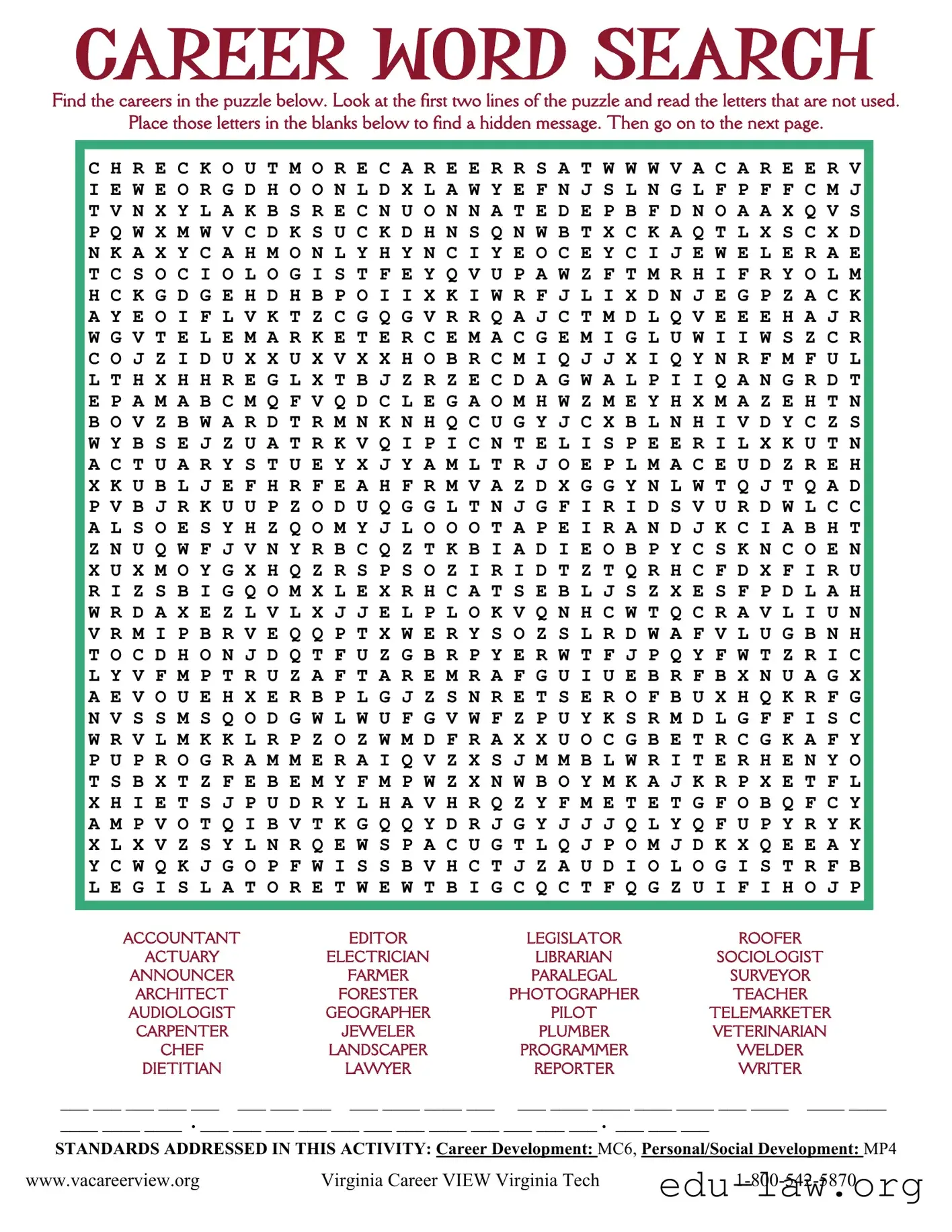
The Career Word Search form is an engaging and interactive tool designed to help individuals explore various career options while enhancing their problem-solving skills. Within this puzzle, participants are invited to find a list of professions hidden among a jumble of letters. As they navigate through the letters, they will also discover that some letters remain unused, which serve a special purpose. These unused letters can be placed in designated blanks to reveal a hidden message, adding an element of surprise and excitement to the activity. After completing the word search, participants are encouraged to move on to the next page, where they can further their understanding of career clusters. This form not only promotes career awareness but also aligns with educational standards in career development and personal/social growth. By engaging with the Career Word Search, individuals can begin to identify their interests and aspirations in the workforce while enjoying a fun and stimulating challenge.

Find the careers in the puzzle below. Look at the first two lines of the puzzle and read the letters that are not used.
Place those letters in the blanks below to find a hidden message. Then go on to the next page.
C H R E C K O U T M O R E C A R E E R R S A T W W W V A C A R E E R V I E W E O R G D H O O N L D X L A W Y E F N J S L N G L F P F F C M J T V N X Y L A K B S R E C N U O N N A T E D E P B F D N O A A X Q V S P Q W X M W V C D K S U C K D H N S Q N W B T X C K A Q T L X S C X D N K A X Y C A H M O N L Y H Y N C I Y E O C E Y C I J E W E L E R A E T C S O C I O L O G I S T F E Y Q V U P A W Z F T M R H I F R Y O L M H C K G D G E H D H B P O I I X K I W R F J L I X D N J E G P Z A C K A Y E O I F L V K T Z C G Q G V R R Q A J C T M D L Q V E E E H A J R W G V T E L E M A R K E T E R C E M A C G E M I G L U W I I W S Z C R C O J Z I D U X X U X V X X H O B R C M I Q J J X I Q Y N R F M F U L L T H X H H R E G L X T B J Z R Z E C D A G W A L P I I Q A N G R D T E P A M A B C M Q F V Q D C L E G A O M H W Z M E Y H X M A Z E H T N B O V Z B W A R D T R M N K N H Q C U G Y J C X B L N H I V D Y C Z S W Y B S E J Z U A T R K V Q I P I C N T E L I S P E E R I L X K U T N A C T U A R Y S T U E Y X J Y A M L T R J O E P L M A C E U D Z R E H X K U B L J E F H R F E A H F R M V A Z D X G G Y N L W T Q J T Q A D P V B J R K U U P Z O D U Q G G L T N J G F I R I D S V U R D W L C C A L S O E S Y H Z Q O M Y J L O O O T A P E I R A N D J K C I A B H T Z N U Q W F J V N Y R B C Q Z T K B I A D I E O B P Y C S K N C O E N X U X M O Y G X H Q Z R S P S O Z I R I D T Z T Q R H C F D X F I R U R I Z S B I G Q O M X L E X R H C A T S E B L J S Z X E S F P D L A H W R D A X E Z L V L X J J E L P L O K V Q N H C W T Q C R A V L I U N V R M I P B R V E Q Q P T X W E R Y S O Z S L R D W A F V L U G B N H T O C D H O N J D Q T F U Z G B R P Y E R W T F J P Q Y F W T Z R I C L Y V F M P T R U Z A F T A R E M R A F G U I U E B R F B X N U A G X A E V O U E H X E R B P L G J Z S N R E T S E R O F B U X H Q K R F G N V S S M S Q O D G W L W U F G V W F Z P U Y K S R M D L G F F I S C W R V L M K K L R P Z O Z W M D F R A X X U O C G B E T R C G K A F Y P U P R O G R A M M E R A I Q V Z X S J M M B L W R I T E R H E N Y O T S B X T Z F E B E M Y F M P W Z X N W B O Y M K A J K R P X E T F L X H I E T S J P U D R Y L H A V H R Q Z Y F M E T E T G F O B Q F C Y A M P V O T Q I B V T K G Q Q Y D R J G Y J J J Q L Y Q F U P Y R Y K X L X V Z S Y L N R Q E W S P A C U G T L Q J P O M J D K X Q E E A Y Y C W Q K J G O P F W I S S B V H C T J Z A U D I O L O G I S T R F B L E G I S L A T O R E T W E W T B I G C Q C T F Q G Z U I F I H O J P
ACCOUNTANT |
EDITOR |
LEGISLATOR |
ROOFER |
ACTUARY |
ELECTRICIAN |
LIBRARIAN |
SOCIOLOGIST |
ANNOUNCER |
FARMER |
PARALEGAL |
SURVEYOR |
ARCHITECT |
FORESTER |
PHOTOGRAPHER |
TEACHER |
AUDIOLOGIST |
GEOGRAPHER |
PILOT |
TELEMARKETER |
CARPENTER |
JEWELER |
PLUMBER |
VETERINARIAN |
CHEF |
LANDSCAPER |
PROGRAMMER |
WELDER |
DIETITIAN |
LAWYER |
REPORTER |
WRITER |
___ ___ ___ ___ ___ ___ ___ ___ ___ ____ ____ ___ |
___ ____ ____ ____ ____ ___ ____ ____ ____ |
||
____ ____ ____ . ___ ___ ___ ___ ___ ___ ___ ____ ___ ___ ___ ___ . ___ ___ ___ |
|
||
STANDARDS ADDRESSED IN THIS ACTIVITY: Career Development: MC6, Personal/Social Development: MP4
www.vacareerview.org |
Virginia Career VIEW Virginia Tech |

Place the occupations from the Career Word Search in the correct career cluster.
Use the first letter of the occupation for clues.
Health Science |
Science, Technology, Engineering & Mathematics |
|
|
|
|
A__ __ __ __ __ __ __ __ __ __ |
G__ __ __ __ __ __ __ __ __ |
|
|
|
|
D__ __ __ __ __ __ __ __ |
|
|
|
Manufacturing |
Education & Training |
Human Service |
J__ __ __ __ __ __ |
L__ __ __ __ __ __ __ __ |
S__ __ __ __ __ __ __ __ __ __ |
W__ __ __ __ __ |
T__ __ __ __ __ __ |
|
|
|
Architecture and Construction
Arts, Audio/Video Technology &Communications
A__ __ __ __ __ __ __ __
A__ __ __ __ __ __ __ __
E__ __ __ __ __
C__ __ __ __ __ __ __ __
E__ __ __ __ __ __ __ __ __ __
P__ __ __ __ __ __ __ __ __ __ __
R__ __ __ __ __ __ __
L__ __ __ __ __ __ __ __ __
W__ __ __ __ __
P__ __ __ __ __ __
R__ __ __ __ __
S__ __ __ __ __ __ __
Government & Public Administration
L__ __ __ __ __ __ __ __ __ |
|
Business, Management & Administrative |
|
|
|
A__ __ __ __ __ __ __ __ __ |
|
Transportation, Distribution, & Logistics |
|
|
|
P__ __ __ __ |
|
Marketing Sales & Service |
|
|
|
|
|
|
|
T__ __ __ __ __ __ __ __ __ __ __ |
|
Agriculture & Natural Resources |
|
|
|
F__ __ __ __ __ |
|
Law, Public Safety, Corrections & Security |
|
|
|
|
|
F__ __ __ __ __ __ __ |
|
L__ __ __ __ __ |
|
V__ __ __ __ __ __ __ __ __ __ __ |
P__ __ __ __ __ __ __ __ |
||
Hospitality & Tourism |
Information Technology |
Finance |
|
C__ __ __ |
P__ __ __ __ __ __ __ __ __ |
A__ __ __ __ __ __ |
|
| Fact Name | Description |
|---|---|
| Purpose | The Career Word Search form is designed to help individuals identify various careers through a puzzle format. |
| Hidden Message | Participants are instructed to find letters not used in the first two lines of the puzzle to uncover a hidden message. |
| Occupations Listed | The form includes a variety of occupations such as teacher, lawyer, and veterinarian. |
| Career Clusters | Occupations are categorized into specific career clusters to aid in organization and understanding. |
| Standards Addressed | The activity addresses career development and personal/social development standards. |
| Source | This form is provided by Virginia Career VIEW, a resource from Virginia Tech. |
| Contact Information | For assistance, individuals can contact Virginia Career VIEW at 1-800-542-5870. |
After completing the Career Word Search form, you will need to organize the occupations into their respective career clusters. This involves using the first letter of each occupation as a clue to place them correctly. Follow the steps below to fill out the form accurately.
What is the purpose of the Career Word Search form?
The Career Word Search form is designed to help individuals explore various careers in an engaging way. By finding careers hidden in a word search puzzle, participants can learn about different occupations while also uncovering a hidden message using the unused letters from the puzzle. This activity combines fun with educational elements related to career development.
How do I find the hidden message in the puzzle?
To find the hidden message, first, look at the first two lines of the puzzle. Identify the letters that are not used in the word search. Write these letters in the blanks provided below the puzzle. Once you fill in the blanks, you will reveal a hidden message related to careers.
Where can I find more information about the careers listed?
For more information about the careers mentioned in the puzzle, visit the website www.vacareerview.org. This site offers resources and details about various occupations, career clusters, and development opportunities. It serves as a valuable tool for anyone looking to explore potential career paths.
What should I do after completing the word search?
After completing the word search and uncovering the hidden message, proceed to the next page as instructed. This may include further activities related to career exploration or additional information on the occupations found in the puzzle. Engaging with the next steps will enhance your understanding of career options.
Neglecting to read instructions: Many people skip the instructions at the beginning of the form. This can lead to confusion and errors in filling out the puzzle.
Overlooking unused letters: Some individuals fail to identify the letters that are not used in the puzzle. These letters are crucial for discovering the hidden message.
Incorrectly placing letters: When transferring the unused letters to the blanks, mistakes in placement can occur, leading to an incorrect hidden message.
Skipping career clusters: Some users forget to categorize the occupations into the correct career clusters, which is an essential part of the task.
Ignoring the first letters: The first letters of the occupations are hints for the career clusters. Not using these clues can make the task more challenging.
Failing to double-check: Many people do not review their answers before submitting. A quick review can help catch simple mistakes.
Rushing through the puzzle: Some individuals hurry to finish the word search, which can lead to overlooking important details.
Using incorrect spelling: Spelling errors when writing down occupations can result in confusion and incorrect categorization.
Not utilizing available resources: Some users do not take advantage of external resources or hints that could assist them in completing the form accurately.
Forgetting to follow up: After completing the form, some individuals forget to proceed to the next page, missing out on additional activities or information.
When using the Career Word Search form, several other documents can enhance the experience and provide additional context. Here’s a list of commonly used forms and documents that may accompany the Career Word Search.
These documents work together to support career exploration and job application processes. Utilizing them alongside the Career Word Search can lead to a more comprehensive understanding of career options and pathways.
The Career Interest Inventory is a tool designed to help individuals identify their career preferences and interests. Similar to the Career Word Search form, it engages users in a fun and interactive way. Both documents encourage exploration of various occupations, providing insights into potential career paths. While the Career Interest Inventory focuses on personal preferences, the Career Word Search incorporates a puzzle format that adds an element of playfulness to the discovery process.
The Job Shadowing Agreement serves as a formal document outlining the terms and conditions for a job shadowing experience. Like the Career Word Search, it aims to enhance understanding of different professions. Both documents encourage individuals to learn about careers through direct engagement. However, the Job Shadowing Agreement is more structured, ensuring that both the shadowing participant and the host organization have clear expectations and responsibilities.
The Resume Template is a practical document that assists individuals in crafting their professional profiles. Similar to the Career Word Search, it supports career development by helping users present their skills and experiences effectively. While the Career Word Search offers a creative way to explore careers, the Resume Template provides a straightforward approach to showcasing qualifications, making it easier for job seekers to connect with potential employers.
The Cover Letter Guide is another resource that aids individuals in the job application process. Like the Career Word Search, it emphasizes the importance of communication in career advancement. Both documents serve to prepare users for the job market, but the Cover Letter Guide focuses specifically on how to express interest in a position. It helps individuals articulate their motivations and qualifications, complementing the exploratory nature of the Career Word Search.
The Career Exploration Worksheet is designed to help users research and evaluate different career options. This document shares a similar purpose with the Career Word Search, as both encourage individuals to consider various occupations. However, the Career Exploration Worksheet is more analytical, prompting users to assess their skills, values, and interests in relation to specific careers. This structured approach complements the playful exploration found in the Career Word Search.
The Skills Assessment Form helps individuals identify their strengths and areas for improvement. Similar to the Career Word Search, it supports personal development and career planning. Both documents encourage self-reflection and exploration of potential career paths. The Skills Assessment Form, however, is more focused on evaluating personal capabilities, providing a foundation for informed career choices, while the Career Word Search offers a more engaging and lighthearted approach to career discovery.
When filling out the Career Word Search form, it’s important to approach the task thoughtfully. Here’s a list of things you should and shouldn’t do to ensure a smooth experience.
By following these guidelines, you can enjoy the process and uncover the hidden message effectively. Happy searching!
Misconceptions about the Career Word Search form can lead to confusion and frustration. Here are five common misunderstandings:
Here are some key takeaways regarding the Career Word Search form: