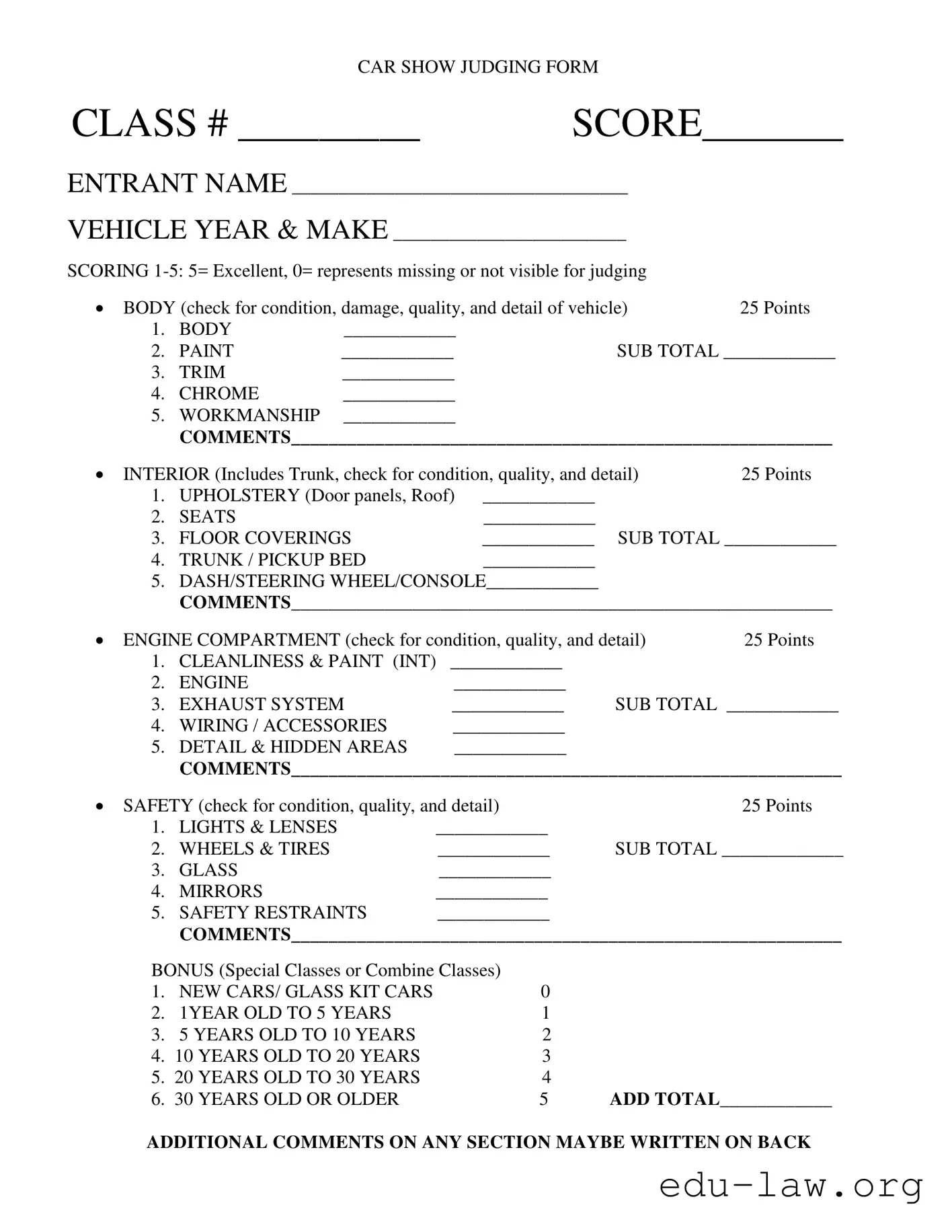
The Car Show Judging form serves as a comprehensive tool for evaluating vehicles at car shows, ensuring that judges assess each entry fairly and consistently. It includes several key sections that focus on different aspects of the vehicle, allowing for a thorough examination. Judges begin by looking at the body of the vehicle, where they check for its overall condition, any damage, and the quality of details such as paint and trim. Each of these components is scored on a scale from 0 to 5, with 5 indicating excellence. The interior section follows, encompassing upholstery, seats, and floor coverings, as well as the trunk and dashboard. Cleanliness and detail in the engine compartment are evaluated next, with specific attention given to the engine and wiring. Safety features also receive scrutiny, including lights, tires, and safety restraints. Additionally, the form allows for bonus points based on the age of the vehicle, recognizing special classes like new cars and vintage models. Judges can provide comments throughout the form, and there’s space for additional notes on the back, ensuring that all observations are captured for a complete assessment.
|
|
CAR SHOW JUDGING FORM |
|
|
CLASS # _________ |
SCORE_______ |
|||
ENTRANT NAME ____________________________________ |
|
|||
VEHICLE YEAR & MAKE _________________________ |
|
|||
SCORING |
|
|||
BODY (check for condition, damage, quality, and detail of vehicle) |
25 Points |
|||
1. |
BODY |
____________ |
|
|
2. |
PAINT |
____________ |
SUB TOTAL ____________ |
|
3. |
TRIM |
____________ |
|
|
4. |
CHROME |
____________ |
|
|
5. |
WORKMANSHIP |
____________ |
|
|
|
COMMENTS__________________________________________________________ |
|||
INTERIOR (Includes Trunk, check for condition, quality, and detail) |
25 Points |
|||
1. |
UPHOLSTERY (Door panels, Roof) |
____________ |
|
|
2. |
SEATS |
|
____________ |
|
3. |
FLOOR COVERINGS |
____________ SUB TOTAL ____________ |
||
4. |
TRUNK / PICKUP BED |
____________ |
|
|
5.DASH/STEERING WHEEL/CONSOLE____________
COMMENTS__________________________________________________________
ENGINE COMPARTMENT (check for condition, quality, and detail) |
25 Points |
|||
1. |
CLEANLINESS & PAINT (INT) ____________ |
|
|
|
2. |
ENGINE |
____________ |
|
|
3. |
EXHAUST SYSTEM |
____________ |
SUB TOTAL ____________ |
|
4. |
WIRING / ACCESSORIES |
____________ |
|
|
5. |
DETAIL & HIDDEN AREAS |
____________ |
|
|
|
COMMENTS___________________________________________________________ |
|||
SAFETY (check for condition, quality, and detail) |
|
25 Points |
||
1. |
LIGHTS & LENSES |
____________ |
|
|
2. |
WHEELS & TIRES |
____________ |
SUB TOTAL _____________ |
|
3. |
GLASS |
____________ |
|
|
4. |
MIRRORS |
____________ |
|
|
5. |
SAFETY RESTRAINTS |
____________ |
|
|
|
COMMENTS___________________________________________________________ |
|||
BONUS (Special Classes or Combine Classes) |
|
|
||
1. |
NEW CARS/ GLASS KIT CARS |
0 |
|
|
2. |
1YEAR OLD TO 5 YEARS |
1 |
|
|
3. |
5 YEARS OLD TO 10 YEARS |
2 |
|
|
4. |
10 YEARS OLD TO 20 YEARS |
3 |
|
|
5. |
20 YEARS OLD TO 30 YEARS |
4 |
|
|
6. |
30 YEARS OLD OR OLDER |
5 |
ADD TOTAL____________ |
|
ADDITIONAL COMMENTS ON ANY SECTION MAYBE WRITTEN ON BACK
| Fact Name | Description |
|---|---|
| Scoring System | The judging form uses a scoring system from 0 to 5, where 5 represents excellent condition and 0 indicates items that are missing or not visible for judging. |
| Categories Assessed | Judging is divided into four main categories: Body, Interior, Engine Compartment, and Safety, each worth a total of 25 points. |
| Bonus Points | Bonus points are awarded based on the age of the vehicle, with a maximum of 5 additional points available for cars older than 30 years. |
| Additional Comments | Entrants can provide additional comments on any section of the judging form, which may be written on the back of the form. |
After gathering all necessary information, proceed to fill out the Car Show Judging form. This form requires specific details about the vehicle and its condition. Follow these steps to ensure accurate completion.
What is the purpose of the Car Show Judging Form?
The Car Show Judging Form is designed to evaluate vehicles based on various criteria, including body condition, interior quality, engine compartment cleanliness, and safety features. Each category is scored on a scale from 0 to 5, allowing judges to provide a comprehensive assessment of each vehicle. This structured approach ensures fairness and consistency in judging, making it easier to determine the best vehicles in the show.
How is the scoring system structured?
The scoring system uses a 1 to 5 scale, where 5 represents excellent condition and 0 indicates that a feature is missing or not visible for judging. Each main category—Body, Interior, Engine Compartment, and Safety—has a maximum score of 25 points, allowing for a total score of up to 100 points. Bonus points may also be awarded for special classes or vehicles based on their age, adding an extra layer of consideration in the judging process.
What categories are evaluated on the form?
The Car Show Judging Form evaluates four main categories: Body, Interior, Engine Compartment, and Safety. Each category is further divided into specific elements. For example, the Body category assesses aspects like paint quality and chrome details, while the Interior category looks at upholstery and trunk condition. This comprehensive evaluation helps judges focus on all critical aspects of a vehicle.
How can judges provide comments on the vehicles?
Judges can provide comments directly on the Car Show Judging Form in the designated comments sections for each category. This allows them to note any specific observations or concerns regarding the vehicle's condition. Additionally, judges have the option to write additional comments on the back of the form if they feel that further explanation is necessary.
What should I do if a vehicle does not meet the judging criteria?
If a vehicle does not meet the judging criteria in certain areas, judges should score those specific aspects accordingly, using the 0 to 5 scale. For example, if a vehicle's paint is severely damaged, it might receive a score of 1 or 0 in that category. It’s important to be objective and fair, as this ensures that all vehicles are judged based on the same standards.
Can judges award bonus points, and how is that determined?
Yes, judges can award bonus points based on the age of the vehicle. The form includes a bonus section that assigns points depending on the vehicle's age, ranging from 0 for new cars to 5 for vehicles that are 30 years old or older. This allows for recognition of classic and vintage cars, which may not compete directly with newer models in terms of condition but hold significant historical value.
Failing to fill in the class number and score at the top of the form can lead to confusion during the judging process.
Not providing a complete entrant name makes it difficult to identify the vehicle and its owner.
Leaving the vehicle year and make blank can result in an incomplete assessment of the car.
Overlooking the subtotals for each section can lead to miscalculations in the final score.
Neglecting to provide comments for each section limits the feedback for entrants and judges alike.
Using inconsistent scoring, such as giving a score of 0 for a minor issue, can skew the overall results.
Not checking all areas of the vehicle, including hidden areas, may result in an unfair evaluation.
Failing to assess the safety features properly can overlook critical aspects of vehicle safety.
Ignoring the bonus points section can lead to a lower score than deserved, especially for newer vehicles.
Not utilizing the space for additional comments on the back of the form can limit the depth of feedback provided.
When organizing a car show, several forms and documents are essential to ensure a smooth judging process and effective communication among participants and organizers. Below is a list of commonly used documents alongside the Car Show Judging Form.
Utilizing these documents effectively can enhance the overall experience of both participants and judges at a car show. Clear communication and organization are key to a successful event.
The Car Show Judging Form shares similarities with a Product Review Form. Both documents aim to evaluate the quality and condition of an item, whether it be a vehicle or a product. In a Product Review Form, specific criteria are often outlined, allowing reviewers to score various aspects such as functionality, design, and usability. Just as the Car Show Judging Form breaks down the vehicle into categories like body, interior, and engine compartment, a Product Review Form typically categorizes features that contribute to the overall assessment of the product. This structured approach facilitates a clear and comprehensive evaluation, making it easier for the reviewer to provide feedback.
Another document that resembles the Car Show Judging Form is the Home Inspection Report. This report serves as a detailed assessment of a property’s condition, focusing on various components such as the roof, plumbing, and electrical systems. Like the Car Show Judging Form, the Home Inspection Report utilizes a scoring system to indicate the quality of each area inspected. Both documents require the inspector or judge to provide comments and observations, ensuring that any deficiencies or areas of concern are clearly noted. This helps potential buyers or participants understand the strengths and weaknesses of the item being evaluated.
The Event Scoring Sheet is yet another document that aligns closely with the Car Show Judging Form. Used in various competitions and events, this sheet allows judges to score participants based on specific criteria relevant to the event. Similar to the Car Show Judging Form, the Event Scoring Sheet often includes sections for different aspects of performance, allowing for a detailed breakdown of scores. Judges may also provide comments to explain their scoring decisions, which enhances transparency and helps participants understand how they can improve in future events.
Lastly, the Performance Evaluation Form for employees bears resemblance to the Car Show Judging Form in its purpose of assessing quality and performance. This form typically includes categories such as teamwork, communication, and job knowledge, much like how the Car Show Judging Form evaluates the body, interior, and engine compartment of a vehicle. Both documents emphasize the importance of providing constructive feedback through comments, helping individuals understand their strengths and areas for improvement. By using a structured scoring system, both forms facilitate a fair and comprehensive assessment process.
When filling out the Car Show Judging form, it's essential to follow some best practices. Here’s a list of things you should and shouldn’t do:
Misconceptions about the Car Show Judging form can lead to confusion and misinterpretation of the judging process. Here are ten common misunderstandings:
Here are key takeaways for filling out and using the Car Show Judging form:
Additional comments can be added on the back of the form for any section that requires more detail.