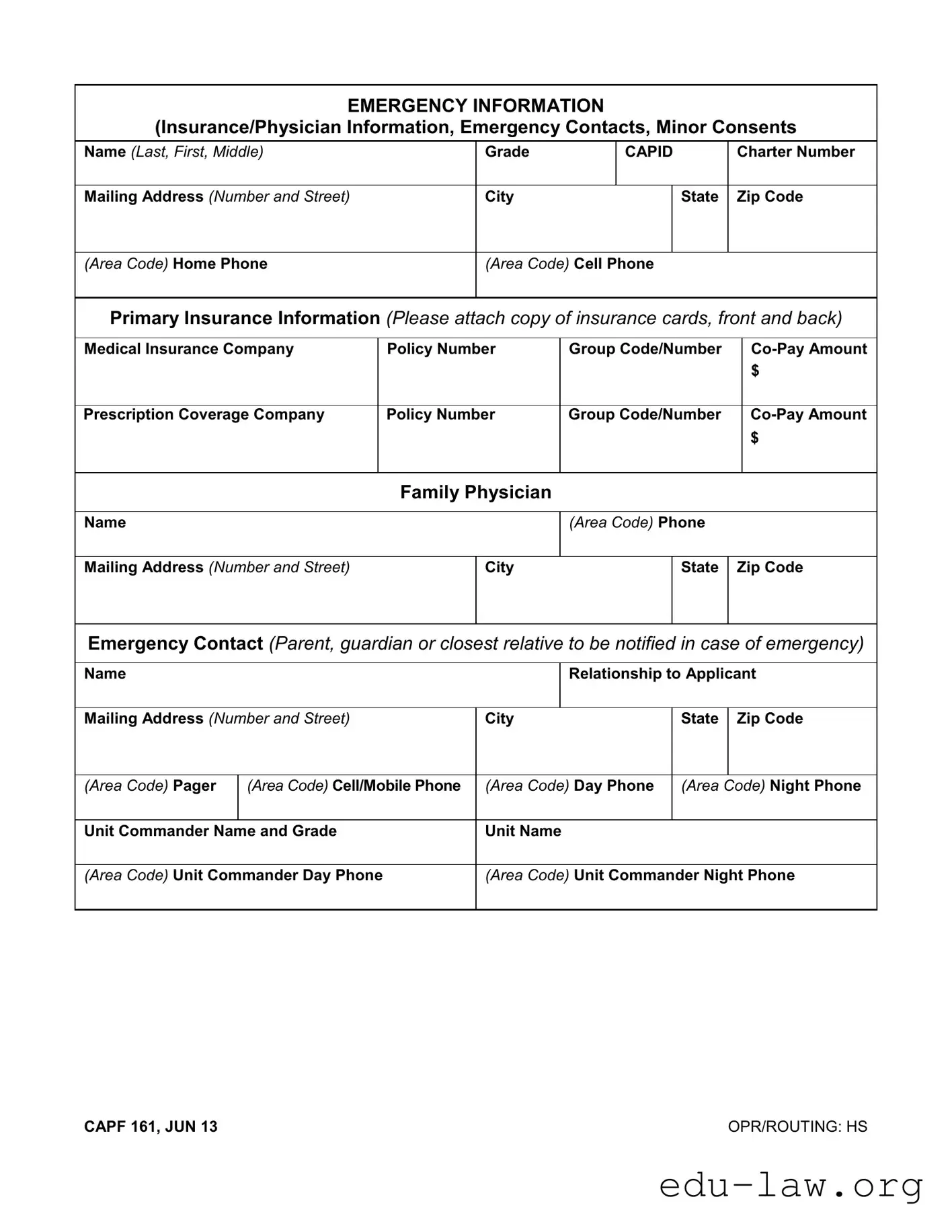
The CAPF 161 form is an essential document designed to gather critical emergency information for individuals involved in the Civil Air Patrol (CAP). This form plays a vital role in ensuring that, in the event of an emergency, the necessary medical and contact details are readily available. It includes sections for insurance information, such as policy numbers and co-pay amounts, which are crucial for quick access to medical care. Additionally, it requires the names and contact information of emergency contacts, such as parents or guardians, ensuring that the right people can be reached swiftly if needed. The form also collects details about the individual's family physician, providing a direct line to medical professionals familiar with the individual's health history. Furthermore, it contains specific identifiers, including the applicant's name, grade, and CAPID, which help in organizing and managing the information effectively. Completing the CAPF 161 accurately is not just a formality; it is a proactive step towards ensuring safety and preparedness in emergency situations.

EMERGENCY INFORMATION
(Insurance/Physician Information, Emergency Contacts, Minor Consents
Name (Last, First, Middle)
Grade
CAPID
Charter Number
Mailing Address (Number and Street)
City
State Zip Code
(Area Code) Home Phone
(Area Code) Cell Phone
Primary Insurance Information (Please attach copy of insurance cards, front and back)
Medical Insurance Company |
Policy Number |
Group Code/Number |
|
|
|
|
$ |
|
|
|
|
Prescription Coverage Company |
Policy Number |
Group Code/Number |
|
|
|
|
$ |
|
|
|
|
Family Physician
Name
(Area Code) Phone
Mailing Address (Number and Street)
City
State Zip Code
Emergency Contact (Parent, guardian or closest relative to be notified in case of emergency)
Name |
|
|
Relationship to Applicant |
||
|
|
|
|
|
|
Mailing Address (Number and Street) |
City |
State |
Zip Code |
||
|
|
|
|
|
|
(Area Code) Pager |
(Area Code) Cell/Mobile Phone |
(Area Code) Day Phone |
(Area Code) Night Phone |
||
|
|
|
|
|
|
Unit Commander Name and Grade |
Unit Name |
|
|
||
|
|
||||
(Area Code) Unit Commander Day Phone |
(Area Code) Unit Commander Night Phone |
||||
|
|
|
|
|
|
CAPF 161, JUN 13 |
OPR/ROUTING: HS |
| Fact Name | Description |
|---|---|
| Purpose | The CAPF 161 form is designed to collect essential emergency information for minors participating in Civil Air Patrol activities. |
| Required Information | This form requires details such as insurance information, emergency contacts, and medical history to ensure proper care in emergencies. |
| Emergency Contacts | Parents, guardians, or closest relatives must be listed as emergency contacts to facilitate quick communication in case of an incident. |
| Insurance Documentation | Participants must attach copies of their insurance cards, both front and back, to the form to confirm coverage during CAP activities. |
| Governing Law | The use of the CAPF 161 form is governed by federal and state laws regarding minors' medical consent and emergency care. |
| Submission Requirements | The completed form should be submitted to the unit commander before participating in any CAP activities, ensuring readiness in emergencies. |
Completing the CAPF 161 form is an important step in ensuring that emergency information is readily available when needed. This form collects essential details about medical insurance, emergency contacts, and consent for minors. Follow these steps carefully to fill out the form accurately.
After completing the form, review all entries for accuracy and completeness. Ensure that all necessary attachments, such as insurance cards, are included before submission. This form is crucial for providing timely assistance in emergencies.
What is the CAPF 161 form?
The CAPF 161 form is an emergency information document used by the Civil Air Patrol (CAP). It collects essential details about an individual's medical insurance, emergency contacts, and physician information. This form is crucial for ensuring that appropriate care can be provided in case of an emergency.
Who needs to fill out the CAPF 161 form?
All members of the Civil Air Patrol, especially minors, are required to complete the CAPF 161 form. Parents or guardians typically fill it out for minors, ensuring that emergency contacts and medical information are readily available.
What information is required on the form?
The form requires personal information, including the member's name, grade, CAPID, and charter number. It also asks for mailing addresses, phone numbers, insurance details, family physician information, and emergency contacts.
Why is insurance information needed?
Insurance information is vital for medical treatment. In an emergency, healthcare providers may need to verify coverage quickly. Including this information helps ensure that any medical services provided are covered, reducing financial burdens on families.
What if I don’t have insurance?
If you do not have insurance, you can indicate this on the form. It’s still important to provide other emergency contact information and medical details to ensure proper care can be given when needed.
How should I submit the completed CAPF 161 form?
Once completed, the CAPF 161 form should be submitted to the appropriate unit commander or designated official within your Civil Air Patrol squadron. Check with your unit for specific submission guidelines.
Is the information on the CAPF 161 form kept confidential?
Yes, the information on the CAPF 161 form is treated as confidential. It is used solely for emergency purposes and will not be shared with unauthorized individuals.
What should I do if my information changes?
If any information on the CAPF 161 form changes, such as a new phone number or insurance provider, you should update the form promptly. Keeping the information current is essential for effective communication in emergencies.
Can I fill out the form online?
The CAPF 161 form may be available in a fillable format online, depending on your unit's resources. However, it's often printed and filled out by hand. Check with your squadron for the preferred method of submission.
What happens if I don’t submit the CAPF 161 form?
Failure to submit the CAPF 161 form may limit your participation in CAP activities, especially for minors. It is essential for safety and emergency preparedness, so ensure it is completed and submitted as required.
Failing to provide complete emergency contact information. It's crucial to include the full name, relationship, and accurate contact details of the emergency contact.
Omitting insurance information. Ensure that you attach a copy of both the front and back of your insurance cards. Missing this can delay processing.
Not listing a family physician. Include the name, phone number, and address of your family doctor. This information is vital in case of a medical emergency.
Using incorrect or incomplete addresses. Double-check the mailing address for both the applicant and emergency contacts to avoid miscommunication.
Forgetting to include contact numbers. Provide area codes for all phone numbers, including home, cell, and emergency contacts. This ensures quick access when needed.
Neglecting to sign or date the form. A signature is necessary to validate the information provided, and without it, the form may be considered incomplete.
The CAPF 161 form is essential for providing emergency information and contact details for individuals involved in the Civil Air Patrol. Along with this form, several other documents may be required to ensure comprehensive coverage and preparedness in case of emergencies. Below is a list of commonly associated forms and documents.
Having these documents ready and properly filled out can significantly enhance safety and preparedness. Always ensure that all information is accurate and up to date, as this can make a difference in urgent situations.
The CAPF 160 form, also known as the "Application for Membership," shares similarities with the CAPF 161 form in that both documents are essential for ensuring the safety and well-being of participants in the Civil Air Patrol. Like the CAPF 161, the CAPF 160 requires personal information, including the applicant's name and contact details. It also seeks emergency contact information, ensuring that in case of an emergency, the appropriate individuals can be reached swiftly. Both forms emphasize the importance of having up-to-date information readily available to facilitate prompt responses during emergencies.
Another related document is the CAPF 162, which is the "Health History" form. The CAPF 162 focuses on an individual's medical background, capturing vital health information that can be crucial in emergencies. While the CAPF 161 collects emergency contact details and insurance information, the CAPF 162 digs deeper into the applicant's health history, allergies, and existing medical conditions. Together, these forms create a comprehensive profile that aids medical personnel in providing appropriate care when needed.
The CAPF 163, known as the "Parental Consent Form," is also similar to the CAPF 161. This document is particularly important for minors participating in Civil Air Patrol activities. It requires parental or guardian consent for the minor's involvement, ensuring that legal guardians are aware and supportive of their child's participation. The CAPF 161 complements this by gathering emergency contact information and medical details, creating a safety net for minors during CAP activities.
Lastly, the CAPF 164, or the "Medical Examination Form," bears resemblance to the CAPF 161 in its purpose of ensuring the health and safety of participants. The CAPF 164 requires a thorough medical examination and documentation of fitness for duty. While the CAPF 161 focuses more on emergency information and insurance details, both forms are critical in assessing and maintaining the health standards necessary for safe participation in Civil Air Patrol activities. Together, they form a comprehensive approach to participant safety and well-being.
When filling out the CAPF 161 form, it is essential to ensure accuracy and completeness. Here are some important dos and don'ts to keep in mind:
By following these guidelines, you can help ensure that your form is processed smoothly and that emergency contacts can be reached when necessary.
The following are common misconceptions about the CAPF 161 form, along with clarifications for each.
Filling out the CAPF 161 form is an important step for ensuring that emergency information is readily available for individuals involved in the Civil Air Patrol. Here are some key takeaways to keep in mind:
Completing the CAPF 161 form accurately helps provide essential information in case of an emergency. It is a crucial tool for ensuring safety and preparedness within the Civil Air Patrol community.