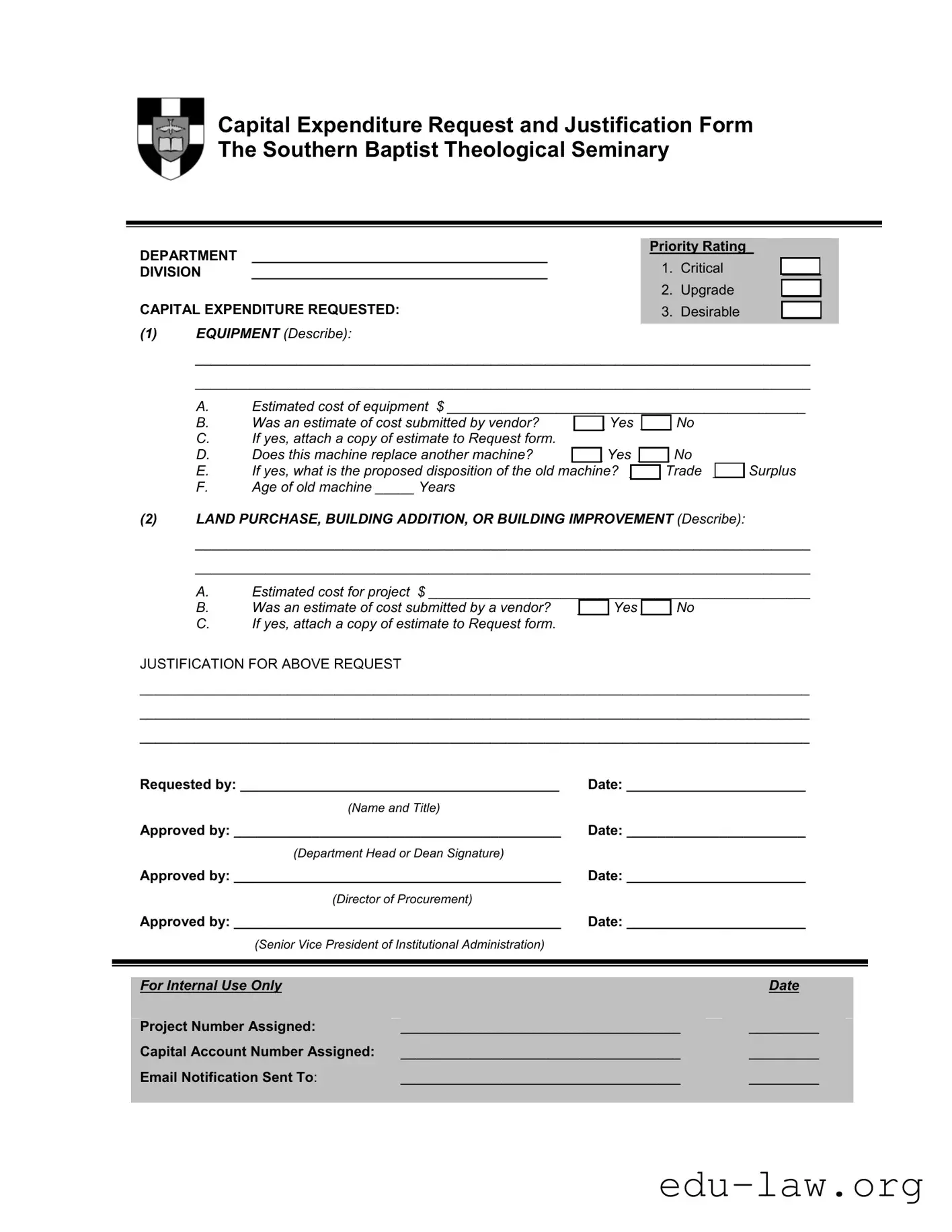
The Capital Expenditure Request and Justification Form serves as a crucial tool for departments at the Southern Baptist Theological Seminary to articulate their financial needs for significant investments. This form is designed to streamline the process of requesting funds for essential equipment, land purchases, building additions, or improvements. Each request must include detailed descriptions of the proposed capital expenditure, along with an estimated cost breakdown. Departments are required to indicate whether the requested equipment replaces existing machinery and to provide justification for the expenditure, emphasizing its importance in maintaining or enhancing operational efficiency. A priority rating system categorizes requests into critical, upgrade, or desirable, ensuring that the most urgent needs are addressed first. Furthermore, the form mandates that estimates from vendors accompany requests for transparency and accuracy in budgeting. Proper routing and approval processes are outlined, ensuring that all requests are vetted and authorized by relevant department heads and procurement officials. By adhering to this structured approach, departments can effectively plan for future capital needs, ultimately contributing to the institution's overall mission and operational success.

CapiTal Expenditure Request and Justification Form The Southern Baptist Theological Seminary
DEPARTMENT |
______________________________________ |
|
Priority Rating_ |
|
|
|
1. |
Critical |
|
||
DIVISION |
______________________________________ |
|
|
||
|
2. |
Upgrade |
|
||
|
|
|
|
||
CAPITAL EXPENDITURE REQUESTED: |
|
3. |
Desirable |
|
|
|
|
|
|
|
|
(1)EQUIPMENT (Describe):
_____
_____
_____
_______________________________________________________________________________
_______________________________________________________________________________
A.Estimated cost of equipment $ ______________________________________________
B. |
Was an estimate of cost submitted by vendor? |
____ |
Yes |
____ |
No |
C.If yes, attach a copy of estimate to Request form.
D. |
Does this machine replace another machine? |
____ |
|
Yes |
____ |
No |
|
|
||
E. |
If yes, what is the proposed disposition of the old machine? |
____ |
Trade |
____ |
Surplus |
|||||
F.Age of old machine _____ Years
(2)LAND PURCHASE, BUILDING ADDITION, OR BUILDING IMPROVEMENT (Describe):
_______________________________________________________________________________
_______________________________________________________________________________
A.Estimated cost for project $ _________________________________________________
B. |
Was an estimate of cost submitted by a vendor? |
____ |
|
Yes |
____ |
No |
C.If yes, attach a copy of estimate to Request form.
JUSTIFICATION FOR ABOVE REQUEST
______________________________________________________________________________________
______________________________________________________________________________________
______________________________________________________________________________________
|
|
Requested by: _________________________________________ |
Date: _______________________ |
|
|||||||
|
|
|
|
(Name and Title) |
|
|
|
|
|
||
|
|
Approved by: __________________________________________ |
Date: _______________________ |
|
|||||||
|
|
|
(Department Head or Dean Signature) |
|
|
|
|
|
|||
|
|
Approved by: __________________________________________ |
Date: _______________________ |
|
|||||||
|
|
|
|
(Director of Procurement) |
|
|
|
|
|
||
|
|
Approved by: __________________________________________ |
Date: _______________________ |
|
|||||||
|
|
(Senior Vice President of Institutional Administration) |
|
|
|
|
|
||||
|
|
|
|
|
|
|
|
|
|
|
|
|
|
|
|
|
|
|
|
|
|
|
|
|
|
|
|
|
|
|
|
|
|
|
|
|
|
For Internal Use Only |
|
|
|
|
|
|
Date |
|
|
|
|
Project Number Assigned: |
|
____________________________________ |
|
_________ |
|
|
|||
|
|
|
|
|
|
||||||
|
|
|
|
|
|
|
|
|
|
|
|
|
|
Capital Account Number Assigned: |
|
____________________________________ |
|
_________ |
|
|
|||
|
|
Email Notification Sent To: |
|
|
____________________________________ |
|
_________ |
|
|
||
|
|
|
|
|
|
|
|
|
|
|
|
Instructions: Capital Expenditure Request and
Justification Form
DEPARTMENT |
Name of the specific department making the request. |
DIVISION |
Name of department’s organizational location: |
|
Academic Administration |
|
Institutional Administration |
|
Institutional Relations |
IMPORTANT! |
Budget Managers are expected to anticipate needs for their departments prior to the |
|
annual budget approval process. Future capital needs should be planned for and |
|
incorporated during the annual budget request. |
|
|
PRIORITY 1: |
CRITICAL – Required to prevent a critical reduction in service, operating efficiency, |
|
economy, and/or safety; to protect valuable property; and/or comply with insurance |
|
or code requirements. |
PRIORITY 2: |
UPGRADE – Required for significant upgrade in service, operating efficiency, |
|
economy and/or safety of current operations. |
PRIORITY 3: |
DESIRABLE – Required to introduce desirable, but optional new service, program, |
|
faculty or staff, or to make small improvements in operating efficiency, economy |
|
and/or safety. |
|
|
“CAPITAL EXPENDITURE REQUESTED” EXPLANATION
(1)How is equipment defined?
Any item(s) not affixed to a building or land. Includes computer items, vehicles, furniture, etc.
A.Estimated cost for project
Total cost of acquiring and placing the equipment in service, including shipping, installation, consulting, training and other direct costs.
B.Was an estimate of cost submitted by a vendor?
Although helpful, quotes are not required as a part of the request for capital expenditure process. If the request is approved, the following schedule should be adhered to for securing quotes.
$2,500 or above requires three (3) quotes
$10,000+ requires the RFP process
E.What is the proposed disposition of the old machine?
If the old equipment is traded in to receive a lower price on the purchase of new equipment check "Trade" box. If not check "Surplus" box and contact Central Stores for removal.
(2)Land Purchase, Building Addition, or Major Improvement
Includes any new independent, habitable structures, additions or renovations of existing habitable structures, and furnishings and equipment which are permanently affixed to a habitable structure.
A.Estimated cost for project
Include shipping, installation, consulting and all other costs directly associated with acquiring the improvement and placing it in service.
B.Was an estimate of cost submitted by a vendor? See explanation on (1) Equipment.
Routing and approval process: Send request, signed by department budget manager, along with any
explanatory attachments to: Office of Procurement Sampey Hall, Room 4103
| Fact Name | Description |
|---|---|
| Purpose | The Capital Expenditure Request and Justification Form is designed to request funding for significant purchases or improvements that enhance operational efficiency or safety. |
| Priority Ratings | The form includes priority ratings: Critical (1), Upgrade (2), and Desirable (3), guiding decision-makers on the urgency and necessity of the request. |
| Cost Estimates | Applicants must provide an estimated cost for the requested equipment or project, and if available, attach vendor quotes to support the request. |
| Disposition of Old Equipment | If the request involves replacing existing equipment, the applicant must indicate how the old machine will be disposed of, either by trade-in or surplus. |
| Routing Process | Once completed, the form should be submitted to the Office of Procurement for review, requiring signatures from the department budget manager and other relevant authorities. |
Filling out the Capital Expenditure Request and Justification Form is a crucial step in securing funding for necessary projects. After completing the form, it will be submitted for review and approval by the relevant authorities within your organization. Following the steps below will ensure that your request is thorough and clear.
Once the form is completed and signed, submit it to the Office of Procurement at Sampey Hall, Room 4103, along with any necessary attachments. This process helps ensure that all capital needs are properly evaluated and approved in a timely manner.
What is the purpose of the Capex form?
The Capex form is designed to request and justify capital expenditures within the Southern Baptist Theological Seminary. It helps departments plan for significant purchases or improvements, ensuring that these requests align with budgetary needs and priorities. This form allows for a structured approach to acquiring equipment, land, or building improvements necessary for the institution's operations.
What types of expenditures can be requested using the Capex form?
Expenditures can include equipment purchases, land acquisitions, building additions, or improvements. Equipment refers to items that are not permanently attached to a building, such as computers or furniture. Land and building-related requests encompass new structures, renovations, and any permanently affixed furnishings or equipment.
How do I determine the priority rating for my request?
The priority rating is categorized into three levels: Critical, Upgrade, and Desirable. A Critical rating indicates the need to prevent a significant reduction in service or safety. An Upgrade is necessary for substantial improvements in efficiency or safety. A Desirable rating is for optional enhancements that are not urgent but would improve operations. Assess your department's needs carefully to select the appropriate priority level.
Is it mandatory to include vendor estimates with my request?
While including vendor estimates is helpful, it is not required at the time of submission. If the request is approved, you will need to follow specific guidelines for obtaining quotes based on the total cost. For expenditures over $2,500, three quotes are required, and for those over $10,000, a Request for Proposal (RFP) process must be initiated.
What happens to old equipment when new equipment is purchased?
When new equipment is purchased, you must indicate the proposed disposition of the old equipment. If you plan to trade it in for a lower price on the new purchase, select the "Trade" option. If you do not intend to trade it, select "Surplus" and contact Central Stores for proper removal of the old equipment.
Who needs to approve the Capex form before submission?
The Capex form must be signed by the department budget manager, the department head or dean, the director of procurement, and the senior vice president of institutional administration. This approval process ensures that all expenditures are reviewed and authorized at multiple levels before they are submitted to the Office of Procurement.
Incomplete Department Information: Failing to provide the name of the specific department making the request can delay processing.
Missing Priority Rating: Not selecting a priority rating can lead to confusion about the urgency of the request.
Insufficient Equipment Description: Providing vague descriptions of the requested equipment can hinder the approval process.
Neglecting Cost Estimates: Omitting estimated costs or not attaching vendor estimates can result in rejection of the request.
Failure to Indicate Replacement: Not specifying whether the new machine replaces an old one may complicate the review process.
Omitting Justification: Leaving the justification section blank can lead to questions about the necessity of the expenditure.
Not Following Submission Guidelines: Ignoring the routing and approval process can cause delays in getting the request reviewed.
When submitting a Capital Expenditure (Capex) request, several other forms and documents may be required to support the process. Each document plays a crucial role in ensuring that the request is clear and justified. Below is a list of commonly used documents along with brief descriptions of their purposes.
These documents, when used alongside the Capex form, create a comprehensive submission that supports informed decision-making. Proper documentation is essential for justifying capital expenditures and ensuring that resources are allocated effectively.
The Capital Expenditure (Capex) form shares similarities with a budget proposal document. Both documents require detailed descriptions of the requested items or projects, including estimated costs and justifications for the expenditure. Budget proposals typically outline the financial needs of a department for a specific period, while the Capex form focuses on long-term investments in capital assets. Each document aims to ensure that funds are allocated effectively and that there is a clear rationale for the requested expenditures.
Another document comparable to the Capex form is a grant application. Like the Capex form, a grant application seeks funding for specific projects or needs, requiring a thorough justification of the request. Both documents necessitate an explanation of how the funds will be used and the expected outcomes. However, grant applications often involve external funding sources, whereas the Capex form typically pertains to internal budget allocations within an organization.
The project proposal document is also similar to the Capex form. Both require a clear outline of the project, including objectives, timelines, and cost estimates. In a project proposal, the emphasis may be on the project's overall goals and benefits, while the Capex form focuses specifically on the financial aspects and justification for capital expenditures. Both documents serve to communicate the need for resources and the anticipated impact of the requested funding.
A procurement request form shares characteristics with the Capex form as well. Both documents involve requests for the acquisition of goods or services, and they require details about the items being requested, including costs and vendor information. While the procurement request form may be used for more routine purchases, the Capex form is specifically designed for significant investments in capital assets, highlighting the need for detailed justification and approval processes.
Additionally, a feasibility study can be compared to the Capex form. Both documents aim to assess the viability of a proposed project or investment. A feasibility study typically evaluates various factors, such as financial, technical, and operational considerations, to determine whether a project should proceed. In contrast, the Capex form focuses on requesting funding for projects that have already been deemed necessary, providing a more straightforward justification for expenditure.
Lastly, a strategic plan may also resemble the Capex form in that both documents involve long-term planning and resource allocation. A strategic plan outlines an organization’s goals and the steps needed to achieve them, including financial investments. The Capex form, while more specific in its focus on capital expenditures, fits within the broader context of an organization’s strategic objectives, ensuring that capital investments align with overall goals and priorities.
When filling out the Capital Expenditure Request and Justification Form, it is important to adhere to certain guidelines to ensure clarity and compliance. Below is a list of things to do and avoid during the process.
Misconceptions about the Capital Expenditure (Capex) form can lead to confusion and inefficiencies in the request process. Here are nine common misconceptions:
Understanding these misconceptions can help streamline the Capex request process and ensure that necessary expenditures are addressed effectively.
When filling out the Capital Expenditure Request and Justification Form, keep the following key points in mind:
By following these guidelines, you can effectively navigate the Capital Expenditure Request process, ensuring that your needs are clearly communicated and appropriately prioritized.