In the competitive landscape of government contracting, a well-crafted Capability Statement is essential for any business seeking to establish credibility and showcase its strengths. This document serves as a powerful marketing tool that highlights your company’s core competencies, past performance, and unique differentiators, all tailored to meet the specific needs of potential clients. A strong Capability Statement starts with a clear presentation of your logo and contact information, ensuring that decision-makers can easily reach you. Following this, a concise introduction connects your core competencies directly to the agency's mission, supported by keyword-rich bullet points that enhance visibility. Past performance is another critical element; listing relevant projects and clients not only demonstrates your experience but also builds trust. Additionally, identifying what sets your company apart from competitors can significantly influence a potential client's decision. Finally, including essential company data and pertinent codes ensures that your business is recognized and compliant with federal requirements. The urgency of crafting a compelling Capability Statement cannot be overstated, as it is often the first impression you make on potential government partners. Tailoring each statement to the specific agency or opportunity is crucial for standing out in a crowded field.
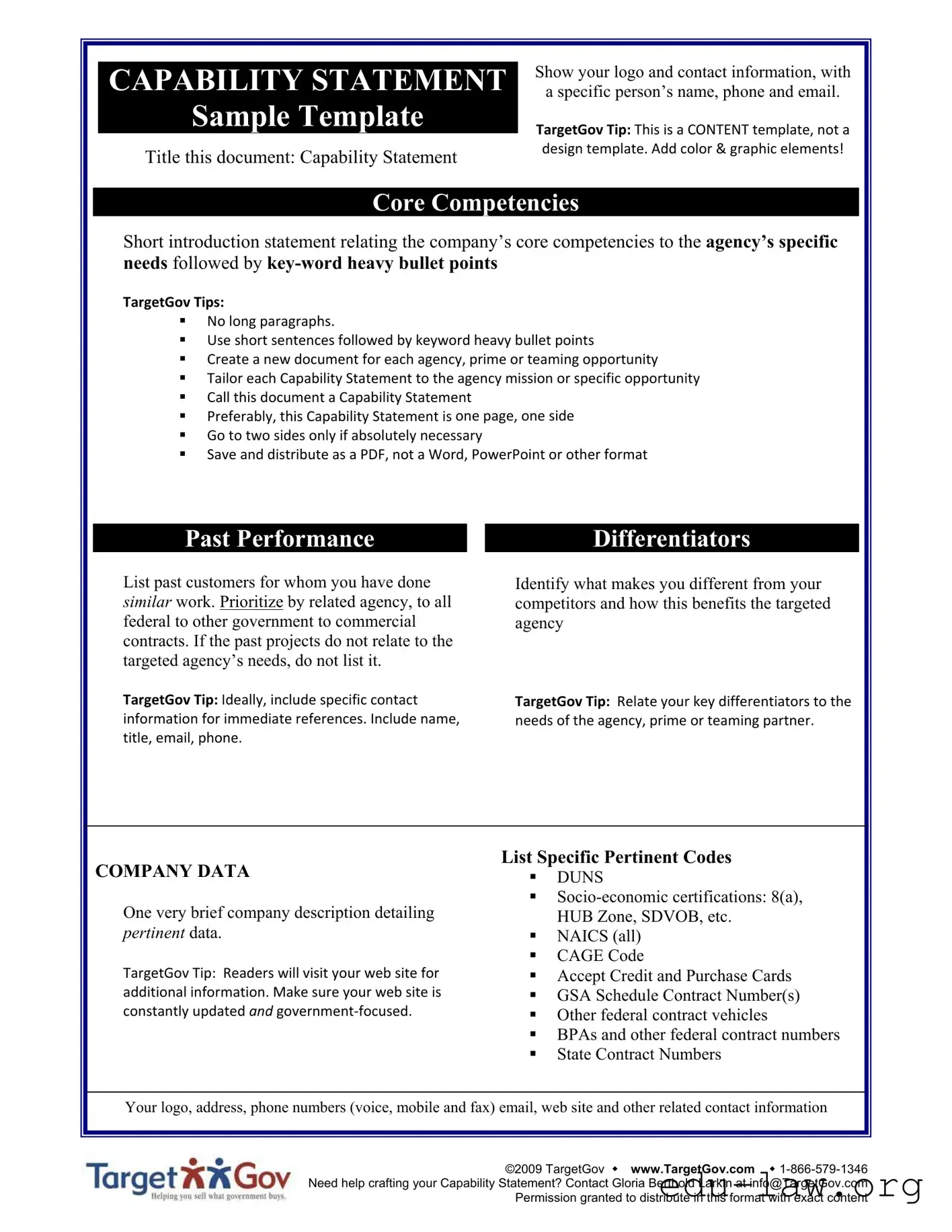
CAPABILITY STATEMENT
Sample Template
Title this document: Capability Statement
Show your logo and contact information, with a specific person’s name, phone and email.
TargetGov Tip: This is a CONTENT template, not a design template. Add color & graphic elements!
Core Competencies
Short introduction statement relating the company’s core competencies to the agency’s specific needs followed by
TargetGov Tips:
No long paragraphs.
Use short sentences followed by keyword heavy bullet points
Create a new document for each agency, prime or teaming opportunity
Tailor each Capability Statement to the agency mission or specific opportunity
Call this document a Capability Statement
Preferably, this Capability Statement is one page, one side
Go to two sides only if absolutely necessary
Save and distribute as a PDF, not a Word, PowerPoint or other format
Past Performance
List past customers for whom you have done similar work. Prioritize by related agency, to all federal to other government to commercial contracts. If the past projects do not relate to the targeted agency’s needs, do not list it.
TargetGov Tip: Ideally, include specific contact information for immediate references. Include name, title, email, phone.
Differentiators
Identify what makes you different from your competitors and how this benefits the targeted agency
TargetGov Tip: Relate your key differentiators to the needs of the agency, prime or teaming partner.
COMPANY DATA
One very brief company description detailing pertinent data.
TargetGov Tip: Readers will visit your web site for additional information. Make sure your web site is constantly updated AND government‐focused.
List Specific Pertinent Codes
DUNS
NAICS (all)
CAGE Code
Accept Credit and Purchase Cards
GSA Schedule Contract Number(s)
Other federal contract vehicles
BPAs and other federal contract numbers
State Contract Numbers
Your logo, address, phone numbers (voice, mobile and fax) email, web site and other related contact information
©2009 TargetGov www.TargetGov.com
| Fact Name | Description |
|---|---|
| Purpose | The Capability Statement serves as a marketing tool for businesses to showcase their core competencies, past performance, and differentiators to potential clients, particularly in government contracting. |
| Format | It is recommended that the Capability Statement be a one-page document, ideally saved and distributed as a PDF. This format ensures accessibility and professionalism. |
| Customization | Each Capability Statement should be tailored to the specific agency or opportunity. This customization enhances relevance and increases the chances of engagement. |
| State-Specific Forms | For state-specific Capability Statements, consult the relevant state procurement laws and regulations, which may vary by state. |
Completing the Capability Statement form requires careful attention to detail and a clear understanding of your business's strengths and offerings. This document serves as a vital marketing tool to showcase your company's capabilities to potential clients, particularly in government contracting. Follow these steps to ensure your Capability Statement is effective and tailored to the specific needs of the agency you are targeting.
After completing these steps, review the document for clarity and conciseness. Aim to keep the Capability Statement to one page, ensuring that it is visually appealing and easy to read. Save the final version as a PDF for distribution, as this format maintains the integrity of your design and layout.
What is a Capability Statement and why is it important?
A Capability Statement is a concise document that outlines a company's core competencies, past performance, differentiators, and essential company data. It serves as a marketing tool to communicate your business's strengths to potential clients, particularly in government contracting. By tailoring the Capability Statement to align with the specific needs of an agency, you increase your chances of securing contracts. This document is crucial for establishing credibility and showcasing your qualifications in a competitive landscape.
What should be included in a Capability Statement?
Your Capability Statement should include several key components: a clear introduction that relates your core competencies to the agency's needs, a list of past performance with relevant clients, and a section highlighting what differentiates you from competitors. Additionally, include company data such as DUNS, NAICS codes, and socio-economic certifications. It's essential to keep the document to one page, focusing on clarity and relevance to the targeted agency.
How can I tailor my Capability Statement for different opportunities?
To effectively tailor your Capability Statement, create a new document for each agency or opportunity. Begin by researching the agency's mission and specific needs. Then, adjust your core competencies and differentiators to match those requirements. Use keyword-heavy bullet points for clarity and impact. This targeted approach demonstrates your understanding of the agency's goals and positions you as a suitable partner for their needs.
What are the best practices for formatting and distributing my Capability Statement?
Your Capability Statement should ideally be formatted as a one-page PDF for easy distribution. Avoid lengthy paragraphs; instead, use short sentences and bullet points for quick readability. Incorporate your logo and contact information prominently. When distributing, ensure that the document is saved in a PDF format rather than Word or PowerPoint. This ensures that the formatting remains intact and professional when viewed by potential clients.
Neglecting to Tailor the Document: Many people use a generic Capability Statement for multiple agencies. Each agency has unique needs, and failing to customize the statement can lead to missed opportunities.
Overloading with Text: Long paragraphs and excessive details can overwhelm the reader. Instead, focus on short sentences and keyword-heavy bullet points to convey information effectively.
Ignoring Past Performance Relevance: Listing past projects that do not relate to the targeted agency’s needs is a common mistake. Only include relevant experiences to demonstrate capability.
Omitting Contact Information: Some individuals forget to include specific contact details for references. Providing names, titles, emails, and phone numbers enhances credibility and accessibility.
Failing to Highlight Differentiators: It's crucial to identify what sets your company apart from competitors. Clearly articulate these differentiators and relate them to the agency's needs.
Using the Wrong Format: Submitting the Capability Statement in formats like Word or PowerPoint can lead to issues. Always save and distribute the document as a PDF to ensure consistency and professionalism.
Neglecting Company Data: A brief company description is essential. Ensure it includes pertinent information, and remember that readers may visit your website for more details, so keep it updated and focused on government work.
A Capability Statement is a crucial document for businesses seeking government contracts. It outlines a company's qualifications, core competencies, and past performance. However, several other forms and documents complement this statement, enhancing a company's credibility and appeal. Below is a list of these essential documents, each serving a unique purpose.
Utilizing these documents alongside a Capability Statement can significantly enhance a company's chances of winning government contracts. Each document plays a role in presenting a comprehensive picture of the business's qualifications and readiness to meet client needs.
The Capability Statement is often compared to a résumé, as both documents serve to showcase an individual or organization's qualifications and experiences. Just as a résumé highlights work history, skills, and achievements to potential employers, a Capability Statement outlines a company’s core competencies, past performance, and differentiators to prospective clients or partners. Both documents are tailored to specific audiences, emphasizing relevant information that aligns with the needs and expectations of the recipient.
Another similar document is the business proposal. Business proposals are crafted to present a detailed plan for a specific project or service, often including pricing, timelines, and methodologies. Like a Capability Statement, a proposal must be tailored to the client’s requirements and demonstrate how the company can meet their needs. While a Capability Statement provides a high-level overview, a business proposal delves deeper into the specifics of how a company intends to deliver its services.
The executive summary shares similarities with the Capability Statement as well. An executive summary condenses a larger report or plan into a brief overview, highlighting key points and recommendations. Both documents aim to grab the reader's attention and provide essential information quickly. They are typically used in professional contexts to summarize qualifications or project proposals for decision-makers who may not have time to read lengthy documents.
A marketing brochure also resembles a Capability Statement in its purpose to inform and persuade. Brochures typically contain engaging visuals and concise text that highlight a company’s offerings. While a Capability Statement is more focused on qualifications and past performance, both documents aim to attract interest and encourage further engagement from potential clients or partners.
Similarly, a pitch deck serves as a visual presentation that outlines a business's value proposition, market potential, and competitive advantages. Like the Capability Statement, a pitch deck is designed to communicate essential information in a clear and compelling manner. Both documents are often used in meetings or presentations to persuade stakeholders of a company's worth and capabilities.
Another related document is the Statement of Work (SOW). An SOW outlines the specific tasks, deliverables, and timelines for a project. While the Capability Statement provides a broader view of a company’s capabilities and past performance, the SOW focuses on the particulars of how those capabilities will be applied in a specific context. Both documents are essential in establishing credibility and clarity in business relationships.
Finally, the letter of intent (LOI) shares some characteristics with the Capability Statement. An LOI expresses a party's intention to enter into a formal agreement or partnership. It often outlines the qualifications and interests of the party, similar to how a Capability Statement presents a company’s strengths and past experiences. Both documents aim to establish a foundation for future collaboration and demonstrate commitment to a potential partnership.
When filling out the Capability Statement form, it is essential to adhere to certain guidelines to ensure clarity and effectiveness. Below are five things you should do, along with five things you should avoid.
Understanding the Capability Statement form is crucial for businesses looking to engage with government agencies. However, several misconceptions can lead to ineffective submissions. Here’s a list of common misunderstandings:
By addressing these misconceptions, businesses can create more effective Capability Statements that resonate with government agencies and enhance their chances of securing contracts.
Creating an effective Capability Statement is essential for businesses looking to engage with government agencies. Here are some key takeaways to consider when filling out and using this important form:
By following these guidelines, businesses can create a compelling Capability Statement that effectively communicates their qualifications and readiness to meet the needs of government agencies.