In California, managing the estate of a deceased loved one can often feel overwhelming, particularly when it comes to navigating the legal requirements. The California Small Estate Affidavit serves as a valuable tool for heirs and beneficiaries when the total value of the estate is relatively modest. This form allows individuals to bypass the lengthy and often costly probate process, streamlining the transfer of assets. With a few key stipulations, such as a maximum value of $166,250 for the estate, the Small Estate Affidavit simplifies the process for those who qualify. It enables heirs to collect property directly from financial institutions or other entities without the need for court intervention. Additionally, the form requires specific information, including the decedent's details, the names of the heirs, and a declaration affirming that no other claims exist against the estate. By understanding how to properly utilize this affidavit, individuals can ensure a smoother transition during a challenging time, allowing them to focus on honoring their loved ones rather than getting bogged down in legal complexities.
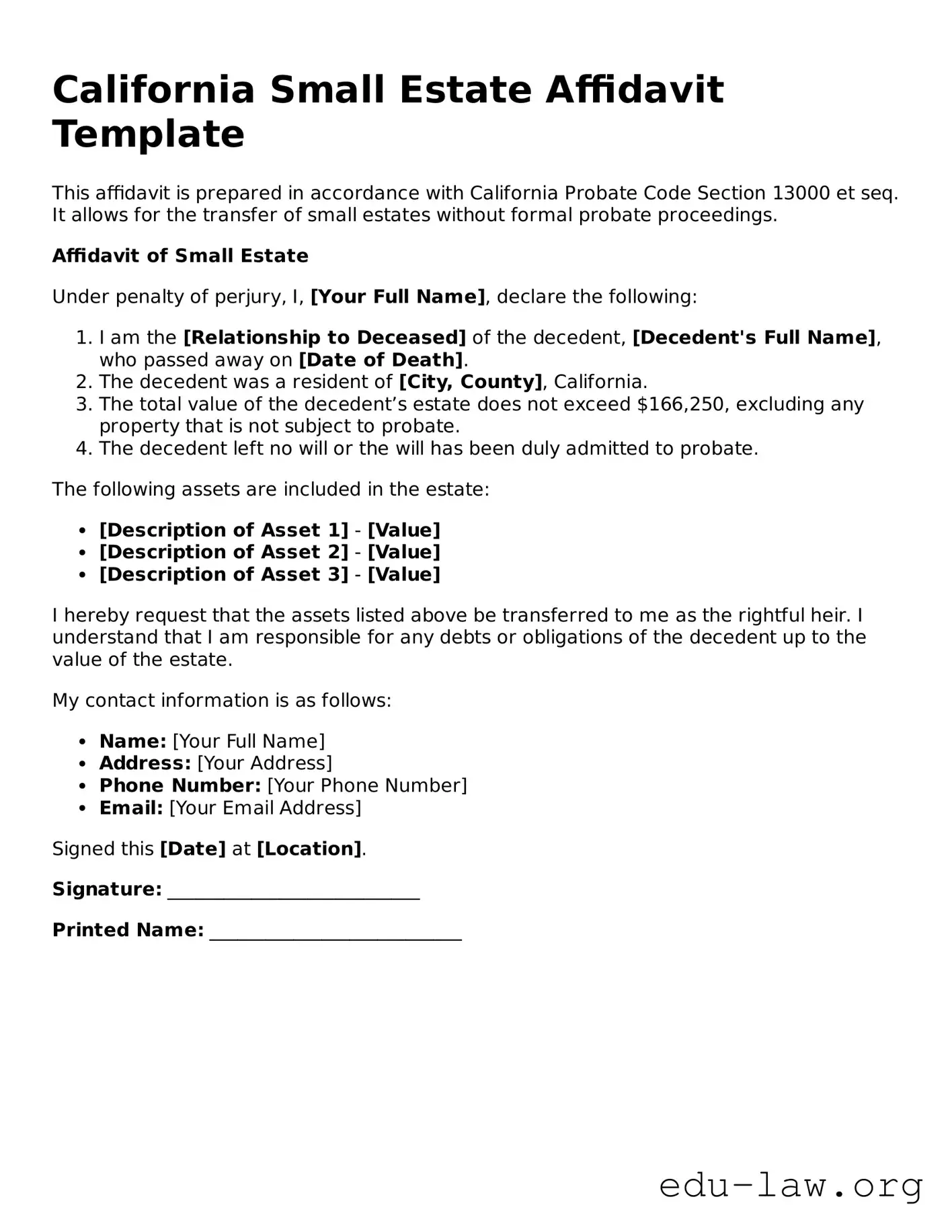
California Small Estate Affidavit Template
This affidavit is prepared in accordance with California Probate Code Section 13000 et seq. It allows for the transfer of small estates without formal probate proceedings.
Affidavit of Small Estate
Under penalty of perjury, I, [Your Full Name], declare the following:
The following assets are included in the estate:
I hereby request that the assets listed above be transferred to me as the rightful heir. I understand that I am responsible for any debts or obligations of the decedent up to the value of the estate.
My contact information is as follows:
Signed this [Date] at [Location].
Signature: ___________________________
Printed Name: ___________________________
| Fact Name | Description |
|---|---|
| Eligibility | The California Small Estate Affidavit can be used when the total value of the decedent's estate is $166,250 or less, excluding certain assets. |
| Governing Law | The form is governed by California Probate Code Section 13000 et seq. |
| Filing Requirements | To file the affidavit, the person claiming the estate must complete the form and present it to the financial institutions or property holders. |
| Timeframe | The affidavit must be filed within 40 days of the decedent's death, ensuring timely access to the estate's assets. |
| Limitations | Real property cannot be transferred using a Small Estate Affidavit; a different process is required for real estate transactions. |
Once you have the California Small Estate Affidavit form ready, it’s time to fill it out accurately. This form helps you manage the assets of someone who has passed away without a will, as long as the estate is below a certain value. Follow these steps to complete the form correctly.
After completing these steps, ensure you keep copies of everything for your records. You may also want to follow up with the court to confirm that your affidavit has been processed.
What is a California Small Estate Affidavit?
The California Small Estate Affidavit is a legal document that allows individuals to transfer property from a deceased person's estate without going through the formal probate process. This form simplifies the transfer of assets for estates valued at $166,250 or less, making it easier for heirs to access their inheritance quickly.
Who is eligible to use the Small Estate Affidavit?
To use the Small Estate Affidavit, you must be an heir or a beneficiary of the deceased's estate. Additionally, the total value of the estate's assets must not exceed $166,250. The assets can include cash, real estate, vehicles, and personal property, but certain assets may be excluded from this total.
What assets are included in the Small Estate Affidavit?
Assets that can be included in the Small Estate Affidavit are those that the deceased owned solely in their name. This may consist of bank accounts, vehicles, and personal belongings. However, assets held in joint tenancy or those with designated beneficiaries, like life insurance policies, do not count toward the $166,250 limit.
How do I complete the Small Estate Affidavit?
To complete the Small Estate Affidavit, you need to fill out the form with accurate information about the deceased and the assets involved. You must provide details such as the deceased's name, date of death, and a list of assets. It is essential to sign the affidavit under penalty of perjury, affirming that the information provided is true and correct.
Do I need to file the Small Estate Affidavit with the court?
No, the Small Estate Affidavit does not need to be filed with the court. Instead, you present the completed affidavit to the financial institutions or entities holding the deceased's assets. They will use the affidavit to transfer the assets to you or the other heirs.
Is there a waiting period before I can use the Small Estate Affidavit?
Yes, there is a waiting period. You must wait at least 40 days after the deceased's date of death before you can use the Small Estate Affidavit. This waiting period allows time for any debts or claims against the estate to be settled.
What if the deceased had debts?
If the deceased had debts, the Small Estate Affidavit can still be used, but it is important to address those debts first. The estate's assets must be used to pay off any outstanding debts before distributing any remaining assets to heirs. The affidavit does not protect heirs from the deceased's debts.
Can I use the Small Estate Affidavit for real property?
Yes, you can use the Small Estate Affidavit to transfer real property, such as a house or land, as long as the total value of the estate does not exceed $166,250. However, specific procedures may apply to transferring real estate, so it's advisable to check local regulations or seek guidance if needed.
What happens if the estate exceeds the $166,250 limit?
If the estate exceeds the $166,250 limit, you cannot use the Small Estate Affidavit. Instead, the estate will need to go through the formal probate process. This process can be more time-consuming and may require legal assistance to navigate the complexities involved.
Where can I obtain a Small Estate Affidavit form?
You can obtain a California Small Estate Affidavit form from various sources. Many county court websites offer downloadable versions of the form. Additionally, legal stationery stores may carry printed copies. Ensure you have the most current version of the form to avoid any issues during the process.
Missing Information: One of the most common mistakes is leaving out crucial details. The form requires specific information about the deceased, including their full name, date of death, and a description of the property. Omitting any of these can delay the process.
Incorrect Value Assessment: People often miscalculate the total value of the estate. Remember, California has a limit for small estates, which is currently set at $166,250. Failing to accurately assess the total value can lead to complications.
Not Including All Assets: It’s easy to overlook certain assets. Ensure that all property, bank accounts, and other valuables are accounted for. Even a small asset can affect eligibility for the small estate process.
Improper Signatures: The affidavit must be signed by the rightful heir or executor. Sometimes, individuals forget to sign or have the wrong person sign. This mistake can render the document invalid.
Failure to Notarize: In California, the Small Estate Affidavit must be notarized. Some people neglect this step, thinking it’s unnecessary. Without a notary's seal, the affidavit may not be accepted.
Ignoring Local Regulations: Each county may have its own requirements for filing. Not checking local regulations can lead to additional hurdles. Always verify that you’re following the correct procedures for your specific area.
The California Small Estate Affidavit is a valuable tool for individuals dealing with the estate of a deceased person. It allows heirs to claim property without going through a lengthy probate process, provided certain conditions are met. Along with this affidavit, several other forms and documents may be necessary to ensure a smooth process. Below is a list of commonly used documents that often accompany the Small Estate Affidavit.
Understanding these accompanying documents can simplify the process of settling a small estate in California. Each document plays a crucial role in ensuring that the estate is handled correctly and efficiently, allowing heirs to receive their rightful inheritance without unnecessary delays.
The California Small Estate Affidavit is similar to the Affidavit of Heirship. This document is used to establish the heirs of a deceased person when there is no will. It serves as proof of the relationship between the deceased and the heirs, allowing them to claim property without going through probate. Both documents aim to simplify the transfer of assets, but the Affidavit of Heirship is specifically focused on identifying heirs rather than detailing the estate's value.
Another document that resembles the Small Estate Affidavit is the Petition for Probate. While the Small Estate Affidavit is used for estates below a certain value, the Petition for Probate is necessary for larger estates. This formal request is filed with the court to initiate the probate process. Both documents facilitate the transfer of assets, but the Petition for Probate involves more legal oversight and court involvement.
The Transfer on Death Deed (TODD) is also similar in its purpose to the Small Estate Affidavit. A TODD allows individuals to transfer real estate to beneficiaries upon their death without going through probate. Like the Small Estate Affidavit, it streamlines the process of asset transfer. However, the TODD is specifically designed for real property, while the Small Estate Affidavit can cover various types of assets.
The Will is another document that shares similarities with the Small Estate Affidavit. A will outlines how a person's assets should be distributed after their death. While a Small Estate Affidavit is used when the estate is small and does not require probate, a will typically necessitates the probate process. Both documents reflect the deceased's intentions regarding their assets, but they differ in terms of complexity and legal requirements.
The Affidavit for Collection of Personal Property is also akin to the Small Estate Affidavit. This document allows a person to collect personal property from a deceased individual’s estate without going through probate. It is often used when the deceased's assets are limited to personal items. Both affidavits provide a way to access assets quickly, but the Affidavit for Collection is more focused on personal property rather than the overall estate.
Another related document is the Small Estate Affidavit for Real Property. This form is specifically designed for transferring real estate under a small estate threshold. It functions similarly to the general Small Estate Affidavit but is tailored for real property transactions. Both documents help simplify the process of transferring ownership, but the latter is specifically for real estate matters.
Lastly, the Declaration of Trust can be compared to the Small Estate Affidavit. A Declaration of Trust outlines how assets held in a trust should be managed and distributed. While the Small Estate Affidavit is used for estates without a trust, both documents serve to clarify asset distribution. However, a Declaration of Trust is typically more comprehensive and involves ongoing management of assets, unlike the one-time use of the Small Estate Affidavit.
When filling out the California Small Estate Affidavit form, it is important to follow specific guidelines to ensure accuracy and compliance. Here are nine things to consider:
Misconception 1: The Small Estate Affidavit can only be used for estates under $50,000.
Many people believe that the limit is strictly $50,000. However, the threshold can vary based on whether the estate includes real property or not. For estates without real property, the limit is $166,250 as of 2023.
Misconception 2: You need a lawyer to file a Small Estate Affidavit.
While legal assistance can be beneficial, it is not required. Individuals can complete and file the affidavit on their own, simplifying the process for many.
Misconception 3: The Small Estate Affidavit is the same as a will.
This form serves a different purpose. A will outlines how a person wishes to distribute their assets after death, while the Small Estate Affidavit allows for the transfer of assets without going through probate.
Misconception 4: All debts must be paid before using the Small Estate Affidavit.
While it’s important to address debts, the affidavit allows for the transfer of assets even if some debts remain unpaid. However, creditors may still have a claim against the estate.
Misconception 5: The Small Estate Affidavit can be used for any type of asset.
This form is limited to certain types of assets, primarily personal property. Real estate typically requires a different process.
Misconception 6: You must wait a certain period after death to file the Small Estate Affidavit.
There is no mandated waiting period. As soon as the individual has passed and the necessary conditions are met, the affidavit can be filed.
Misconception 7: The Small Estate Affidavit guarantees that assets will be transferred smoothly.
While it simplifies the process, complications can arise. Disputes among heirs or challenges from creditors may still occur, potentially delaying the transfer.
Filling out and using the California Small Estate Affidavit form can be a straightforward process, but it’s essential to understand the key aspects involved. Here are some important takeaways to keep in mind:
By understanding these key points, you can navigate the process with greater confidence and ease. Remember, you are not alone in this; support is available to help you through the process.