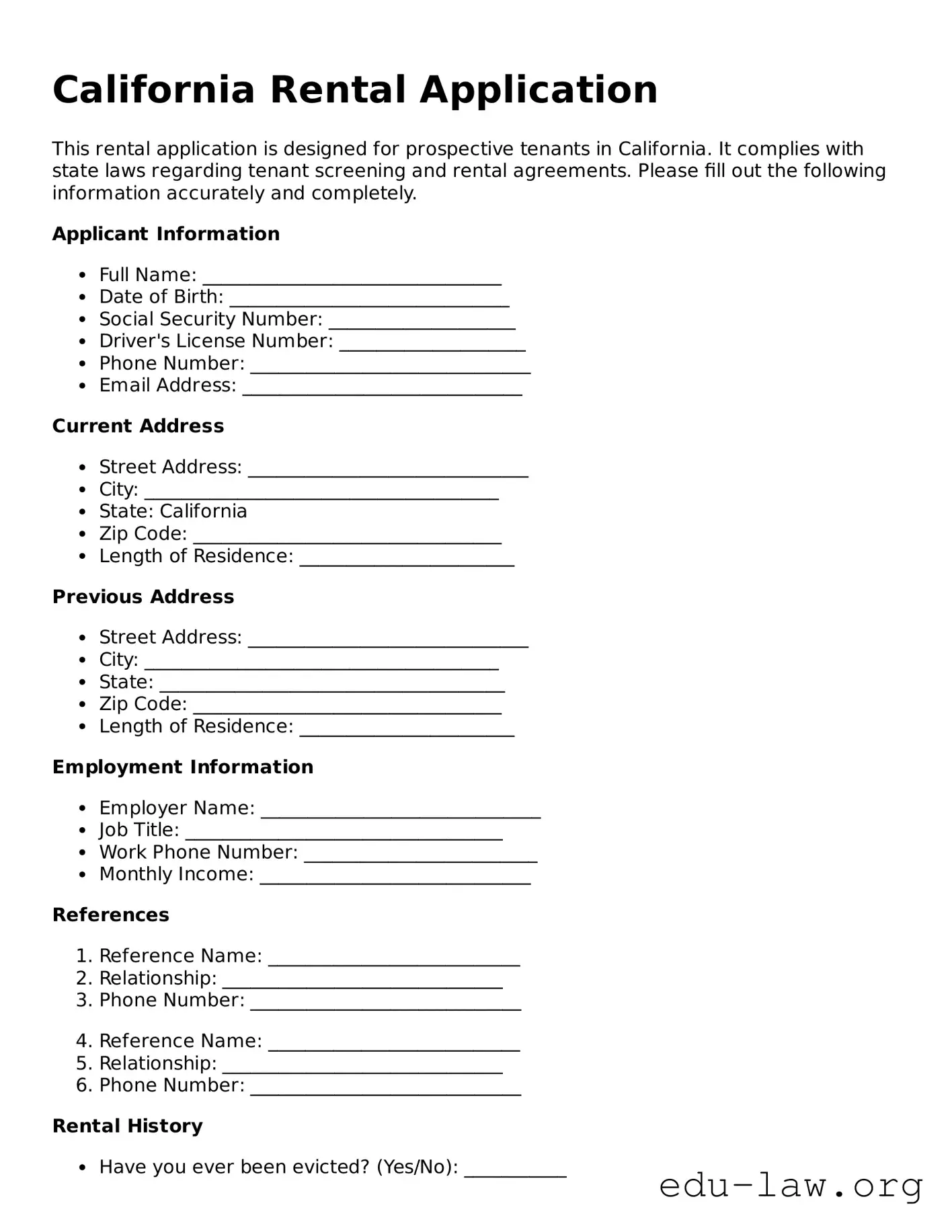
When searching for a rental property in California, the rental application form plays a crucial role in the process. This document not only helps landlords evaluate potential tenants but also ensures that applicants provide essential information for consideration. Key aspects of the form typically include personal details such as name, contact information, and Social Security number, which help verify identity. Additionally, applicants are often required to disclose their employment history and income, allowing landlords to assess financial stability. Rental history is another vital component, as it provides insight into an applicant's past behavior as a tenant. Furthermore, the form may include questions about pets, smoking habits, and references, giving landlords a clearer picture of who they might be renting to. Understanding these elements can make the application process smoother and more efficient for everyone involved.
California Rental Application
This rental application is designed for prospective tenants in California. It complies with state laws regarding tenant screening and rental agreements. Please fill out the following information accurately and completely.
Applicant Information
Current Address
Previous Address
Employment Information
References
Rental History
Consent
By signing below, you authorize the landlord to conduct a background check, including credit history, rental history, and employment verification.
Applicant Signature: _____________________________
Date: _________________________________________
| Fact Name | Description |
|---|---|
| Purpose | The California Rental Application form is used by landlords to screen potential tenants. |
| Information Required | Applicants typically provide personal details, rental history, and employment information. |
| Application Fee | Landlords can charge an application fee, but it must be reasonable and non-refundable. |
| Fair Housing Laws | The application process must comply with Fair Housing laws, prohibiting discrimination based on protected classes. |
| Credit Check | Landlords may conduct a credit check, but they must obtain the applicant's permission first. |
| Security Deposit | Information regarding the security deposit amount is usually included in the application. |
| Background Check | Landlords can perform background checks, but they must disclose this to the applicant. |
| Governing Laws | The application process is governed by California Civil Code Sections 1950.5 and 1942.5. |
| Signature Requirement | Applicants must sign the form, indicating that all information provided is accurate. |
After obtaining the California Rental Application form, you will need to provide accurate and complete information to ensure a smooth rental process. Follow these steps carefully to fill out the form correctly.
Once the form is completed, submit it to the landlord or property management for review. They will then process the application and inform you of the next steps in securing your rental agreement.
What is a California Rental Application form?
The California Rental Application form is a document that landlords use to collect information from potential tenants. This form typically includes personal details, rental history, employment information, and references. It helps landlords assess whether an applicant is suitable for renting their property.
What information do I need to provide on the application?
When filling out the application, you will generally need to provide your name, contact information, Social Security number, and date of birth. Additionally, you may need to include your employment details, income, rental history, and personal references. Some landlords may also request a credit check, so be prepared to authorize that as well.
Is there a fee for submitting a rental application?
Yes, many landlords charge a non-refundable application fee. This fee covers the cost of processing your application and conducting background checks. In California, the fee cannot exceed the cost of obtaining a credit report, plus any additional costs incurred by the landlord. It’s important to ask about the fee before submitting your application.
How long does it take to process a rental application?
The processing time for a rental application can vary. Typically, landlords may take anywhere from a few days to a week to review applications. Factors such as the number of applications received, the thoroughness of background checks, and the landlord's schedule can influence this timeline. It’s a good idea to follow up if you haven’t heard back within a week.
Can I be denied a rental application? What are the common reasons?
Yes, a rental application can be denied. Common reasons for denial include poor credit history, insufficient income to cover rent, a history of eviction, or negative references from previous landlords. Landlords must provide a reason for denial if you request it, especially if they are using information from a credit report.
What should I do if I am denied a rental application?
If you are denied a rental application, first ask the landlord for the specific reasons for the denial. You can also request a copy of any reports used in the decision. If you believe the denial was unjust, consider addressing any issues that led to the denial. This might involve improving your credit score or providing additional references. You may also seek legal advice if you suspect discrimination.
Incomplete Information: One of the most common mistakes is leaving sections blank. Every part of the application is important. Missing information can delay the approval process or even lead to rejection.
Inaccurate Details: Providing incorrect information, such as the wrong Social Security number or misspelled names, can cause significant issues. Always double-check your entries to ensure accuracy.
Failure to Disclose Rental History: Not listing all previous rental addresses or failing to mention past evictions can raise red flags. Honesty is crucial; landlords appreciate transparency.
Neglecting to Include References: Skipping the references section can weaken your application. Include reliable personal or professional references who can vouch for your character and reliability as a tenant.
Not Providing Proof of Income: Landlords often require proof of income to ensure you can afford the rent. Failing to attach pay stubs or bank statements can hinder your chances of approval.
Ignoring Application Fees: Many rental applications require a fee. Forgetting to include this payment can result in your application not being processed. Always check the requirements and submit the fee as instructed.
When applying for a rental property in California, several documents are commonly required alongside the California Rental Application form. These documents help landlords assess the applicant's suitability and financial stability. Below is a list of some of the essential forms and documents.
These documents play a crucial role in the rental application process, ensuring that landlords make informed decisions while protecting the interests of both parties. Having these forms ready can streamline the application process and enhance the likelihood of securing the desired rental property.
The California Rental Application form shares similarities with the standard lease agreement. Both documents require detailed personal information from the applicant, including their employment history and references. While the rental application focuses on assessing the applicant's suitability for tenancy, the lease agreement formalizes the terms of the rental arrangement once the application is approved. Together, they provide a comprehensive view of the rental relationship.
Another document that resembles the California Rental Application is the tenant screening report. This report typically includes credit history, rental history, and background checks. Landlords often use this report alongside the rental application to make informed decisions about potential tenants. Both documents aim to ensure that the landlord can trust the tenant to fulfill their obligations.
The rental history verification form is also similar to the California Rental Application. This document specifically requests information about a potential tenant's past rental experiences. It often requires previous landlords to confirm the applicant’s reliability and payment history. Like the rental application, it plays a crucial role in evaluating the applicant's suitability.
The employment verification letter is another document that aligns with the rental application. Landlords often request this letter to confirm an applicant’s income and job stability. By providing proof of employment, applicants can strengthen their rental application. Both documents work together to assure landlords of the applicant's financial capability.
The guarantor application form is closely related as well. This form is used when a tenant requires a co-signer to secure the lease. It collects similar information about the guarantor's financial status and creditworthiness. Both the rental application and guarantor application are essential for landlords to assess risk and ensure rent will be paid.
The credit application form is another document that parallels the California Rental Application. This form focuses specifically on the applicant's credit history and score. Landlords may request this document to evaluate financial responsibility. Both forms serve the purpose of determining whether an applicant is a good fit for the rental property.
The pet application form can also be compared to the rental application. This document is used when tenants wish to have pets in the rental property. It collects information about the pet's breed, size, and vaccination history. Like the rental application, it helps landlords assess whether the tenant will adhere to property rules and maintain a safe environment.
Lastly, the roommate agreement form is similar in that it outlines the responsibilities and expectations of multiple tenants living together. While the rental application focuses on individual applicants, the roommate agreement addresses the dynamics of shared living. Both documents are essential for establishing clear communication and understanding among all parties involved.
When filling out a California Rental Application, attention to detail is crucial. Here are ten important things to consider, divided into dos and don'ts.
Things You Should Do:
Things You Shouldn't Do:
By following these guidelines, you can increase your chances of a successful rental application in California.
Many people have misunderstandings about the California Rental Application form. Here are five common misconceptions, along with clarifications to help you navigate the process more effectively.
While many landlords request a social security number for credit checks, it is not mandatory. If you do not have one, you can provide alternative identification, such as a tax identification number.
In California, landlords are allowed to charge a reasonable application fee to cover the cost of background checks and processing. However, this fee must be disclosed upfront and cannot exceed a certain amount.
Submitting a rental application does not guarantee that you will be approved for the rental. Landlords will review applications and make decisions based on various factors, including credit history and income.
Each rental application can differ from one landlord to another. Some may ask for additional information or have specific requirements. Always read the application carefully before filling it out.
If you believe that incorrect information is affecting your application, you can address it with the landlord. Providing documentation or clarification can help resolve any discrepancies.
Understanding these misconceptions can help you approach the rental application process with confidence. Always communicate openly with landlords and ask questions if you are unsure about any part of the application.
When filling out and using the California Rental Application form, keep these key takeaways in mind: