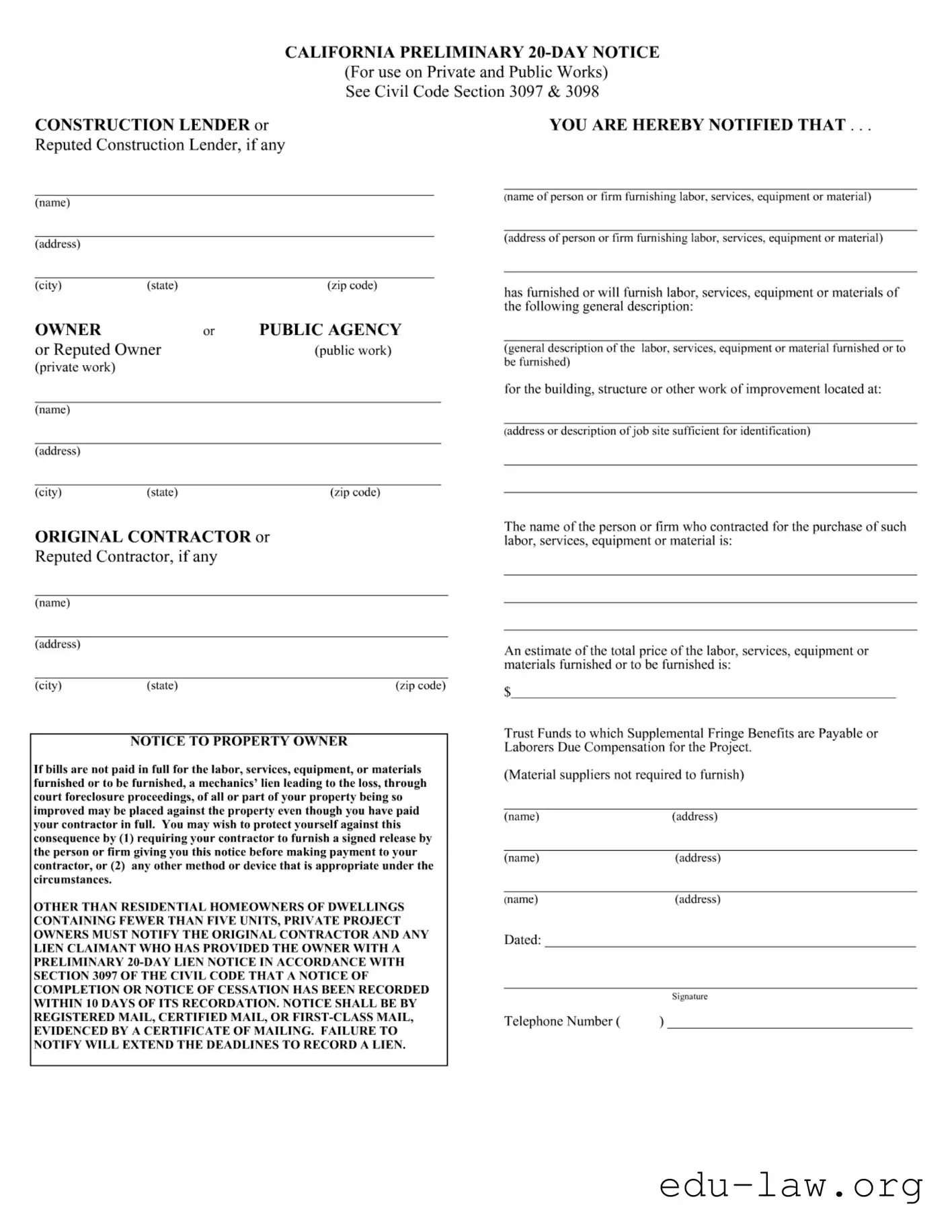
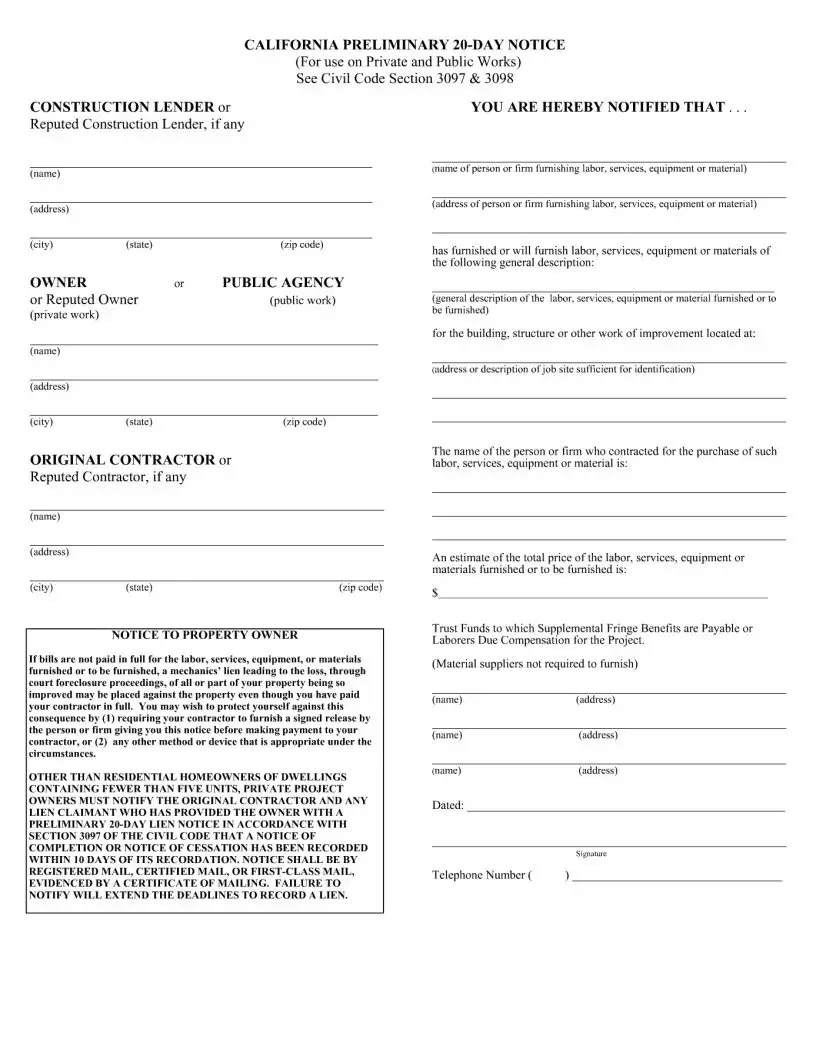
The California Preliminary 20-Day Notice form serves as an important document in the construction industry, particularly for those involved in private and public works projects. This notice is designed to inform property owners about the potential risks associated with unpaid bills for labor, services, equipment, or materials provided for a construction project. It outlines the responsibilities of various parties, including the construction lender, owner, and original contractor, while providing essential details such as the project location and a description of the work being performed. Additionally, the form highlights the consequences of not paying for services rendered, specifically the possibility of a mechanics' lien being placed against the property, which could lead to foreclosure proceedings. To safeguard against such outcomes, property owners are encouraged to take proactive measures, such as requiring signed releases from contractors before making payments. Furthermore, the form stipulates that owners of private projects must notify original contractors and lien claimants of any recorded notices of completion or cessation within a specified timeframe, emphasizing the importance of communication in the construction process. Understanding the components and implications of this notice is crucial for all parties involved in a construction project.
| Fact Name | Details |
|---|---|
| Purpose | The California Preliminary 20-Day Notice is designed to inform property owners and contractors about potential liens for unpaid labor or materials on a construction project. |
| Governing Law | This form is governed by California Civil Code Sections 3097 and 3098, which outline the requirements for providing notice to property owners. |
| Timeframe | The notice must be served within 20 days of the first day labor or materials were provided to the project, ensuring timely communication regarding payment obligations. |
| Recipient | The notice must be sent to the property owner, the original contractor, and any reputed construction lender, ensuring all relevant parties are informed. |
| Mechanics' Lien Warning | The notice serves as a warning that if bills remain unpaid, a mechanics' lien could be placed on the property, potentially leading to foreclosure. |
| Notification Requirement | Private project owners must notify the original contractor and any lien claimants of a recorded notice of completion or cessation within 10 days, as per Civil Code Section 3097. |
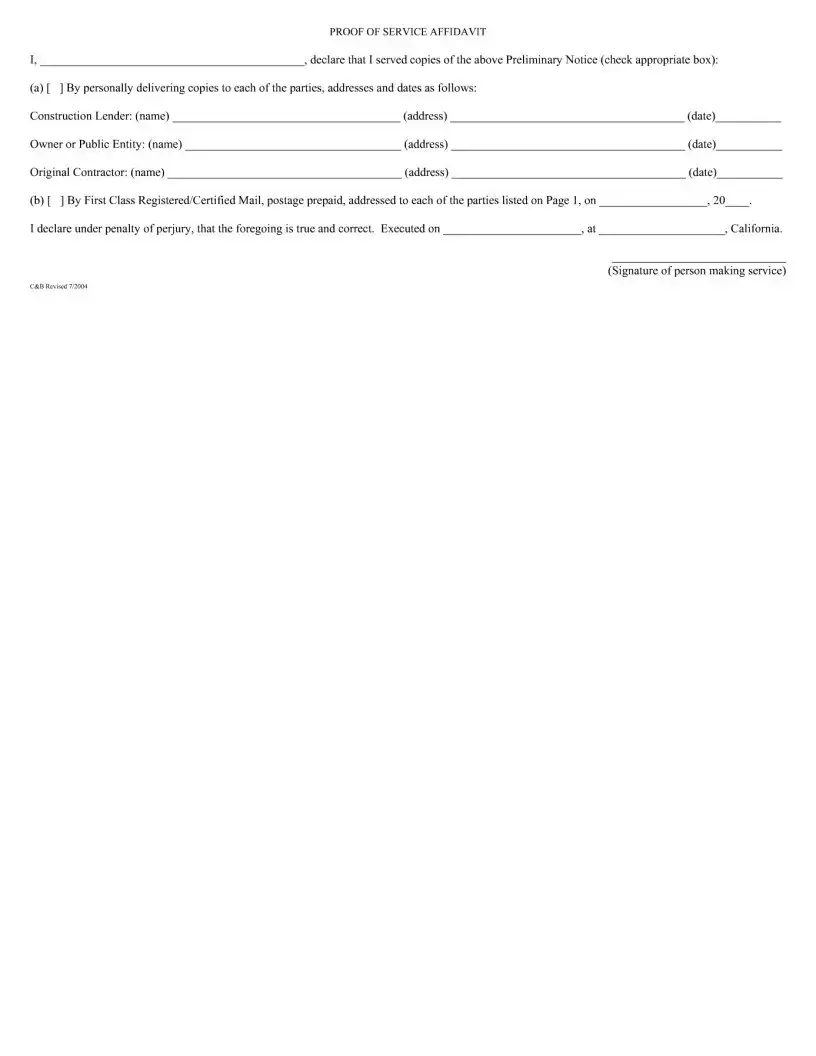
| Proof of Service | The form includes a proof of service affidavit, which verifies that the notice was delivered either personally or via certified mail, ensuring accountability in the notification process. |
After completing the California Preliminary 20 Day Notice form, it is essential to ensure that all parties involved receive their copies. This step is crucial to maintain compliance with the law and protect your rights regarding the labor, services, equipment, or materials provided. Below are the steps to fill out the form correctly.
What is the purpose of the California Preliminary 20-Day Notice?
The California Preliminary 20-Day Notice serves to inform property owners and other interested parties that a contractor or supplier has provided or will provide labor, services, equipment, or materials for a construction project. This notice is crucial as it protects the rights of those who contribute to a project by ensuring they can claim payment if necessary, even if the property owner has already paid the contractor.
Who is required to send a Preliminary 20-Day Notice?
What information must be included in the notice?
The notice must include the names and addresses of the property owner, the contractor, and the party providing the labor or materials. Additionally, it should describe the work being performed, the job site address, and an estimate of the total price for the work. This information helps clarify the nature of the services provided and the parties involved.
How should the Preliminary 20-Day Notice be delivered?
The notice can be delivered in several ways. It may be personally delivered to each party involved, or it can be sent via registered, certified, or first-class mail. It’s essential to keep proof of delivery, as this can be critical if any disputes arise later regarding payment or liens.
What happens if the property owner does not receive the notice?
If the property owner does not receive the Preliminary 20-Day Notice, they may not be aware of potential claims against their property. This lack of awareness can lead to complications, such as unpaid labor or materials resulting in a mechanics' lien. Therefore, it’s in the best interest of property owners to ensure they receive this notice and understand its implications.
What are the consequences of not sending the notice?
If a contractor or supplier fails to send the Preliminary 20-Day Notice, they may lose their right to file a mechanics' lien for unpaid services. This can significantly affect their ability to collect payment, as the notice serves as a legal safeguard that establishes their claim to the property in question.
How does the Preliminary 20-Day Notice relate to mechanics' liens?
The Preliminary 20-Day Notice is a key step in the process of establishing a mechanics' lien. By sending this notice, contractors and suppliers formally alert property owners of their involvement in the project and their right to payment. If payment is not received, this notice provides the necessary groundwork for filing a lien, which can lead to a legal claim against the property if disputes arise.
Missing Information: Failing to fill in all required fields can lead to delays or invalid notices. Ensure every section, especially names and addresses, is complete.
Incorrect Dates: Entering the wrong date can cause confusion. Make sure the date of the notice is accurate and reflects when the notice is being served.
Improper Service Method: Not using the correct method of service can invalidate the notice. Always follow the guidelines for personal delivery or mailing.
Inaccurate Description: Providing a vague or incorrect description of the labor, services, equipment, or materials can lead to disputes. Be specific and clear in your descriptions.
Omitting the Total Price: Failing to include an estimate of the total price can weaken your notice. Always provide an estimated cost for the work done or to be done.
Not Notifying the Original Contractor: Forgetting to inform the original contractor about the notice can extend lien deadlines. This notification is crucial for compliance.
Signature Issues: Not signing the notice or having an incomplete signature can render it invalid. Ensure that the notice is properly signed and dated.
Ignoring Proof of Service: Failing to complete the proof of service section can create legal complications. Always document how and when the notice was served.
The California Preliminary 20 Day Notice form is an important document in construction projects, serving to inform property owners and other parties about the provision of labor, services, equipment, or materials. To ensure a smooth process and protect the rights of all involved, several other forms and documents are often used in conjunction with this notice. Below is a list of these related documents, along with a brief description of each.
Using these documents alongside the California Preliminary 20 Day Notice can help protect the rights of all parties involved in a construction project. Understanding each form's purpose is essential for navigating the complexities of construction law and ensuring compliance with state regulations.
The California Preliminary 20-Day Notice is similar to the Notice of Intent to Lien. Both documents serve to inform property owners and contractors that a party has provided labor or materials for a project and may seek to secure a lien if payment is not made. The Notice of Intent to Lien is often sent before filing an actual lien, allowing the property owner a chance to settle any outstanding payments. This proactive approach can help avoid disputes and ensure that all parties are aware of potential claims against the property.
Another document that shares similarities is the Notice of Completion. This notice is filed by the property owner or general contractor to officially declare that a construction project has been completed. Like the Preliminary 20-Day Notice, it serves to protect the interests of those who provided labor or materials by starting the timeline for filing a lien. When a Notice of Completion is recorded, it can limit the time frame for subcontractors and suppliers to file a mechanics' lien, thus helping to clarify the status of the project.
The Notice of Cessation is also akin to the Preliminary 20-Day Notice. It is filed when construction work has stopped for a specified period, typically 30 days or more. This document notifies all parties involved that work has ceased, which can affect the rights of those who have provided labor or materials. By informing everyone of the cessation, it helps clarify the timeline for potential lien claims and ensures that all parties are aware of the project's status.
The 20-Day Notice is similar to a Claim of Lien. A Claim of Lien is a legal document filed to assert a right to payment for services rendered or materials supplied. While the Preliminary 20-Day Notice serves as a warning and an opportunity for resolution, the Claim of Lien is a formal step taken when payment is overdue. Both documents are essential tools in the construction industry for protecting the rights of those who contribute to a project.
The Preliminary Notice also resembles the Release of Lien. A Release of Lien is a document that confirms the satisfaction of a debt and removes the lien from the property. Like the Preliminary 20-Day Notice, it involves communication between parties regarding payment and project status. Both documents help maintain transparency and can prevent future disputes over unpaid work or materials.
Another comparable document is the Notice of Non-Payment. This notice is sent to inform property owners and contractors that payment has not been received for work performed. It serves a similar purpose to the Preliminary 20-Day Notice by alerting the parties involved about potential payment issues. This can prompt discussions and negotiations to resolve outstanding debts before they escalate into legal action.
The Preliminary 20-Day Notice is also similar to the Notice of Default. A Notice of Default is issued when a party fails to meet their obligations under a contract, often related to payment. Like the Preliminary Notice, it serves to inform the other party of a potential breach and allows for corrective actions to be taken. Both documents aim to prevent further complications by addressing issues early in the process.
The Notice of Right to Cure is another document that shares similarities. This notice informs a property owner that they have the opportunity to rectify a breach of contract before further legal actions are pursued. Like the Preliminary 20-Day Notice, it emphasizes communication and resolution between parties, allowing for the possibility of avoiding a lien or other legal claims.
Lastly, the Conditional Waiver and Release is akin to the Preliminary 20-Day Notice. This document is used when a contractor or supplier agrees to waive their right to file a lien in exchange for payment. Similar to the Preliminary Notice, it involves the exchange of information and agreements between parties. Both documents are crucial in ensuring that all parties are aware of their rights and obligations in the construction process.
When filling out the California Preliminary 20 Day Notice form, it is essential to follow specific guidelines to ensure accuracy and compliance. Below is a list of important dos and don’ts.
By adhering to these guidelines, you can help ensure that the notice is effective and that your rights are protected throughout the construction process.
Here are four common misconceptions about the California Preliminary 20-Day Notice form:
Filling out and using the California Preliminary 20 Day Notice form is an important step for those involved in construction projects. Here are some key takeaways to keep in mind:
Understanding these aspects can help prevent issues and ensure that your rights are protected throughout the construction process.