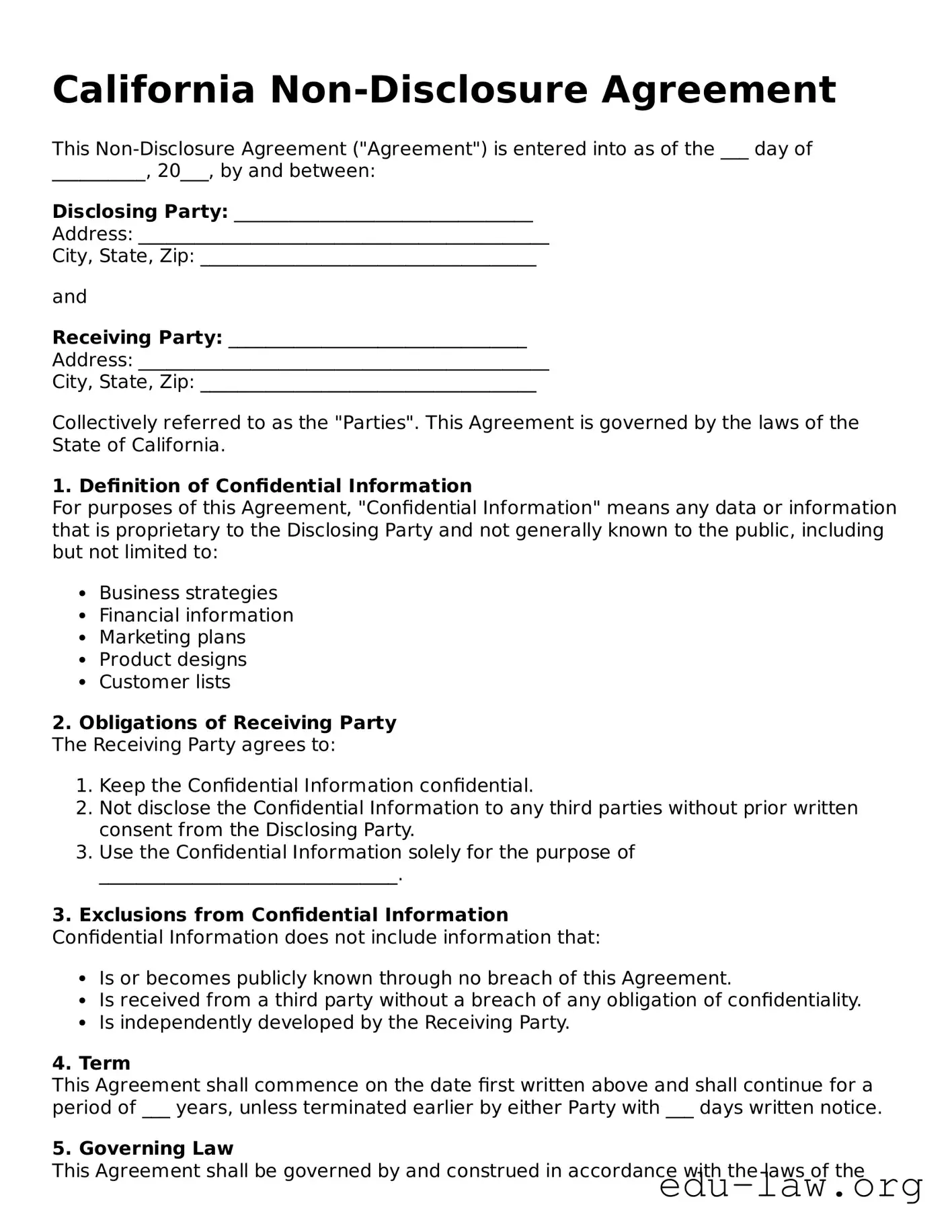
In the competitive landscape of business, protecting sensitive information is crucial. The California Non-disclosure Agreement (NDA) form serves as a vital tool for individuals and companies looking to safeguard their proprietary data. This legally binding document outlines the obligations of parties involved regarding the handling of confidential information. It typically specifies what constitutes confidential information, the duration of the confidentiality obligation, and the consequences of breach. By clearly defining these aspects, the NDA helps to establish trust between parties while minimizing the risk of unauthorized disclosure. Whether you are a startup sharing innovative ideas with potential investors or an established company disclosing trade secrets to a partner, understanding the key components of the California NDA form is essential for effective protection of your intellectual property.
California Non-Disclosure Agreement
This Non-Disclosure Agreement ("Agreement") is entered into as of the ___ day of __________, 20___, by and between:
Disclosing Party: ________________________________
Address: ____________________________________________
City, State, Zip: ____________________________________
and
Receiving Party: ________________________________
Address: ____________________________________________
City, State, Zip: ____________________________________
Collectively referred to as the "Parties". This Agreement is governed by the laws of the State of California.
1. Definition of Confidential Information
For purposes of this Agreement, "Confidential Information" means any data or information that is proprietary to the Disclosing Party and not generally known to the public, including but not limited to:
2. Obligations of Receiving Party
The Receiving Party agrees to:
3. Exclusions from Confidential Information
Confidential Information does not include information that:
4. Term
This Agreement shall commence on the date first written above and shall continue for a period of ___ years, unless terminated earlier by either Party with ___ days written notice.
5. Governing Law
This Agreement shall be governed by and construed in accordance with the laws of the State of California.
6. Miscellaneous
This Agreement constitutes the entire agreement between the Parties regarding the subject matter hereof and supersedes all prior agreements and understandings.
IN WITNESS WHEREOF, the Parties hereto have executed this Non-Disclosure Agreement as of the date first above written.
Disclosing Party Signature: ____________________________
Date: _______________
Receiving Party Signature: ____________________________
Date: _______________
| Fact Name | Description |
|---|---|
| Definition | A Non-disclosure Agreement (NDA) is a legally binding contract that establishes a confidential relationship between parties. |
| Purpose | NDAs are used to protect sensitive information from being disclosed to unauthorized parties. |
| Governing Law | The NDA is governed by California state law, specifically the California Civil Code. |
| Parties Involved | Typically, there are two parties involved: the disclosing party and the receiving party. |
| Duration of Confidentiality | The duration for which the information must remain confidential can vary, often specified in the agreement. |
| Permitted Disclosures | NDAs may outline specific circumstances under which disclosure is permitted, such as legal requirements. |
| Consequences of Breach | Violating an NDA can lead to legal consequences, including potential damages and injunctions. |
| Enforceability | California courts generally enforce NDAs, provided they are reasonable in scope and duration. |
Once you have the California Non-disclosure Agreement form in front of you, it’s time to fill it out carefully. Completing this form accurately is essential for ensuring that all parties understand their obligations and rights. Below are the steps to guide you through the process.
Once completed, the form should be distributed to all parties involved. Each party should retain a copy for their records. This way, everyone is clear about their responsibilities moving forward.
What is a California Non-disclosure Agreement (NDA)?
A California Non-disclosure Agreement is a legal contract that protects confidential information shared between parties. It ensures that sensitive information, such as trade secrets, business strategies, or proprietary data, remains private. This agreement is commonly used in business relationships, employment situations, and during negotiations to safeguard intellectual property and other confidential information.
Who typically uses an NDA in California?
Businesses, entrepreneurs, and employees often use NDAs. Companies may require employees to sign an NDA to protect their proprietary information. Similarly, businesses entering partnerships or negotiations may ask potential partners to sign an NDA to ensure that shared information remains confidential. In California, these agreements are prevalent in industries such as technology, entertainment, and healthcare.
What should be included in a California NDA?
An effective NDA should clearly define the confidential information being protected. It should specify the obligations of the parties involved, including how the information can be used and the duration of the confidentiality obligation. Additionally, the agreement should outline any exclusions, such as information that is already public knowledge or independently developed by the receiving party.
How long does the confidentiality obligation last?
The duration of the confidentiality obligation can vary. Generally, NDAs specify a time frame during which the information must remain confidential. This period can range from a few years to indefinitely, depending on the nature of the information and the parties' agreement. It is essential to define this duration clearly to avoid confusion later.
What happens if someone breaches an NDA?
If a party breaches an NDA, the injured party may seek legal remedies. This could include monetary damages for any losses incurred due to the breach. In some cases, the injured party may also seek an injunction to prevent further disclosure of the confidential information. The specific remedies available will depend on the terms of the NDA and the nature of the breach.
Can an NDA be enforced in California?
Yes, NDAs can be enforced in California, provided they meet certain legal requirements. The agreement must be reasonable in scope and duration. Courts will generally uphold NDAs that protect legitimate business interests without being overly restrictive. However, if an NDA is deemed too broad or unfair, a court may refuse to enforce it.
Are there any limitations to what can be protected under an NDA?
Yes, there are limitations. NDAs cannot protect information that is already publicly available or information that the receiving party can demonstrate was independently developed. Additionally, NDAs cannot be used to protect illegal activities or to prevent whistleblowing. It is crucial to ensure that the information being protected is legitimate and justifiable.
Do I need a lawyer to draft an NDA?
While it is not strictly necessary to have a lawyer draft an NDA, it is highly advisable. A legal professional can ensure that the agreement complies with California law and adequately protects your interests. A well-drafted NDA can prevent misunderstandings and disputes down the line, making it a worthwhile investment for individuals and businesses alike.
Failing to identify all parties involved. It’s essential to clearly list everyone who will be bound by the agreement. Missing a party can lead to confusion later.
Not specifying the confidential information. Be clear about what information is considered confidential. Vague terms can create loopholes.
Leaving out the duration of confidentiality. Indicating how long the information remains confidential is crucial. Without this, the agreement may lack enforceability.
Using ambiguous language. Clarity is key. Using terms that can be interpreted in multiple ways can lead to disputes.
Not including the purpose of the disclosure. Stating why the information is being shared helps set boundaries and expectations.
Overlooking the consequences of breach. Clearly outline what happens if someone violates the agreement. This can deter potential breaches.
Neglecting to sign and date the agreement. Without signatures, the document lacks validity. Ensure all parties sign and date the form.
Failing to keep a copy of the signed agreement. Always retain a copy for your records. This can be crucial if disputes arise in the future.
When entering into a Non-disclosure Agreement (NDA) in California, several other documents may complement or support the NDA. These forms help clarify the relationship between the parties involved and ensure that all aspects of the agreement are covered. Below is a list of commonly used forms and documents that often accompany an NDA.
These forms and documents are essential in ensuring that all parties understand their rights and responsibilities regarding confidential information. By having a comprehensive set of agreements, businesses can protect their interests and foster trust in their professional relationships.
A Confidentiality Agreement, like a Non-disclosure Agreement, aims to protect sensitive information shared between parties. Both documents outline the obligations of the parties to keep certain information private. While a Non-disclosure Agreement often focuses on business information, a Confidentiality Agreement can apply to various contexts, including personal relationships and employment situations.
A Mutual Non-disclosure Agreement involves two parties sharing confidential information with each other. This type of agreement is similar to a standard Non-disclosure Agreement, but it emphasizes that both parties have responsibilities to protect each other’s information. This is particularly useful in joint ventures or collaborations where both sides are exchanging sensitive data.
An Employment Agreement may contain confidentiality clauses similar to those found in a Non-disclosure Agreement. Employers often require employees to keep proprietary information private. While an Employment Agreement covers various employment terms, the confidentiality aspect is crucial for protecting business interests.
A Proprietary Information Agreement focuses specifically on protecting proprietary information, such as trade secrets. This document is similar to a Non-disclosure Agreement in that it outlines what constitutes proprietary information and the obligations of the parties to safeguard it. Both agreements aim to prevent unauthorized disclosure and use of sensitive information.
A Non-compete Agreement may also include confidentiality provisions. While its primary purpose is to prevent individuals from working for competitors, it often requires the individual to keep certain information confidential. This overlap with Non-disclosure Agreements highlights the importance of protecting business interests in various ways.
A Service Agreement can incorporate confidentiality clauses to protect sensitive information exchanged during the service provision. Similar to a Non-disclosure Agreement, it specifies what information must remain confidential and the consequences for breaches. This ensures that both parties can work together without fear of sensitive information being disclosed.
A Licensing Agreement may require the licensee to keep certain information confidential. This document is similar to a Non-disclosure Agreement as it often involves sharing proprietary information between the licensor and licensee. Both agreements emphasize the need for confidentiality to protect the interests of the parties involved.
A Partnership Agreement often includes confidentiality provisions. In this context, partners are required to keep each other’s business information private. This is similar to a Non-disclosure Agreement, as both documents aim to create a secure environment for sharing sensitive information in a business relationship.
A Settlement Agreement may require confidentiality about the terms of the settlement. This is similar to a Non-disclosure Agreement, as both documents aim to protect sensitive information from being disclosed to third parties. Maintaining confidentiality in settlements can be crucial for the parties involved.
A Memorandum of Understanding (MOU) can also include confidentiality clauses. While an MOU outlines the intentions of the parties, it may require them to keep certain discussions private. This similarity to a Non-disclosure Agreement underscores the importance of confidentiality in various agreements and collaborations.
When filling out the California Non-disclosure Agreement form, it is important to follow specific guidelines to ensure accuracy and effectiveness. Below are some recommended practices and common pitfalls to avoid.
Misconceptions about the California Non-disclosure Agreement (NDA) can lead to misunderstandings about its purpose and function. Here are four common misconceptions:
Understanding these misconceptions can help individuals and businesses navigate the complexities of non-disclosure agreements more effectively.
When filling out and using the California Non-disclosure Agreement (NDA) form, it is essential to keep several key points in mind. These takeaways will help ensure that the agreement serves its intended purpose effectively.
By following these key takeaways, you can effectively fill out and utilize the California Non-disclosure Agreement form to protect your confidential information.