The California Medical Power of Attorney form is an essential document that empowers individuals to designate a trusted person to make medical decisions on their behalf in the event they become unable to communicate their wishes. This form plays a crucial role in ensuring that healthcare choices align with personal values and preferences. It allows the appointed agent to access medical information, discuss treatment options with healthcare providers, and make decisions regarding medical procedures, medications, and end-of-life care. Importantly, the form can be tailored to reflect specific wishes regarding life-sustaining treatments, ensuring that an individual's desires are honored even when they cannot voice them. Understanding how to properly complete and execute this form is vital for anyone looking to safeguard their healthcare decisions and provide peace of mind for themselves and their loved ones.
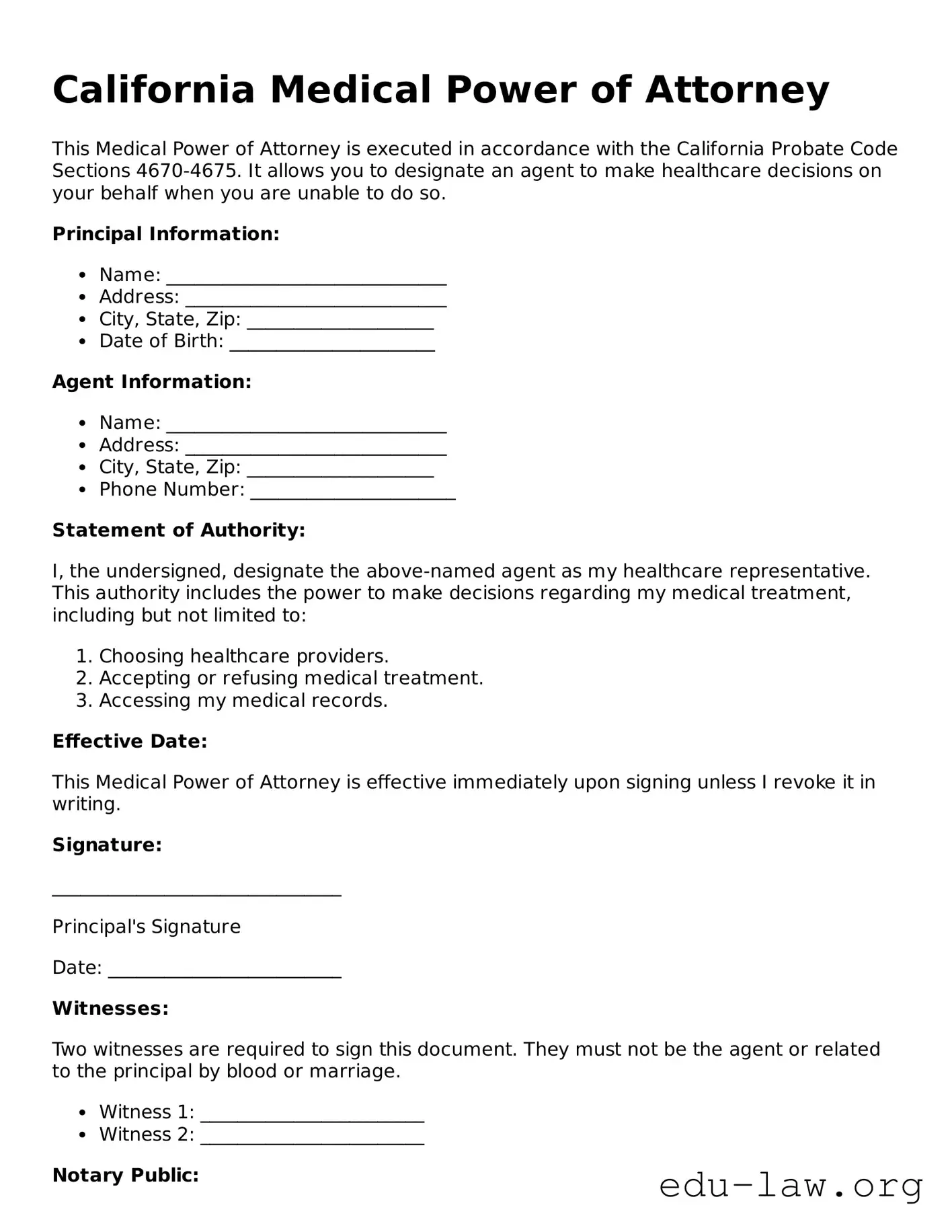
California Medical Power of Attorney
This Medical Power of Attorney is executed in accordance with the California Probate Code Sections 4670-4675. It allows you to designate an agent to make healthcare decisions on your behalf when you are unable to do so.
Principal Information:
Agent Information:
Statement of Authority:
I, the undersigned, designate the above-named agent as my healthcare representative. This authority includes the power to make decisions regarding my medical treatment, including but not limited to:
Effective Date:
This Medical Power of Attorney is effective immediately upon signing unless I revoke it in writing.
Signature:
_______________________________
Principal's Signature
Date: _________________________
Witnesses:
Two witnesses are required to sign this document. They must not be the agent or related to the principal by blood or marriage.
Notary Public:
State of California, County of ________________
On this ______ day of __________, 20__, before me, ______________________, a notary public, personally appeared ______________________, who proved to me on the basis of satisfactory evidence to be the person whose name is subscribed to this document, and acknowledged that he/she executed it.
______________________________
Notary Public Signature
My commission expires: _______________
| Fact Name | Description |
|---|---|
| Definition | A California Medical Power of Attorney form allows individuals to designate someone to make healthcare decisions on their behalf if they become unable to do so. |
| Governing Law | The form is governed by the California Probate Code, specifically Sections 4650-4670. |
| Principal | The person creating the power of attorney is known as the principal. This individual retains the right to make decisions until they are incapacitated. |
| Agent | The agent is the person designated by the principal to make medical decisions. This person should be someone the principal trusts. |
| Durability | The California Medical Power of Attorney is durable, meaning it remains effective even if the principal becomes incapacitated. |
| Witness Requirements | To be valid, the form must be signed by the principal in the presence of two witnesses or notarized. |
| Revocation | The principal can revoke the Medical Power of Attorney at any time as long as they are mentally competent. |
| Healthcare Decisions | The agent can make a wide range of healthcare decisions, including consent to medical treatment, surgical procedures, and end-of-life care. |
| Advance Healthcare Directive | This form can be combined with an Advance Healthcare Directive, which outlines specific wishes regarding medical treatment. |
After obtaining the California Medical Power of Attorney form, you will need to complete it accurately to ensure that your healthcare preferences are clearly communicated. Follow these steps to fill out the form correctly.
What is a California Medical Power of Attorney?
A California Medical Power of Attorney is a legal document that allows you to appoint someone, known as your agent, to make healthcare decisions on your behalf if you become unable to do so. This can include decisions about medical treatments, surgeries, and end-of-life care. It ensures that your healthcare preferences are respected even when you cannot communicate them yourself.
Who can be appointed as an agent in a Medical Power of Attorney?
You can choose anyone you trust to act as your agent, provided they are at least 18 years old and capable of making informed decisions. This could be a family member, a close friend, or a trusted advisor. It’s important to select someone who understands your values and wishes regarding medical care.
How do I create a Medical Power of Attorney in California?
To create a Medical Power of Attorney, you need to fill out a specific form, which is often available online or through healthcare providers. After completing the form, you must sign it in front of a witness or a notary public. This helps ensure that the document is legally valid and that your wishes are clearly documented.
Can I change or revoke my Medical Power of Attorney?
Yes, you can change or revoke your Medical Power of Attorney at any time, as long as you are mentally competent. To revoke it, you can create a new document stating your intentions or simply destroy the original document. It’s wise to inform your agent and any healthcare providers about the changes you’ve made.
What if I do not have a Medical Power of Attorney?
If you do not have a Medical Power of Attorney and become unable to make decisions for yourself, your family may need to go through a court process to appoint a guardian or conservator. This can be time-consuming and may not reflect your wishes, making it crucial to have a Medical Power of Attorney in place.
What kinds of decisions can my agent make?
Your agent can make a wide range of healthcare decisions, including consent to or refusal of medical treatments, choosing healthcare providers, and making decisions about long-term care. However, they must act in accordance with your wishes and best interests as outlined in the document.
Does a Medical Power of Attorney cover financial decisions?
No, a Medical Power of Attorney specifically pertains to healthcare decisions. If you want someone to manage your financial matters, you will need a separate document known as a Financial Power of Attorney. This ensures that both your medical and financial wishes are clearly addressed.
Is it necessary to have a lawyer to create a Medical Power of Attorney?
While it is not legally required to have a lawyer to create a Medical Power of Attorney, consulting with one can provide valuable guidance. A lawyer can help ensure that your document complies with California laws and accurately reflects your wishes, which can be especially important in complex situations.
How can I ensure my Medical Power of Attorney is honored?
To ensure that your Medical Power of Attorney is honored, share copies of the document with your healthcare providers and your appointed agent. Discuss your healthcare wishes with them so they understand your preferences. Additionally, keep the original document in a safe but accessible location, and consider registering it with your medical records if possible.
Not Naming an Alternate Agent: Many people forget to designate an alternate agent. If the primary agent is unavailable, your wishes may not be honored.
Failing to Sign and Date: A common mistake is neglecting to sign and date the form. Without your signature, the document is not valid.
Using Incorrect or Outdated Forms: Ensure you are using the most current version of the California Medical Power of Attorney form. Using an outdated form can lead to complications.
Not Specifying Medical Preferences: Be clear about your medical preferences. Vague language can lead to confusion about your wishes.
Overlooking Witness Requirements: California law requires that the form be signed in front of witnesses. Failing to meet this requirement can invalidate the document.
Neglecting to Inform Your Agent: After completing the form, inform your chosen agent about their responsibilities. They should understand your wishes and be willing to act on them.
Not Reviewing the Form Periodically: Life circumstances change. Regularly review your Medical Power of Attorney to ensure it still reflects your wishes.
Ignoring State-Specific Requirements: Each state has its own rules regarding Medical Power of Attorney forms. Familiarize yourself with California’s specific requirements.
Failing to Store the Document Safely: After completing the form, store it in a safe yet accessible place. Your agent and loved ones should know where to find it when needed.
When creating a California Medical Power of Attorney, it's essential to consider additional forms and documents that can complement your healthcare planning. These documents help ensure your medical wishes are respected and provide clarity in various situations.
Incorporating these forms into your healthcare planning can provide peace of mind. By clearly expressing your wishes and designating trusted individuals to advocate for you, you can ensure that your healthcare decisions align with your values and preferences.
The California Medical Power of Attorney (MPOA) form shares similarities with the Durable Power of Attorney (DPOA). Both documents allow individuals to designate someone to make decisions on their behalf. However, while the MPOA specifically focuses on medical decisions, the DPOA can encompass a broader range of financial and legal matters. This distinction highlights the importance of choosing the right form based on the individual's needs and circumstances.
Another document akin to the MPOA is the Advance Healthcare Directive (AHCD). The AHCD combines the functions of a living will and a medical power of attorney. It allows individuals to express their healthcare preferences and appoint a healthcare agent. This dual purpose makes the AHCD a comprehensive option for those who want to ensure their medical wishes are honored while also designating someone to advocate for them if they are unable to communicate.
The Healthcare Proxy is also similar to the MPOA. In many states, this document allows individuals to appoint someone to make healthcare decisions on their behalf. While the terminology and specific requirements may vary by state, the core function remains the same: to ensure that someone trusted can make medical choices if the individual is incapacitated.
The Living Will is another document that aligns closely with the MPOA. A living will outlines an individual's preferences for medical treatment in specific situations, particularly at the end of life. Unlike the MPOA, which designates a person to make decisions, the living will expresses the individual's wishes directly. Many people choose to use both documents together to provide a clearer picture of their healthcare preferences.
The Mental Health Power of Attorney is a specialized version of the MPOA, focusing specifically on mental health treatment decisions. This document allows individuals to appoint someone to make choices regarding their mental health care, including treatment options and hospitalization. It ensures that individuals receive the care they need while respecting their autonomy and preferences.
The Financial Power of Attorney (FPOA) is another related document. While the MPOA is concerned with healthcare decisions, the FPOA grants someone the authority to manage financial matters on behalf of another person. This can include paying bills, managing investments, and handling real estate transactions. Both documents are essential for comprehensive planning, but they serve different purposes.
The Guardianship document can also be compared to the MPOA. In situations where an individual is unable to make decisions due to incapacity, a court may appoint a guardian to make decisions on their behalf. This process is often more complex and involves legal proceedings, unlike the MPOA, which allows individuals to choose their own representatives in advance.
The Do Not Resuscitate (DNR) order is another relevant document. While the MPOA allows for the appointment of someone to make medical decisions, a DNR specifically instructs healthcare providers not to perform cardiopulmonary resuscitation (CPR) in the event of cardiac arrest. This document is crucial for individuals who wish to refuse certain life-saving measures, emphasizing the importance of clear communication of medical preferences.
Lastly, the Authorization for Release of Medical Records is similar in that it allows individuals to control who has access to their medical information. While the MPOA designates someone to make decisions, this authorization ensures that the appointed individual can obtain necessary medical records to make informed choices. Both documents empower individuals regarding their healthcare, but they do so in different ways.
When filling out the California Medical Power of Attorney form, it's essential to follow certain guidelines to ensure that your wishes are respected. Here’s a list of things to do and avoid:
Understanding the California Medical Power of Attorney form is important for making informed decisions about healthcare. Here are six common misconceptions about this form:
Many believe that a Medical Power of Attorney is solely for end-of-life situations. In reality, this document allows you to designate someone to make healthcare decisions on your behalf in various circumstances, not just at the end of life.
While you can choose a trusted individual, not everyone is eligible to serve as your agent. For example, certain healthcare providers cannot act as your agent unless they are related to you.
A Medical Power of Attorney and a living will serve different purposes. A living will outlines your preferences for medical treatment, while the Medical Power of Attorney designates someone to make decisions on your behalf.
Some people think that once they complete the form, it is permanent. However, you can revoke or update your Medical Power of Attorney at any time, as long as you are of sound mind.
Although notarization is not always required, having your Medical Power of Attorney notarized can provide an extra layer of validation and may be necessary for certain healthcare providers.
This misconception overlooks the fact that anyone, regardless of age, can benefit from having a Medical Power of Attorney. Accidents and sudden illnesses can happen to anyone, making it wise to have this document in place.
Filling out and using a California Medical Power of Attorney form is an important step in ensuring that your healthcare preferences are honored when you cannot communicate them yourself. Here are some key takeaways to consider:
By taking the time to properly fill out and utilize the California Medical Power of Attorney form, individuals can gain peace of mind knowing that their healthcare wishes will be respected.