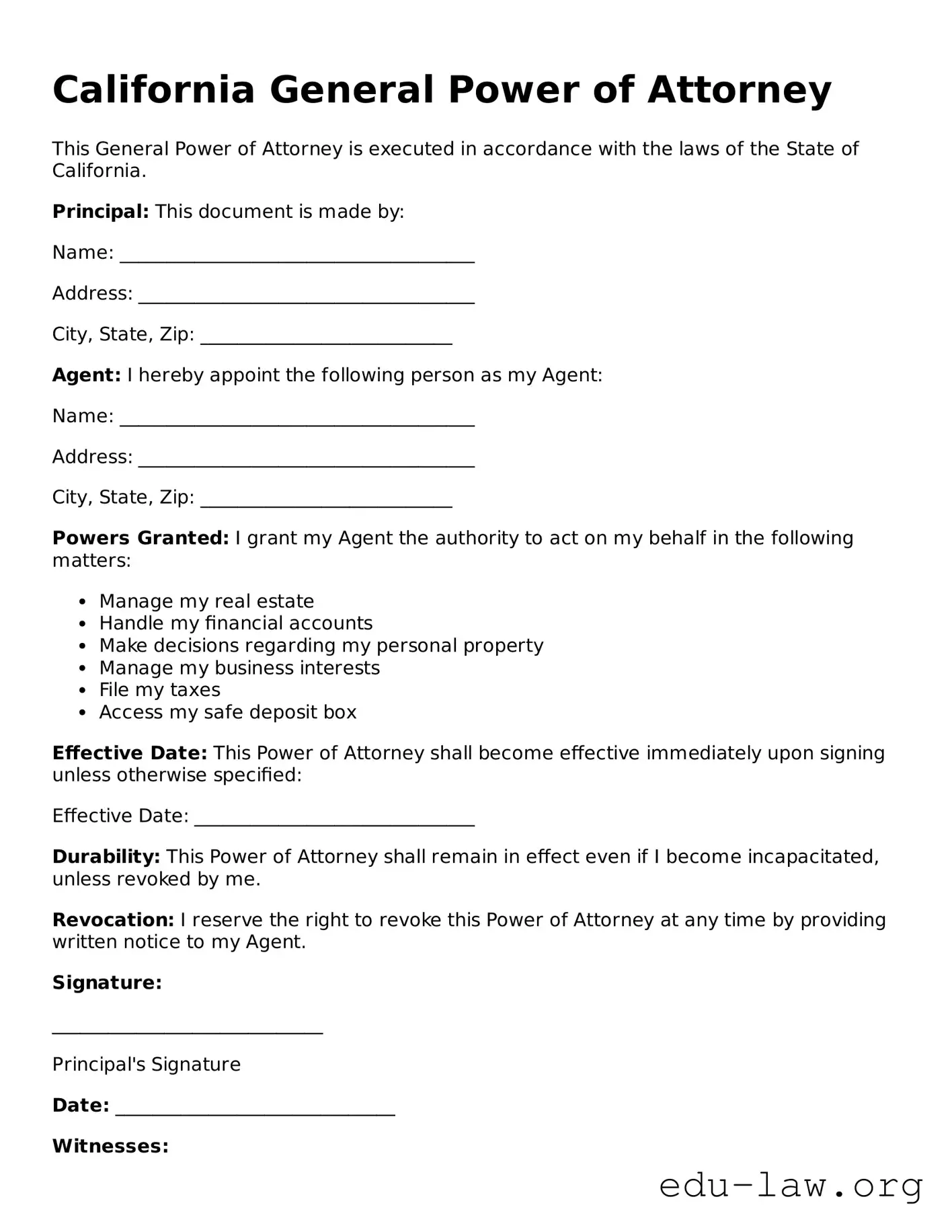
The California General Power of Attorney form serves as a vital legal document that empowers individuals to designate a trusted person, known as an agent, to make financial and legal decisions on their behalf. This form is particularly important for those who may be unable to manage their affairs due to illness, absence, or incapacity. The document outlines specific powers granted to the agent, which can range from managing bank accounts to handling real estate transactions. Importantly, the form can be tailored to meet individual needs, allowing the principal to specify the extent of authority granted. Additionally, it provides clear instructions on when the authority becomes effective and when it may terminate. Understanding the implications of this form is essential for ensuring that one’s financial and legal matters are handled according to their wishes, especially in unforeseen circumstances.
California General Power of Attorney
This General Power of Attorney is executed in accordance with the laws of the State of California.
Principal: This document is made by:
Name: ______________________________________
Address: ____________________________________
City, State, Zip: ___________________________
Agent: I hereby appoint the following person as my Agent:
Name: ______________________________________
Address: ____________________________________
City, State, Zip: ___________________________
Powers Granted: I grant my Agent the authority to act on my behalf in the following matters:
Effective Date: This Power of Attorney shall become effective immediately upon signing unless otherwise specified:
Effective Date: ______________________________
Durability: This Power of Attorney shall remain in effect even if I become incapacitated, unless revoked by me.
Revocation: I reserve the right to revoke this Power of Attorney at any time by providing written notice to my Agent.
Signature:
_____________________________
Principal's Signature
Date: ______________________________
Witnesses:
This document must be signed in the presence of a notary public to be valid.
| Fact Name | Description |
|---|---|
| Definition | A California General Power of Attorney form allows an individual to grant another person the authority to act on their behalf in financial and legal matters. |
| Governing Law | This form is governed by the California Probate Code, specifically Sections 4000-4545. |
| Durability | The General Power of Attorney can be durable, meaning it remains effective even if the principal becomes incapacitated, as long as it is explicitly stated in the document. |
| Agent Responsibilities | The appointed agent has a fiduciary duty to act in the best interests of the principal, managing their affairs responsibly and ethically. |
| Revocation | The principal can revoke the General Power of Attorney at any time, provided they are mentally competent to do so. |
| Signing Requirements | The form must be signed by the principal and, in some cases, notarized or witnessed to be legally valid. |
| Limitations | While the agent has broad powers, there are certain limitations, such as the inability to make healthcare decisions unless specified in a separate document. |
Filling out the California General Power of Attorney form is a straightforward process. After completing the form, you will need to sign it in front of a notary public. This step is crucial to ensure that the document is legally valid. Once notarized, you can provide copies to your designated agent and any relevant institutions.
What is a California General Power of Attorney?
A California General Power of Attorney is a legal document that allows you to appoint someone to act on your behalf in various financial and legal matters. This document gives your agent the authority to handle tasks such as managing bank accounts, signing checks, and making investment decisions. It is important to choose someone you trust, as they will have significant control over your financial affairs.
How do I create a General Power of Attorney in California?
To create a General Power of Attorney in California, you need to complete a specific form. You can find this form online or through legal stationery stores. Fill out the required information, including your name, the agent's name, and the powers you wish to grant. After signing the document, you may want to have it notarized to ensure its validity. It’s advisable to keep a copy for your records and provide one to your agent.
Can I revoke a General Power of Attorney?
Yes, you can revoke a General Power of Attorney at any time, as long as you are mentally competent. To do this, you should create a written revocation document and notify your agent of the change. It’s also a good idea to inform any institutions or individuals who may have relied on the original power of attorney. This ensures that they are aware that your agent no longer has authority to act on your behalf.
What happens if I become incapacitated?
If you become incapacitated and have a General Power of Attorney in place, your agent can continue to act on your behalf. However, it’s important to note that the powers granted to your agent may vary depending on the specific terms outlined in the document. If you did not set up a power of attorney before becoming incapacitated, the court may need to appoint a conservator to manage your affairs.
Is a General Power of Attorney valid in other states?
A General Power of Attorney created in California is generally valid in other states, but there may be variations in laws and requirements. Some states may require additional documentation or specific language to recognize the power of attorney. If you plan to use your California General Power of Attorney in another state, it's wise to check the local laws or consult with a legal professional in that state to ensure its acceptance.
Not specifying the powers granted. It's essential to clearly outline what authority the agent will have. Leaving this vague can lead to confusion and potential disputes.
Failing to date the document. A date is crucial for determining when the power of attorney takes effect and can prevent issues regarding its validity.
Overlooking the requirement for signatures. Both the principal and the agent must sign the form. Without these signatures, the document may be deemed invalid.
Not having the document notarized. In California, a notary public must witness the signing of the power of attorney for it to be legally binding.
Using outdated forms. Laws change, and using an old version of the form may lead to complications. Always ensure you have the most current version.
Neglecting to inform the agent about their responsibilities. The agent should be aware of their duties and the extent of their powers to act effectively.
Failing to keep copies of the document. Retaining copies is important for both the principal and the agent, ensuring everyone has access to the same information.
When preparing a California General Power of Attorney, it’s important to consider additional forms and documents that may complement this legal instrument. These documents can help clarify your intentions and ensure your wishes are respected. Below is a list of commonly used forms that often accompany a General Power of Attorney.
By considering these additional documents, you can create a comprehensive plan that addresses both your financial and health care needs. Taking the time to prepare these forms can help prevent confusion and ensure that your wishes are followed in various situations.
The California Durable Power of Attorney is similar to the General Power of Attorney but includes a key feature: it remains effective even if the principal becomes incapacitated. This means that if the person who created the document can no longer make decisions due to illness or injury, the agent can still act on their behalf. This added durability makes it a preferred choice for many who want to ensure their financial and legal matters are managed without interruption.
A Medical Power of Attorney allows someone to make healthcare decisions for another person. Like the General Power of Attorney, it grants authority to an agent, but it specifically focuses on medical decisions. This document is essential for individuals who want to ensure that their health care preferences are honored if they cannot communicate them themselves. It provides clarity during critical times when decisions about medical treatment need to be made quickly.
The Limited Power of Attorney is another similar document. It grants an agent authority to act on behalf of the principal for specific tasks or a limited time. Unlike the General Power of Attorney, which provides broad powers, the Limited Power of Attorney restricts the agent's authority. This can be useful for situations like selling a property or managing a specific financial transaction without giving away complete control.
A Springing Power of Attorney becomes effective only under certain conditions, typically when the principal becomes incapacitated. This type is similar to the General Power of Attorney in that it allows someone to act on behalf of another person, but it includes a triggering event. This can provide peace of mind, as the agent will not have authority until the specified conditions are met.
The Financial Power of Attorney focuses solely on financial matters. It allows an agent to manage the principal's financial affairs, such as banking, investments, and property management. While it shares similarities with the General Power of Attorney, which can cover a wide range of areas, the Financial Power of Attorney is specifically tailored for financial decision-making. This specialization can help ensure that financial interests are well managed.
Lastly, a Revocation of Power of Attorney document is related to the General Power of Attorney as it allows the principal to cancel or revoke any previously granted powers. If someone decides they no longer want their agent to have authority, this document serves as a formal way to terminate that relationship. It’s important to have this in place to ensure that no one can act on behalf of the principal without their consent.
When filling out the California General Power of Attorney form, it is important to follow certain guidelines to ensure accuracy and compliance. Below is a list of things to do and avoid during this process.
Things You Should Do:
Things You Shouldn't Do:
Adhering to these guidelines can help ensure that the General Power of Attorney form is filled out correctly and serves your intended purpose.
Understanding the California General Power of Attorney (GPOA) form can be challenging. Here are ten common misconceptions about this important legal document.
The GPOA can cover a wide range of decisions, including health care and property management, not just financial affairs.
You can revoke a GPOA at any time, as long as you are mentally competent. This flexibility allows you to change your mind as circumstances evolve.
Not all powers are granted by default. The specific powers must be clearly outlined in the document for them to be effective.
Anyone you trust can serve as your agent, as long as they are of legal age and mentally competent.
A GPOA can be effective immediately, or it can be set to activate only upon incapacitation, depending on your preference.
While a GPOA can be durable, it is not automatically so. A Durable Power of Attorney specifically remains in effect if you become incapacitated.
You can create a GPOA on your own, but consulting a lawyer can help ensure that it meets your needs and complies with the law.
Anyone can benefit from a GPOA, regardless of age. Life is unpredictable, and having one in place can provide peace of mind.
Your agent's powers are limited to what you specify in the GPOA. Be clear about what you want them to handle.
Signing a GPOA does not mean you lose control over your affairs. You can still make decisions for yourself as long as you are capable.
Filling out and using the California General Power of Attorney form is an important step in ensuring that your financial and legal matters are managed according to your wishes. Here are some key takeaways to consider: