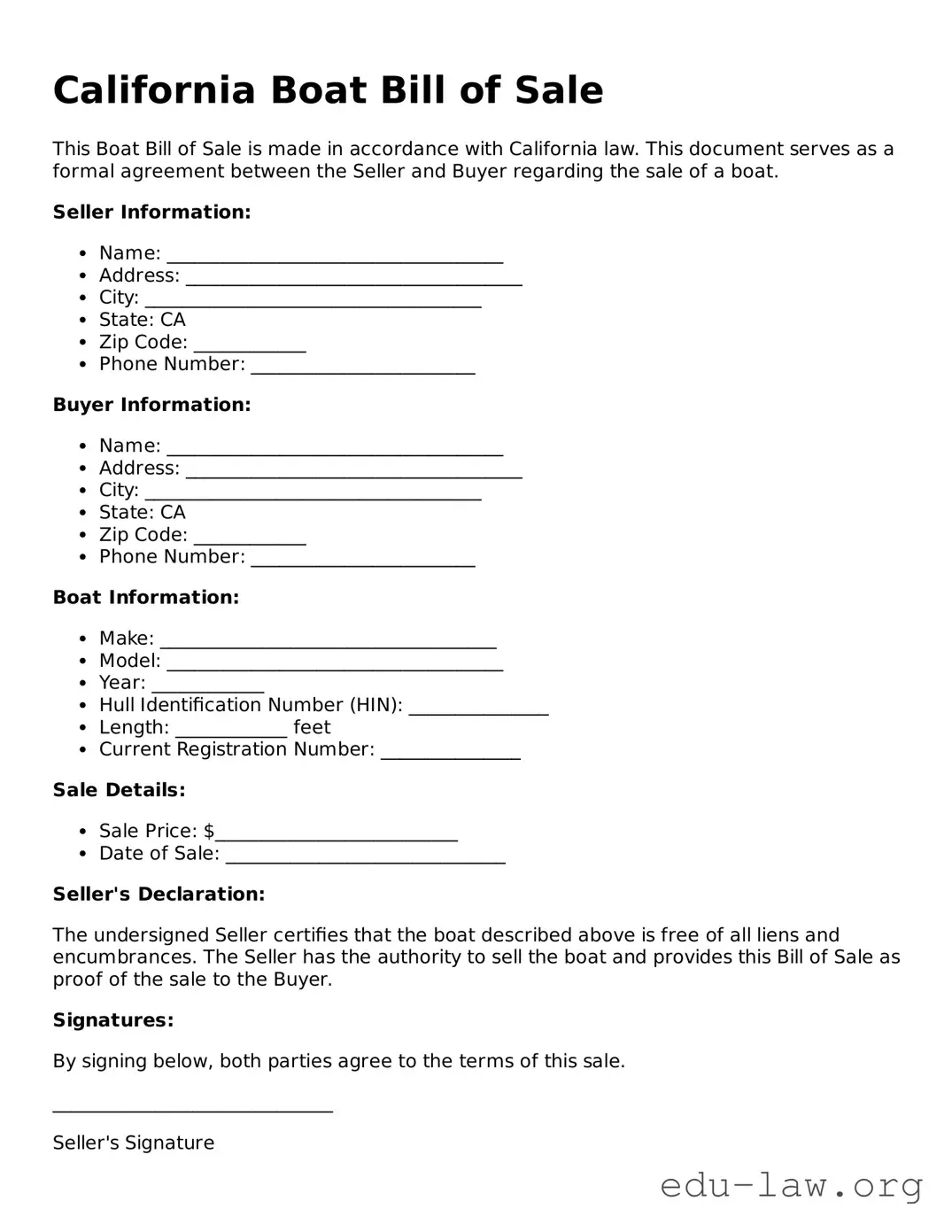
When it comes to buying or selling a boat in California, ensuring a smooth transaction requires using a Boat Bill of Sale form. This essential document acts as a written record of the sale, capturing all key details about the boat and the parties involved. It typically includes the names and addresses of both the seller and the buyer, descriptions of the vessel—such as the make, model, year, and hull identification number—as well as the sale price. This not only protects both parties but also helps in establishing ownership, which is crucial for registration purposes. Additionally, the form may include information about any liens, which are claims against the boat for debts. Completing a Boat Bill of Sale form serves to safeguard the interests of both the buyer and seller by providing clear proof of the transaction. Whether you're trading up or moving on from your watercraft, understanding the nuances of this form is vital for a legally binding and effective sale.
California Boat Bill of Sale
This Boat Bill of Sale is made in accordance with California law. This document serves as a formal agreement between the Seller and Buyer regarding the sale of a boat.
Seller Information:
Buyer Information:
Boat Information:
Sale Details:
Seller's Declaration:
The undersigned Seller certifies that the boat described above is free of all liens and encumbrances. The Seller has the authority to sell the boat and provides this Bill of Sale as proof of the sale to the Buyer.
Signatures:
By signing below, both parties agree to the terms of this sale.
______________________________
Seller's Signature
Date: _________________________
______________________________
Buyer's Signature
Date: _________________________
Note: It is advisable for both parties to retain a copy of this Bill of Sale for their records.
| Fact Name | Description |
|---|---|
| Definition | The California Boat Bill of Sale form is a legal document that serves as proof of the sale and transfer of ownership of a boat between a seller and a buyer. |
| Governing Law | This form is governed by California Civil Code Sections 1646 through 1654, which outlines the requirements for sales contracts. |
| Notarization | Notarization is not strictly required for the Boat Bill of Sale to be valid in California, but it is recommended to prevent disputes. |
| Required Information | The form must include details about the boat, such as the make, model, year, and hull identification number (HIN). |
| Buyer and Seller Details | Complete names and addresses of both the seller and the buyer should be clearly stated on the form. |
| Sales Price | The sales price of the boat must be explicitly noted, as this informs tax authorities of the transaction value. |
| As-Is Condition | Most Boat Bills of Sale will include a clause stating the boat is sold "as-is," meaning there are no warranties on condition or performance. |
| Transfer of Title | The Bill of Sale facilitates the transfer of title, but a separate document, the title itself, must also be transferred to complete the sale. |
| Record Keeping | Both parties should retain a copy of the Bill of Sale for their records to verify the transaction in the future. |
| Usage | The completed form can also assist in registering the boat with the California Department of Motor Vehicles (DMV), making it an essential document for boat ownership. |
After gathering the necessary information, you are ready to complete the California Boat Bill of Sale form. This document is crucial for transferring ownership of a boat, providing proof of sale, and ensuring that both parties are protected in the transaction. Following these steps will help you fill out the form accurately and effectively.
What is a California Boat Bill of Sale form?
The California Boat Bill of Sale form is a legal document used to record the sale of a boat. This form not only serves as proof of purchase but also provides important information regarding the transaction, such as the parties involved and details about the boat being sold.
Is a Boat Bill of Sale required in California?
In California, a Boat Bill of Sale is not legally required for every transaction. However, it is highly recommended as it protects both the buyer and seller. This document ensures that both parties have a clear understanding of the sale and can validate their ownership in the future.
What information is included in the Boat Bill of Sale?
The Boat Bill of Sale typically includes the names and addresses of the buyer and seller, the purchase price, the boat's description (including make, model, year, and hull identification number), and the date of the transaction. Both parties should sign the form to confirm their agreement.
How do I complete the Boat Bill of Sale?
To complete a Boat Bill of Sale, fill out all required information accurately. Ensure that both the buyer and seller review the details before signing. It’s advisable to keep a copy of the completed form for future reference. This document can be created using a template or drafted manually if all necessary information is included.
Can I use a generic Bill of Sale for my boat?
Yes, you can use a generic Bill of Sale for your boat transaction, provided it includes all necessary information. However, utilizing a specific California Boat Bill of Sale form can ensure compliance with state regulations and may provide added protection. This form often includes specific terms related to boat sales.
Do I need to have the Boat Bill of Sale notarized?
While notarization is not a requirement for a Boat Bill of Sale in California, it can add an extra layer of verification that may be beneficial, especially in disputes. If both parties agree, they can have the document notarized to ensure authenticity and to safeguard against future claims.
What happens if I lose the Boat Bill of Sale?
If a Boat Bill of Sale is lost, it can be challenging, but there are steps to take. The buyer and seller can recreate the document if both agree on the terms and details of the sale. Including a statement indicating the loss of the original can also be helpful. Having a witness to the original transaction can provide additional supporting information if needed.
What should I do with the Boat Bill of Sale after the sale?
After completing the sale, both the buyer and seller should keep their copies of the Boat Bill of Sale for record-keeping purposes. Buyers typically would need to submit it to the California Department of Motor Vehicles (DMV) when registering the boat, while sellers should retain theirs to document the transfer of ownership.
When completing the California Boat Bill of Sale form, individuals often overlook important details that can lead to complications. Here are seven common mistakes to avoid:
Being mindful of these mistakes when filling out the California Boat Bill of Sale can make the process smoother and prevent legal complications later on.
The California Boat Bill of Sale form is an essential document for anyone buying or selling a boat. However, there are several other documents that often accompany this form to ensure a smooth transaction and proper registration. Each of these documents serves a unique purpose, adding clarity and legitimacy to the boat sale process.
Having these documents ready can greatly enhance the buying or selling process, ensuring that all legal requirements are met. It helps both parties understand their rights and responsibilities, creating a smoother transaction experience.
The Vehicle Bill of Sale is a document used when transferring ownership of a motor vehicle. Like the Boat Bill of Sale, it includes details such as the seller's and buyer's names, signatures, and the vehicle identification number (VIN). Both documents provide legal proof of the transaction, making them essential for registration purposes. They ensure that the buyer gains proper ownership and that the seller is released from future liabilities associated with the vehicle or boat.
The Trailer Bill of Sale serves a similar purpose for the sale of a trailer. It outlines the terms of the transfer, including the trailer's identification details and the personal information of both parties involved. Much like the Boat Bill of Sale, it acts as proof of ownership transfer and is necessary for registering the trailer with the Department of Motor Vehicles. Both documents help prevent disputes by documenting the agreed-upon terms of sale.
A Motorcycle Bill of Sale is another comparable document. It is used when buying or selling a motorcycle, capturing key information about the vehicle and the parties involved in the transaction. This document shares similarities with the Boat Bill of Sale by providing essential proof of ownership and acting as a record that detailing the transaction, thus protecting both the buyer and seller from future claims.
The Manufactured Home Bill of Sale is specifically designed for the sale of manufactured homes or mobile homes. It contains similar elements, such as identification details and contact information for both the seller and buyer. Just like the Boat Bill of Sale, this document solidifies the transaction and provides evidence necessary for the new owner to register the home with relevant authorities and acquire any necessary permits.
An ATV (All-Terrain Vehicle) Bill of Sale is utilized when transferring ownership of an all-terrain vehicle. The format and purpose align closely with that of the Boat Bill of Sale, including buyer and seller information, vehicle identification details, and the sale price. This document helps transfer ownership legally, ensuring both parties are protected and that the buyer can register the ATV without complications.
The Snowmobile Bill of Sale functions in the same manner for snowmobiles. It captures critical transaction details, distinguishing it from other sales forms. This document is essential for establishing ownership, much like the Boat Bill of Sale, as it provides necessary documentation during registration with state authorities and illustrates proof of the sale for both the buyer and seller.
The Home Appliance Bill of Sale is used when appliances like refrigerators or washing machines are sold. Although less costly than vehicles or boats, it still documents ownership transfer. Like the Boat Bill of Sale, it protects both the buyer and seller by providing evidence of the transaction and outlining the condition and warranty of the appliance upon sale.
The Animal Bill of Sale is applicable for transactions involving pets or livestock. Much like the Boat Bill of Sale, it documents buyer and seller information and details about the animal, including breed and health status. This document solidifies the transfer of ownership and can provide proof if any disputes arise regarding the animal's ownership in the future.
The Business Bill of Sale is a more comprehensive document used when selling an entire business or a business's assets. Similar to the Boat Bill of Sale, it outlines terms, seller and buyer information, and the assets being transferred. It serves to protect both parties by legally documenting the sale agreement, ensuring clarity in ownership and responsibilities post-sale.
When filling out the California Boat Bill of Sale form, it’s important to pay attention to certain key elements to ensure a smooth process. Here’s a helpful list of dos and don’ts:
The California Boat Bill of Sale form is an important document for transferring ownership of a boat. However, there are several misconceptions surrounding this form. Below is a list of eight common misunderstandings along with explanations to clarify these points.
Many people believe that a Bill of Sale is optional when selling or buying a boat. In California, it is a crucial document that provides legal evidence of the transaction and protects both the buyer and seller.
While notarization can add an extra layer of security to the transaction, California does not require a Bill of Sale to be notarized for it to be legally valid.
Many people think that only new boats need a Bill of Sale. In fact, any transfer of ownership—whether for a new or used boat—should be documented with this form.
Though it is essential for the Bill of Sale to contain certain information, it does not need to follow a strict template. As long as key details such as buyer and seller information and vessel description are present, the form is valid.
While some states require a title for boat ownership, California permits the sale of boats that do not have a title, provided a Bill of Sale is executed.
Buyers and sellers both have responsibilities regarding fees. Buyers should be aware that they may need to pay sales tax, registration fees, and other costs associated with the transfer.
Some people believe that a verbal agreement suffices for transferring ownership of a boat. However, having a written Bill of Sale is critical for establishing a clear transaction record.
There is no minimum value for which a Bill of Sale is required. Any sale, regardless of the boat's worth, benefits from having this important documentation.
Understanding these points can help ensure that the boat buying or selling process is smooth and legally sound. It is advisable to create a Bill of Sale that meets the specific requirements in California for a successful transaction.
When it comes to buying or selling a boat in California, understanding how to properly fill out and utilize the Boat Bill of Sale form is crucial. Here are nine essential takeaways that can guide you through the process.
Understanding these key points can help streamline the buying or selling process and ensure a smoother experience for all parties involved. Take the time to prepare and fill out the California Boat Bill of Sale properly.
How to Get a New Title for a Boat - The document may include any additional stipulations agreed upon by both parties.
Free Bill of Sale for Boat in Texas - Serves as a receipt for the transaction between the buyer and seller.
Does a Bill of Sale Have to Be Notarized in Florida - The Boat Bill of Sale can be more than just a transaction record; it is a safeguard for both parties.
Ga Boat Bill of Sale - Filling out the form completely can assist in ensuring a smooth registration process with state authorities.