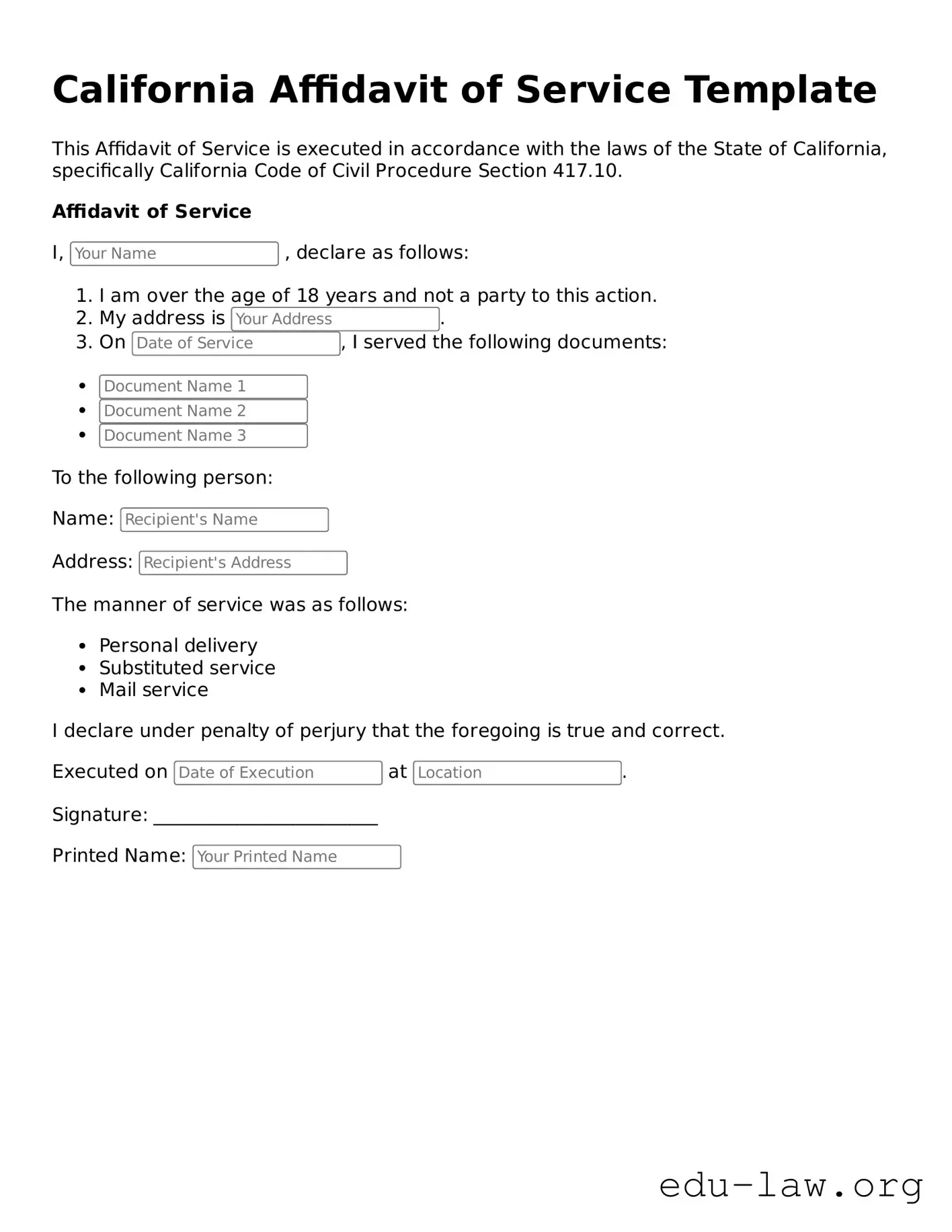
In the realm of legal proceedings, ensuring that all parties are properly informed is crucial for the integrity of the judicial process. One essential tool that facilitates this communication is the California Affidavit of Service form. This document serves as a formal declaration, affirming that legal papers have been delivered to the appropriate individuals or entities involved in a case. It outlines critical information, including the date and manner of service, the identity of the recipient, and the signature of the individual who performed the service. By providing a clear and detailed account of how and when the documents were served, this affidavit plays a pivotal role in upholding the principles of due process. Moreover, it is not merely a procedural formality; it can significantly impact the outcome of a case if service is contested. Therefore, understanding the nuances of the California Affidavit of Service is essential for anyone navigating the legal landscape, whether they are attorneys, litigants, or individuals seeking to comprehend their rights and responsibilities within the judicial system.
California Affidavit of Service Template
This Affidavit of Service is executed in accordance with the laws of the State of California, specifically California Code of Civil Procedure Section 417.10.
Affidavit of Service
I, , declare as follows:
To the following person:
Name:
Address:
The manner of service was as follows:
I declare under penalty of perjury that the foregoing is true and correct.
Executed on at .
Signature: ________________________
Printed Name:
| Fact Name | Details |
|---|---|
| Purpose | The California Affidavit of Service form is used to confirm that legal documents have been delivered to the intended recipient. |
| Governing Law | This form is governed by California Code of Civil Procedure, Section 417.10. |
| Filing Requirement | The completed affidavit must be filed with the court to establish proof of service. |
| Signature Requirement | The server must sign the affidavit, affirming that the information provided is accurate. |
After obtaining the California Affidavit of Service form, you will need to fill it out accurately. This form is essential for confirming that legal documents were served properly. Follow these steps to complete the form.
Once the form is completed, it should be filed with the appropriate court or agency as required. Make sure to keep a copy for your records.
What is a California Affidavit of Service?
The California Affidavit of Service is a legal document used to confirm that a specific legal document, such as a summons or complaint, has been delivered to a party involved in a legal proceeding. This affidavit serves as proof that the required service of process has been completed, ensuring that the other party is aware of the legal actions being taken against them.
Who can serve documents in California?
In California, documents can be served by a variety of individuals. This includes registered process servers, law enforcement officers, or any adult who is not a party to the case. The person serving the documents must be competent and over the age of 18. It is essential that the individual serving the documents follows the proper procedures to ensure the service is valid.
What information is required on the Affidavit of Service?
The Affidavit of Service must include several key pieces of information. This includes the name of the person served, the date and time of service, the method of service, and the address where the service occurred. Additionally, the affidavit must be signed by the person who completed the service, affirming that the information provided is accurate.
Is the Affidavit of Service mandatory?
Yes, in most cases, filing an Affidavit of Service is mandatory. Courts require this document to confirm that all parties have been properly notified of the legal proceedings. Without it, there may be delays in the case, or the court could dismiss the case altogether due to improper service.
How do I complete the Affidavit of Service?
To complete the Affidavit of Service, begin by filling out the required fields with accurate information regarding the service. Ensure that the details about the recipient and the method of service are correct. After completing the form, the server must sign it in the presence of a notary public or another authorized official to validate the affidavit.
Can I serve documents myself?
Yes, you can serve documents yourself, provided you are over 18 and not a party to the case. However, it is often advisable to hire a professional process server to ensure that the service is executed correctly and in compliance with legal requirements. This can help avoid complications later in the legal process.
What happens if the Affidavit of Service is not filed?
If the Affidavit of Service is not filed, the court may not recognize that the other party has been properly notified of the legal action. This could lead to delays in your case or even dismissal. It is crucial to file the affidavit promptly to avoid these potential issues.
Where do I file the Affidavit of Service?
The Affidavit of Service should be filed with the court where your case is being heard. Ensure that you keep a copy of the affidavit for your records. Check with the specific court for any local rules or procedures regarding the filing process.
Incomplete Information: Many individuals fail to provide all the necessary details required on the form. This can include missing names, addresses, or dates. Each piece of information is crucial for verifying that the service was properly executed.
Incorrect Service Method: People sometimes select the wrong method of service. California law outlines specific methods, such as personal service or substituted service, and choosing incorrectly can lead to delays or dismissals.
Signature Issues: A common mistake is neglecting to sign the affidavit. The form must be signed by the server, and without this signature, the document is not valid.
Failure to Include the Date of Service: It is essential to include the exact date when the service occurred. Omitting this information can create uncertainty about whether the service was completed within the required time frame.
Not Keeping Copies: After filling out the affidavit, individuals often forget to make copies for their records. Keeping a copy is important for future reference and can be helpful if any disputes arise.
Ignoring Local Rules: Each court may have specific requirements regarding the affidavit. Failing to check local rules can lead to additional complications, as what works in one jurisdiction may not be acceptable in another.
The California Affidavit of Service form is an important document used to prove that legal papers were delivered to the right person. However, it often works alongside other forms and documents that help ensure the legal process runs smoothly. Here are four other documents you might encounter in this context:
Each of these documents plays a vital role in the legal process, helping to ensure that all parties are informed and that the court has the necessary information to proceed. Understanding these forms can help demystify the legal system and empower individuals to navigate it more effectively.
The California Affidavit of Service is similar to the Proof of Service form used in various jurisdictions. Both documents serve the same purpose: to confirm that legal documents have been delivered to the appropriate parties. They outline details such as who was served, what documents were served, and when and where the service took place. This ensures that all parties are aware of the legal proceedings and can respond accordingly.
Another document that shares similarities is the Certificate of Service. This certificate typically accompanies legal filings and verifies that all necessary parties have received copies of the documents. Like the Affidavit of Service, it includes information about the parties involved and the method of service, providing a clear record of compliance with legal requirements.
The Summons is also comparable, as it is a legal document that initiates a lawsuit. While the Affidavit of Service confirms delivery, the Summons itself informs the defendant of the legal action against them. Both documents work together to ensure that the defendant is properly notified and has the opportunity to respond.
The Notice of Acknowledgment of Receipt is another related document. This form is used when a party acknowledges receipt of legal documents. It serves as proof that the documents were received, similar to the Affidavit of Service, which provides evidence of delivery. Both documents help maintain transparency in legal proceedings.
The Return of Service document is closely related as well. It is filed by the process server to confirm that they have completed the service of process. This document provides details about how and when the service was executed, much like the Affidavit of Service. It ensures that there is an official record of the service being performed.
The Service of Process form is similar in that it outlines the procedures for delivering legal documents to the involved parties. While the Affidavit of Service provides proof of that delivery, the Service of Process form details the steps that must be taken to ensure proper service, ensuring that legal protocols are followed.
The Notice of Motion is another document that can be compared to the Affidavit of Service. It notifies parties about a motion being filed in court. While the Affidavit of Service confirms that the Notice of Motion has been served, both documents are essential in keeping all parties informed about the proceedings and deadlines.
Lastly, the Affidavit of Mailing is akin to the Affidavit of Service, as it provides proof that documents were sent through the mail. This affidavit confirms that the recipient was notified, similar to how the Affidavit of Service confirms delivery, ensuring that all parties are kept in the loop regarding legal matters.
When filling out the California Affidavit of Service form, it's important to follow certain guidelines to ensure that your document is completed correctly. Here are some things you should and shouldn't do:
By following these tips, you can ensure that your Affidavit of Service is filled out properly and meets the necessary requirements.
When it comes to the California Affidavit of Service form, there are several misconceptions that can lead to confusion. Here are five common misunderstandings:
While it's true that many people can serve documents, there are specific rules. Generally, the person serving the documents must be at least 18 years old and not a party to the case.
Some believe that providing proof of service is not necessary. In reality, it's crucial to file the Affidavit of Service to show the court that the other party was properly notified.
Many think that mailing the documents is sufficient. However, personal service is often required, especially for certain legal actions.
Some people assume they can complete the affidavit later. It's important to fill it out immediately after serving the documents to ensure accuracy.
Many mistakenly believe that serving documents means the case is over. In fact, serving documents is just one step in the legal process.
Understanding these misconceptions can help ensure that you navigate the legal process more effectively.
When filling out and using the California Affidavit of Service form, there are several important points to keep in mind. Understanding these key takeaways can help ensure that the process goes smoothly and that all legal requirements are met.
By following these key takeaways, you can navigate the process of using the California Affidavit of Service form with confidence and clarity.