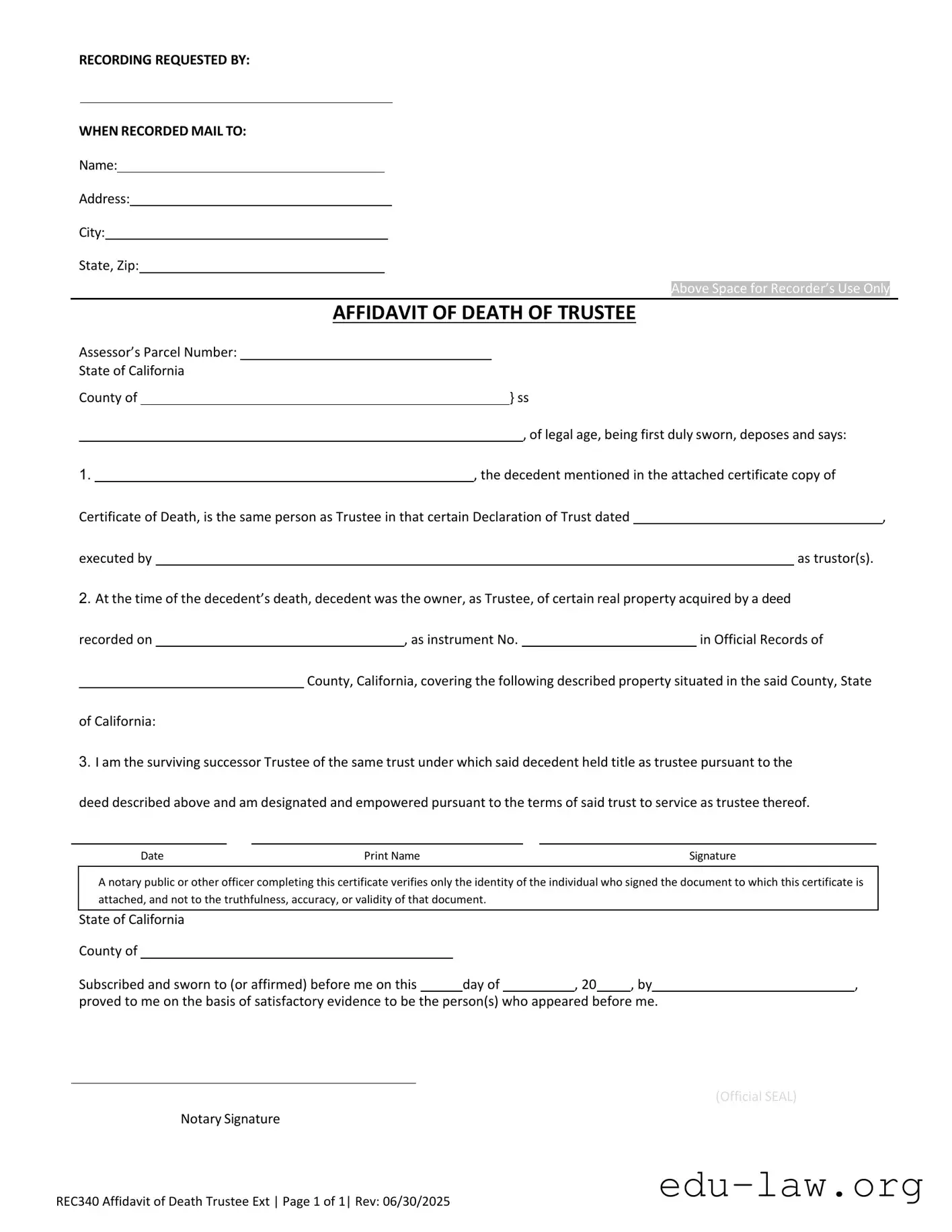
The California Affidavit of Death of a Trustee form serves a vital purpose in the realm of estate management and trust administration. When a trustee passes away, this form provides a formal mechanism to notify interested parties and facilitate the transition of responsibilities. It allows the successor trustee or beneficiaries to affirm the death of the trustee, ensuring that the trust can continue to be administered according to its terms. This affidavit is not merely a notification; it also serves to update public records, helping to clarify the legal standing of the trust and its assets. By completing this form, the successor trustee can take necessary actions, such as accessing trust assets or distributing them to beneficiaries, without unnecessary delays. The affidavit must include specific details, such as the deceased trustee's name, date of death, and pertinent trust information. This ensures that all parties involved have a clear understanding of the situation and can proceed with the trust's administration in a timely manner. Understanding the significance of this form is essential for those navigating the complexities of trust law in California, particularly during what can be a challenging time for families and beneficiaries.

Above Space for Recorder’s Use Only
|
|
|
|
AFFIDAVIT OF DEATH OF TRUSTEE |
|
||||||
Assessor’s Parcel Number: |
|
|
|
|
|
|
|
|
|||
State of California |
|
|
|
|
|
|
|
|
|||
County of |
|
|
|
} ss |
|
||||||
|
|
|
|
|
|
|
|
, of legal age, being first duly sworn, deposes and says: |
|
||
1. |
|
|
|
|
, the decedent mentioned in the attached certificate copy of |
|
|||||
Certificate of Death, is the same person as Trustee in that certain Declaration of Trust dated |
, |
||||||||||
executed by |
|
|
|
|
|
|
|
as trustor(s). |
|
||
2.At the time of the decedent’s death, decedent was the owner, as Trustee, of certain real property acquired by a deed
recorded on, as instrument No.in Official Records of
County, California, covering the following described property situated in the said County, State
of California:
3.I am the surviving successor Trustee of the same trust under which said decedent held title as trustee pursuant to the
deed described above and am designated and empowered pursuant to the terms of said trust to service as trustee thereof.
Date |
Print Name |
Signature |
A notary public or other officer completing this certificate verifies only the identity of the individual who signed the document to which this certificate is attached, and not to the truthfulness, accuracy, or validity of that document.
State of California
County of |
|
|
|
|
|
|
|
|
|
|
|
Subscribed and sworn to (or affirmed) before me on this |
|
|
day of |
, 20 |
, by |
, |
|||||
proved to me on the basis of satisfactory evidence to be |
|
|
|
|
|
|
|
|
|
||
the person(s) who appeared before me. |
|
|
|||||||||
(Official SEAL)
Notary Signature
REC340 Affidavit of Death Trustee Ext | Page 1 of 1| Rev: 06/30/2025
| Fact Name | Description |
|---|---|
| Purpose | The California Affidavit of Death of a Trustee form is used to officially notify interested parties of a trustee's death and to facilitate the transfer of trust assets. |
| Governing Law | This form is governed by California Probate Code Section 15660, which outlines the procedures for handling a trustee's death. |
| Filing Requirement | While filing the affidavit is not mandatory, it is recommended to provide clear evidence of the trustee's death to avoid disputes. |
| Signatures | The affidavit must be signed by the successor trustee or a beneficiary of the trust, affirming the death of the trustee. |
| Notarization | Notarization of the affidavit is required to ensure authenticity and to validate the document in legal matters. |
After filling out the California Affidavit of Death of a Trustee form, you'll need to submit it to the appropriate county office. This step is important to ensure that the trustee's death is officially recognized and that any necessary changes to the trust can be made.
What is the California Affidavit of Death of a Trustee form?
The California Affidavit of Death of a Trustee form is a legal document used to officially declare the death of a trustee in a trust. This form helps to update the records of the trust and facilitates the transfer of responsibilities to the successor trustee. It serves as proof that the named trustee has passed away, allowing the trust to continue operating smoothly under new management.
Who needs to fill out this form?
The form must be filled out by the successor trustee or an individual who has the authority to act on behalf of the trust. This person will need to provide information about the deceased trustee, including their name, date of death, and details about the trust itself. It’s important that the individual completing the form has access to the necessary documentation to support the claim of death.
Where do I file the California Affidavit of Death of a Trustee form?
This form is typically filed with the county recorder’s office where the trust property is located. Depending on the specifics of the trust and the assets involved, you may also need to provide copies to other relevant parties, such as beneficiaries or financial institutions holding trust assets. Always check with local authorities to ensure compliance with any additional requirements.
Is there a fee associated with filing this form?
Yes, there may be a fee for filing the California Affidavit of Death of a Trustee form. The exact amount can vary by county, so it’s advisable to contact the local county recorder’s office for their specific fee schedule. Keep in mind that there may also be additional costs if you need certified copies of the filed document.
What happens after the form is filed?
Once the form is filed, the successor trustee can begin managing the trust according to its terms. The filing of this affidavit officially recognizes the change in trusteeship, allowing the new trustee to access trust assets, make distributions, and fulfill their duties. It’s crucial for the successor trustee to keep accurate records and communicate with beneficiaries about the trust’s status moving forward.
Failing to include the full legal name of the deceased trustee. It’s crucial to provide the exact name as it appears in legal documents.
Not specifying the date of death accurately. This date is essential for legal clarity and should be verified.
Omitting the trust name or providing an incorrect name. The trust name must match the documentation to avoid confusion.
Neglecting to sign the affidavit. A signature is required to validate the document, and a missing signature can lead to delays.
Using an incorrect format for the address of the deceased. Ensure that the address is complete and formatted correctly.
Forgetting to include the notary acknowledgment. This is a necessary step to confirm the identity of the signer.
Failing to provide supporting documentation, such as a death certificate. This documentation is often required to substantiate the claim.
Not checking for inconsistencies in the information provided. Double-check all details to ensure accuracy and coherence.
Submitting the form without making copies for personal records. Always keep a copy for your files in case of future inquiries.
Overlooking the filing deadline. Be aware of any time limits associated with submitting the affidavit to avoid complications.
The California Affidavit of Death of a Trustee form serves as an important legal document when a trustee passes away. It helps to clarify the status of a trust and ensures that the trust's assets are managed according to the deceased trustee's wishes. In addition to this affidavit, several other forms and documents may be necessary to facilitate the proper administration of the trust and the transfer of assets. Below is a list of commonly used forms and documents that may accompany the affidavit.
Understanding these documents can facilitate a smoother transition of responsibilities and ensure that the trust is administered according to the deceased trustee's intentions. Each document plays a crucial role in the overall process of trust management and asset distribution.
The California Affidavit of Death of a Trustee form shares similarities with the Affidavit of Death of a Joint Tenant. Both documents serve to establish the death of an individual and facilitate the transfer of property interests. In the case of the Affidavit of Death of a Joint Tenant, it is specifically used when one joint tenant passes away, allowing the surviving tenant to claim full ownership of the property without going through probate. This document simplifies the process, ensuring that the remaining owner can quickly access their rights to the property.
Another document that resembles the California Affidavit of Death of a Trustee is the Death Certificate. While the Affidavit of Death of a Trustee is a legal declaration made by a surviving trustee, the Death Certificate is an official record issued by a government authority that confirms an individual’s death. Both documents are essential in proving the death of the individual involved, but the Death Certificate is often required to support the affidavit in legal proceedings or property transfers.
The California Affidavit of Death of a Trustee also has parallels with the Will. A Will outlines how a person's assets should be distributed after their death, including the appointment of a trustee to manage certain assets. When a trustee passes away, the Affidavit of Death of a Trustee is used to inform relevant parties of the trustee's death, ensuring that the management of the trust can continue smoothly. Both documents are crucial in the estate planning process, providing clarity on asset distribution and management.
Similar to the Affidavit of Death of a Trustee is the Petition for Probate. This legal document is filed to initiate the probate process after an individual passes away. While the Affidavit of Death of a Trustee focuses on the death of a trustee specifically, the Petition for Probate addresses the overall estate of the deceased. Both documents serve to facilitate the handling of a deceased person's affairs, but the Petition for Probate typically encompasses a broader scope, dealing with all assets and beneficiaries.
The California Affidavit of Death of a Trustee is also akin to the Certificate of Trust. This document provides proof of the existence of a trust and the authority of the trustee. While the Affidavit of Death of a Trustee confirms the death of a trustee, the Certificate of Trust can be used to demonstrate the trust's validity and the powers of the remaining trustees. Together, they ensure that the trust operates effectively, even in the face of changes in its management.
Lastly, the California Affidavit of Death of a Trustee is similar to the Notice of Death. This document serves to inform interested parties, such as beneficiaries and creditors, of an individual's passing. While the Notice of Death may not have the same legal weight as the Affidavit, it plays a crucial role in the communication process following a death. Both documents aim to ensure transparency and proper management of the deceased's affairs, fostering clear communication among all parties involved.
When filling out the California Affidavit of Death of a Trustee form, there are several important dos and don'ts to keep in mind. Following these guidelines can help ensure that your form is completed correctly and efficiently.
Understanding the California Affidavit of Death of a Trustee form can be challenging, especially with the various misconceptions that often arise. Here are nine common misunderstandings about this form, clarified for better comprehension.
This is not entirely accurate. While the form is primarily used when a trustee dies, it can also be relevant if the trustee is unable to fulfill their duties due to other circumstances, such as incapacity.
In reality, the form may vary depending on the type of trust involved. Different trusts have specific requirements, so it’s essential to ensure you are using the correct form for your situation.
This is a misconception. Filing the affidavit is often necessary to formally acknowledge the death of a trustee and to facilitate the transition of responsibilities to a successor trustee.
While it is possible for individuals to fill out the form themselves, it is advisable to seek guidance. Mistakes can lead to delays or complications in the trust administration process.
This is not always true. In many cases, the affidavit is filed with the financial institutions or entities that manage the trust assets rather than with a court.
Actually, if there are errors or changes in circumstances, it is possible to amend the affidavit. However, this process may require additional documentation.
This is misleading. While there may not be a strict deadline, timely filing is crucial to ensure the smooth operation of the trust and to avoid potential disputes.
This misconception overlooks that the affidavit applies to various types of trusts, including revocable and irrevocable trusts, not just family trusts.
While filing the affidavit is a step towards transition, the successor trustee may need to provide additional documentation to assume their role officially.
By addressing these misconceptions, individuals can navigate the process with greater confidence and clarity. Understanding the California Affidavit of Death of a Trustee form is crucial for effective trust administration.
The California Affidavit of Death of a Trustee form is an important legal document used to address the death of a trustee. Here are key takeaways regarding its completion and use: