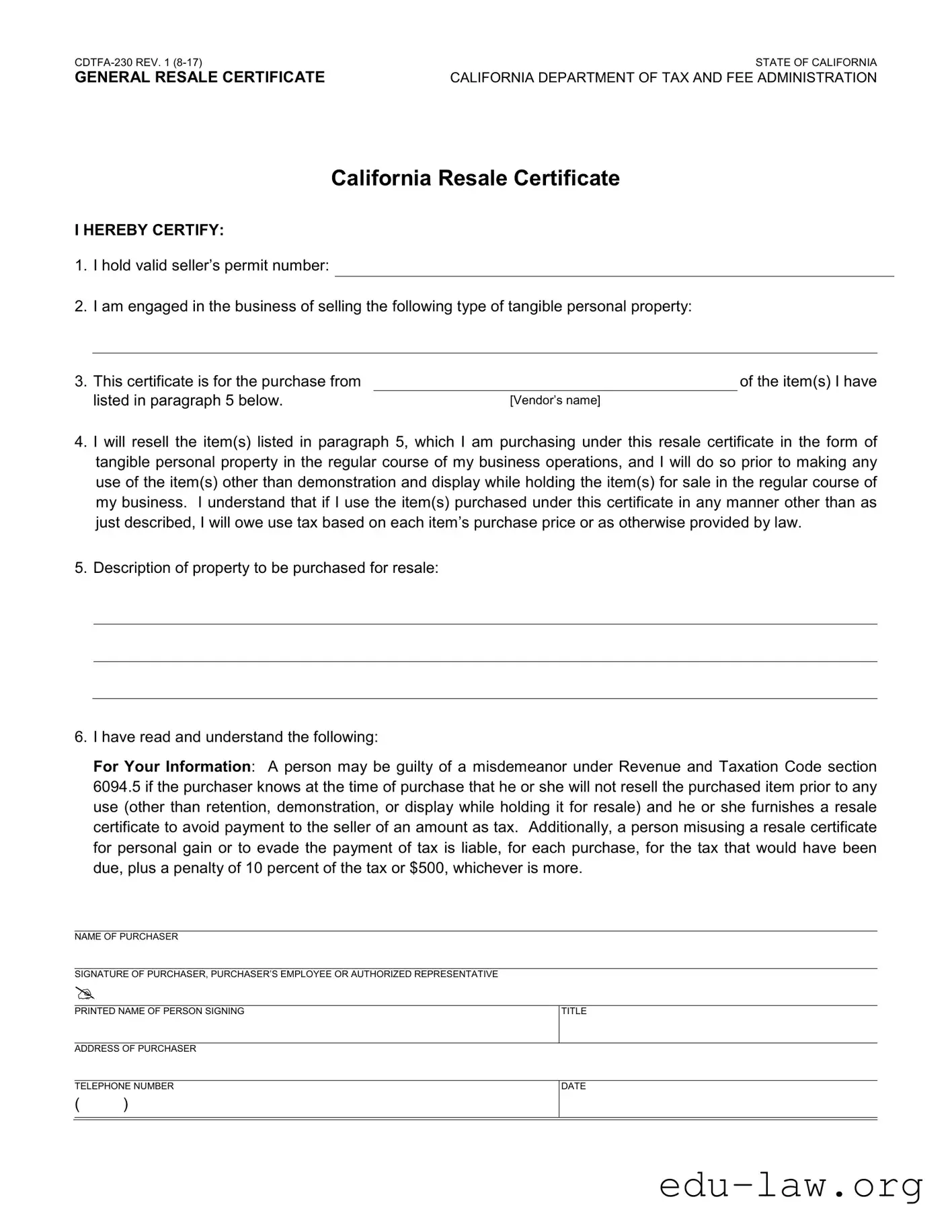
The California Resale Certificate, officially designated as CDTFA-230 REV. 1 (8-17), serves as a vital tool for businesses engaged in the sale of tangible personal property. This form allows a purchaser to buy items without paying sales tax at the point of sale, provided that these items are intended for resale in the regular course of business. Essential details captured on the form include the seller’s permit number, the type of tangible goods being sold, and the vendor's name from whom the items are being purchased. The certificate also requires the purchaser to affirm their commitment to resell the listed items without using them for personal purposes, aside from demonstration or display. It is crucial for businesses to understand the implications of misuse; if a purchaser fails to resell the items as stated, they may incur a use tax based on the purchase price. This document not only facilitates smooth transactions but also underscores the legal responsibilities that accompany its use, thereby ensuring compliance with California’s tax regulations. By signing the form, the purchaser acknowledges their understanding of these responsibilities and the potential penalties for misuse, including fines that may arise from non-compliance.
CDTFA230 REV. 1 (817) |
STATE OF CALIFORNIA |
GENERAL RESALE CERTIFICATE |
CALIFORNIA DEPARTMENT OF TAX AND FEE ADMINISTRATION |
CALIFORNIA RESALE CERTIFICATE
I HEREBY CERTIFY:
1.I hold valid seller’s permit number:
2.I am engaged in the business of selling the following type of tangible personal property:
3. This certificate is for the purchase from |
|
of the item(s) I have |
listed in paragraph 5 below. |
[Vendor’s name] |
|
4.I will resell the item(s) listed in paragraph 5, which I am purchasing under this resale certificate in the form of tangible personal property in the regular course of my business operations, and I will do so prior to making any use of the item(s) other than demonstration and display while holding the item(s) for sale in the regular course of my business. I understand that if I use the item(s) purchased under this certificate in any manner other than as just described, I will owe use tax based on each item’s purchase price or as otherwise provided by law.
5.Description of property to be purchased for resale:
6.I have read and understand the following:
FOR YOUR INFORMATION: A person may be guilty of a misdemeanor under Revenue and Taxation Code section 6094.5 if the purchaser knows at the time of purchase that he or she will not resell the purchased item prior to any use (other than retention, demonstration, or display while holding it for resale) and he or she furnishes a resale certificate to avoid payment to the seller of an amount as tax. Additionally, a person misusing a resale certificate for personal gain or to evade the payment of tax is liable, for each purchase, for the tax that would have been due, plus a penalty of 10 percent of the tax or $500, whichever is more.
NAME OF PURCHASER
SIGNATURE OF PURCHASER, PURCHASER’S EMPLOYEE OR AUTHORIZED REPRESENTATIVE
PRINTED NAME OF PERSON SIGNING
TITLE
ADDRESS OF PURCHASER
TELEPHONE NUMBER
()
DATE
| Fact Name | Fact Description |
|---|---|
| Form Title | California Resale Certificate (CDTFA-230 REV. 1 (8-17)) |
| Governing Law | Revenue and Taxation Code, Section 6094.5 |
| Seller's Permit Requirement | The purchaser must hold a valid seller’s permit number to use this certificate. |
| Purpose of the Certificate | This certificate is used to purchase items intended for resale without paying sales tax at the time of purchase. |
| Use of Purchased Items | Items must be resold in their original form, except for demonstration or display purposes. |
| Consequences of Misuse | Misusing the certificate can result in misdemeanor charges and penalties, including tax liability and fines. |
| Signature Requirement | The form must be signed by the purchaser or an authorized representative to be valid. |
| Information Disclosure | Purchasers must understand the implications of using the resale certificate, including potential penalties for misuse. |
Filling out the California Resale Certificate is an important step in ensuring compliance with tax regulations when purchasing items for resale. Follow these steps carefully to complete the form accurately.
What is the purpose of the California Resale Certificate (CDTFA-230)?
The California Resale Certificate, also known as CDTFA-230, serves as a document for businesses to purchase items intended for resale without paying sales tax at the time of purchase. By completing this certificate, a purchaser certifies that they hold a valid seller's permit and are engaged in selling tangible personal property. This allows businesses to avoid upfront tax costs, which they will later collect from customers when the items are sold.
Who is eligible to use the California Resale Certificate?
Any individual or business that holds a valid seller's permit in California is eligible to use the California Resale Certificate. The certificate is specifically for those engaged in the business of selling tangible personal property. It is important that the purchaser intends to resell the items listed on the certificate in the regular course of business operations, without using them for personal purposes before the resale.
What information is required on the California Resale Certificate?
The California Resale Certificate requires several key pieces of information. The purchaser must provide their valid seller’s permit number, describe the type of tangible personal property they are selling, and include the vendor's name from whom they are purchasing the items. Additionally, a detailed description of the property being purchased for resale must be included. The certificate must also be signed by the purchaser or an authorized representative, along with their printed name, title, address, and contact number.
What are the consequences of misusing the California Resale Certificate?
Misuse of the California Resale Certificate can lead to serious legal consequences. If a purchaser knowingly uses the certificate to avoid paying sales tax while intending to use the items for personal gain rather than resale, they may be guilty of a misdemeanor. In such cases, the purchaser is liable for the tax that would have been due, along with a penalty of 10 percent of the tax owed or $500, whichever amount is greater. This emphasizes the importance of using the certificate correctly and understanding its implications.
How should the California Resale Certificate be presented to the vendor?
The California Resale Certificate should be presented to the vendor at the time of purchase. It is advisable for the purchaser to ensure that the certificate is completed accurately and signed. The vendor will retain this certificate as proof of the tax-exempt status of the sale. It is recommended to keep a copy of the certificate for the purchaser's records, as this may be necessary for future reference or audits.
Not Providing a Valid Seller’s Permit Number: One common mistake is failing to include a valid seller’s permit number. This number is essential for the resale certificate to be valid.
Incorrect Description of Property: Some individuals do not accurately describe the tangible personal property they intend to resell. A clear and specific description is crucial.
Omitting the Vendor’s Name: Leaving out the vendor’s name from whom the items are being purchased can lead to complications. This information is necessary for the form's validity.
Misunderstanding the Use of Items: Many people mistakenly believe they can use the items purchased under the resale certificate for personal use. The form strictly requires that items be resold without prior use.
Failing to Sign the Certificate: A signature is a critical component of the form. Without it, the certificate is not considered valid.
Not Including Contact Information: Some individuals neglect to provide their contact information, such as address and telephone number. This information is essential for any follow-up communication.
Ignoring the Legal Implications: Many do not read or understand the legal ramifications outlined in the form. Awareness of these implications can prevent potential legal issues.
Using Outdated Forms: Using an outdated version of the resale certificate can lead to rejection. Always ensure that you are using the most current form.
Providing Incomplete Information: Incomplete forms are a common issue. Each section must be filled out completely to avoid delays or rejections.
Assuming All Purchases Qualify: Not all items may qualify for resale under this certificate. Understanding what can and cannot be purchased under this certificate is important.
When dealing with the California Resale Certificate, several other forms and documents are often necessary to ensure compliance with state regulations. Here are four key documents that complement the resale certificate:
Understanding these documents is crucial for any business owner in California. Proper documentation not only ensures compliance but also helps in maintaining organized records for tax purposes.
The California Seller's Permit Application is similar to the California Resale Certificate in that both documents are essential for businesses engaged in selling tangible personal property. The seller's permit serves as official permission from the state to collect sales tax on behalf of the government. Like the resale certificate, it requires the applicant to provide detailed information about their business operations and the type of goods sold. Both documents ensure compliance with state tax regulations and help to maintain accurate records for tax purposes.
The California Exempt Use Certificate also shares similarities with the California Resale Certificate. This document allows businesses to purchase items without paying sales tax when those items will be used in a manner that is exempt from taxation. Both certificates require the purchaser to certify their intentions regarding the use of the items, thereby ensuring that tax obligations are met. The exempt use certificate focuses on specific uses rather than resale, but both serve to clarify the tax status of transactions.
The IRS Form W-9 is another document that parallels the California Resale Certificate. While the W-9 is primarily used for tax identification purposes, it also requires the signer to certify that the information provided is accurate. Both forms emphasize the importance of honesty and compliance in business transactions. The W-9, like the resale certificate, serves as a safeguard against misuse of tax exemptions and provides necessary information for tax reporting.
The Sales Tax Exemption Certificate is similar in function to the California Resale Certificate. This document allows eligible purchasers to buy goods without paying sales tax, provided they meet certain criteria. Both certificates require the buyer to declare their intention to use the purchased items in a specific way that justifies the exemption. They both aim to streamline the purchasing process for businesses while ensuring compliance with tax laws.
The Vendor's Certificate of Exemption is another document that aligns closely with the California Resale Certificate. This certificate allows vendors to sell goods without charging sales tax to certain qualified purchasers. Both documents require detailed information about the purchaser and the nature of the transaction. They serve as a means to prevent tax evasion while facilitating legitimate business operations.
The California Use Tax Return form bears similarity to the California Resale Certificate in that it addresses tax obligations related to the purchase of tangible personal property. While the resale certificate allows for tax-free purchases intended for resale, the use tax return requires businesses to report and pay taxes on items that were not resold but used instead. Both documents are crucial for maintaining compliance with state tax laws and ensuring that businesses fulfill their tax responsibilities.
Lastly, the Business License Application is comparable to the California Resale Certificate in that it is a prerequisite for operating a business legally. Both documents require the applicant to provide information about their business activities and intentions. The business license ensures that the company is authorized to operate within a specific jurisdiction, while the resale certificate confirms the purchaser's eligibility to buy goods tax-free for resale. Both are vital components of the regulatory framework governing business operations.
When filling out the California Resale Certificate (CDTFA-230), there are important guidelines to follow. Here’s a list of things you should and shouldn’t do to ensure your form is completed accurately.
Here are six common misconceptions about the California Resale Certificate (CDTFA-230) that you should be aware of:
When filling out and using the California Resale Certificate (CDTFA-230), it is crucial to understand the implications and requirements involved. Here are some key takeaways to keep in mind:
Understanding these points will help ensure that you use the California Resale Certificate correctly and avoid any unintended consequences. Always consult with a tax professional if you have questions about your specific situation.