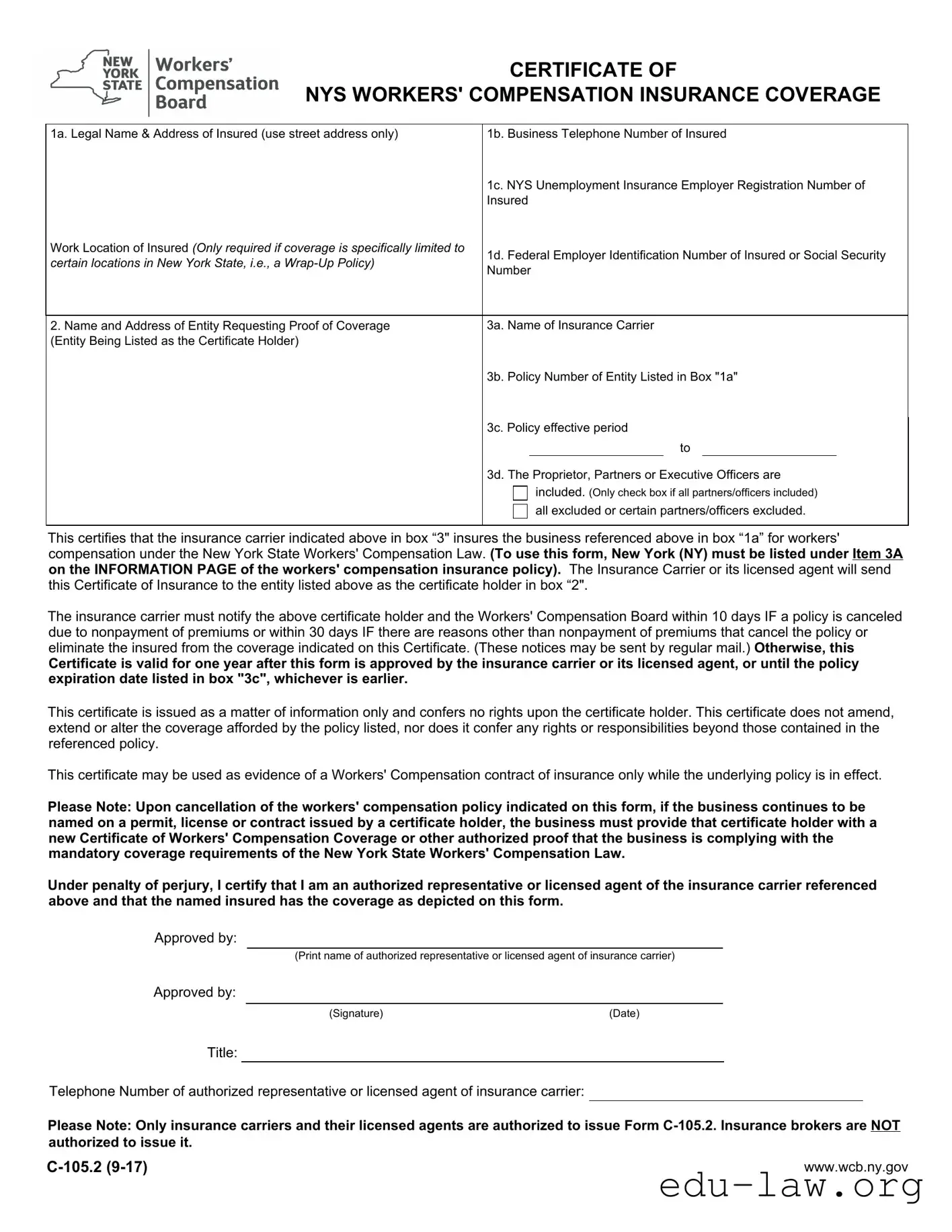
The C 105 2 form, also known as the Certificate of New York State Workers' Compensation Insurance Coverage, serves a critical role in ensuring businesses comply with state regulations regarding workers' compensation. This document provides essential information about the insured business, including its legal name, address, and contact details, as well as the specifics of its insurance coverage. Key elements include the name of the insurance carrier, policy number, and the effective period of the policy. The form also indicates whether the business's executives and partners are covered under the policy, ensuring clarity about who is protected. Furthermore, it outlines the responsibilities of the insurance carrier, such as notifying the certificate holder and the Workers' Compensation Board in case of policy cancellation. This certificate is valid for one year or until the policy expires, making it a vital piece of documentation for businesses operating in New York. It is important to note that this form does not grant any additional rights beyond what is specified in the insurance policy itself. Therefore, businesses must maintain compliance and provide updated proof of coverage if their policy is canceled, ensuring they meet the mandatory requirements set forth by New York State Workers' Compensation Law.
CERTIFICATE OF
NYS WORKERS' COMPENSATION INSURANCE COVERAGE
1a. Legal Name & Address of Insured (use street address only) |
1b. |
Business Telephone Number of Insured |
|||||
|
1c. NYS Unemployment Insurance Employer Registration Number of |
||||||
|
Insured |
||||||
Work Location of Insured (Only required if coverage is specifically limited to |
1d. |
Federal Employer Identification Number of Insured or Social Security |
|||||
certain locations in New York State, i.e., a |
|||||||
Number |
|||||||
|
|||||||
|
|
|
|
|
|
|
|
2. Name and Address of Entity Requesting Proof of Coverage |
3a. |
Name of Insurance Carrier |
|||||
(Entity Being Listed as the Certificate Holder) |
|
|
|
|
|
|
|
|
3b. |
Policy Number of Entity Listed in Box "1a" |
|||||
|
|
|
|
||||
|
3c. Policy effective period |
||||||
|
|
|
|
to |
|
|
|
|
3d. The Proprietor, Partners or Executive Officers are |
||||||
|
|
|
included. (Only check box if all partners/officers included) |
||||
|
|
|
all excluded or certain partners/officers excluded. |
||||
|
|
|
|
|
|
|
|
This certifies that the insurance carrier indicated above in box “3" insures the business referenced above in box “1a” for workers' compensation under the New York State Workers' Compensation Law. (To use this form, New York (NY) must be listed under Item 3A on the INFORMATION PAGE of the workers' compensation insurance policy). The Insurance Carrier or its licensed agent will send this Certificate of Insurance to the entity listed above as the certificate holder in box “2".
The insurance carrier must notify the above certificate holder and the Workers' Compensation Board within 10 days IF a policy is canceled due to nonpayment of premiums or within 30 days IF there are reasons other than nonpayment of premiums that cancel the policy or eliminate the insured from the coverage indicated on this Certificate. (These notices may be sent by regular mail.) Otherwise, this
Certificate is valid for one year after this form is approved by the insurance carrier or its licensed agent, or until the policy expiration date listed in box "3c", whichever is earlier.
This certificate is issued as a matter of information only and confers no rights upon the certificate holder. This certificate does not amend, extend or alter the coverage afforded by the policy listed, nor does it confer any rights or responsibilities beyond those contained in the referenced policy.
This certificate may be used as evidence of a Workers' Compensation contract of insurance only while the underlying policy is in effect.
Please Note: Upon cancellation of the workers' compensation policy indicated on this form, if the business continues to be named on a permit, license or contract issued by a certificate holder, the business must provide that certificate holder with a new Certificate of Workers' Compensation Coverage or other authorized proof that the business is complying with the mandatory coverage requirements of the New York State Workers' Compensation Law.
Under penalty of perjury, I certify that I am an authorized representative or licensed agent of the insurance carrier referenced above and that the named insured has the coverage as depicted on this form.
Approved by:
(Print name of authorized representative or licensed agent of insurance carrier)
Approved by:
(Signature) |
(Date) |
Title:
Telephone Number of authorized representative or licensed agent of insurance carrier:
Please Note: Only insurance carriers and their licensed agents are authorized to issue Form
www.wcb.ny.gov |
Workers' Compensation Law
Section 57. Restriction on issue of permits and the entering into contracts unless compensation is secured.
1.The head of a state or municipal department, board, commission or office authorized or required by law to issue any permit for or in connection with any work involving the employment of employees in a hazardous employment defined by this chapter, and notwithstanding any general or special statute requiring or authorizing the issue of such permits, shall not issue such permit unless proof duly subscribed by an insurance carrier is produced in a form satisfactory to the chair, that compensation for all employees has been secured as provided by this chapter. Nothing herein, however, shall be construed as creating any liability on the part of such state or municipal department, board, commission or office to pay any compensation to any such employee if so employed.
2.The head of a state or municipal department, board, commission or office authorized or required by law to enter into any contract for or in connection with any work involving the employment of employees in a hazardous employment defined by this chapter, notwithstanding any general or special statute requiring or authorizing any such contract, shall not enter into any such contract unless proof duly subscribed by an insurance carrier is produced in a form satisfactory to the chair, that compensation for all employees has been secured as provided by this chapter.
| Fact Name | Description |
|---|---|
| Form Purpose | The C 105 2 form certifies that a business has workers' compensation insurance coverage in compliance with New York State law. |
| Insured Information | It requires the legal name, address, and contact information of the insured business, ensuring accurate identification. |
| Policy Details | The form includes critical policy information, such as the insurance carrier's name, policy number, and effective dates. |
| Exclusions | There is a provision to indicate if any partners or executive officers are excluded from coverage. |
| Notification Requirement | The insurance carrier must notify the certificate holder and the Workers' Compensation Board within specified timeframes if the policy is canceled. |
| Validity Period | This certificate is valid for one year or until the policy expiration date, whichever comes first. |
| Authorized Issuers | Only licensed agents of the insurance carrier can issue the C 105 2 form; brokers are not authorized. |
| Governing Law | This form is governed by New York State Workers' Compensation Law, specifically Section 57 regarding proof of coverage for permits and contracts. |
Completing the C 105 2 form is an essential step in demonstrating compliance with New York State Workers' Compensation requirements. Once you have filled out the form accurately, the insurance carrier will send it to the entity requesting proof of coverage. This process ensures that all necessary parties are informed and protected under the law.
After completing these steps, ensure that the form is submitted to the appropriate entity. Keep a copy for your records, as it may be needed for future reference or verification.
What is the purpose of the C 105 2 form?
The C 105 2 form serves as a Certificate of New York State Workers' Compensation Insurance Coverage. It provides proof that a business has the necessary workers' compensation insurance as required by New York State law. This form is often needed when applying for permits, licenses, or contracts that involve employment in hazardous jobs. It ensures that employees are covered in case of work-related injuries or illnesses.
Who can issue the C 105 2 form?
Only insurance carriers and their licensed agents are authorized to issue the C 105 2 form. Insurance brokers cannot issue this form. The insurance carrier must provide the form to the entity requesting proof of coverage, ensuring that all required information is accurately completed.
How long is the C 105 2 form valid?
The C 105 2 form is valid for one year after it is approved by the insurance carrier or its licensed agent, or until the policy expiration date, whichever comes first. If the underlying workers' compensation policy is canceled, the business must provide a new certificate to any certificate holder that requires proof of coverage.
What should I do if my workers' compensation policy is canceled?
If your workers' compensation policy is canceled, it is essential to inform any certificate holders listed on the C 105 2 form. You must provide them with a new Certificate of Workers' Compensation Coverage or another authorized proof of compliance with New York State Workers' Compensation Law. Failure to do so may result in penalties or complications with permits and contracts.
Incorrect Legal Name or Address: Ensure the legal name and street address of the insured are accurately filled in. Mistakes here can lead to delays or denials of coverage.
Missing Business Telephone Number: Always include the business telephone number of the insured. Omitting this detail can create communication issues with the insurance carrier.
Not Providing NYS Unemployment Insurance Number: This number is essential. Without it, the form may be considered incomplete.
Errors in Policy Effective Period: Double-check the policy effective dates. An incorrect date can lead to misunderstandings about coverage duration.
Improperly Completing Box 3c: Be careful when indicating if all or certain partners/officers are included. This box must reflect the correct status to avoid compliance issues.
Signature of Authorized Representative: The form must be signed by an authorized representative or licensed agent. A missing signature can invalidate the certificate.
The C 105 2 form is essential for demonstrating compliance with New York State Workers' Compensation Law. Alongside this form, several other documents are often required to ensure proper coverage and compliance. Here are some commonly used forms and documents that complement the C 105 2:
Understanding these forms and their purposes is key to navigating the workers' compensation landscape in New York. Each document plays a vital role in ensuring compliance and protecting both employers and employees.
The C-105.2 form, which serves as proof of New York State Workers' Compensation Insurance coverage, shares similarities with the Certificate of Liability Insurance (COI). Both documents provide verification of insurance coverage to third parties, often required in contractual agreements. While the C-105.2 specifically addresses workers' compensation, the COI can encompass various types of liability insurance. Both forms detail the insured's information, the insurance carrier, and the policy effective dates, ensuring that parties involved have clear documentation of coverage in place.
Another document comparable to the C-105.2 is the Certificate of Insurance for General Liability. This certificate also serves as proof of coverage, confirming that the insured has a valid general liability policy. Like the C-105.2, it includes essential details such as the insured's name, the insurer's name, and policy dates. However, the general liability certificate focuses on liability risks, while the C-105.2 specifically addresses workers' compensation, which is crucial for employee-related claims.
The C-105.2 is also akin to the Employer’s Liability Insurance Certificate. This document provides evidence of coverage for employer liability claims, which can arise from employee injuries not covered by workers' compensation. Both certificates are vital for businesses to demonstrate compliance with insurance requirements. They include similar sections detailing the insured's information, the insurance carrier, and the coverage period, ensuring that businesses can meet legal obligations regarding employee safety and protection.
Another related document is the Workers' Compensation Policy Declaration Page. This page summarizes the key details of the workers' compensation policy, including coverage limits and effective dates. While the C-105.2 certifies that coverage is in effect, the declaration page provides a broader overview of the policy terms. Both documents are essential for businesses to prove compliance with workers' compensation laws, but they serve different purposes in the insurance documentation process.
The C-105.2 form can also be compared to the Waiver of Subrogation form. This document is often required in contracts to indicate that an insurer waives its right to pursue claims against a third party. While the C-105.2 confirms the existence of workers' compensation coverage, the Waiver of Subrogation protects the interests of parties involved in a contract by ensuring that liability claims are managed without conflict. Both documents are crucial in risk management and contractual agreements, but they address different aspects of insurance coverage.
Finally, the C-105.2 form is similar to the Certificate of Insurance for Auto Liability. This certificate verifies that a business has the necessary auto liability coverage for vehicles used in operations. Like the C-105.2, it is issued by the insurance carrier and includes details about the insured, the insurer, and the coverage period. Both documents aim to provide assurance to third parties that the insured is adequately covered, although they pertain to different types of insurance risks associated with business operations.
When filling out the C 105 2 form, it's essential to be careful and thorough. Here’s a list of what you should and shouldn’t do:
Understanding the C 105 2 form, which certifies New York State workers' compensation insurance coverage, is crucial for businesses and contractors. However, several misconceptions often arise regarding its purpose and requirements. Here are ten common misconceptions:
By clarifying these misconceptions, businesses can better navigate the requirements of the C 105 2 form and ensure compliance with New York State workers' compensation laws.
When filling out and using the C 105 2 form, it is essential to understand its purpose and requirements. This form serves as proof of workers' compensation insurance coverage in New York State. Below are key takeaways to consider:
Understanding these points will help ensure that the C 105 2 form is filled out correctly and used effectively. Proper adherence to these guidelines protects both the insured and the certificate holder.